«Биткоин будет откуплен». Как поведут себя криптовалюты в октябре

cryptonews.ruPublished on 2025-04-29Last updated on 2025-09-30

Эксперты рассказали о перспективах ведущих криптовалют, о том, что повлияет на цены монет и каких целей они могут достигнуть в предстоящем месяце

«РБК-Крипто» не дает инвестиционных советов, материал опубликован исключительно в ознакомительных целях. Криптовалюта — это волатильный актив, который может привести к финансовым убыткам.

30 сентября курс биткоина (BTC) колеблется около $113 тыс. За прошедший месяц BTC подорожал примерно на 4%.

BTC/USD

113 190 +880 (0,78%)
ОКХ Sep 30 14:36:16
rbc.group

Рост — это хороший показатель для сентября. Средняя доходность первой криптовалюты в этом месяце за последние 12 лет ниже, чем в любом другом, она составляет -3,12%, по данным Coinglass. Больше чем в этом году, BTC рос только в сентябре 2016 года (+6,04%) и в сентябре 2024 года (+7,29%).
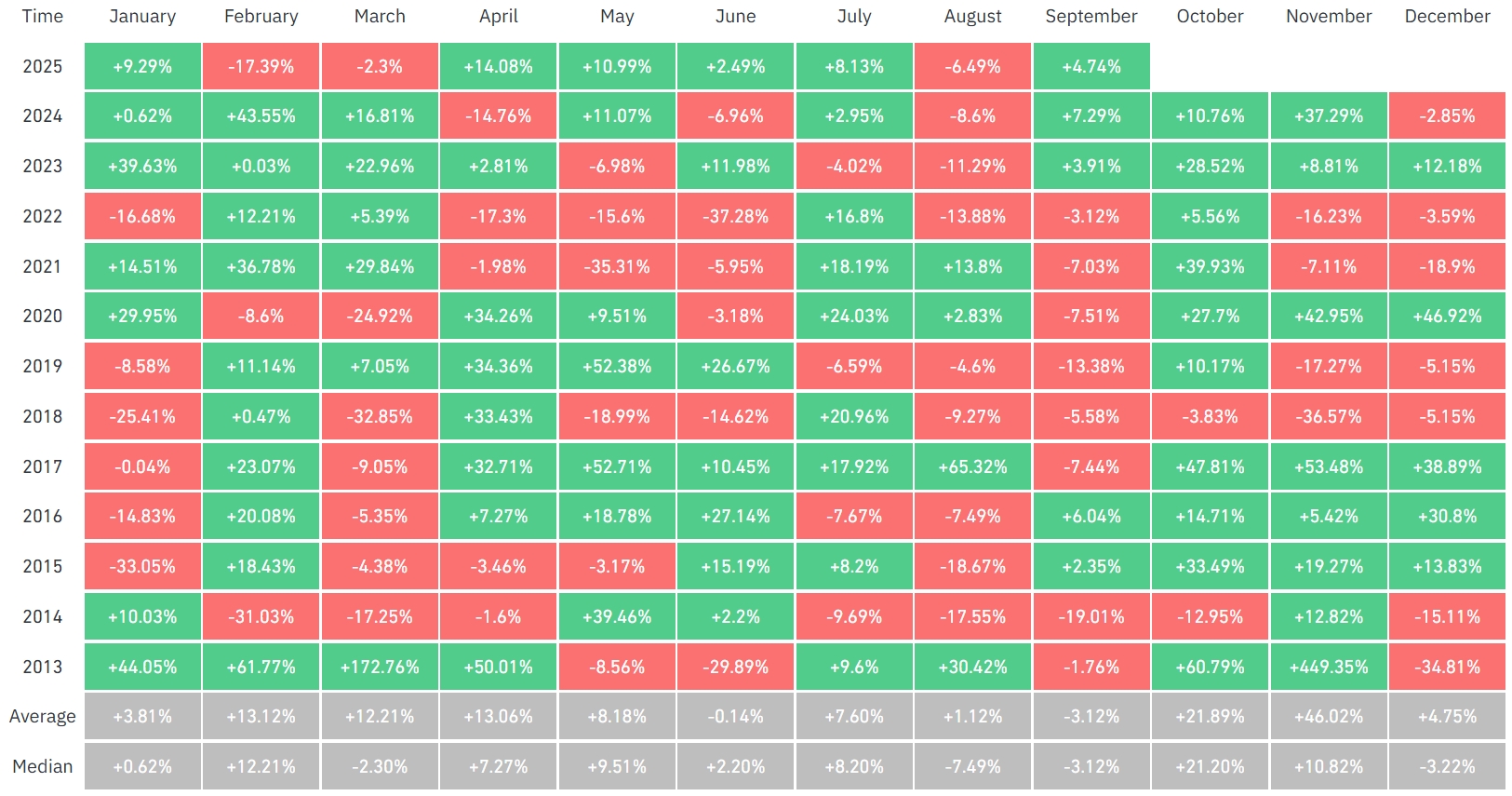
Доходность биткоина по месяцам. Источник: Coinglass

Октябрь же, напротив, считается удачным месяцем для биткоина. Монета только два раза с 2013 года падала в цене в этом месяце — в 2014 и 2018 годах. Средняя доходность за 11 лет (с 2013 по 2024 год) составила 21,89%. В честь этого октябрь на крипторынке даже называют Uptober (от английского Up, вверх).

Эксперты рассказали «РБК-Крипто», какие перспективы у биткоина в предстоящем октябре, что может повлиять на цену актива и каких целей она может достигнуть.

«Страхи и надежды инвесторов»

Конец сентября, когда биткоин падал ниже $110 тыс., а Ethereum (ETH) — ниже $4 тыс., стал испытанием на прочность для криптовалют, говорит глава Tehnobit Александр Пересичан. По его словам, инвесторы начали фиксировать прибыль и сокращать рисковые позиции, усилились оттоки из спотовых биржевых фондов (ETF) на криптовалюты.

На фоне роста цен на золото и серебро наблюдается бегство капитала из рисковых активов в традиционные тихие гавани, пояснил эксперт. В то же время он полагает, что ослабление доллара и ожидания снижения ставки Федеральной резервной системой США (ФРС) в перспективе четвертого квартала продолжают работать в пользу восстановления интереса к криптовалютам.

«Технически для биткоина ближайшие поддержки сосредоточены в зоне $105–107 тыс., ниже — ключевой рубеж $100 тыс., но его пробой маловероятен, так как даже в случае снижения до $105 тыс. биткоин будет откуплен ордерами инвесторов, надеющихся увеличить экспозицию в этой криптовалюте на спаде», — считает Пересичан.

По оценкам аналитика, уровень сопротивления на ближайшие недели по BTC — это $115 тыс. и при его преодолении — $120 тыс. Для «эфира» сильная поддержка прослеживается в районе $3,8–4 тыс., уровни сопротивления — $4,5 тыс. и $4,8–5 тыс.

В октябре основным событием станет публикация данных по инфляции в США 15 октября: мягкие данные способны вернуть капитал в ETF и подтолкнуть BTC к $115–118 тыс., а ETH к $4,5–4,8 тыс., рассказал Пересичан. Но, по его мнению, если и в октябре данные по инфляции окажутся хуже ожидаемых, распродажи на крипторынке могут усилиться, что откроет путь для биткоина к $100 тыс. и $3,7–3,8 тыс. для Ethereum.

Наибольшее влияние на состояние крипторынка в октябре будут оказывать денежно-кредитная политика ФРС США, а точнее, ожидания и прогнозы участников рынка, сказал Пересичан. Он добавил, что криптовалюты растут и падают на страхах и надеждах инвесторов, поэтому основное влияние заседания ФРС по ставке, которое состоится 29 октября, проявится в двухнедельный период до самого события.

Таким образом, вторая половина октября «пройдет под знаком повышенной волатильности и осторожности», говорит эксперт. По его словам, рынок остается чувствителен к ETF-потокам и макроданным, а сценарий на месяц будет определяться балансом между надеждами на смягчение ставки ФРС и страхом перед новым оттоком ликвидности.

«Без резких движений»

Наибольшее влияние на криптовалюты в октябре окажут решения и риторика ФРС США, подтверждает управляющий партнер VG GROUP Вагиз Нуруллов. По словам эксперта, в середине месяца, в преддверии заседания ФРС 29 октября, рынок может начать плавный рост на позитивных ожиданиях понижения ставки и притока ликвидности. Однако Нуруллов тоже отметил, что все будет зависеть от показателей по инфляции, а также данных по американскому рынку труда за сентябрь.

В октябре пройдет ряд крупных мероприятий, на которых могут быть сделаны важные и громкие заявления, которые также подарят позитивный настрой индустрии, говорит эксперт. С 12 по 15 октября в Дубае пройдет Future Blockchain Summit 2025, 28–29 октября также в Дубае состоится криптоконференция Blockchain Life 2025.

Замечены повышенная активность эмитентов ETF и спекуляции по поводу запуска новых продуктов, отметил Нуруллов. Шансы на запуск новых биржевых криптофондов в США теперь равны 100%, заявил ранее аналитик рынка ETF в Bloomberg Эрик Балчунас, добавив, что ETF на Solana (SOL) может быть сейчас запущен в любой момент.

Согласно новым правилам в США, формы 19b-4, которые требовали долгого рассмотрения, больше не актуальны. По словам Балчунаса, теперь нужно только подать регистрационное заявление S-1 и получить его одобрение от отдела корпоративных финансов Комиссии по ценным бумагам и биржам (SEC) США.

Что касается целей по биткоину, эксперт VG GROUP не ожидает в октябре BTC дешевле $109 тыс. за монету при условии отсутствия новой геополитической напряженности на Ближнем Востоке. При этом первая криптовалюта может достигнуть значений около $119–121 тыс. без резких ценовых движений, полагает Нуруллов.

Related Reads

GPT-5.6 Countdown: Abandon the Illusion of a Single API, Computational Iteration Can't Outpace a Single Page of Compliance

In mid-June, three seemingly independent industry events—the compliance-driven throttling of Fable 5, the open-sourcing of GLM-5.2, and the leaked release timeline for GPT-5.6—are pushing the global AI industry toward a watershed moment. These shifts signal a fundamental restructuring of the industry's underlying logic. First, **"usability" has substantially overtaken "advanced capabilities"** as the primary weight, pushing the global large language model (LLM) supply chain into a "dual-track" phase of controlled closed-source and local open-source coexistence. Second, **the competitive moats of closed-source giants are shifting**. Their technical focus is moving from "language intelligence" toward "spatial intelligence (world models)"—a domain heavily reliant on computing power. Third, faced with常态化 transnational compliance risks, **a "model-agnostic" decoupled design has become a survival necessity for application-layer developers to maintain business continuity.** The article details how Anthropic's Fable 5, despite its advanced engineering feats, was restricted for non-U.S. citizens within 72 hours of launch, highlighting how geopolitical compliance can instantly limit even the most advanced models. In response, the open-source camp, exemplified by Zhipu AI's MIT-licensed GLM-5.2, is gaining market share by offering stable performance improvements and significant cost advantages (up to 70% savings for enterprises), while achieving full adaptation with domestic semiconductor platforms. Meanwhile, closed-source leaders like OpenAI are pivoting. The anticipated GPT-5.6 reportedly shifts focus from language to spatial intelligence and world models, aiming to rebuild a generational gap in areas like 3D understanding, simulation, and industrial design that demand immense compute. The core conclusion is that the LLM supply chain's logic has changed. Enterprises must now evaluate infrastructure based on a composite of technical performance and policy compliance. For developers, complete reliance on a single closed-source API poses unacceptable risk. Implementing a truly model-agnostic architecture—enabling swift switches to compliant, locally deployable open-source alternatives—is no longer just good practice but a fundamental baseline for business continuity.

marsbit2h ago

GPT-5.6 Countdown: Abandon the Illusion of a Single API, Computational Iteration Can't Outpace a Single Page of Compliance

marsbit2h ago

Is the 'Token Subsidy War' Among AI Giants Almost Over?

The article discusses the ongoing "token subsidy war" among AI giants like OpenAI and Anthropic, questioning whether it's nearing its end. It reveals that current AI subscription prices are heavily subsidized, with some plans offering tokens at up to 70 times the actual cost to attract and retain heavy users, especially developers and enterprises. This strategy mirrors past internet-era subsidy battles, but with a key difference: AI tokens lack "lock-in" effects. Unlike ride-hailing or food delivery apps, users can easily switch between AI providers as APIs become standardized, making it difficult for companies to raise prices post-subsidy. The piece highlights a structural asymmetry in the competition. Giants like Google, with massive advertising revenue, can afford to subsidize tokens indefinitely, akin to using "tokens as a weapon." In contrast, venture-backed companies like OpenAI and Anthropic face pressure to become profitable, especially as they approach IPO. The article cites Google Ventures founder Bill Maris, who suggests Google could slash token prices by 80%, putting immense pressure on competitors. Two potential endgames are presented: the "internet service" model (subsidize, monopolize, then raise prices) and the "utility" model (tokens become a standardized, low-margin commodity like electricity). Given the low switching costs, the latter seems more likely. The competition may not have a single winner but could instead accelerate AI's evolution into a foundational, infrastructure-level technology, akin to a public utility. For now, users continue to benefit from heavily subsidized token costs.

marsbit2h ago

Is the 'Token Subsidy War' Among AI Giants Almost Over?

marsbit2h ago

Beyond the Stadium: The Profitable Games Surrounding the World Cup

"Beyond the Pitch: The Profit Game Around the World Cup" The FIFA World Cup transcends being a sporting spectacle, evolving into a massive global arena for speculation and profit-seeking. The 2026 tournament has amplified this dynamic, creating a multi-layered ecosystem of financial opportunism alongside the football. **Prediction markets** have surged into the mainstream. Platforms like Polymarket and Kalshi saw trading volumes for World Cup contracts soar, attracting new users with their financial trading model and high-profile, chain-based wealth stories that overshadow traditional sports betting in terms of growth and narrative. However, **traditional sportsbooks** remain the dominant force, leveraging established user habits, legal markets, and comprehensive product offerings to handle the vast majority of speculative wagers, with projections suggesting record-breaking betting volumes. Capital markets also react. **"Concept stocks"** in countries like South Korea and Japan experience volatile price swings based on team performance and anticipated fan spending on items like chicken, beer, and viewing parties, effectively becoming a stock market reflecting fan sentiment. The **ticket resale market** has become a sophisticated arena for arbitrage. Prices fluctuate wildly based on team draws and star power, with sellers sometimes listing tickets they don't yet own in a practice akin to short-selling, while FIFA's own "Right to Buy" tokens add another layer of speculative trading. **Collectibles and merchandise** offer another avenue. Panini sticker albums, with their inherent scarcity and nostalgic value, can become high-value collectibles. Limited-edition or locally themed jerseys command significant premiums on secondary markets, and even counterfeit vendors profit from fans' desire for affordable match-day identity. The **cryptocurrency** space has seen a frenzy of speculative, unauthorized World Cup-themed meme coins on chains like Solana. These tokens, often exploiting team names and player imagery, experience extreme pump-and-dump cycles, creating stories of massive gains for a few early entrants and steep losses for many others. Finally, an entire industry thrives on **providing information and tools** to other speculators. Developers create platforms like SeatSidekick to track ticket inventory and prices, while paid Telegram groups and subscriptions sell betting tips and predictions, monetizing the widespread desire for an informational edge. In essence, the World Cup has become a compressed, global laboratory for speculation. While the games determine champions on the field, a parallel, complex network of financial transactions—spanning prediction contracts, bets, stocks, tickets, collectibles, crypto, and information services—settles its own scores in the global market.

marsbit3h ago

Beyond the Stadium: The Profitable Games Surrounding the World Cup

marsbit3h ago

Trading

Spot
Futures
活动图片