Messaging App Bitchat Sees Unprecedented Boom Amid Madagascar Turmoil

bitcoinistPublished on 2025-09-29Last updated on 2025-09-29

Abstract

Protests over repeated water and power cuts have turned violent in Madagascar's capital, and interest in offline messaging tools has...

Trusted Editorial content, reviewed by leading industry experts and seasoned editors. Ad Disclosure

Protests over repeated water and power cuts have turned violent in Madagascar’s capital, and interest in offline messaging tools has jumped alongside the unrest, according to multiple reports and public signals.

Protests Shake The Capital

Reports have disclosed that crowds took to the streets after days of blackouts and shortages. Authorities imposed a dusk-to-dawn curfew to try to stop looting and clashes.
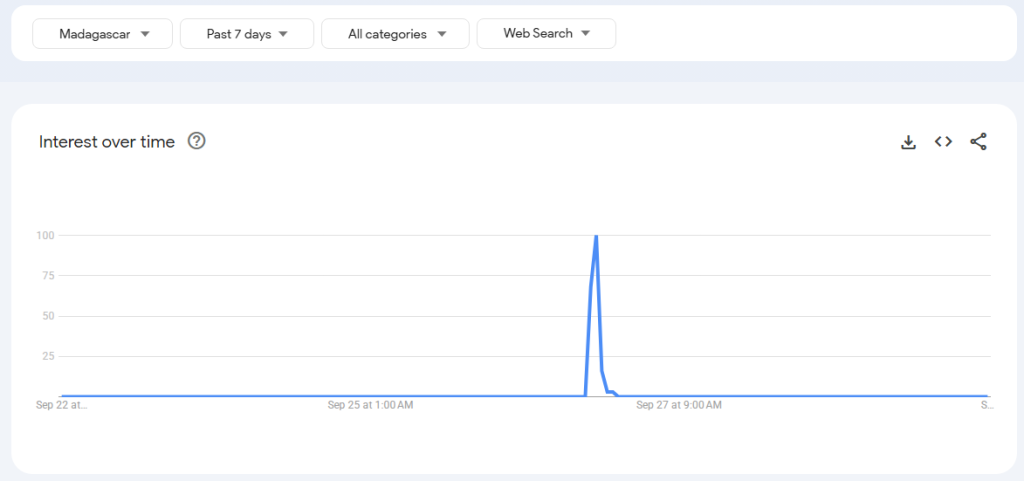
Source: Google Trends

Police used tear gas against some demonstrators and at least five deaths have been linked to the unrest. The pressure on the government was high enough that the Energy minister was removed from office amid the turmoil.

Bitchat Interest Surges

According to analytics cited by tech outlets, searches for the name “Bitchat” in Madagascar moved from 0 to 100 on Google Trends during the same period, a sign of intense relative interest in a short window.
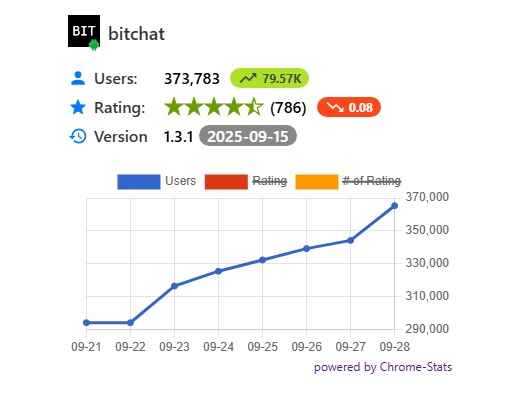
Chrome-Stats figures show 365,307 total downloads of the app since launch, with 21,000 installs reported in the last 24 hours and 71,000 in the past week — numbers that were published as global totals.

According to reports, related queries such as “Bitchat download” and “how to use Bitchat” were marked as breakout topics in the country’s search activity.

Bitchat is a Bluetooth mesh messaging tool that can operate without an internet connection or phone numbers.

Bitchat is tied to the blockchain and uses the Bitcoin network to finalize transactions and allows users to securely send Bitcoin over Bluetooth.

Its design emphasizes privacy through end-to-end encryption, ephemeral messages, and the use of cryptocurrency wallets as an alternative to traditional identifiers like phone numbers.

These technical features showcase usefulness when internet service is limited or when individuals fear a disruption in their networks. Observers noted that there was a heightened level of local interest when protests, and curfews were in place.

Total crypto market cap at $3.81 trillion on the daily chart: TradingView

Madagascar Struggles With Digital Divide As Most Residents Are Offline

According to DataReportal, at the start of 2025, only 6.6 million of nearly 32 million residents in Madagascar are online. The data highlights the digital divide facing Madagascar, as limited access to information and economic opportunity limit progress.

The report further indicates that over 18 million mobile subscriptions are active, and many rely on voice calling and SMS which does not mean access to the full internet, again reflecting issues with access and affordability in Madagascar.

Featured image from AFP, chart from TradingView

Editorial Process for bitcoinist is centered on delivering thoroughly researched, accurate, and unbiased content. We uphold strict sourcing standards, and each page undergoes diligent review by our team of top technology experts and seasoned editors. This process ensures the integrity, relevance, and value of our content for our readers.

Christian, a journalist and editor with leadership roles in Philippine and Canadian media, is fueled by his love for writing and cryptocurrency. Off-screen, he's a cook and cinephile who's constantly intrigued by the size of the universe.

Related Reads

Rented Faith: How Much of the Bitcoin ETF Inflows Is Real Money?

"Rented Conviction: How Much of Bitcoin ETF Flows Is Real Money" The weekly inflows into Bitcoin ETFs are often interpreted as a gauge of institutional belief. However, a significant portion of this activity is driven by a hidden arbitrage trade, not directional conviction. The core mechanism is a cash-and-carry arbitrage: traders buy spot Bitcoin (often via ETFs) while simultaneously shorting CME futures to lock in the price difference, or "basis." This delta-neutral trade is essentially an interest rate play. In weekly data, about half the fluctuation in ETF flows can be explained by new short positions added by leveraged funds (hedge funds), with a correlation of 0.70. Bitcoin's price movement in a given week shows no statistical power in predicting these flows. While this arbitrage trade drives weekly *volatility*, it is not the main component of the cumulative *stock*. Of the total ~$55 billion in net ETF inflows, the current net arbitrage position is only about $1 billion. The remainder is steady, directional buying averaging ~$400 million per week, which constitutes the vast majority of the accumulated "mountain" over two years. Thus, ETF flow data overstates the *volatility* of conviction, not its *level*. This arbitrage trade has been unwinding for nearly two years. Leveraged fund short positions peaked at ~$14 billion in late 2024 and have since declined to ~$4.5 billion. When the basis compresses to unprofitable levels, ETF inflows and short positions retreat together. Recent outflows should not be mistaken for a loss of faith but rather the routine unwinding of this rate trade. For Ethereum ETFs, the pattern is weaker. Accounting for staking yield makes the basis often negative, so neither strong conviction buying nor robust arbitrage supports its flows. To interpret ETF flows correctly, monitor the CME basis versus T-bill rates and leveraged fund net shorts. They reveal how much of the next "demand" headline is real. The real, patient buy-and-hold demand is what constitutes the enduring bulk of ETF assets.

marsbit45m ago

Rented Faith: How Much of the Bitcoin ETF Inflows Is Real Money?

marsbit45m ago

Soaring Over Tenfold Within the Year: The Frenzy Over SK Hynix Leveraged Products

South China Morning Post The leveraged ETF tracking SK Hynix has surged over tenfold year-to-date, fueled by intense market speculation on the memory chip sector. By June 22, the value of the 'South Korea 2x Long SK Hynix ETF' listed in Hong Kong had skyrocketed by more than 1,061% since the start of the year, while its asset size exploded over twenty times from the end of last year. The rally is driven by AI-driven demand for high-bandwidth memory (HBM), with SK Hynix recently sampling its next-generation HBM4E product. However, industry professionals warn of significant risks. Leveraged ETFs magnify both gains and losses. During a recent market correction, while the underlying SK Hynix stock fell 19.1%, its double-leveraged ETF dropped nearly 38%. Korean regulators noted that such products could theoretically lose 60% in a single day. Additionally, these ETFs face risks like time decay in volatile markets, liquidity spirals during mass redemptions, and extreme price dislocations from market-making failures, as seen in early June when an ETF moved opposite to its underlying stock. The trading is predominantly driven by retail investors, with institutional capital largely absent due to the products' high volatility. Analysts caution that with the semiconductor sector at elevated valuations and facing geopolitical and supply chain uncertainties, leveraged ETFs pose a substantial threat of amplified losses for uninformed investors.

marsbit1h ago

Soaring Over Tenfold Within the Year: The Frenzy Over SK Hynix Leveraged Products

marsbit1h ago

18 Months, Over 50x Surge: KIOXIA's Epic Comeback

KIOXIA, a NAND flash memory giant, staged a dramatic comeback driven by AI demand. After a period of significant losses, a failed merger, and missed HBM opportunities, its 2024 IPO began modestly. However, fueled by explosive demand for AI data storage, its stock price skyrocketed over 50 times within 18 months, making it Japan's most valuable company, surpassing Toyota. Its Q1 FY2026 profit guidance soared 30-fold year-over-year, with 2026 NAND capacity already sold out. Key to its success is its 3D NAND technology, BiCS FLASH. As the inventor of NAND, KIOXIA advanced its technology through generations, reaching over 200 layers by 2023. Key innovations include CBA (CMOS directly Bonded to Array), which separately manufactures control circuits and memory arrays for better performance, and OPS (On Pitch Select Gate) to increase density. The company is now developing high-capacity packages like an 8TB solution stacking 32 dies. Looking beyond NAND, KIOXIA is exploring 3D DRAM with its OCTRAM technology, using oxide semiconductor transistors for ultra-low leakage to reduce power consumption. This fundamental research differs from HBM and represents a long-term bet to extend its 3D expertise from NAND into future DRAM architectures. KIOXIA's story highlights how technological assets and shifting market cycles can rapidly transform a company's fortunes. While questions remain about sustaining growth beyond the current AI boom, its resurgence demonstrates that in semiconductors, being down does not necessarily mean being out.

marsbit1h ago

18 Months, Over 50x Surge: KIOXIA's Epic Comeback

marsbit1h ago

Trading

Spot
Futures
活动图片