Shiba Inu Dev Issues New Security Update On Shibarium Bridge

bitcoinistPublished on 2025-09-22Last updated on 2025-09-23

Abstract

Shiba Inu core developer Kaal Dhairya has issued a detailed security update following the September 12 incident that exploited validator...

Trusted Editorial content, reviewed by leading industry experts and seasoned editors. Ad Disclosure

Shiba Inu core developer Kaal Dhairya has issued a detailed security update following the September 12 incident that exploited validator signing power on the Shibarium PoS bridge to push a malicious state/exit and withdraw multiple assets. The post, published on September 21, 2025 outlines what happened, what has been done so far, and what will govern a phased restoration once independent reviews conclude.

Shiba Inu Core Dev Shares Another Update

In a personal foreword that framed both the technical and human dimensions of the episode, Dhairya opened by distancing himself from any singular leadership mantle and reiterated the original ethos driving his work. “I want to clarify first: I’m not ‘the lead.’ I never was and never want to be. I’m just a builder who bet on SHIB’s ethos,” he wrote, adding that “in moments like these, you realize you may have just been a pawn in the whole game.”

The Shiba Inu core dev cautioned that, given “the sophistication of this attack,” he could not presently vouch for the safety of any existing keys, and he signaled fatigue with expectations that individual contributors could “keep it all together” without broader structural support.

The account of the incident describes how, at 18:44 UTC on September 12, “unauthorized validator signing power was used to push a malicious state/exit through the PoS bridge.” The method, per the update, combined short-lived stake amplification with malicious checkpoint/exit proofs to authorize withdrawals. Post-incident on-chain activity linked to the attacker is said to include sales of portions of ETH, SHIB and ROAR, though the team is withholding the “evolving wallet graph” while containment and coordination with authorities continue. “We’ll release the full technical narrative after doing so no longer increases risk,” the post states.

Immediate measures include restricting specific bridge operations to prevent new unauthorized exits, upgrading and gating contract pathways covering deposits, withdrawals, claims and rewards, and applying “targeted defensive controls against misuse of delegated stake.” The team says it recovered and secured at-risk BONE at the stake-manager level and notes that any short-term BONE stake under the attacker remains “effectively immobilized” by interventions and protocol mechanics.

Key and custody hygiene steps have involved rotating validator signers and migrating contract control to multi-party hardware custody, while live monitoring and automated alerts continue in coordination with exchanges, external security researchers, incident-response firms and relevant authorities.

The update also engages frequently asked questions about validator compromise and operational accountability. It says validator signing keys were “primarily stored in AWS KMS, with rare usage on developer machines,” and that ultimate responsibility for key management lies with operational leadership. While a single intrusion vector has not been confirmed, preliminary possibilities include a developer machine compromise, a cloud KMS compromise, exposure during an AWS-to-GCP migration, or a supply-chain attack, such as via npm.

The post acknowledges decentralization shortcomings underscored by the fact that “10 of 12 validators” signed the malicious state, and it commits to greater validator decentralization, stronger key-rotation policy, tighter custody, improved disclosures, and higher due-diligence thresholds for sensitive access.

A roadmap preview sets out four gated phases. “Containment” remains ongoing with restricted bridge functionality and live monitoring; “Hardening,” in collaboration with Hexens, includes signer/validator hygiene, policy-level controls such as rate limits, challenge windows and circuit-breakers, and deny-list extensions where technically appropriate.

Next, “Safe Restoration” will not begin until independent reviews sign off on mitigations, post-incident integrity checks pass and drills on test environments succeed, with restoration executed in phases and with rollback levers; finally, a comprehensive technical postmortem will precede a community-reviewed remediation path for affected users and liquidity, with the update noting that “token-specific approaches may differ.”

Timelines remain intentionally unspecified: “We won’t publish dates that could be gamed by an adversary,” the team writes, reiterating that updates will post to official channels.

For Shiba Inu token holders and victims, the message is blunt: beware of scams, ignore unverified “recovery/claim portals,” and expect bridge restrictions to persist “until we confirm it’s safe to restore.” Questions about bridging back to Ethereum, the timing of bridge resumption, validator rotation and full audit all receive the same answer—safety first, details to follow when security allows. On fund recovery and potential compensation, the team says options are being evaluated and any proposal will be published for community review “once viable and secure.”

The Shiba Inu developer closes by reaffirming priorities and situating communication within a disciplined cadence. “Our priorities are unchanged: protect users, secure the network, contain the attacker, and restore services safely.” The next major communication, he writes, will be the technical postmortem and a remediation proposal “once the environment is safe for full disclosure.”

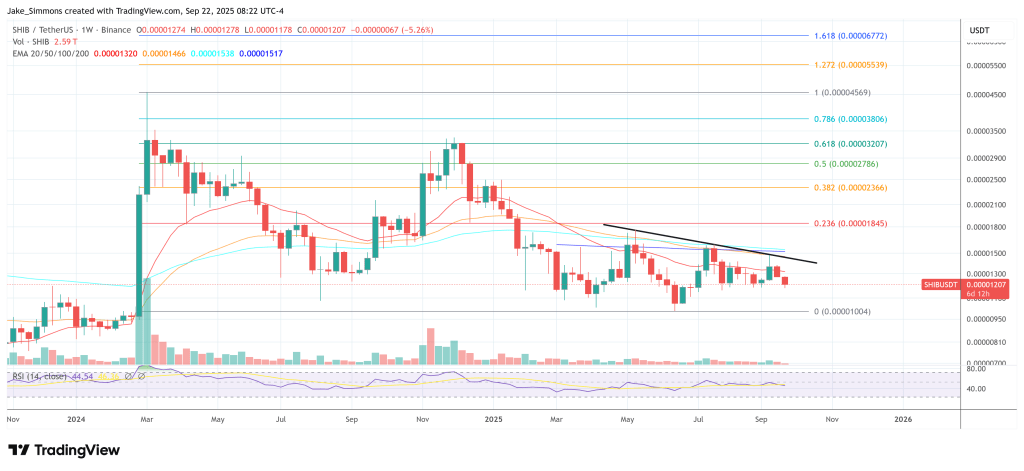
At press time, Shiba Inu traded at $0.00001207.
Shiba Inu price
Shiba Inu price downtrend continues, 1-week chart | Source: SHIBUSDT on TradingView.com
Featured image created with DALL.E, chart from TradingView.com
Editorial Process for bitcoinist is centered on delivering thoroughly researched, accurate, and unbiased content. We uphold strict sourcing standards, and each page undergoes diligent review by our team of top technology experts and seasoned editors. This process ensures the integrity, relevance, and value of our content for our readers.

Jake Simmons has been a Bitcoin enthusiast since 2016. Ever since he heard about Bitcoin, he has been studying the topic every day and trying to share his knowledge with others. His goal is to contribute to Bitcoin's financial revolution, which will replace the fiat money system. Besides BTC and crypto, Jake studied Business Informatics at a university. After graduation in 2017, he has been working in the blockchain and crypto sector. You can follow Jake on Twitter at @realJakeSimmons.

Related Reads

The Full Story of How Crypto Unicorn Blockstream Is Mired in Serious Fraud Allegations

This article details serious allegations of fraud against Bitcoin infrastructure company Blockstream, founded by Bitcoin pioneer Adam Back. In June 2024, investigative account NatInfoSec published a report accusing Blockstream's mining note (BMN) program of potentially operating a multi-billion dollar scheme with Ponzi-like characteristics. The core allegations focus on Blockstream Mining Notes (BMNs), which offer investors fixed annual yields up to approximately 20% from Bitcoin mining. NatInfoSec's investigation raises several key issues: 1. **Suspicious Hashrate & Payout Capacity**: The analysis suggests Blockstream would need 20-45 EH/s of mining power to cover its BMN obligations, but its public dashboard shows only around 15 EH/s. Furthermore, no verifiable public evidence (e.g., grid connection records, import data) was found to support the massive mining operation required. 2. **Questionable Payout Source**: The BMN contract allows Blockstream to use Bitcoin from *any source* (Substitute Performance BTC) to fulfill investor payouts, raising concerns that payouts may not come from actual mining revenue. 3. **High-Risk, Fixed Returns**: Offering ~20% fixed yields in the volatile, cyclical Bitcoin mining industry is viewed as highly unusual and requires clear explanation. 4. **Undisclosed Criminal Record of Key Figure**: Christopher William Cook, a key figure in Blockstream's mining operations and CEO of spin-off Exacore, was found to have a federal felony conviction for mail fraud in 2008, a fact not disclosed in BMN offering documents. His background was also allegedly embellished. 5. **Potential Contagion to BSTR SPAC**: Questions were raised about whether these liabilities and Cook's record should have been disclosed in the SEC filings for Bitcoin Standard Treasury Company (BSTR), a separate Adam Back-associated firm planning a SPAC merger. The crypto community is divided. BitMEX Research validated Cook's criminal record and expressed concern over the high yields but found other evidence lacking or misleading, noting the legal separation between BMN, Blockstream, and BSTR. Blockstream defenders, like Samson Mow, argue the mining is real. Critics, however, emphasize the lack of independent, verifiable proof of the mining operation's scale and the true source of investor payouts. The article concludes that BMN remains shrouded in key unanswered questions regarding its actual size, the verifiability of its underlying mining assets and payouts, the source of its high yields, and the full role and disclosure concerning Chris Cook. Blockstream had not issued a comprehensive response at the time of writing.

marsbit1h ago

The Full Story of How Crypto Unicorn Blockstream Is Mired in Serious Fraud Allegations

marsbit1h ago

The Full Story Behind Encryption Unicorn Blockstream's Deep Entanglement in Serious Fraud Allegations

This article details allegations of serious fraud surrounding the crypto company Blockstream, founded by Bitcoin pioneer Adam Back. Investigation account NatInfoSec accuses Blockstream of raising billions through its Blockstream Mining Note (BMN) products, which offer high fixed yields of up to 20% from purported mining revenue. The core allegations are: 1) Blockstream's public mining hash rate (15 EH/s) appears insufficient to cover the massive payout obligations from sold BMN notes, raising questions about the true source of investor payouts. 2) Key executive Christopher William Cook, central to the mining operations, has a prior federal conviction for mail fraud, a fact not disclosed to investors. Cook's background and lavish lifestyle are highlighted as red flags. 3) The structure allows payouts from any source of BTC, not necessarily mining revenue, which critics argue gives it Ponzi-like characteristics. The controversy also touches on Bitcoin Standard Treasury Company (BSTR), a related entity planning a SPAC上市. Critics question whether BMN's liabilities and Cook's record should be disclosed in BSTR's filings. BitMEX Research offered a tempered analysis, confirming Cook's criminal record is likely true and the high yields concerning, but found other claims like insufficient抵押证据 less substantiated. Community debate centers on the need for verifiable proof of Blockstream's mining output and revenue. The article concludes that while fraud is not proven, BMN presents significant, unresolved questions regarding its actual scale, the source of its high fixed returns, the verifiability of its mining operations and payouts, and the full disclosure of associated risks and personnel backgrounds. Blockstream has not yet issued a formal response.

链捕手3h ago

The Full Story Behind Encryption Unicorn Blockstream's Deep Entanglement in Serious Fraud Allegations

链捕手3h ago

Trading

Spot
Futures
活动图片