Laos Eyes Bitcoin Mining To Tackle Mounting Debt

bitcoinistPublished on 2025-09-18Last updated on 2025-09-18

Abstract

Laos is exploring a new way to service the debts from its decades-long hydropower build-out: turning excess electricity into Bitcoin....

Trusted Editorial content, reviewed by leading industry experts and seasoned editors. Ad Disclosure

Laos is exploring a new way to service the debts from its decades-long hydropower build-out: turning excess electricity into Bitcoin. In a report published on September 17, the South China Morning Post framed the pivot bluntly: “Saddled with debt and surplus electricity, the ‘battery of Southeast Asia’ is eyeing energy-intensive crypto mining to turn a profit.” The article situates the move within a dam-driven development model that has left Laos with power it cannot always sell and a mounting repayment schedule.

Why Laos Eyes Bitcoin Mining

The policy logic is straightforward. Bitcoin mining converts electrons into a globally liquid asset and can be sited directly at hydropower plants, mitigating transmission bottlenecks and absorbing seasonal surpluses. Laos has promoted electricity exports for years—SCMP notes power accounted for roughly a quarter of the country’s exports last year—yet export deals and grids do not always line up with generation, exacerbating revenue-timing mismatches against hard-currency debt obligations from dam construction.

According to SCMP “environmental campaigners view the turn to crypto as symptomatic of a flawed energy policy that has left Laos indebted and unable to offload its surplus power.” The Chinese news report cites Witoon Permpongsacharoen, director of the Mekong Energy and Ecology Network: “Laos allowing electricity to be used for cryptocurrency mining is clearly not something driven by internal conditions. It stems from the fact that Laos is heavily indebted and unable to pay off its debts.”

If implemented, this would not be Laos’s first embrace of digital-asset mining. In September 2021, the government launched a pilot program authorizing six firms to mine and trade Bitcoin and cryptocurrencies under regulated power-purchase terms, a move widely read as an attempt to capture miners displaced by China’s crackdown.

However, the stance has seesawed amid hydrological stress and grid constraints: in August 2023, the state utility Électricité du Laos (EDL) halted electricity supply to Bitcoin miners citing drought and power shortages; by May 2024, Reuters reported crypto data centers made up “over a third of the country’s power” consumption and contributed to outages, prompting authorities to stop approving new operations even as they weighed proposals to stabilize supply.

The fiscal backdrop helps explain the renewed interest. External public debt service is projected by the World Bank to average about $1.3 billion per year over 2025–2028—around 9% of GDP annually—keeping gross financing needs elevated as key hydropower assets are still ramping. Separate reporting this year underscored the strain: a Chinese dam operator initiated a $555 million arbitration against EDL for alleged unpaid dues, highlighting the financial pressures on the state power sector.

Yet the “surplus power” narrative is not uniform. Hydropower output is volatile, impacted by erratic rainfall and a warming climate, while export pipelines remain politically and commercially complex. Laos produces surplus electricity in the wet season but must import power from neighboring countries during the dry months. These structural frictions are precisely the niches where mobile, interruptible loads like Bitcoin mines can monetize stranded energy—until the water runs low.

Analysts who champion “wasted renewables” see a broader pattern. “Bhutan, Ethiopia, and now Laos use Bitcoin mining to monetize wasted renewable energy,” Bitcoin climate activist Daniel Batten wrote via X as coverage of the SCMP story circulated, casting the strategy as part of a 2025 “vibe shift.”

Bhutan has openly leaned into hydro-powered mining this year, calling bitcoin “a strategic battery” to arbitrage seasonal surpluses and fund development; Ethiopia’s power utility has said it generated about $55 million over 10 months by selling surplus hydro to miners. Laos’s plan would slot into that template, albeit with more fragile hydrology and balance-sheet constraints.

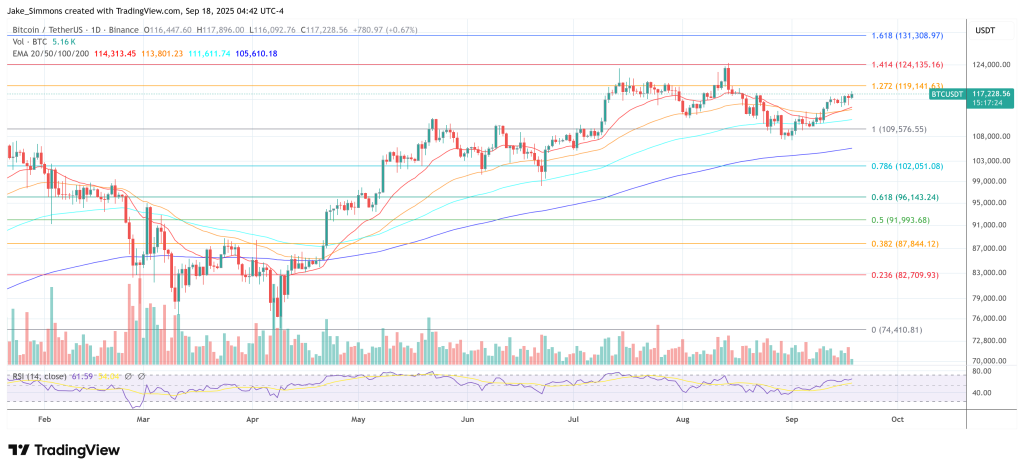
At press time, BTC traded at $117,228.
Bitcoin price
BTC is back above $117,000, 1-day chart | Source: BTCUSDT on TradingView.com
Featured image created with DALL.E, chart from TradingView.com
Editorial Process for bitcoinist is centered on delivering thoroughly researched, accurate, and unbiased content. We uphold strict sourcing standards, and each page undergoes diligent review by our team of top technology experts and seasoned editors. This process ensures the integrity, relevance, and value of our content for our readers.

Jake Simmons has been a Bitcoin enthusiast since 2016. Ever since he heard about Bitcoin, he has been studying the topic every day and trying to share his knowledge with others. His goal is to contribute to Bitcoin's financial revolution, which will replace the fiat money system. Besides BTC and crypto, Jake studied Business Informatics at a university. After graduation in 2017, he has been working in the blockchain and crypto sector. You can follow Jake on Twitter at @realJakeSimmons.

Related Reads

Tidal Investment: We Remain Bullish on the AI Industry Chain, But the Reasons Have Changed

Tidal Investment remains optimistic about the AI industry chain, but the rationale has shifted. The market narrative has changed. While recent large-scale IPOs (e.g., SpaceX) and major fundraising plans by tech giants like Alphabet and Meta have caused some nervousness, this isn't a sign of an AI peak. The focus has moved from the initial question of AI's viability to the sustainability of massive investment cycles. The key players—primarily the major cloud providers—are not slowing down; their capital expenditure (Capex) guidance for 2026 has been increased across the board (e.g., Alphabet to $180B, Amazon to $200B). This investment cycle is proving resilient and difficult to stop. Unlike traditional hardware cycles, current AI Capex is distributed across multiple physical layers—computing, memory, networking, and critically, power infrastructure. Bottlenecks are shifting from chips to elements like electricity, transformers, and cooling systems, which have much longer lead times and cannot be easily pre-built like fiber optics during the dot-com bubble. Supply chain data (e.g., Eaton's 240% YoY data center orders) confirms this broad-based, project-driven expansion. Market concerns are acknowledged but viewed differently. First, while Capex growth currently outpaces revenue growth, raising ROI questions, this mirrors the early scaling phase of cloud computing itself. A change in view would require concrete signals like downward Capex revisions or missed AI product targets, which haven't materialized by mid-2026. Second, comparisons to the 2000 dot-com bust are flawed. That crash was driven by a massive, parallel oversupply of cheap capacity (fiber). The current cycle faces *supply constraints* in critical, capital-intensive physical infrastructure that cannot be overbuilt as easily. In conclusion, the wave of fundraising reflects the next, more complex act of the AI story. Physical bottlenecks and sustained high Capex plans suggest this is not the finale but an ongoing, capital-intensive build-out phase. The script has changed, but the play is far from over.

marsbit41m ago

Tidal Investment: We Remain Bullish on the AI Industry Chain, But the Reasons Have Changed

marsbit41m ago

Tidal Investment: We Remain Bullish on the AI Industry Chain, But for Different Reasons Now

Tidal Investments remains optimistic about the AI industry chain, but the rationale has shifted. The market is concerned about massive concurrent fundraising by tech giants like SpaceX, OpenAI, Alphabet, and Meta, fearing an AI peak. However, the authors argue this signals the next act of AI development, not its end. Capital expenditure (Capex) from major cloud providers (Alphabet, Amazon, Meta, Microsoft, Oracle) continues to surge aggressively into 2026. This investment cycle is more resilient than past hardware cycles due to its scale and complexity. Bottlenecks have shifted from chips to critical physical infrastructure like power grids, transformers, cooling, and data center construction—areas with long lead times and limited capacity for rapid expansion. Supply chain data (e.g., Eaton's orders) confirms substantial, tangible progress. Key market concerns are addressed: 1. **ROI vs. Capex Growth**: While Capex growth outpaces revenue, the authors note cloud giants have historically overcome similar phases through scale. The cycle will only be in danger if Capex guidance is cut, orders are canceled, or AI product demand falters—none of which are currently observed. 2. **Comparison to the 2000 Dot-com Bubble**: Unlike the telecom bubble, where cheap, oversupplied fiber crashed prices, AI infrastructure (especially power) is constrained, customized, and subject to lengthy approvals, making a similar supply glut and crash unlikely. In conclusion, the wave of fundraising reflects the immense, ongoing capital needs for AI's next phase, constrained by slow-moving physical bottlenecks. The AI cycle is not over; the script has simply changed.

链捕手47m ago

Tidal Investment: We Remain Bullish on the AI Industry Chain, But for Different Reasons Now

链捕手47m ago

Grayscale: These 15 Profitable Crypto Protocols Are Severely Undervalued

Grayscale Research identifies 15 top-revenue crypto protocols trading at significant valuation discounts, with many at single-digit or even 1x revenue multiples. Protocols like Pump.fun, PancakeSwap, and Meteora have market capitalizations roughly equal to their annual revenue. The report argues these financially-focused protocols (DEXs, lending, staking) are fundamentally undervalued and could benefit from the potential passage of the CLARITY Act, expected as soon as next month. This legislation aims to clarify digital asset regulation, potentially reducing institutional barriers and driving on-chain activity. The analysis breaks down the protocols into three groups: the "1x Club" (market cap ≈ revenue), mid-tier protocols with 3-9x multiples (e.g., Aave, Lido, Jupiter), and high-multiple protocols like Hyperliquid (15x) and Uniswap (37x), where valuation reflects future potential rather than current cash flows. Grayscale applies a traditional DCF model to Aave, suggesting a one-year price target of ~$175, representing ~130% upside from current levels. The report notes a risk-off macro environment since the Iran conflict has further compressed valuations, creating a potential entry window. The conclusion highlights that while the valuation data presents an intriguing opportunity, the investment thesis is contingent on the CLARITY Act's passage and subsequent institutional capital flows. Investors are cautioned to consider Grayscale's inherent conflict of interest as a crypto asset manager with products tied to these assets.

marsbit1h ago

Grayscale: These 15 Profitable Crypto Protocols Are Severely Undervalued

marsbit1h ago

Sam Altman's Personal Alchemy of Wealth: Investing in 400 Companies, Over 10 Deeply Tied to OpenAI

The article investigates Sam Altman's personal wealth strategy, centered around his investments in approximately 400 companies while serving as OpenAI's CEO. Despite not holding direct equity in OpenAI, Altman has built a vast portfolio, with at least 10 of his investments having commercial ties or ongoing negotiations with OpenAI. This creates a complex network of potential conflicts of interest, drawing scrutiny from U.S. congressional committees and state attorneys general. Key investments highlighted include the anti-aging startup Retro Biosciences (valued at $258 million for his stake as of late last year) and the chipmaker Cerebras, whose value soared following an OpenAI procurement deal. His most significant financial gain is linked to the nuclear fusion company Helion, where a recent funding round reportedly increased his stake's value to at least $4.1 billion. The article details a decade-long relationship between Altman, Helion, and OpenAI, including a controversial non-binding power purchase agreement and Altman's efforts to secure investments from OpenAI and its backer SoftBank for Helion. Other points include internal investigations at Tools for Humanity (developer of Worldcoin) and OpenAI's massive contracts with tech giants like Nvidia. According to Forbes, Altman's net worth is around $3.4 billion, ranking him 1251st globally—a rise of over 1400 places since 2024. OpenAI's board states that Altman's external dealings are transparent and potential conflicts are carefully managed.

Odaily星球日报1h ago

Sam Altman's Personal Alchemy of Wealth: Investing in 400 Companies, Over 10 Deeply Tied to OpenAI

Odaily星球日报1h ago

Trading

Spot
Futures
活动图片