18 Block Reorg Slams Monero, Erasing 36 Minutes Of Blockchain

bitcoinistPublished on 2025-09-15Last updated on 2025-09-16

Abstract

Monero’s privacy chain endured its deepest-ever chain reorganization in the last 24 hours, when 18 consecutive blocks were replaced, briefly...

Trusted Editorial content, reviewed by leading industry experts and seasoned editors. Ad Disclosure

Monero’s privacy chain endured its deepest-ever chain reorganization in the last 24 hours, when 18 consecutive blocks were replaced, briefly “rewriting” roughly 36 minutes of ledger history and invalidating about 118 already-confirmed transactions. Multiple independent monitors flagged the event late Sunday into Monday, describing a rollback spanning block heights 3,499,659 through 3,499,676 before nodes converged on a new best chain. With Monero targeting two-minute blocks, an 18-block reorg translates to ~36 minutes of history—an extraordinary depth for a mature proof-of-work network.

Monero Hit By Record 18 Block Reorg

“The attack against Monero is back. Hours ago XMR experienced an 18-block reorg. If you accept XMR make sure to wait for more than the usual 10 confs,” warned independent monitor OrangeFren as alerts circulated across crypto social channels. The post, amplified by several industry accounts, captured the immediate operational takeaway for merchants and services: raise confirmation thresholds until conditions normalize.

The incident comes a month after the controversial AI-oriented project Qubic claimed to have marshaled a majority of Monero’s hashrate, a campaign that coincided with a six-block reorg in August and led to temporary deposit suspensions at some exchanges. Security researchers at the time cautioned that the August event did not, by itself, prove sustained 51% dominance—streaks of mining “luck” can produce short, probabilistic reorganizations—but they also warned that persistent hashrate concentration raises the ceiling on how deep such reorgs can go. Monday’s 18-block episode materially raises that ceiling.

Community voices reacted with a mix of alarm and realism. SlowMist founder Yu Xian commented via X: “If no one in the Monero community takes the issue of block reorganization seriously, then this Sword of Damocles will always hang over Monero’s head… It may not necessarily carry out a double-spend attack, but having this capability… It doesn’t even have to strictly exceed 51% of the hash power…”

Qubic founder Sergey Ivancheglo, who is known by the alias “Come-from-Beyond”, posted via X: “Monero will stay because Qubic wanted it to stay.”

At a technical level, a chain reorg occurs when two valid histories compete and the network ultimately converges on the one with the most accumulated proof-of-work, discarding the other and any transactions exclusive to it. In Monero’s design, two-minute target block intervals and dynamic block sizing aim to keep throughput smooth while preserving privacy primitives like ring signatures and stealth addresses.

In practice, however, a miner or pool with outsized hashpower can—at least in bursts—privately extend a side chain and then release it, “out-working” the public tip and forcing nodes to reorganize. That is what appears to have happened here, with a depth that exceeded the de facto 10-confirmation comfort zone commonly used by wallets and exchanges.

The August–September sequence has re-opened a contentious debate inside Monero about defenses. Proposals span the spectrum: “rolling 10-block checkpoints” that finalize recent blocks to cap reorg depth; adopting elements akin to Dash’s ChainLocks to bolt on a finality layer; “detective mining” incentives to counter selfish-mining strategies at the pool level; and even merge-mining concepts that would piggyback Monero’s security on a larger PoW base.

Each trade-off is sharp: checkpoints and ChainLocks introduce degrees of centralization or new trust assumptions, while pool-level changes may be unevenly adopted. The community has not yet coalesced around a specific fix, but the urgency has unmistakably increased.

Markets treated the event with surprising resilience. Within hours, XMR rallied between roughly 5% and 7%, trading above $300 on some venues.
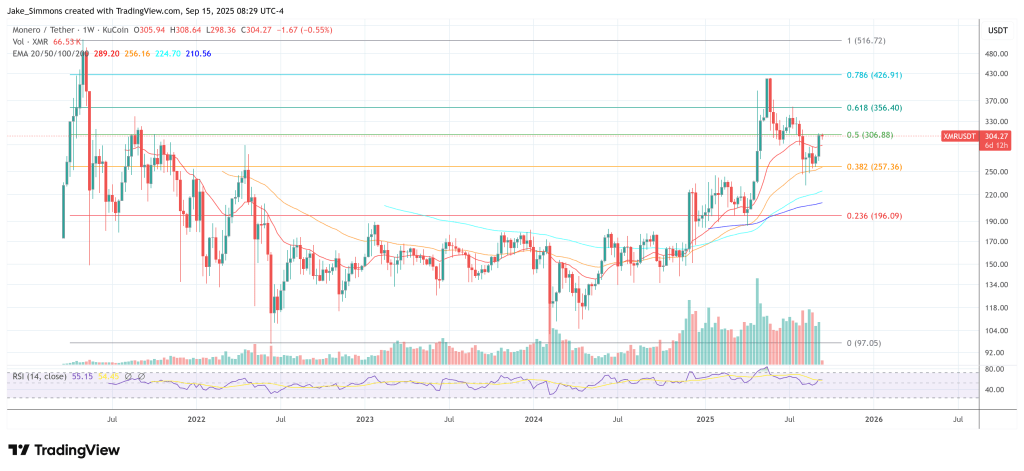
Monero price
XMR price, 1-week chart | Source: XMRUSDT on TradingView.com
Featured image created with DALL.E, chart from TradingView.com
Editorial Process for bitcoinist is centered on delivering thoroughly researched, accurate, and unbiased content. We uphold strict sourcing standards, and each page undergoes diligent review by our team of top technology experts and seasoned editors. This process ensures the integrity, relevance, and value of our content for our readers.

Jake Simmons has been a Bitcoin enthusiast since 2016. Ever since he heard about Bitcoin, he has been studying the topic every day and trying to share his knowledge with others. His goal is to contribute to Bitcoin's financial revolution, which will replace the fiat money system. Besides BTC and crypto, Jake studied Business Informatics at a university. After graduation in 2017, he has been working in the blockchain and crypto sector. You can follow Jake on Twitter at @realJakeSimmons.

Related Reads

Bitcoin at 59,000 Is Not the Bottom, One Last Drop Needed! Chain Data and Liquidity Analysis: Where is BTC's True Bottom?

Based on analysis by trader Mr. Beggar, Bitcoin's (BTC) recent low of $59k is likely not the final cycle bottom. He argues that while a bottom is near, a final downward movement is still probable to target liquidity below that level, making a deeper low healthier for a sustainable reversal. Mr. Beggar's framework combines on-chain data for long-term cycles and liquidity-based technical analysis for shorter-term trades. His "four deep bear buying models" include Cointime Price (market cost weighted by coin holding time) and AVIV (an enhanced MVRV indicator), which currently suggest prices are nearing cyclical bottom zones. While a PSIP (Percent Supply in Profit) signal has flashed below 50%, it alone is not considered definitive; typically, the first signal is not the final bottom. He presents three potential scenarios for the current market: 1) a direct drop from here, 2) an upward liquidity sweep (stop hunt) of the recent high near $67.3k before declining, and 3) a direct reversal without new lows. He heavily discounts the third scenario due to significant un-swept liquidity in the $59k-$62.3k range, suggesting the market must revisit these levels. Mr. Beggar shares that he used on-chain signals to identify potential cycle tops in late 2024/early 2025 and later established low-leverage BTC-denominated short positions. He emphasizes the importance of risk management and staying within one's expertise ("strike zone"), warning against investing in assets like AI/semiconductor stocks simply because they are rising.

marsbit29m ago

Bitcoin at 59,000 Is Not the Bottom, One Last Drop Needed! Chain Data and Liquidity Analysis: Where is BTC's True Bottom?

marsbit29m ago

From Signal Monitoring to Strategy Copy Trading: How PPP Lowers the Barrier to Trading on Polymarket?

From Signal Monitoring to Strategy Copy Trading: How PPP Lowers the Barrier to Polymarket Trading The surge in trading demand on prediction markets like Polymarket, especially during events like the World Cup, exposes a common challenge for novice users: emotional and impulsive trading due to a lack of stable strategies and reliable signals. Prediction Position Platform (PPP) addresses this by serving as a Telegram-based tool for strategy discovery and automated copy-trading on Polymarket. PPP offers a suite of features through a subscription model. Key functionalities include 24/7 market signal monitoring (tracking smart money movements and rapid probability shifts), an "AI Address Analysis" tool to evaluate trader performance metrics, and specialized sections like a "World Cup Zone" for quick access to related markets. Its core value lies in two curated lists: the "Strategy Square," which identifies addresses suitable for long-term tracking based on comprehensive metrics like returns, win rate, and drawdowns, and the "Trading Leaderboard," highlighting recently outperforming addresses for short-term opportunities. Users can manually analyze any address or set up automated copy-trading with customizable parameters like investment amount and stop-loss. After initiating copy-trades, users can manage all positions from a unified dashboard, adjusting parameters or stopping follows as needed, and review historical performance data. Crucially, PPP employs a non-custodial wallet model, meaning user funds remain in their own self-custodied wallets, enhancing security and trust. In summary, PPP aims to reduce the learning curve and trial-and-error cost for Polymarket users by aggregating signals, curating and analyzing profitable traders, and facilitating automated, yet manageable, copy-trading execution.

Odaily星球日报30m ago

From Signal Monitoring to Strategy Copy Trading: How PPP Lowers the Barrier to Trading on Polymarket?

Odaily星球日报30m ago

From the White-Haired Stock God to the Billion-Dollar Fund Titan: The Smart People Shorting NVIDIA Are Getting Rich Using the Same Framework

From "white-haired stock god" to billionaire fund manager, those profiting from shorting NVIDIA share a common framework. The article analyzes the critical bottlenecks in the AI hardware supply chain, which have become key investment focal points. The core argument is that the real constraint on the AI boom isn't software or algorithms, but fundamental physical infrastructure. The piece dissects nine major bottlenecks, organized around the lifecycle of an AI accelerator circuit board. *Before the Board*: The pre-manufacturing stage faces constraints in EDA tools, new materials (like GaN, SiC, InP) replacing silicon, and the critical, non-renewable supply of helium for semiconductor fabrication. *On the Board*: The primary bottlenecks are High-Bandwidth Memory (HBM), essential for unleashing GPU power, and advanced packaging (e.g., CoWoS), required to integrate components. Both are in severe shortage. *Between Boards*: Chip-to-chip communication is hitting limits with copper, pushing photonics and optical interconnects (CPO) as the next-gen solution, with NVIDIA heavily investing in this area. *Around the Board*: Power delivery requires new materials (GaN/SiC) for efficient voltage conversion from 48V to sub-1V. High-density AI racks (120kW+) are forcing a shift from air to liquid cooling as the standard. *Beyond the Board*: The ultimate bottleneck is electricity. AI data centers consume power equivalent to mid-sized cities, and grid expansion lags far behind demand, causing project delays and a scramble for power contracts. Prominent investors like Leopold and "white-haired stock god" are heavily betting on these infrastructure bottlenecks. Leopold's fund, for instance, holds no NVIDIA stock but uses massive put options to short the semiconductor sector while going long on power and physical infrastructure. His thesis is that while chip competition may eventually erode margins, the scarcity of foundational elements like electricity is more persistent. The framework's validity is tied to the supply-demand gap. Major new capacity in HBM and photonics is scheduled for 2027-2028, but demand continues to outpace it. Experts like Intel's CEO suggest no relief before 2028. However, the article warns of a potential reversal around 2028-2029 if AI capex slows and new capacity floods the market, turning scarcity into oversupply. Until then, the imbalance persists.

链捕手1h ago

From the White-Haired Stock God to the Billion-Dollar Fund Titan: The Smart People Shorting NVIDIA Are Getting Rich Using the Same Framework

链捕手1h ago

Trading

Spot
Futures
活动图片