HSBC и BNP Paribas поддержали инициативу Canton Foundation по токенизации институциональных активов

cryptonews.ruPublished on 2025-03-09Last updated on 2025-09-10

Два крупных мировых банка - BNP Paribas и HSBC - присоединились к Canton Foundation, организации, занимающейся разработкой Canton Network, ориентированной на токенизацию, что подчеркивает сохраняющийся интерес институциональных инвесторов к применению технологии блокчейн в сфере реальных активов.

Во вторник фонд объявил о том, что BNP Paribas и HSBC стали его членами, наряду с недавно присоединившимися Goldman Sachs, Hong Kong FMI Services и Moody’s Ratings. Canton Foundation, объединяющий более 30 участников, обеспечивает управление и стратегическое руководство сетью, одновременно продвигая варианты использования блокчейна в финансовой сфере.

Canton Network - это блокчейн, разработанный для институционального финансирования, с основным акцентом на токенизацию реальных активов (RWA), соблюдение нормативных требований и операционную совместимость.

Руководитель отдела глобальных рынков BNP Paribas Юбер де Ламбийи заявил, что этот шаг отражает стремление банка внедрить технологию распределенного реестра «для удовлетворения меняющихся потребностей наших клиентов».

Участие BNP основано на его предыдущей поддержке Digital Asset, компании, стоящей за Canton Network. Французский банк принял участие в раунде финансирования Digital Asset на сумму 135 миллионов долларов, который, по заявлению компании, ускорит институциональное внедрение и реализацию инициатив по децентрализации финансов в Canton.

Глава отдела цифровых активов и валют HSBC Джон О’Нил заявил, что присоединение к фонду будет способствовать развитию блокчейн-индустрии и созданию реальной ликвидности на рынках цифровых активов.

HSBC активно участвует в блокчейн-инициативах и, согласно сообщениям, готовится подать заявку на получение лицензии на стейблкоины в Гонконге в рамках нового режима регулирования города. Согласно ранее раскрытым данным, HSBC Hong Kong также изучает возможности применения блокчейна в сфере депозитария, токенизации и выпуска облигаций.

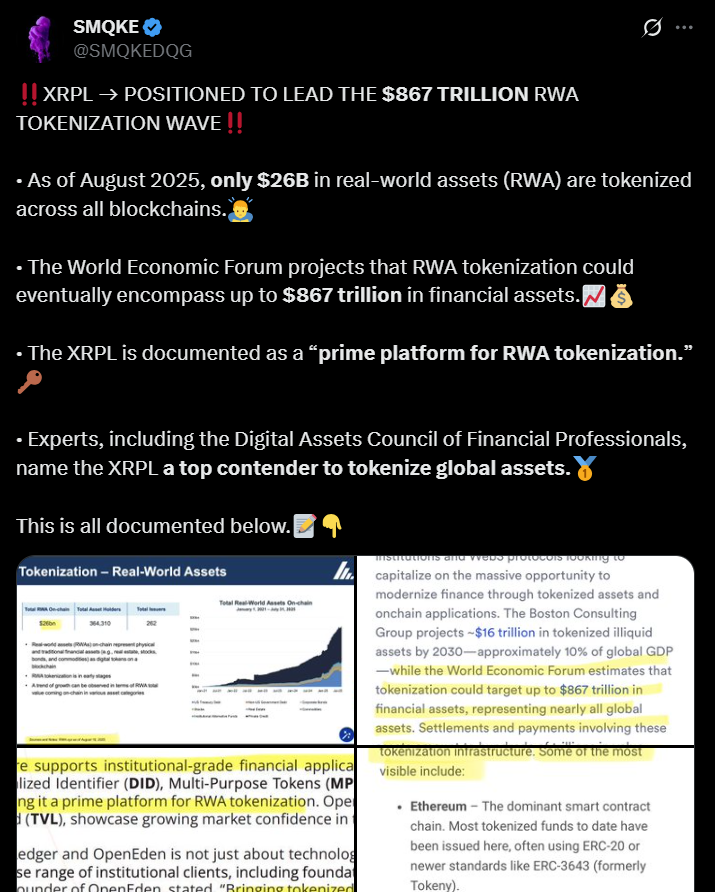
Институциональный интерес к токенизированным активам, основанным на риске (RWA), растет

Институциональный спрос на токенизированные активы реального мира формирует динамику криптовалют в 2025 году, знаменуя собой резкий отход от предыдущих циклов, характеризовавшихся спекуляциями в розничной торговле на бычьих рынках 2017 и 2021 годов.

Всемирный экономический форум (ВЭФ) недавно подчеркнул эту тенденцию, отметив, что теперь отрасль выигрывает от уникального сочетания институтов, регуляторов и технологических компаний, которые работают вместе над «созданием надежных, совместимых платформ». ВЭФ заявил, что в случае успеха это сотрудничество может позволить токенизации активов раскрыть свой давно обещанный потенциал.
Регулирование также играет решающую роль. В США принятие GENIUS Act, ориентированного на стейблкоины, а также одобрение Палатой представителей законопроектов о структуре рынка и запрете на CBDC укрепили доверие крупных финансовых учреждений, которые изучают возможность внедрения блокчейна.

До сих пор усилия по токенизации были сосредоточены на рынках частного кредитования и казначейских векселях. Но сфера деятельности расширяется: проводятся эксперименты с акциями, сырьевыми товарами и энергетической инфраструктурой.

Биржа цифровых активов Kraken взаимодействует с целевой группой SEC по криптовалютам для обсуждения вопросов токенизации, что подчеркивает, насколько будущее сектора зависит от диалога с регуляторами.

Related Reads

BIT Research: The 2028 Halving Is Not the End, the Real Shake-Up of the Bitcoin Mining Industry Is Just Beginning

The Bitcoin mining industry is undergoing its most complex structural adjustment since inception. Despite Bitcoin's price holding near $61,000 and the network hash rate approaching a record 1 ZH/s, miner profitability is deteriorating. The industry is operating close to its breakeven point, with the 2028 halving expected to accelerate consolidation. The challenges extend beyond the halving's subsidy reduction; the industry's revenue model has yet to successfully transition towards a fee-driven structure. Increasingly, mining companies are evolving from simple Bitcoin producers into infrastructure and energy operators, including providers of AI/HPC computing power. Competition is shifting from pure hash rate expansion to business model upgrades. Economic pressure is evident. The theoretical daily mining revenue at current prices is around $78 million, yet the actual figure is only about $33 million—a 136% gap. Transaction fees remain low at roughly $220k daily, far below historical implied levels. With a current estimated industry-wide breakeven price near $65,000, mining alone is struggling to generate ideal profits. The 2028 halving is projected to push the fundamental production cost floor to approximately $93,289. This will likely accelerate a shift towards consolidation among larger, well-capitalized miners with diversified revenue streams. Competitive advantage will belong to institutionalized players with access to low-cost energy, AI/HPC hosting operations, and stronger balance sheets. In essence, Bitcoin mining is transitioning from a "mining business" to an "infrastructure business." Future profitability and resilience will depend less on block rewards and more on diversified income sources like energy management and computational infrastructure services. For investors, the key question is not the halving itself, but which miners can successfully navigate this business model transformation.

marsbit15m ago

BIT Research: The 2028 Halving Is Not the End, the Real Shake-Up of the Bitcoin Mining Industry Is Just Beginning

marsbit15m ago

This is How God Karpathy Uses Claude?

Andrej Karpathy, a prominent figure in AI, has reportedly joined Anthropic, leading to a noticeable decrease in his open-source contributions and social media activity. A document claiming to be his personal "CLAUDE.md" file—a set of instructions for the Claude AI to follow within a specific codebase—has been circulating online. While its authenticity is unverified, the content aligns closely with Karpathy's publicly shared principles on effective AI-assisted programming. The document outlines key rules for AI coding assistants, emphasizing the importance of reading existing code thoroughly before writing new code to maintain consistency. It advises against over-engineering, advocating for simple, surgical modifications that match the project's existing style. Other guidelines include clarifying assumptions upfront, writing meaningful tests, thoughtful debugging, and carefully considering dependencies. The core message is that these principles help prevent common AI coding failures, such as introducing unnecessary abstractions, style drift, or making invisible architectural decisions. The community has noted that even experts like Karpathy require detailed instructions to guide AI effectively, akin to managing a junior developer. A related GitHub repository, "andrej-karpathy-skills," which encapsulates these ideas, is reported to significantly reduce Claude's code error rate. Ultimately, the advice stresses that the best CLAUDE.md is tailored to one's own tech stack and coding practices.

marsbit15m ago

This is How God Karpathy Uses Claude?

marsbit15m ago

Trading

Spot
活动图片