‘Crypto Cloud Reset’: Putin Adviser Accuses US Of Plot To Erase $35 Trillion Debt

bitcoinistPublished on 2025-09-09Last updated on 2025-09-09

Abstract

A senior adviser to Russian President Vladimir Putin has alleged that the United States is preparing to use cryptocurrencies —specifically...

Trusted Editorial content, reviewed by leading industry experts and seasoned editors. Ad Disclosure

A senior adviser to Russian President Vladimir Putin has alleged that the United States is preparing to use cryptocurrencies —specifically US dollar stablecoins—alongside gold to “devalue” and ultimately reset its towering national liabilities. Speaking at the Eastern Economic Forum in Vladivostok, Anton Kobyakov framed crypto and gold as “alternative currencies” to the dollar-centric system and argued that Washington aims to harness them to address what he called a crisis of confidence in the greenback.

“Right now, the United States is trying to change the rules on the gold and cryptocurrency markets. Just think about their debt – $35 trillion. These are two alternative currencies to the global market,” Kobyakov said.
He added: “Washington’s actions in this direction clearly demonstrate one of the main American goals. They want to solve the problem of lowering the dollar’s trust. The United States, as it was in the 1930s and 1970s, will solve its financial problems at the expense of the whole world, driving everyone into the cryptocurrency cloud.”

Kobyakov’s most arresting claim was operational: “Over time, when part of the US government debt is placed in stablecoins, the US will devalue this debt. In other words, they have a $35 trillion debt, they drive it into the cryptocurrency cloud, devalue it and start from scratch.” The remarks, which were circulated by Russian state-adjacent outlets, did not include a detailed mechanism for how “placing” sovereign obligations into stablecoins would alter their real value.

Can Bitcoin And Crypto (Stablecoins) Erase The US Debt?

The accusation lands amid two relevant backdrops: a US debt load now measured in the mid-$30 trillions and a fast-expanding stablecoin and tokenized-Treasury ecosystem that nonetheless remains orders of magnitude smaller than public debt. Treasury data and Congressional dashboards put gross federal debt at roughly $37.4 trillion in early September, with about $30.1 trillion held by the public. By contrast, the entire stablecoin market stands in the high-$200 billions, and tokenized US Treasury products total about $7.4 billion—hardly a platform capable of “absorbing” sovereign liabilities at scale.

US policy developments complicate Kobyakov’s narrative in another way. In July, President Donald Trump signed the GENIUS Act, the first federal framework for payment stablecoins. The law requires 100% reserve backing in cash and short-term Treasuries and mandates regular public disclosures—design choices that, if anything, tie stablecoin growth to incremental demand for Treasury bills rather than a mechanism for extinguishing US obligations. That is, more regulated stablecoins typically mean more private-sector buying of T-bills to back those tokens, not fewer Treasuries outstanding.

Kobyakov’s historical analogy—invoking the 1930s and 1970s—references episodes when US authorities changed the monetary regime: FDR’s dollar devaluation against gold in 1933–34 and Nixon’s 1971 closure of the gold window. But translating that precedent into a “stablecoin devaluation” is tenuous.

Stablecoins are issued by private or specially licensed entities and are designed to be redeemed at par; moving government liabilities “into” them would neither novate the debt nor change its legal terms. Any genuine devaluation of dollar-denominated debt would still occur via familiar channels—higher inflation, negative real rates, buybacks at discounts, or maturity transformation—not by wrapping the debt in token form.

Beyond the stablecoin debate, Washington has already sketched an alternative pathway: a Strategic Bitcoin Reserve. On March 6, 2025, the White House issued an executive order establishing a federal bitcoin reserve alongside a US Digital Asset Stockpile to manage government-owned crypto (largely from forfeitures) on a long-term, “budget-neutral” basis; companion legislation—the BITCOIN Act introduced in both chambers—would codify governance and disclosure rules.

US President Donald Trump himself has floated the idea in blunt terms. In an Aug. 2024 Fox Business interview with Maria Bartiromo, he mused: “Who knows? Maybe we’ll pay off our $35 trillion, hand them a little crypto check, right? We’ll hand them a little Bitcoin and wipe out our $35 trillion.” The remark was rhetorical rather than an operational plan, but it prefigured the administration’s March 6, 2025 executive order establishing a Strategic Bitcoin Reserve.

At press time, Bitcoin traded at $113,237.
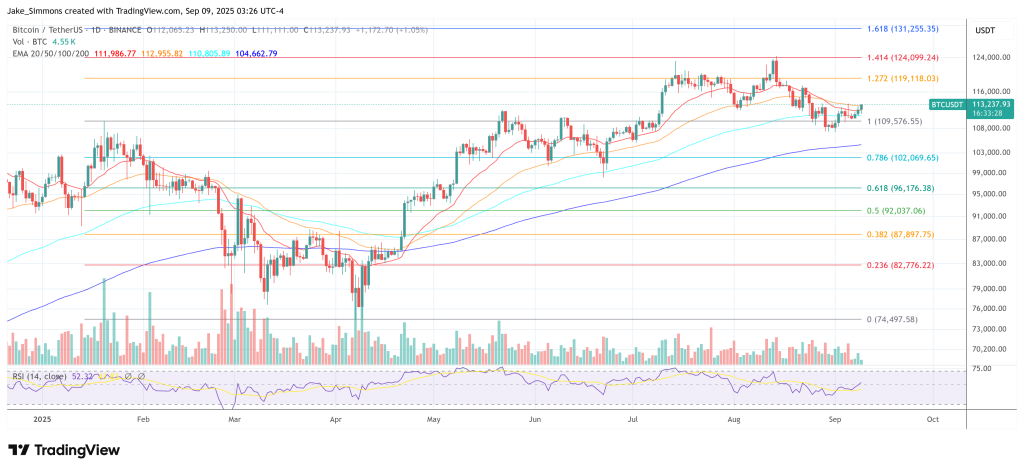
Bitcoin price
BTC rises back above $113,000, 1-day chart | Source: BTCUSDT on TradingView.com
Featured image created with DALL.E, chart from TradingView.com
Editorial Process for bitcoinist is centered on delivering thoroughly researched, accurate, and unbiased content. We uphold strict sourcing standards, and each page undergoes diligent review by our team of top technology experts and seasoned editors. This process ensures the integrity, relevance, and value of our content for our readers.

Jake Simmons has been a Bitcoin enthusiast since 2016. Ever since he heard about Bitcoin, he has been studying the topic every day and trying to share his knowledge with others. His goal is to contribute to Bitcoin's financial revolution, which will replace the fiat money system. Besides BTC and crypto, Jake studied Business Informatics at a university. After graduation in 2017, he has been working in the blockchain and crypto sector. You can follow Jake on Twitter at @realJakeSimmons.

Related Reads

BIT Research: The 2028 Halving Is Not the End, the Real Shake-Up of the Bitcoin Mining Industry Is Just Beginning

The Bitcoin mining industry is undergoing its most complex structural adjustment since inception. Despite Bitcoin's price holding near $61,000 and the network hash rate approaching a record 1 ZH/s, miner profitability is deteriorating. The industry is operating close to its breakeven point, with the 2028 halving expected to accelerate consolidation. The challenges extend beyond the halving's subsidy reduction; the industry's revenue model has yet to successfully transition towards a fee-driven structure. Increasingly, mining companies are evolving from simple Bitcoin producers into infrastructure and energy operators, including providers of AI/HPC computing power. Competition is shifting from pure hash rate expansion to business model upgrades. Economic pressure is evident. The theoretical daily mining revenue at current prices is around $78 million, yet the actual figure is only about $33 million—a 136% gap. Transaction fees remain low at roughly $220k daily, far below historical implied levels. With a current estimated industry-wide breakeven price near $65,000, mining alone is struggling to generate ideal profits. The 2028 halving is projected to push the fundamental production cost floor to approximately $93,289. This will likely accelerate a shift towards consolidation among larger, well-capitalized miners with diversified revenue streams. Competitive advantage will belong to institutionalized players with access to low-cost energy, AI/HPC hosting operations, and stronger balance sheets. In essence, Bitcoin mining is transitioning from a "mining business" to an "infrastructure business." Future profitability and resilience will depend less on block rewards and more on diversified income sources like energy management and computational infrastructure services. For investors, the key question is not the halving itself, but which miners can successfully navigate this business model transformation.

marsbit1h ago

BIT Research: The 2028 Halving Is Not the End, the Real Shake-Up of the Bitcoin Mining Industry Is Just Beginning

marsbit1h ago

This is How God Karpathy Uses Claude?

Andrej Karpathy, a prominent figure in AI, has reportedly joined Anthropic, leading to a noticeable decrease in his open-source contributions and social media activity. A document claiming to be his personal "CLAUDE.md" file—a set of instructions for the Claude AI to follow within a specific codebase—has been circulating online. While its authenticity is unverified, the content aligns closely with Karpathy's publicly shared principles on effective AI-assisted programming. The document outlines key rules for AI coding assistants, emphasizing the importance of reading existing code thoroughly before writing new code to maintain consistency. It advises against over-engineering, advocating for simple, surgical modifications that match the project's existing style. Other guidelines include clarifying assumptions upfront, writing meaningful tests, thoughtful debugging, and carefully considering dependencies. The core message is that these principles help prevent common AI coding failures, such as introducing unnecessary abstractions, style drift, or making invisible architectural decisions. The community has noted that even experts like Karpathy require detailed instructions to guide AI effectively, akin to managing a junior developer. A related GitHub repository, "andrej-karpathy-skills," which encapsulates these ideas, is reported to significantly reduce Claude's code error rate. Ultimately, the advice stresses that the best CLAUDE.md is tailored to one's own tech stack and coding practices.

marsbit1h ago

This is How God Karpathy Uses Claude?

marsbit1h ago

Trading

Spot
活动图片