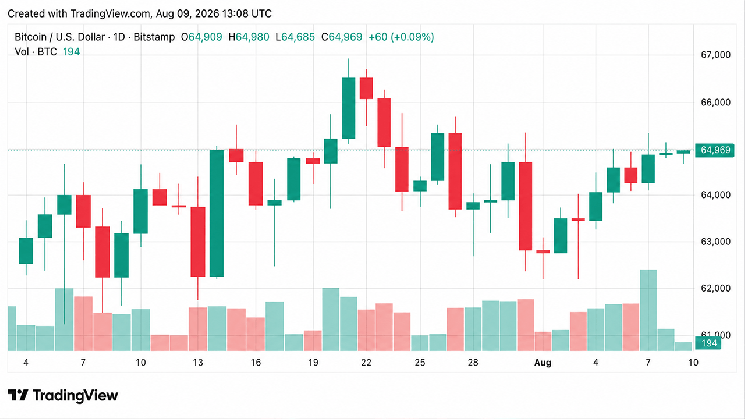
Модель консолидации биткоина имеет бычий тренд и цель в $140 тыс.

cryptonews.ruPublished on 2025-11-20Last updated on 2025-11-20

  • Биткоин повторяет цикл неудачных прорывов, потерь ликвидности и резких разворотов.
  • BTC торгуется на уровне около $113 900 с рыночной капитализацией $2,26 трлн и дневным объемом $66,55 млрд.
  • RSI на уровне 43,36 и отрицательный MACD сигнализируют о краткосрочном медвежьем импульсе.

Согласно новому анализу Crypto Rover, биткоин вновь следует привычной ценовой структуре, определявшей множество рыночных циклов. Текущая консолидация, отмеченная серией неудачных попыток прорыва, является частью повторяющейся модели изменений ликвидности, которая исторически определяла общую динамику биткоина.

A MAJOR BITCOIN PATTERN KEEPS REPEATING

1️⃣ Range forms
2️⃣ Failed breakout attempt
3️⃣ Liquidity sweep on the downside (bear trap)

We’re now right at step 3.

Don’t get shaken out. pic.twitter.com/OmSkkDlRBQ

— Crypto Rover (@rovercrc) August 21, 2025

Следует ли Биткоин историческому сценарию?

Многолетний график, представленный Crypto Rover, демонстрирует повторяющийся цикл фаз консолидации, неудачных прорывов и резких перепадов ликвидности. Зелёные круги на графике обозначают попытки прорыва сопротивления, которые быстро сменяются, а красные круги — провалы ниже уровня поддержки, которые сопровождаются агрессивными скупками.

Точно такое же поведение наблюдалось в 2023 и 2024 годах, когда эти отклонения от диапазона в конечном итоге предшествовали сильным ралли к новым максимумам. Теперь, в 2025 году, та же тенденция снова проявляется. Если эта историческая структура продолжит развиваться, прогноз аналитика предполагает, что биткоин в ближайшие годы может протестировать диапазон от 120 000 до 140 000 долларов.

По теме: Анализ цены биткоина: ключевые цели, на которые стоит обратить внимание в свете важных новостей

О чем говорят краткосрочные индикаторы BTC?

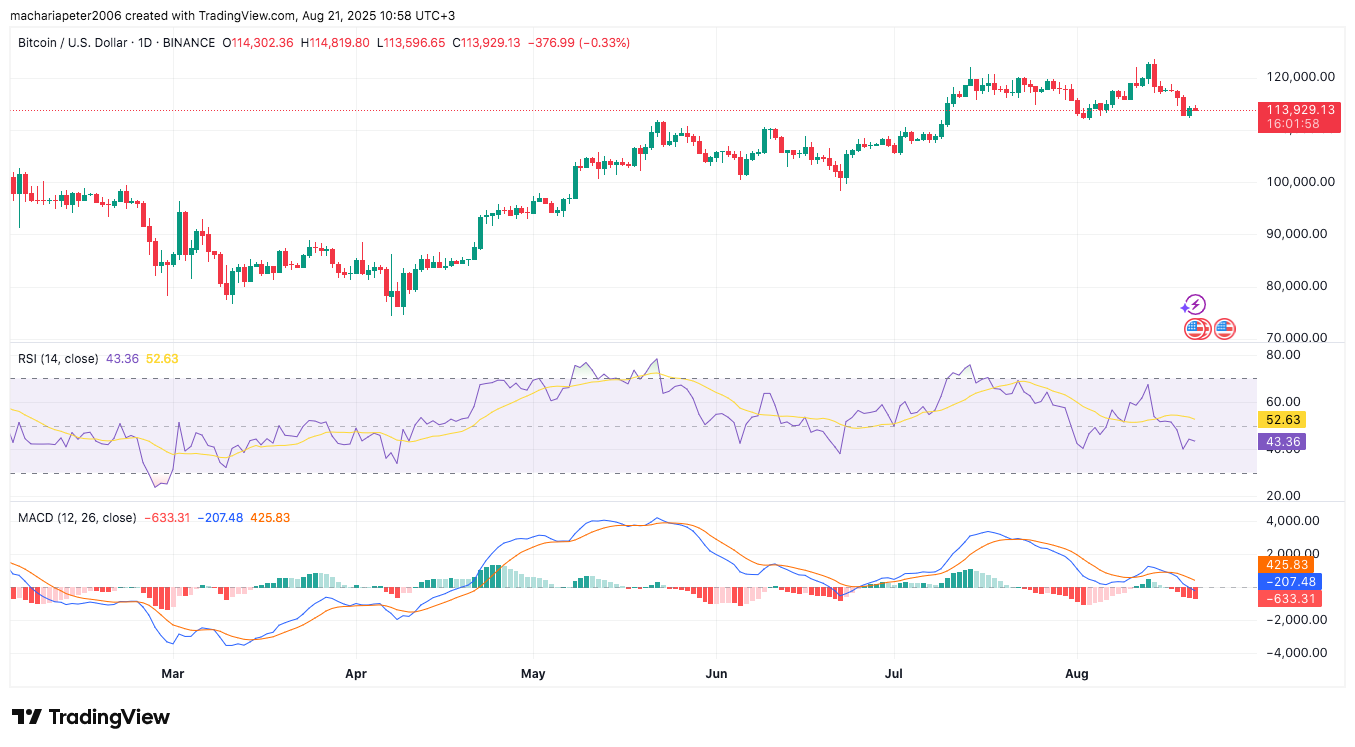
Хотя долгосрочная карта выглядит привычной, текущие технические индикаторы указывают на осторожность. Индекс относительной силы (RSI) находится на уровне 43,36, снизившись с 52,63, что свидетельствует об ослаблении покупательной способности. RSI, близкий к 30, будет указывать на перепроданность.
Источник: TradingView

Схождение-расхождение скользящих средних (MACD) подтверждает эту ситуацию. Линия MACD находится на уровне -207,48 против сигнальной линии 425,83, что соответствует отрицательному значению гистограммы -633,31. Расширяющиеся красные полосы на гистограмме указывают на возможное сохранение давления продаж.

Текущая ценовая битва биткоина

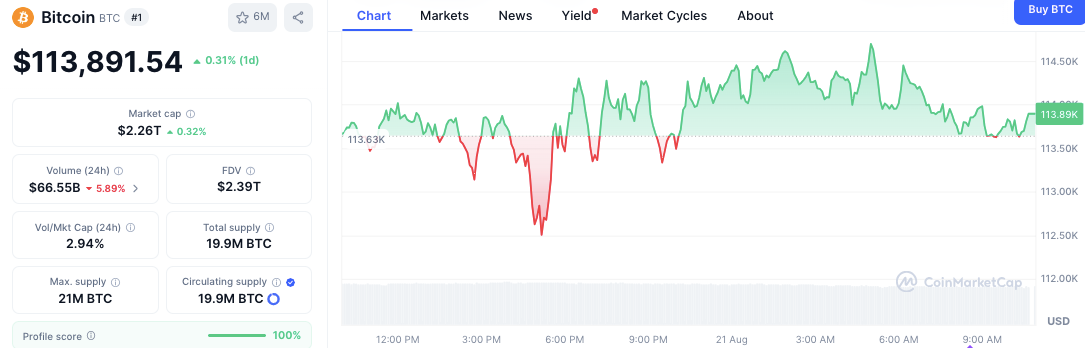
На момент публикации цена биткоина составляла $113 891,54, увеличившись за последние сутки на 0,31%. Рыночная капитализация составляет $2,26 трлн, а полная разводнённая стоимость (FDV) — $2,39 трлн. Объём торгов за 24 часа снизился на 5,89% до $66,55 млрд, в результате чего соотношение объёма к рыночной капитализации составило 2,94%. Объём торгов составляет около 19,9 млн BTC, что приближается к хардкапу в 21 млн.
Источник: CoinMarketCap

Внутридневные колебания демонстрируют волатильность: минимумы достигаются вблизи $113 600, а быстрый отскок превышает $114 000. Уровень сопротивления находится чуть выше $114 500, в то время как уровень поддержки остаётся стабильным в районе $113 000.

Этот узкий диапазон отражает консолидацию, отмеченную в долгосрочной модели, поскольку трейдеры ждут решающего катализатора, подробно описанного в нашем последнем отчете: цена биткоина упала до $115 тыс., поскольку трейдеры ожидают выступления председателя ФРС Пауэлла в Джексон-Хоуле..

Related Reads

Alliance's Co-Founder's Letter to Entrepreneurs: Written on the Occasion of Cursor's $60 Billion Sale

In this letter to entrepreneurs, Alliance reflects on the success of Cursor's $60 billion sale to Elon Musk, using it as a case study to counter the misconception that opportunities in crowded fields like AI or crypto are exhausted. The piece argues that great companies like Cursor, Stripe, Figma, and Shopify are not built by geniuses with perfect ideas, but by founders who start with a non-consensus belief about the future and build for years before that future becomes obvious to everyone. They identify long-term shifts, find overlooked entry points, and execute relentlessly. The framework for success involves: 1. **Identifying your place in the technology cycle**: Early-stage opportunities focus on making new tech usable for power users (e.g., Coinbase, Cursor). Later-stage opportunities involve finding the "yin" to an existing "yang"—the blind spots of first-generation players (e.g., Stripe vs. PayPal, Figma vs. Adobe). 2. **Cultivating unique insights**: Immerse yourself deeply in the market. Use every product, talk to users, and build an audience. Insights will emerge naturally from deep engagement. 3. **Finding a "hair-on-fire" problem**: Look for a 10x improvement or a severe, urgent pain point. The strongest signal is people already building clumsy workarounds. 4. **Building a focused MVP**: Don't just add features because you can. Ask why users would abandon their current tool for yours. The best startups rarely force new behaviors; they improve familiar workflows with drastically lower friction. 5. **Winning a distribution channel**: Distribution is often the moat. Before product-market fit, achieve channel-market fit. Find where your customers are and build an engine to reach them, even through unscalable, manual efforts initially. 6. **Persistence**: The final, unteachable ingredient is resilience. Success stories like Cursor, Airbnb, and Nvidia involved years of grinding, rejection, and perseverance when the path forward seemed unclear. The conclusion is that there is no secret. Most people fail to consistently execute these steps over the long term. The few who do build the companies that define the next era. The world is yours to create.

链捕手4m ago

Alliance's Co-Founder's Letter to Entrepreneurs: Written on the Occasion of Cursor's $60 Billion Sale

链捕手4m ago

Crypto Miners' Big AI Gamble: Valuations Enter Differentiation Stage, Comeback Fight Proves Tough

Crypto Mining Firms' AI Bet: Valuation Divergence and a Challenging Transformation Facing declining profitability in crypto mining, mining companies are pivoting to AI infrastructure, capitalizing on their existing power resources, land, and data center expertise to offer GPU compute power. This transition narrative has boosted their stock prices significantly, with firms like Hut 8 and Bitfarms seeing gains over 100% year-to-date, far outpacing Bitcoin. This has led to a market valuation split, with pioneers like CoreWeave reaching a $62.8B market cap, while others remain below $5B. The market currently prioritizes growth potential over short-term profits, which remain under pressure due to heavy capital expenditures for AI build-outs and crypto asset volatility. However, the transformation is a high-stakes gamble. Bitcoin mining profitability is shrinking, with the average production cost around $63,707 and miner margins contracting. While AI offers a more lucrative long-term path, it requires massive investment—estimated at a $500B near-term funding gap. Success now hinges on execution: delivering on contracted power capacity, securing quality tenants like major cloud providers, and managing the immense financial burden. The valuation focus is shifting from mere power capacity to project delivery, future cash flows, and tenant quality, making this a difficult but critical turnaround attempt.

链捕手13m ago

Crypto Miners' Big AI Gamble: Valuations Enter Differentiation Stage, Comeback Fight Proves Tough

链捕手13m ago

Analysis of the Latest Portfolio Adjustment by the "Top Player" in the U.S. Stock Market: $9 Billion Short on NVIDIA, Shifting Focus to Power and Memory Sectors

AI investor Leopold Aschenbrenner has made a significant portfolio shift, taking a $9 billion nominal short position against top AI infrastructure stocks like NVIDIA, ASML, and Oracle. Simultaneously, he is redirecting capital towards what he sees as the next critical bottlenecks in the AI boom: power, memory, and data center networking, alongside private investments in AI model companies like Anthropic. This move is interpreted not as a call that the AI bubble has burst, but as a rotation within the infrastructure stack. The analysis highlights NVIDIA's recent $25 billion bond issuance as a potential signal, questioning why a cash-rich company would seek external debt despite high profits and increased dividends/buybacks. The core investment thesis is that the initial, crowded "picks and shovels" trade in semiconductors is maturing. The next wave of capital is expected to flow into the physical and logistical constraints of AI expansion: electricity supply, memory chip capacity, data center construction, and enabling technologies like optical networking (fiber) for high-bandwidth communication, where copper remains crucial for short distances. Aschenbrenner's substantial (approx. 20% of fund) private stake in Anthropic is noted as a key part of his strategy—investing directly in the "mine" (AI models) rather than just the "shovels." The discussion concludes that while certain segments may be overvalued, the overarching AI infrastructure demand driven by real product usage remains robust. The most promising long-term investments are seen in essential, non-sexy infrastructure—particularly energy and power companies—whose demand is viewed as a global constant irrespective of AI's cyclicality.

marsbit34m ago

Analysis of the Latest Portfolio Adjustment by the "Top Player" in the U.S. Stock Market: $9 Billion Short on NVIDIA, Shifting Focus to Power and Memory Sectors

marsbit34m ago

BIT Research: Liquidity is Disappearing, Will Bitcoin Replay the Bottoming Pattern of 2022?

The crypto market is currently in an adjustment phase driven by policy expectations and liquidity shifts. Despite a brief rebound fueled by geopolitical easing and SpaceX's strong IPO performance, unexpectedly hawkish signals from new Fed Chair Kevin Warsh have removed anticipated easing support. Concurrently, stablecoin liquidity is shrinking, with insufficient new capital inflows, pushing the market into a typically quiet summer period. Pricing lacks catalysts for a sustained rally. Daily trading volume has significantly contracted, stablecoin growth has slowed markedly, and the supportive effect of Strategy's (formerly MicroStrategy) STRC preferred stock-financed Bitcoin purchases is fading. Amid policy uncertainty, seasonal weakness, and liquidity contraction, Bitcoin faces near-term downward pressure. Warsh's hawkish pivot and refusal to provide a clear policy outlook have increased risk premiums, historically unfavorable for Bitcoin. Technically, the trend remains bearish below $73,700, with $62,446 as critical support. A break below could accelerate declines, though a prolonged consolidation phase, similar to 2022's bottoming process, is possible. Liquidity is a core constraint. Current daily volume is around $500 billion, roughly 25% of the peak during the July-Oct 2025 rally. The 12-month growth rates for USDT and USDC have fallen to ~20%, with 6-month growth near zero, indicating weak new inflows. Bitcoin ETF and Strategy-driven inflows have also weakened, with a 30-day rolling net outflow. With inflation at 4.2% above the Fed's target, combined hawkish policy, seasonal factors, and liquidity shortages challenge Bitcoin's ability to hold above $60,000. However, this adjustment phase may be forming a cyclical low this summer, potentially setting the stage for the next bull cycle.

marsbit1h ago

BIT Research: Liquidity is Disappearing, Will Bitcoin Replay the Bottoming Pattern of 2022?

marsbit1h ago

Trading

Spot
Futures
活动图片