Why Is Crypto Down Today? Investors Watch These Top Presales to Weather the Crash

bitcoinistPublished on 2025-08-18Last updated on 2025-08-18

Abstract

Crypto’s bleeding pretty badly today, with red dominating the charts. Bitcoin ($BTC) sits around $115,440, down –2.23% in 24 hours....

Trusted Editorial content, reviewed by leading industry experts and seasoned editors. Ad Disclosure

Crypto’s bleeding pretty badly today, with red dominating the charts.

Bitcoin ($BTC) sits around $115,440, down –2.23% in 24 hours. Ethereum ($ETH) has slipped to $4,287 after a –4.22% daily drop, while Solana ($SOL) also has fallen –5.55% in 24h to $181.

Even Dogecoin ($DOGE), the OG meme coin, has dumped to $0.2229, losing –4.68%.
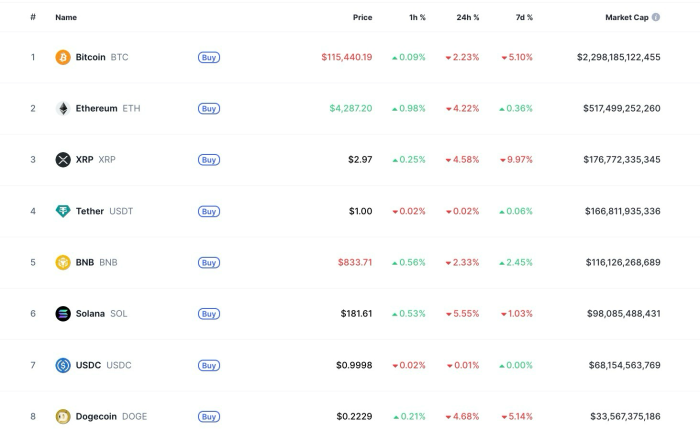
Prices of the top 8 cryptos by market cap.
Source: CoinMarketcap

For seasoned investors, this isn’t surprising. Volatility defines crypto. Yet when the market turns south, it raises a familiar question: how do you stay active without being whipsawed by sudden price swings?

That’s where the best crypto presales come in. Unlike listed tokens, presales run on fixed pricing through each stage, meaning they’re protected from the dips and spikes hammering the broader market.

Instead of reacting to daily charts, presale investors lock in early allocations and wait for potential upside after launch.

This is why many traders treat presales as a safe harbor during market crashes. They don’t just sit out volatility; they shift their attention to projects with fresh narratives and long-term growth plans.

With the market flashing red, here are four presales worth considering.

1. Bitcoin Hyper ($HYPER) – Bitcoin Finally Gets Its Own Layer 2

Bitcoin Hyper ($HYPER) positions itself as the first ‘true’ Bitcoin Layer 2.

By integrating Solana’s Virtual Machine (SVM), it delivers speed and scalability that Bitcoin has always lacked. This means sub-second, low-fee $BTC transactions and the ability to finally run dApps, DeFi, and even meme coins directly on Bitcoin’s Network.
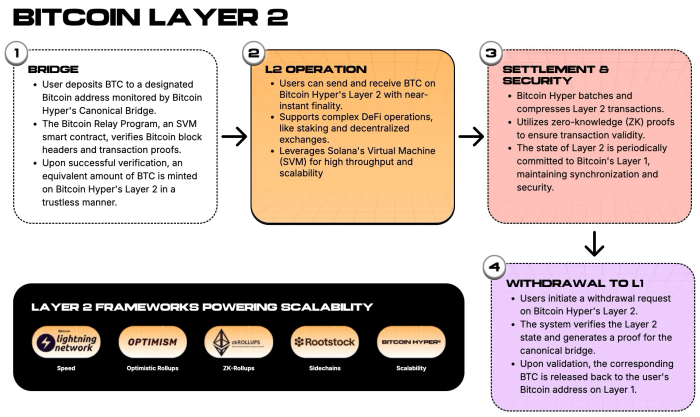
Bitcoin Hyper ($HYPER) layer 2 framework for powering scalability.

From launch, Bitcoin Hyper is cross-chain compatible with $BTC, $ETH, and $SOL, opening the doors to liquidity and app flows across multiple ecosystems. The $HYPER token underpins the system, covering transactions, staking, and governance.

So far, the presale has already raised over $10.3M, with tokens priced at $0.012745 and staking rewards set at a competitive 106% APY.

Why does it matter? Scalability has long been Bitcoin’s Achilles’ heel. If Bitcoin Hyper ($HYPER) delivers, it could shift $BTC from being just a ‘store of value’ into a true platform for payments and applications.

This gives presale buyers a rare first-in advantage. Especially considering our Bitcoin Hyper price prediction looks at a potential $0.32 by year’s end (+2,415%).

Check out how to buy Bitcoin Hyper to get involved in the presale.

2. Snorter Token ($SNORT) – The Telegram Bot Built for Meme Coins

Snorter Token ($SNORT) takes meme coins a step further by pairing its humor with hard utility.

It powers a Telegram-native trading bot built for Solana and Ethereum, giving degen traders the tools they need without ever leaving the chat. The bot (not launched yet) handles sub-second swaps, copy-trading, rugpull detection, and instant sniping on new launches, all in a single interface.
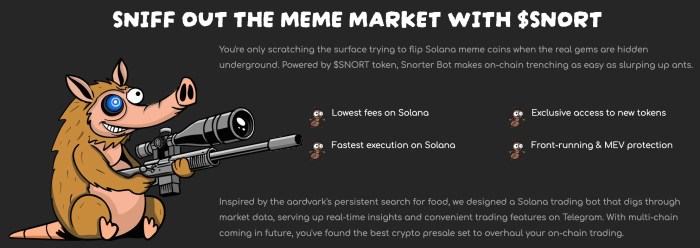
Benefits of holding $SNORT token.

Holding $SNORT cuts trading fees from 1.5% down to 0.85%, making it cheaper than its rivals. Security is also part of the pitch: in closed beta, Snorter’s blacklist scans achieved an 85% success rate at spotting rugs and honeypots before traders lost funds.

Snorter Bot will be a retail trader’s best friend, as it lets you get into trades before whales even realize what’s happening. And being early is often the key to monstrous profits in crypto.

The presale has raised almost $3.2M so far, with tokens priced at $0.1017 and offering 138% APY through staking.

By merging meme branding with real-world functionality, Snorter Token ($SNORT) sits at the intersection of two booming markets (meme tokens and Telegram bots), giving it a stronger case than most speculative coins.

To learn more about the project’s utility, tokenomics, and more, visit our what is Snorter guide. And check out or Snorter Token price prediction to see why we forecast a 824% increase by year’s end.

3. Best Wallet Token ($BEST) – The Next-Gen Crypto Wallet Token

Best Wallet is positioning itself as a serious challenger to MetaMask and other crypto wallets, with a cleaner interface and features designed for today’s Web3 user.

Its native token, $BEST, unlocks perks such as reduced transaction fees, early access to presales, higher staking rewards, and exclusive governance rights to vote on the direction of the project.

Best Wallet Token benefits for holders.

One standout feature is the ‘Upcoming Tokens’ tool, which has funneled more than $2M into new presales directly through the app. The launch hyper was clear: the first $100K stage sold out in just six hours, with $162K raised in the opening day alone.

Since then, the project has gone on to raise over $14.9M to date, with tokens currently priced at $0.025495 and staking rewards set at 90% APY.

With over 73K+ followers on X and 50% monthly user growth, Best Wallet’s adoption curve is steep. If Best Wallet continues to win market share from established traders, $BEST could benefit directly as users look for added benefits.

Plus, the wallet’s roadmap promises a fiat card, in-app staking, an NFT gallery, and more user rewards for maximum engagement. And $BEST will be a key part of this ecosystem.

Learn more about what Best Wallet Token is in our comprehensive guide

4. Lightchain AI ($LCAI) – Proof of Intelligence on Blockchain

Lightchain AI ($LCAI) blends two of crypto’s biggest narratives: artificial intelligence and blockchain scalability.

Its defining feature is Proof-of-Intelligence (PoI) consensus, where nodes perform useful AI computations (like model training and optimization) instead of wasting energy on meaningless puzzles.
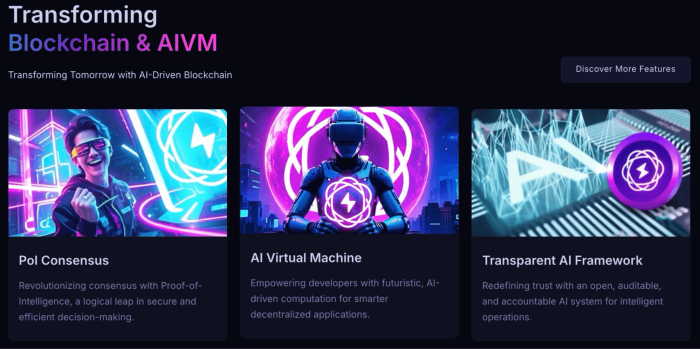
Lightchain AI ($LCAI) transforming blockchain and AIVM.

At the core sits the AI Virtual Machine (AIVM), a computational layer that allows developers to build and run AI-powered dApps directly on-chain. To boost trust, Lightchain is pushing a transparent, auditable AI framework, making every decision process open to community scrutiny.

Investor traction has been strong: the presale has raised $22.3M so far, with $LCAI tokens priced at $0.007125.

As AI remains one of the most powerful long-term narratives in crypto. By marrying AI workloads with blockchain consensus, Lightchain positions itself as a serious contender in a sector with plenty of room to run.

Read the Lightchain AI whitepaper for more detailed information.

Final Thoughts – Presales as Shelter in a Storm

Today’s red market is a sharp reminder of crypto’s volatility, with $BTC, $ETH, $SOL, $DOGE, and more all sliding lower.

For investors looking beyond the daily noise, presales like $HYPER, $SNORT, and $BEST offer a way to position ahead of the next cycle without being tied to short-term price swings.

That said, presales remain speculative and high-risk, just like anything crypto-related. This article is not financial advice. Always do your own research (DYOR) before committing any funds.

Editorial Process for bitcoinist is centered on delivering thoroughly researched, accurate, and unbiased content. We uphold strict sourcing standards, and each page undergoes diligent review by our team of top technology experts and seasoned editors. This process ensures the integrity, relevance, and value of our content for our readers.

Aidan Weeks, a Master's graduate in Mechanical Engineering, has thrived as a content writer for over four years. Specializing in crypto, tech, engineering, AI, and B2B sectors, Aidan adeptly crafts web copy, blog posts, buying guides, manuals, product pages, and more, making complex concepts accessible and engaging. His transition from academia to full-time writing reflects his passion for bridging technical expertise with clear, informative content. Since joining Bitcoinist, Aidan has written extensively about DeFi, dApps, AI, and meme coins, solidifying his grasp on emerging blockchain technologies. An early adopter, he began investing in Solana in 2020, further deepening his insights into crypto markets and innovation. Today, he combines hands-on experience with a sharp editorial instinct to help readers cut through hype, spot real trends, and make sense of a fast-moving space.

Related Reads

You Use Claude and Codex Every Day, but Meta Has Restricted Internal Use

In May, Meta imposed internal restrictions on its engineers regarding the use of Claude Code and Codex, two widely used AI programming tools. Despite being a major client, Meta's guidelines, still in effect, prohibit these external models from being used for specific tasks to prevent potential "escalations with partners." The core concern is "distillation"—the risk that outputs from Claude or Codex could inadvertently contaminate the training data and evaluation processes for Meta's in-house AI coding assistant, MetaCode. If MetaCode is trained or evaluated using data generated by these external models, it risks learning their capabilities rather than developing its own, blurring the line of intellectual origin. The restrictions are precise: engineers cannot use the external models to generate test questions, debug source code, or suggest test cases. AI-generated content is also barred from environments accessible to MetaCode. However, AI can still assist with peripheral tasks like workflow setup and code organization, provided all outputs are manually reviewed. This caution reflects a broader industry dilemma. While distillation is a common technique, using a competitor's model output for training raises legal and ethical questions about the ownership of derived capabilities. Contractual terms from companies like OpenAI and Anthropic explicitly forbid using their outputs to build competing products, putting enforcement power in the hands of rivals. The move is also financially motivated, as Meta seeks to reduce its hefty internal AI spending, estimated in the billions this year. Meta's policy illustrates the delicate balance companies must strike: leveraging powerful external AI tools while safeguarding the integrity and independence of their own AI development. As AI systems increasingly help build other AIs, distinguishing the origin of capabilities becomes a fundamental challenge for the entire industry.

marsbit59m ago

You Use Claude and Codex Every Day, but Meta Has Restricted Internal Use

marsbit59m ago

Why Do We Need an AI Content Perspective Today?

The article "Why Do We Need an AI Content Perspective Today?" explores the complex and often contentious integration of AI into the cultural and creative industries, particularly film and television. It begins with the cancellation of Amazon's AI-generated animation "Punky Duck," highlighting the ethical debates surrounding AI content. AI's rapid advancement is transforming video production, enabling cost-effective, full-length AI films (e.g., "RAPHAEL," "Dreams of Violets") while sparking industry resistance over issues like "synthetic actors." The core debate has shifted from whether to use AI to how to use it responsibly. The article analyzes why AI's entry into film is uniquely unsettling. It distinguishes between "cultural fast food" (short-form, fast-paced content like micro-dramas) and "cultural main courses" (traditional, long-form film/TV). AI currently excels at the former, matching its fragmented narratives, shallow emotional needs, and free-to-consumer models. However, venturing into the latter challenges the human-centric essence of storytelling—creativity, emotional depth, and the unique value of human labor and experience. While AI can generate massive volumes of content and lower costs, it risks devaluing human creativity, leading to homogenized output, and creating unfair competition through potential intellectual property infringement. Its efficiency also amplifies content safety risks, making preemptive governance crucial. To counter these risks, the article proposes establishing clear boundaries guided by a human-centered AI content perspective. It outlines four principles: 1) Amplify, rather than displace, human creative space; 2) Respect and protect human creative output; 3) Ensure human creative control and responsibility remain paramount; and 4) Guarantee transparency and traceability in AI creation. The conclusion emphasizes that humans must act as the "helmsmen" of technology, steering AI development to enhance, not replace, the core human values at the heart of cultural expression.

marsbit1h ago

Why Do We Need an AI Content Perspective Today?

marsbit1h ago

Planck Retracted? The Father of Quantum Tripped by an Algorithm

The recent discovery that two articles (published in 1940 and 1942) by Max Planck, the Nobel laureate and founder of quantum theory, are marked as "retracted" on Springer's digital platform highlights a curious clash between historical publishing practices and modern automated systems. An investigation suggests these retractions are algorithmic errors, not due to fraud or misconduct. The papers, philosophical reflections on science published in *Die Naturwissenschaften*, were likely flagged by the platform's systems. One article, a republished lecture, may have been mistaken for duplicate publication. Another, sharing a title with a prior article by a different author (a common practice for continuing debates at the time), may have triggered a similar automated check. The digital versions have even been replaced with blank pages, contrary to normal practice of preserving retracted texts. This incident underscores how contemporary digital infrastructure, built around concepts like "self-plagiarism" and strict copyright, can misclassify and obscure legitimate historical scholarly communication. It serves as a warning that digital archives are not neutral mirrors of the past but are filtered by platform rules, potentially distorting the scientific record. As AI systems increasingly rely on such databases, such erroneous metadata could propagate, affecting how future tools interpret and access historical knowledge.

marsbit1h ago

Planck Retracted? The Father of Quantum Tripped by an Algorithm

marsbit1h ago

Trading

Spot
活动图片