Правила Базельского комитета создают «узкое место» для криптовалют

cryptonews.ruPublished on 2025-03-17Last updated on 2025-08-18

Действующие требования к резервированию капитала делают хранение криптовалют слишком затратным для банков, что сдерживает развитие сектора.

Крис Перкинс, президент инвестиционной компании CoinFund, заявил, что нормативы Базельского комитета по банковскому надзору (BCBS), разрабатывающего международные банковские стандарты, формируют искусственное «узкое место», ограничивающее рост криптоиндустрии.

По его словам, текущие правила снижают рентабельность собственного капитала (ROE) банков — ключевой показатель прибыльности в этой сфере. Это происходит из-за повышенных требований к резервам при работе с криптовалютами, что делает такую деятельность экономически невыгодной.

«Это скрытое узкое место, поскольку оно действует не напрямую. Это изощренный способ подавления активности: банки просто отказываются от операций, которые становятся для них слишком дорогими», — пояснил Перкинс.

«Если у меня есть капитал для инвестиций, я вложу его в активы с высокой, а не низкой доходностью», — добавил он.

В апреле Перкинс раскритиковал Банк международных расчетов (БМР) за предложение распространить правила «Знай своего клиента» (KYC) и другие устаревшие банковские нормы на протоколы децентрализованных финансов (DeFi) и стейблкоины. По его мнению, это противоречит фундаментальным принципам публичных блокчейн-сетей.

«Реальный системный риск исходит из асимметрии: публичные децентрализованные сети работают круглосуточно, обеспечивая мгновенные расчеты, тогда как традиционная финансовая инфраструктура отключается по ночам и выходным, отказываясь адаптироваться к технологиям», — подчеркнул он.

Банк международных расчетов сохраняет жесткую позицию против криптовалют

БМР, выполняющий функции центрального банка для национальных регуляторов и координирующий работу BCBS, в апрельском докладе утверждал, что криптовалюты угрожают стабильности финансовой системы.

Авторы документа также связали рост крипторынка с увеличением разрыва в благосостоянии и призвали к усилению государственного контроля.

В июне БМР опубликовал новый отчет — «Рост стейблкоинов: вызовы и политические подходы». В нем утверждается, что стейблкоины не могут считаться деньгами и несут системные риски.

«Рыночная капитализация стейблкоинов и их интеграция с традиционными финансами достигли уровня, когда негативные последствия для системы уже неизбежны», — говорится в докладе.

БМР последовательно продвигает цифровые валюты центральных банков (CBDC) и другие централизованные решения как альтернативу частным и децентрализованным криптовалютам.
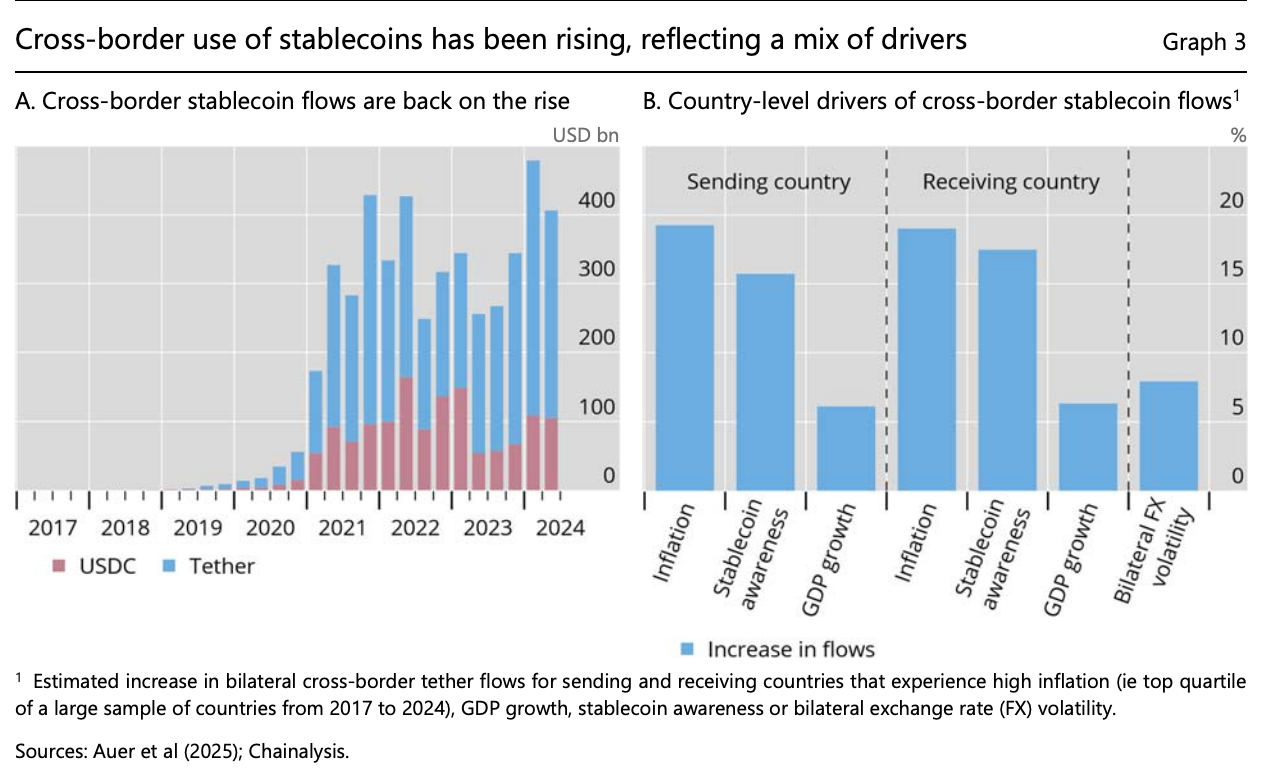

Трансграничное использование стейблкоинов расширяется. Источник: BIS

Related Reads

Google's 'Reasoning King' Also Departs for Meta, Originally Recruited by Fei-Fei Li

"Google's 'King of Reasoning' Leaves for Meta, Quietly Departing After Over Eight Years. Denny Zhou, a key figure behind Google's AI reasoning advancements including work showcased by CEO Sundar Pichai, has joined Meta's MSL as a research scientist. His low-profile move, discovered via a LinkedIn update, occurred months before the high-profile departures of Noam Shazeer to OpenAI and Nobel laureate John Jumper to Anthropic. Zhou was originally recruited to Google by Fei-Fei Li's China center initiative after nearly 11 years at Microsoft. This is part of a significant talent drain at Google, with top researchers like Shazeer (co-author of the Transformer paper) and Jumper (AlphaFold lead) recently leaving for rivals. Reports suggest internal friction is a contributing factor, particularly around Google's strategic shift. The company has reportedly formed a high-priority 'AI Coding Strike Team,' involving co-founder Sergey Brin, to urgently bridge the gap in AI coding agents, potentially reallocating resources and focus away from other research directions like DeepMind's 'world model' AGI approach. This pivot towards commercially-proven coding applications may have influenced departures, as hinted by Shazeer's comment about his compute allocation being given to another team. Meanwhile, Meta continues to bolster its team, also recently hiring UC Berkeley professor and 'security godmother' Dawn Song, along with her startup Virtue AI team, as a VP of AI research."

marsbit44m ago

Google's 'Reasoning King' Also Departs for Meta, Originally Recruited by Fei-Fei Li

marsbit44m ago

How Did Hundreds of Billions of Dollars Flow into SpaceX After Its Index Inclusion on June 26th? Will SpaceX Experience a Massive Price Surge?

Will SpaceX ($SPCX) stock surge when billions in passive index fund money flows in on the effective date? A common retail investor belief is that a massive wave of buying will hit on July 6th, when SpaceX joins the Nasdaq-100, potentially causing a huge price spike. However, the reality is far more complex and less dramatic. The anticipated billions are not controlled by a single entity but are spread across hundreds of passive fund managers (e.g., BlackRock, Vanguard) whose sole mandate is to minimize "tracking error." They aim to buy shares at prices as close as possible to the index's closing price on the effective date, not to aggressively drive the price up. There are two key index inclusion scripts: 1) For the Russell US Index (effective June 26th at close), buying is compressed into the final minutes via Market-On-Close (MOC) orders. 2) For the Nasdaq-100 (announced June 26th, effective July 6th), a 10-day window creates a layered game. Arbitrage funds buy early, betting on selling to passive funds later. Some index funds "front-run" by accumulating shares gradually before the deadline. The bulk of passive funds execute large MOC orders at the July 6th close, often trading directly with arbitrageurs. A critical wildcard is SpaceX's limited free float due to a standard 180-day post-IPO lockup. To avoid causing a massive price spike by competing for scarce shares on the open market, large funds will likely use off-exchange methods: 1) Negotiating large block trades (over-the-counter) with major holders. 2) Using derivatives like total return swaps with locked-up shareholders to gain economic exposure without physically buying the stock. Most of the index-driven buying will thus happen invisibly, not on public exchanges. For retail investors, trying to front-run these sophisticated flows is risky. More viable strategies include: waiting for post-inclusion volatility to subside before establishing a long-term position, or employing options strategies like selling strangles to profit from elevated, but potentially overstated, implied volatility around the event. In conclusion, while price appreciation may occur in the days following the announcement due to arbitrage and front-running activity, a single-day "explosive pump" on July 6th is highly unlikely. The major index fund buying will be executed efficiently and discreetly, often away from public markets, turning the anticipated climax into a well-orchestrated, anti-climactic settlement.

marsbit56m ago

How Did Hundreds of Billions of Dollars Flow into SpaceX After Its Index Inclusion on June 26th? Will SpaceX Experience a Massive Price Surge?

marsbit56m ago

Trading

Spot
活动图片