Ripple’s XRP Cannot Replace SWIFT? Expert Says This Crypto Is A Better Fit

bitcoinistPublished on 2025-08-12Last updated on 2025-08-13

Abstract

Ripple has long made its ambitions of challenging and eventually replacing SWIFT as the backbone of global cross-border payments very...

Trusted Editorial content, reviewed by leading industry experts and seasoned editors. Ad Disclosure

Ripple has long made its ambitions of challenging and eventually replacing SWIFT as the backbone of global cross-border payments very clear. Ripple CEO Brad Garlinghouse has openly criticized SWIFT’s inefficiencies and noted how the company aims to capture a sizable 14% share of the multi-trillion-dollar payments market within the next five years. 

However, although XRP’s utility in facilitating near-instant settlements has kept the XRP replacing SWIFT narrative alive for years, one expert argues that reality may be pointing in a different direction.

XRP Cannot Replace SWIFT

Ripple’s goal is to compete with SWIFT and capture a large portion of the $5 trillion worth of transactions that the network processes each day. However, according to Zach Rynes, who is a community liaison with Chainlink, the idea of XRP replacing SWIFT does not reflect what is actually happening behind the scenes. In a post on the social media platform X, Rynes highlighted that SWIFT is already integrating with blockchain technology through its partnership with Chainlink. 

Reports indicate that SWIFT currently uses Chainlink’s infrastructure to connect more than 11,500 SWIFT member banks to both public and private blockchains. This level of integration not only modernizes SWIFT’s existing network but also allows it to interact with tokenized assets and smart contract platforms without abandoning its established global banking relationships. 
Ripple
Source: Zach Rynes on X

Proponents like Zack Ryne also argue that it places SWIFT on par with Ripple’s blockchain advances, and it effectively removes any advantage that the latter has. As such, the competition for dominance in global payments may not be a case of Ripple replacing SWIFT completely, but if SWIFT can catch up through partners like Chainlink and perhaps make its utility coin LINK a better institutional cryptocurrency.

SWIFT’s Partnership With Chainlink

SWIFT’s relationship with Chainlink kicked off in 2016, when Chainlink (known as SmartContract.com at the time) participated in and won SWIFT’s startup competition. However, their partnership has really gained speed in recent years. In September 2022, SWIFT and Chainlink publicly introduced an initial proof‑of‑concept using Chainlink’s Cross‑Chain Interoperability Protocol (CCIP) during the SmartCon 2022 event.

In August 2023, SWIFT conducted a successful proof-of-concept test (with institutions like ANZ, BNP Paribas, BNY Mellon, and Citi) using Chainlink’s Cross‑Chain Interoperability Protocol (CCIP). That pilot has grown into real-world use cases with thousands of SWIFT member banks worldwide. 

Interestingly, recent advancements with Chainlink have also seen more activity from big investors with LINK and heavy accumulations from whale traders. At the time of writing, LINK is trading at $21.40, trading above $20 for the first time since February. 

Ripple, on the other hand, has also expanded its partnership in its quest to compete with SWIFT. This partnership includes the European Central Bank and the Bank of Japan, who are reviewing Ripple’s infrastructure alongside SWIFT.

Ripple
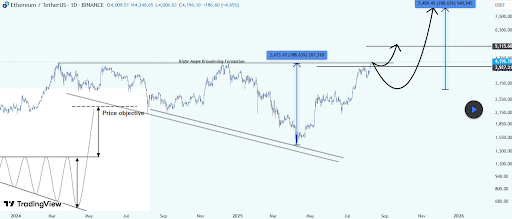
XRP trading at $3.12 on the 1D chart | Source: XRPUSDT on Tradingview.com
Featured image from iStock, chart from Tradingview.com
Editorial Process for bitcoinist is centered on delivering thoroughly researched, accurate, and unbiased content. We uphold strict sourcing standards, and each page undergoes diligent review by our team of top technology experts and seasoned editors. This process ensures the integrity, relevance, and value of our content for our readers.

Scott Matherson is a leading crypto writer at Bitcoinist, who possesses a sharp analytical mind and a deep understanding of the digital currency landscape. Scott has earned a reputation for delivering thought-provoking and well-researched articles that resonate with both newcomers and seasoned crypto enthusiasts. Outside of his writing, Scott is passionate about promoting crypto literacy and often works to educate the public on the potential of blockchain.

Related Reads

The AI Stock Genius Who Made 60x Bets $7.7 Billion on Nvidia Topping Out

An AI-focused hedge fund named Situational Awareness LP, known for its 60x returns, has taken a significant bearish stance on semiconductor stocks in Q1 2026. Its 13F filing reveals a massive 148% quarterly increase in nominal exposure to $13.677 billion, with over 60% of the new exposure directed towards put options on major chip players. Key bearish bets include $2.04 billion in puts on the VanEck Semiconductor ETF (SMH) and $1.56 billion on NVIDIA, alongside positions against Broadcom, Oracle, AMD, and others. The fund simultaneously increased its long equity holdings in AI infrastructure and compute providers like CoreWeave and Bitcoin mining companies repurposing for compute. The core thesis behind this positioning is a shift in the primary constraint for AI expansion. The fund argues that while GPU supply was the critical bottleneck in previous years, the new limiting factors for large-scale AI cluster deployment are physical infrastructure: electrical grid access (with multi-year backlogs in the US), power availability, land, and data center construction timelines. The fund is not betting against AI's success but rather hedging against potential valuation corrections in semiconductor stocks whose prices may have run ahead, while directly investing in the downstream physical bottlenecks—power and data center capacity—it believes will capture value next. This move translates a previously theoretical narrative about infrastructure constraints into a concrete, high-conviction portfolio structure.

链捕手1h ago

The AI Stock Genius Who Made 60x Bets $7.7 Billion on Nvidia Topping Out

链捕手1h ago

Trading

Spot
Futures

Hot Articles

What is XRP 2.0

XRP 2.0: A New Frontier in the Cryptocurrency Landscape Introduction to XRP 2.0 In the ever-evolving realm of cryptocurrency, new projects continuously emerge, vying for attention and adoption. One such promising initiative is XRP 2.0, a novel cryptocurrency project designed to leverage advanced blockchain technology and robust encryption methodologies. While the name draws parallels with Ripple’s XRP, it’s crucial to note that XRP 2.0 operates independently, focusing on enhancing transaction security, privacy, and scalability. As the digital financial landscape increasingly embraces decentralized solutions, XRP 2.0 aims to contribute meaningfully to web3 and the overall expansion of crypto projects. What is XRP 2.0? At its core, XRP 2.0 is a cryptocurrency project that aims to create a secure and decentralized digital currency ecosystem. Its foundational technology integrates sophisticated blockchain principles with cutting-edge encryption techniques. The overarching goal of XRP 2.0 is to establish itself as a reliable and efficient platform enabling swift transaction execution while prioritizing enhanced privacy protections for its users. The project is promoted as a solution to many limitations faced by existing cryptocurrencies, proposing a system that can handle a higher volume of transactions with improved speed and privacy. This versatility positions XRP 2.0 as a significant contender in a marketplace riddled with various digital currencies. Who is the Creator of XRP 2.0? The identity of the creator behind XRP 2.0 has been flagged as ‘Wilbur.’ However, comprehensive details regarding Wilbur or their associated entity remain elusive. The anonymity of many cryptocurrency creators is not an uncommon phenomenon in the industry, often designed to maintain a degree of privacy and security. Who are the Investors of XRP 2.0? As of now, specific information related to the investment foundations or organizations supporting XRP 2.0 is not publicly available. In the cryptocurrency sector, the backing by reputed investors can significantly influence a project's credibility and success, yet the transparency regarding the financial supporters of XRP 2.0 has not been established. How Does XRP 2.0 Work? XRP 2.0 stands out by employing a combination of blockchain technology and advanced encryption algorithms that ensures secure and decentralized transactions. Its innovative structure includes unique features designed to foster user engagement and broaden functionalities beyond conventional cryptocurrency transactions. Among these features, XRP 2.0 incorporates AI-powered capabilities, such as text-to-image and text-to-speech functionalities. These additions are designed to enhance the interactive experience for users, promoting broader applicability across various sectors. By bridging technological advancements with user-centered design, XRP 2.0 aims to capture the attention of a diverse range of individuals and enterprises looking to integrate cryptocurrency solutions into their operational frameworks. Timeline of XRP 2.0 Understanding XRP 2.0 requires examining the milestones that have defined its journey thus far: July 23, 2023: XRP 2.0 is introduced as a novel cryptocurrency project, aiming to revolutionize secure and decentralized transaction capabilities in the blockchain domain. September 8, 2023: The launching of another project, XRP20, occurs, marking the emergence of an ERC-20 token on the Ethereum blockchain that remains unrelated to XRP 2.0. November 13, 2023: The XRP Ledger undergoes a significant update with the release of rippled server software version 2.0.0. It is essential to note that this development is disconnected from the XRP 2.0 cryptocurrency project. Key Points About XRP 2.0 To distill the essence of XRP 2.0, several critical factors emerge: Unique Features: The inclusion of features like AI-powered text-to-image and text-to-speech further diversifies the potential applications of XRP 2.0. Blockchain Technology: The framework utilizes advanced blockchain mechanisms and encryption protocols, ensuring a secure and decentralized environment for transactions. Scalability and Privacy: XRP 2.0 prioritizes enhanced privacy protections in transaction processes and the scalability necessary to accommodate a growing user base. No Affiliation with Ripple: Importantly, despite its name, XRP 2.0 does not have any allegiance or collaboration with Ripple’s XRP, distinguishing its operational framework and objectives within the cryptocurrency ecosystem. Conclusion XRP 2.0 represents an ambitious venture into the cryptocurrency sphere, aiming to offer a combination of security, privacy, and efficiency in digital transactions. By integrating sophisticated technologies and user-friendly features, the project sets out to broaden the horizons of what cryptocurrency can achieve in today's digital economy. While the anonymity of its creator and lack of disclosed investors might raise questions for some, XRP 2.0's focus on advanced functionalities and decentralisation enhances its appeal amidst an increasingly crowded crypto market. As the cryptocurrency landscape continues to evolve, XRP 2.0 may yet emerge as a pivotal player in the expansion of secure and scalable blockchain solutions.

942 Total ViewsPublished 2024.04.01Updated 2024.12.03

What is XRP 2.0

Discussions

Welcome to the HTX Community. Here, you can stay informed about the latest platform developments and gain access to professional market insights. Users' opinions on the price of XRP (XRP) are presented below.

活动图片