Is Bitcoin Bull Run Nearing Its End? LTH Conviction Is Strong But STH Pressure Builds

bitcoinistPublished on 2025-08-04Last updated on 2025-08-05

Abstract

Bitcoin has entered a critical consolidation phase after reaching its $123,000 all-time high, sparking a wave of caution among investors....

Trusted Editorial content, reviewed by leading industry experts and seasoned editors. Ad Disclosure

Bitcoin has entered a critical consolidation phase after reaching its $123,000 all-time high, sparking a wave of caution among investors. Since the peak, price action has cooled down, with BTC now trading below key resistance levels. This slowdown has led some analysts to speculate that $123K could represent the market top for this cycle, increasing fears of a potential bearish reversal.

However, data from CryptoQuant offers a more balanced perspective. Metrics reveal that long-term holders (LTH) remain steadfast, showing strong conviction in Bitcoin’s upward trajectory. These investors continue to hold significant unrealized profits without signs of mass distribution, which supports the argument that the macro trend remains bullish.

Conversely, short-term holders (STH) are showing signs of weakness, with profit margins shrinking during recent rallies. This divergence between LTH confidence and STH selling pressure has created short-term volatility, but the broader supply dynamics remain healthy.

Long-Term Holders Support Bullish Structure Amid Short-Term Selling Pressure

CryptoQuant analyst AbramChart highlights that Long-Term Holders (LTH) continue to anchor Bitcoin’s bullish narrative, with the Net Unrealized Profit/Loss (NUPL) metric remaining solidly above 0.5. This indicates that LTH are still in significant profit territory and show no signs of capitulation. Their strong conviction and willingness to hold are providing a solid foundation for Bitcoin’s price, even as market sentiment shows signs of cooling after the recent rally to $123K.
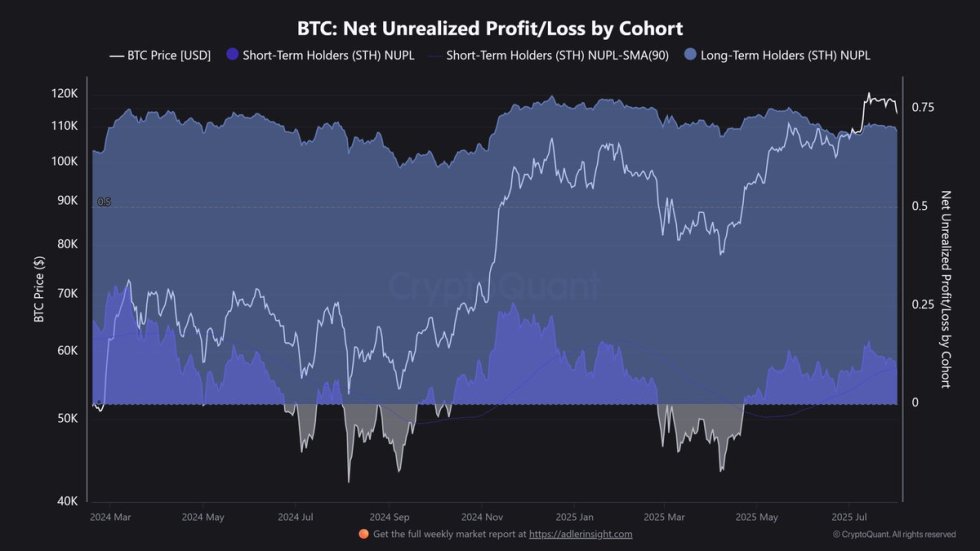
Bitcoin Net Unrealized PnL by Cohort | Source: CryptoQuant

In contrast, Short-Term Holders (STH) are operating under different conditions. Their NUPL levels are fluctuating near lower profit margins, suggesting that many are either realizing gains during brief rallies or are feeling pressure from holding underwater positions. This behavior is creating short-term corrective waves in Bitcoin’s price action, contributing to the recent volatility.

Currently, Bitcoin is trading close to the $104K zone, a level that appears to be supported mainly by LTH confidence. The absence of mass selling from these long-term holders reflects their belief in Bitcoin’s continued upward trajectory, despite temporary market pullbacks.

AbramChart emphasizes that unless LTH begin to distribute their holdings aggressively, the macro uptrend remains intact. Therefore, current price action is likely a phase of consolidation within a larger bullish cycle, where STH-driven volatility offers strategic accumulation opportunities for long-term participants.

Price Action Details: Testing Key Resistance

Bitcoin (BTC) is currently trading at $114,316, following a sharp pullback from the local highs at $122,077. The chart shows that BTC is now retesting the $115,724 resistance zone, which was previously a key support level during the two-week consolidation range. The 100-period moving average (green line) around $115,326 is adding additional pressure, creating a confluence resistance level that bulls need to overcome for further upside momentum.
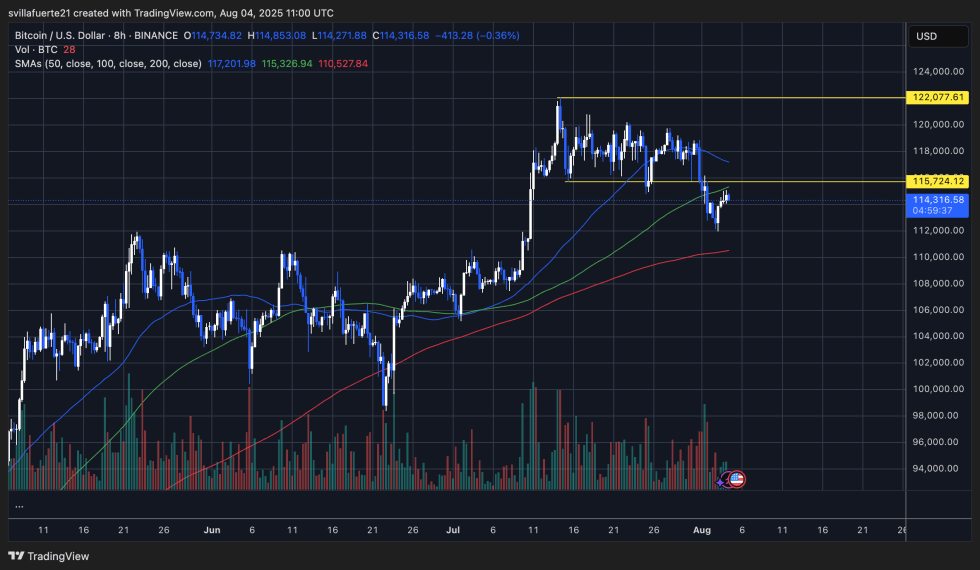
BTC testing key resistance | Source: BTCUSDT chart on TradingView

Volume has picked up during the recent bounce, indicating that buyers are attempting to defend the $112K zone. However, BTC is still trading below the 50-period moving average (blue line) at $117,201, suggesting that short-term trend momentum remains bearish unless BTC can reclaim this level.

The overall structure suggests a relief rally within a corrective phase. Bulls need a decisive close above $115,724 to shift the short-term bias back to bullish and aim for a retest of the $122,077 highs. Failure to break above resistance could result in continued range-bound price action, with support at $112,000 being the immediate level to watch.

Featured image from Dall-E, chart from TradingView

Editorial Process for bitcoinist is centered on delivering thoroughly researched, accurate, and unbiased content. We uphold strict sourcing standards, and each page undergoes diligent review by our team of top technology experts and seasoned editors. This process ensures the integrity, relevance, and value of our content for our readers.

Sebastian's journey into the world of crypto began four years ago, driven by a fascination with the potential of blockchain technology to revolutionize financial systems. His initial exploration focused on understanding the intricacies of various crypto projects, particularly those focused on building innovative financial solutions. Through countless hours of research and learning, Sebastian developed a deep understanding of the underlying technologies, market dynamics, and potential applications of cryptocurrencies. As his knowledge grew, Sebastian felt compelled to share his insights with others. He began actively contributing to online discussions on platforms like X and LinkedIn, focusing on fintech and crypto-related content. His goal was to expose valuable trends and insights to a wider audience, fostering a deeper understanding of the rapidly evolving crypto landscape. Sebastian's contributions quickly gained recognition, and he became a trusted voice in the online crypto community. To further enhance his expertise, Sebastian pursued a UC Berkeley Fintech: Frameworks, Applications, and Strategies certification. This rigorous program equipped him with valuable skills and knowledge regarding Financial Technology, bridging the gap between traditional finance (TradFi) and decentralized finance (DeFi). The certification deepened his understanding of the broader financial landscape and its intersection with blockchain technology. Sebastian's passion for finance and writing is evident in his work. He enjoys delving into financial research, analyzing market trends, and exploring the latest developments in the crypto space. In his spare time, Sebastian can often be found immersed in charts, studying 10-K forms, or engaging in thought-provoking discussions about the future of finance. Sebastian's journey as a crypto analyst and investor has been marked by a relentless pursuit of knowledge and a dedication to sharing his insights. His ability to navigate the complex world of crypto, combined with his passion for financial research and communication, makes him a valuable asset to the industry. As the crypto landscape continues to evolve, Sebastian remains at the forefront, providing valuable insights and contributing to the growth of this revolutionary technology.

Related Reads

How Far Are We from the End of the Crypto Bear Market?

How Much Longer Until the Crypto Bear Market Ends? A persistent negative Coinbase Bitcoin Premium Index, reaching a record 46 consecutive days of negative values, underscores the ongoing crypto bear market. The downturn accelerated in late May/early June when MicroStrategy (referred to as "Strategy" in the text), a major BTC holder, sold a small amount of Bitcoin (32 BTC), shattering market confidence and triggering sharp declines in BTC, ETH, and SOL. This was compounded by sustained net outflows from US spot Bitcoin ETFs. June saw Bitcoin briefly fall below $60,000, its worst weekly performance since 2022, breaking below the critical 200-week moving average—a signal some analysts consider confirmation of a bear market. While some institutional analyses in mid-June suggested the bottom might be near (e.g., around $53,600 based on realized price, or a potential end during the 2026 World Cup summer), further price drops quickly disproved these optimistic forecasts. Key bear market indicators include: the severe de-pegging of MicroStrategy's preferred shares (STRC) from their $100 NAV, which later recovered partly due to company stabilization plans; a record number of BTC (over 10.83 million) and a significant portion of long-term ETH holders now in unrealized loss; and Bitcoin's price trading below its 200-week moving average. Predictions for the bear market's end vary. Some, like investor Yilihua, suggest July-August 2026 could present a final buying opportunity. Others, like miner Jiang Zhu'o'er, predict a bottom between $42,000-$44,000 in October-December 2026, based on the historical lag between MicroStrategy's mNAV ratio bottom and Bitcoin's price bottom. Technical indicators like the BTC 4-year average price index dipped briefly below 1, and the Coinbase Premium Index remains negative, suggesting a need for a price rebound to around $77,000 for a return to positive territory. In the absence of major external catalysts, the consensus leans toward the bear market persisting for another 2-3 months, with late September to early October 2026 being a potential turning point window.

Odaily星球日报23m ago

How Far Are We from the End of the Crypto Bear Market?

Odaily星球日报23m ago

Solana Ecosystem Shows Signs of Recovery: On-Chain Governance Upgrade, Tokenized Stocks and Meme Coins Heat Up

Solana Ecosystem Shows Signs of Revival: Governance Upgrades, Tokenized Stocks, and Memecoins Heat Up While the broader crypto market faces a downturn, Solana has shown relative strength with its price rising nearly 15% recently. This resilience is attributed to warming ecosystem activity, particularly in tokenized stocks and memecoins, coupled with a major upgrade to its on-chain governance. In the Real World Assets (RWA) sector, Solana now leads all public chains in both the number of unique holder wallets and the quantity of RWA assets. Its tokenized stock weekly trading volume has surged to a record $1.42 billion, capturing about 96% of the market share, largely driven by the Backpack exchange. Simultaneously, the Solana memecoin sector has reignited, fueled by the rapid ascent of the ANSEM token following endorsements from a prominent crypto influencer. This has boosted activity across platforms like Pump.fun and increased fee revenue for several Solana-based exchanges. A key development is the launch of Solana Governance Proposals (SGP), a new on-chain mechanism. It allows validators with at least 100,000 SOL delegated to submit proposals for community vote, enhancing decentralized decision-making. SGP will operate alongside the existing technical proposal process (SIMD), focusing on broader ecosystem governance. Despite these positive signals in specific areas, overall on-chain activity and transaction volumes still lag behind previous bull market peaks, indicating the recovery remains partial rather than ecosystem-wide.

marsbit47m ago

Solana Ecosystem Shows Signs of Recovery: On-Chain Governance Upgrade, Tokenized Stocks and Meme Coins Heat Up

marsbit47m ago

While Semiconductor Stocks Plunge, Anthropic Plans to Develop a 2nm Chip

Anthropic, the AI company behind Claude, is exploring the development of its own custom AI chip, according to a report from The Information. The company is in early discussions with Samsung Electronics to manufacture the chip using Samsung's most advanced 2-nanometer process and packaging technology. While the project is still in preliminary stages, including defining chip specifications, and could be abandoned, it marks a strategic step for Anthropic. The move comes as the company seeks greater control over its computing costs and hardware optimization, particularly for inference tasks to run its models more efficiently and cheaply. Samsung's potential involvement follows its participation as a strategic investor in Anthropic's recent $65 billion funding round. For Samsung, partnering with a major AI lab represents a significant opportunity for its foundry business to compete with market leader TSMC in advanced semiconductor manufacturing. Anthropic's CEO, Dario Amodei, has previously highlighted the immense financial challenge of securing enough computing power for anticipated growth, making cost-effective inference a critical focus. The company would join other tech giants like Google, Amazon, Microsoft, Meta, and OpenAI in pursuing custom AI silicon. However, analysts note this trend creates deeper interdependencies rather than independence, as US AI labs become more tightly woven into Asian semiconductor supply chains. Despite this move, Anthropic remains heavily reliant on a multi-cloud, multi-vendor strategy for its immediate computing needs. It has secured massive, long-term commitments for capacity from Amazon Web Services (Trainium chips), Google (TPUs), and even leased a large GPU cluster from xAI. For now, Nvidia continues to dominate the AI chip market, with its share reportedly growing to 74%.

链捕手49m ago

While Semiconductor Stocks Plunge, Anthropic Plans to Develop a 2nm Chip

链捕手49m ago

Korean Companies Following Strategy in Accumulating Cryptocurrency: From Bull Market to Delisting?

Title: Korean DAT Companies Following "Strategy" Bitcoin Hoarding Model Face Delisting Amid Bear Market Summary: Several Korean KOSDAQ-listed companies, known as Digital Asset Trusts (DATs), are at risk of being delisted due to a combination of stricter regulatory thresholds and a downturn in crypto markets. These firms, inspired by models like Strategy and Japan's Metaplanet, raised capital to buy Bitcoin, relying on a cycle of rising crypto prices to boost their stock value. However, recent reforms in Korea have raised the minimum market capitalization required to stay listed from 150 billion won to 200 billion won (approx. $1.3M), with a further increase to 300 billion won set for next January. The new rules also close loopholes like reverse stock splits used to artificially inflate share prices. The situation is exacerbated by a significant drop in Bitcoin's price from its 2025 peak and a weak KOSDAQ market. While the main KOSPI index has surged nearly 95% year-to-date, KOSDAQ has fallen about 10%, draining liquidity from smaller companies. Many DATs now hover near or below the new market cap thresholds and must also book substantial valuation losses on their Bitcoin holdings. Analysts suggest that without a sustained recovery in both crypto prices and broader market interest in KOSDAQ stocks, these companies have limited options to avoid delisting, marking a precarious moment for Korea's crypto-linked public companies.

marsbit58m ago

Korean Companies Following Strategy in Accumulating Cryptocurrency: From Bull Market to Delisting?

marsbit58m ago

Trading

Spot
活动图片