ЕЦБ: Наличные деньги останутся с нами, несмотря на развитие цифрового евро

cryptonews.ruPublished on 2025-06-03Last updated on 2025-08-04

На фоне растущей популярности стейблкоинов и частных цифровых валют Европейский центральный банк (ЕЦБ) подтвердил намерение сохранить государственные деньги — как физические, так и цифровые — в основе европейской финансовой системы.

В понедельник член Исполнительного совета ЕЦБ Пьеро Чиполлоне в своем блоге отметил, что банкноты и монеты евро сохранят важную роль в финансовой экосистеме, даже после внедрения цифрового евро.

«Будьте уверены: цифровой евро не заменит наличные, а дополнит их», — подчеркнул Чиполлоне.

По его словам, доступность денег как в физической, так и в цифровой форме укрепит платежную автономию Европы.

Заявление ЕЦБ прозвучало на фоне роста криптовалютных платежей и изменений в финансовом ландшафте, где стейблкоины все чаще используются для трансграничных переводов и повседневных расчетов.
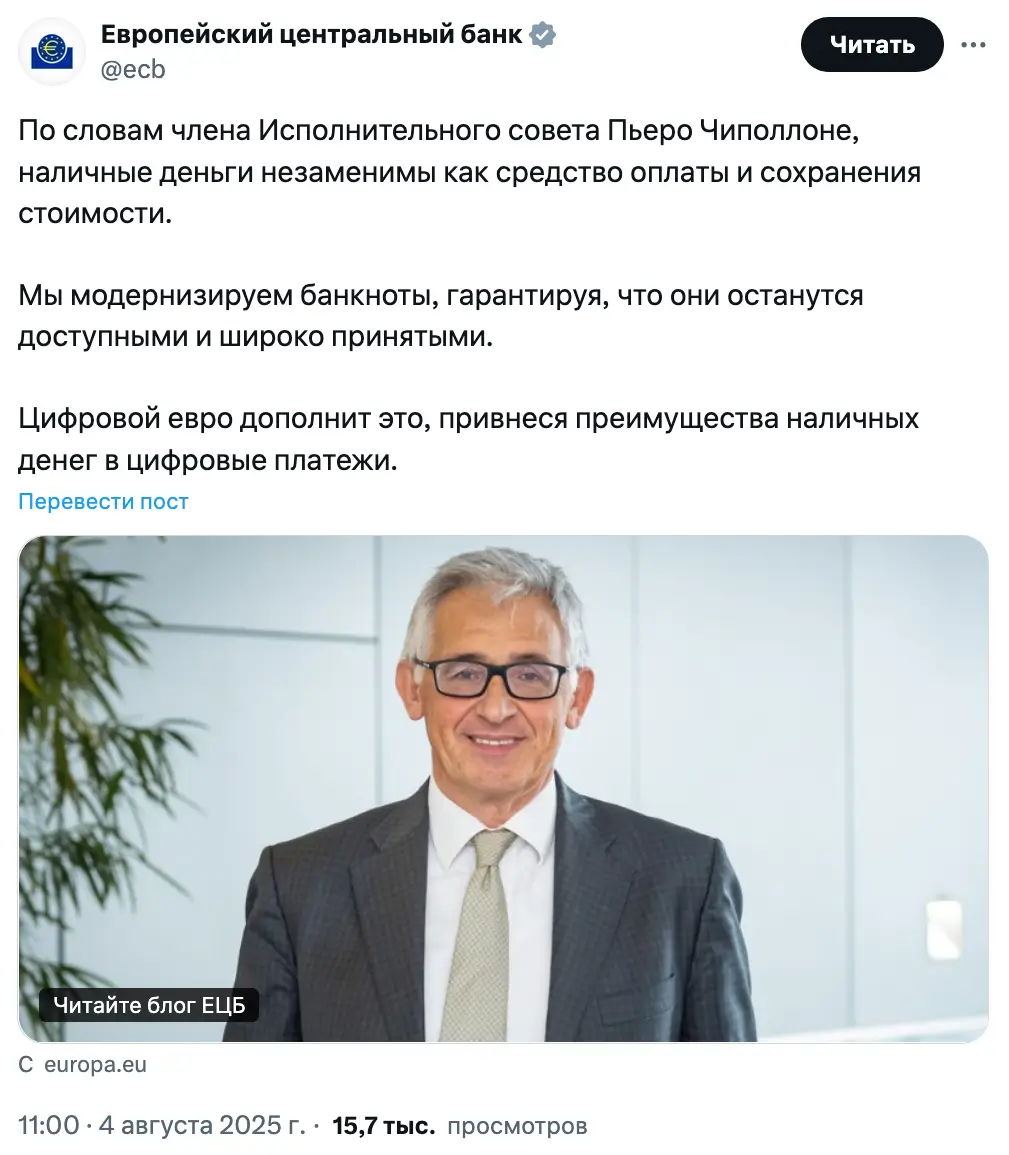

Источник: Европейский центральный банк

Стремление ЕЦБ к цифровому евро

ЕЦБ разрабатывает государственную цифровую валюту (CBDC) как регулируемую альтернативу частным стейблкоинам.

8 апреля Чиполлоне заявил, что цифровой евро ограничит влияние стейблкоинов в иностранной валюте как средства расчетов в Европе. Он предупредил, что отсутствие цифрового евро создаст риски и лишит банк возможностей.

Несмотря на развитие цифровой валюты, Чиполлоне подчеркнул незаменимость наличных, особенно в кризисных ситуациях, когда цифровая инфраструктура может быть недоступна.

«Наличные останутся с нами, — написал он. — Жители еврозоны оценят возможность выбора между банкнотами, монетами и цифровым евро. Все эти формы будут иметь статус законного платежного средства, доступны в любое время и адаптированы к разным сценариям использования».

Мартовское исследование ЕЦБ показало слабый интерес европейцев к цифровому евро.

13 марта в рабочем документе ЕЦБ отмечалось, что при распределении гипотетической суммы в 10 000 евро ($10 800) респонденты выделили минимальную долю на цифровой евро, что не повлияло на традиционные активы, включая наличные.

Риск доминирования стейблкоинов без единых правил

В четверг советник ЕЦБ Юрген Шааф в своем блоге призвал к глобальной координации регулирования стейблкоинов для противодействия доминированию долларовых стейблкоинов.

Он перечислил стратегические варианты для ЕС: регулируемые стейблкоины, привязанные к евро; приложения на основе распределенного реестра (DLT); и цифровой евро.


Related Reads

Morgan Stanley Research Report Analysis: Treasury's Repurchase Scale Doubles, The Logic for a Steepening Yield Curve Remains Unchanged

Morgan Stanley report: US Treasury doubles long-term bond buyback size, steepening yield curve thesis intact. The US Treasury will double the size of its regular liquidity support buyback operations for 10-20 year and 20-30 year bonds to at least $4 billion per operation starting Sept 9. Morgan Stanley views this move, the first adjustment outside a quarterly refunding window since the program's May 2024 launch, as a more important signal than the buybacks themselves. The Treasury is signaling close attention to long-end yield dynamics, using the tool to buy time ahead of the November refunding where it could cut long-term issuance. The report argues recent long-end yield rises and curve steepening are driven not by supply/deficit concerns but by repricing of energy prices and central bank policy paths. Analysis of cash Treasury vs. swap spreads shows no clear pattern consistent with dominant supply worries. The action echoes a November 2023 "supply surprise" that briefly flattened the curve. MS maintains its recommendation to steepen the 7s30s curve, targeting a 100 bps spread vs. ~71 bps currently. It believes fundamentals—cooling inflation, weaker-than-expected labor data, and potential downward revision of the Fed's terminal rate—will ultimately drive markets, supporting further steepening. In FX, MS strategists note the move was interpreted as a mild tool to curb USD strength. A refocus on USD policy could lead to further weakness, particularly against CHF, with EUR/USD potentially rising toward 1.2150.

marsbit12m ago

Morgan Stanley Research Report Analysis: Treasury's Repurchase Scale Doubles, The Logic for a Steepening Yield Curve Remains Unchanged

marsbit12m ago

Kaito Revives 'Talk-to-Earn' Economy, But Many Are Hesitant to Install the New Plugin

Kaito AI has launched a new browser extension called Kaito Pulse, aiming to integrate users' discussions on X (formerly Twitter) with their on-chain activities and social influence to build a new "attention + behavior verification" scoring system. The plugin displays users' public trading positions from platforms like Polymarket directly on the X timeline, allowing others to assess if their statements align with their actual market behavior. This move is seen as reviving "influence-to-earn" incentives. However, the launch sparked significant privacy concerns. Critics, including an analysis by "Ultra," allege the extension collects extensive data, such as device fingerprints (via GPU, hardware info), X user behavior (browsing paths, clicks), and may access sensitive data from third-party accounts (e.g., ChatGPT, trading platforms). This raised debates about trading privacy for verified influence. In response, Kaito founder Yu Hu stated the design follows data minimization principles, aiming to generate verification proofs without collecting or storing raw user data, using technologies like zkTLS. He acknowledged some permission descriptions could be misleading and promised improvements. The controversy highlights a core dilemma for social finance (SocialFi) platforms: as fake engagement and AI content grow, more user data is needed to verify genuine influence, but this risks encroaching on user privacy and trust.

marsbit12m ago

Kaito Revives 'Talk-to-Earn' Economy, But Many Are Hesitant to Install the New Plugin

marsbit12m ago

Kaito Reboots 'Talk-to-Earn Economy', but Many Are Hesitant to Install the New Plugin

Kaito AI has launched a new browser extension called Kaito Pulse, aiming to revitalize what the community terms the "talk-to-earn" or "social-fi" economy on X (formerly Twitter). The plugin displays users' on-chain trading activity, such as positions from platforms like Polymarket, directly within the X timeline. This aims to create a new "attention + behavior verification" system, shifting focus from who generates the most discussion to whose discussions are backed by credible, verifiable actions. However, the launch quickly sparked significant privacy concerns within the crypto community. Critics, led by an analysis from user "Ultra," allege the extension's code enables deep data collection. This includes potential device fingerprinting (using GPU, hardware, and audio data), tracking of X user behavior (browsing paths, clicks, engagement), and verification processes that could access sensitive data from third-party accounts like ChatGPT, Claude, and trading platforms. The debate centers on whether such extensive verification is necessary to combat fake engagement and AI-generated content, or if it constitutes an unacceptable privacy sacrifice. In response, Kaito founder Yu Hu stated the design follows data minimization principles. He claimed Kaito Pulse does not collect or store users' raw data but instead uses verification techniques, including zkTLS, to generate proofs of identity or behavior without exposing the underlying information. Yu Hu acknowledged that some permission descriptions could be misleading and promised improvements in future versions. The controversy highlights a core dilemma for social-fi projects: platforms need more user data to distinguish real influence from artificial hype, but users must decide how much privacy they are willing to trade for potential rewards and ranking within these new incentive systems.

Odaily星球日报33m ago

Kaito Reboots 'Talk-to-Earn Economy', but Many Are Hesitant to Install the New Plugin

Odaily星球日报33m ago

After Two and a Half Years of Entrepreneurship and Full AI Adoption, the Company Has Actually Become More 'Traditional'

"After 2.5 years of running my company, achieving near 100% AI adoption with Agents in roles like finance, HR, and operations, we've paradoxically become more 'traditional.' We learned that establishing a thick AI middle layer creates bottlenecks. Instead, we advocate for a 'thin platform, thick frontline' model, empowering employees closest to problems to use AI tools themselves, fostering ownership and initiative. The true foundation isn't the AI models, but the unique data and context a company accumulates—our most vital, irreplaceable asset, requiring diligent governance. As AI handles repetitive, describable tasks, human roles revert to their core: building genuine relationships, trust, and brand reputation through authentic communication, which AI cannot accelerate. A critical question is where the time saved by AI goes. It must be returned—to clients, to creative work, to employees' own lives—rather than just fueling higher output demands. For managers, AI strips away execution-focused busywork, exposing the necessity to define clear goals, make tough judgments, and take ultimate responsibility. Onboarding newcomers presents a challenge: while AI can generate 80% solutions instantly, we must deliberately design paths for them to develop judgment, understand context, and safely learn from mistakes. Ultimately, AI's organizational value isn't about replacing people but removing unnecessary friction, allowing more meaningful human connection. The real test of an 'AI-era' company isn't its tech stack, but how it treats people: delegating creative power, returning saved time, fostering growth, and upholding accountability. The core luxury and purpose of our work remains authentic human relationships."

marsbit41m ago

After Two and a Half Years of Entrepreneurship and Full AI Adoption, the Company Has Actually Become More 'Traditional'

marsbit41m ago

Trading

Spot
活动图片