Новый 25%-ный тариф Трампа на Индию обрушил рынок криптовалют на 4%

cryptonews.ruPublished on 2025-12-30Last updated on 2025-12-30

  • Трамп раскритиковал Индию за то, что у нее одни из самых высоких торговых барьеров в мире и что она является крупным покупателем российских товаров, что он представил как поддержку военных усилий Москвы.
  • Министерство торговли Индии пока не прокомментировало объявление о введении тарифов.
  • Эти новые пошлины, вероятно, повлияют на экспорт товаров из Индии в США, который в 2024 году оценивался примерно в 87 миллиардов долларов.

Сегодня президент США Дональд Трамп объявил через Truth Social, что с 1 августа Индия столкнётся с 25-процентной пошлиной на свой экспорт в США. Кроме того, Индия понесёт неопределённый штраф за закупку российской военной техники и энергоносителей.

Трамп раскритиковал Индию за то, что она установила одни из самых высоких торговых барьеров в мире и является крупным покупателем российских товаров, что он расценил как поддержку военных действий Москвы. Пошлины возрождают прежние угрозы, высказанные ещё в апреле, и были объявлены на фоне зашедших в тупик торговых переговоров между двумя странами.

Министерство торговли Индии пока не прокомментировало объявление о введении тарифов.

В статье на сайте Truth Social Трамп написал: «Помните, хотя Индия и является нашим другом, на протяжении многих лет мы вели с ней сравнительно мало бизнеса, поскольку ее тарифы слишком высоки, одни из самых высоких в мире, и у нее самые жесткие и отвратительные неденежные торговые барьеры среди всех стран».

Новые пошлины, скорее всего, затронут товарный экспорт Индии в США, который в 2024 году оценивался примерно в 87 миллиардов долларов. Они будут особенно направлены на трудоемкие товары, такие как текстиль, фармацевтические препараты, драгоценные камни и ювелирные изделия, а также нефтехимическая продукция.

По официальным данным США, в прошлом году дефицит торгового баланса США с Индией составил 45,7 млрд долларов.

Рынок криптовалют упал сразу на 4%

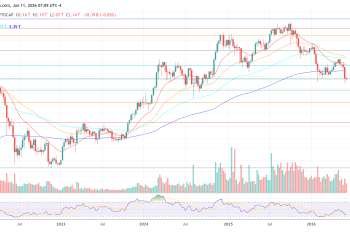
После объявления о введении пошлин рынок криптовалют упал примерно на 4%, при этом Bitcoin и Ethereum потерпели неудачу.

Аналитики считают, что инфляция и ослабление доллара, вызванное торговой напряженностью, являются факторами, которые криптовалюты (особенно биткоин) могут пережить лучше, чем традиционные активы. В долгосрочной перспективе некоторые прогнозируют, что это может даже принести пользу цифровым активам, таким как криптовалюты.

Индия входит в число наиболее быстрорастущих криптовалютных юрисдикций в мире и является мировым лидером по внедрению криптовалют: число ее пользователей превышает 107 миллионов, что составляет примерно 7% населения.

По данным Statista, ожидается, что выручка криптовалютного рынка страны в этом году достигнет 9,7 млрд долларов, а к 2026 году увеличится до 10 млрд долларов.

Несмотря на столь широкое распространение, в Индии отсутствует комплексная правовая база, поскольку криптосегмент в целом находится в серой зоне регулирования.

Однако предлагаемый нормативный акт, Закон о криптовалютах (COINS Act 2025), направлен на революционные изменения в политике в отношении криптовалют в стране. Среди основных целей — потенциальная отмена действующего 30%-го налога на криптовалюты, защита прав самостоятельного хранения криптовалют и создание нового специализированного надзорного органа — CARA.

Related Reads

Can Generative Models Finally Be Trained End-to-End? The Core Is a For Loop

This article introduces a novel training paradigm for generative models called Explorative Modeling (XM), which enables true end-to-end training. Traditionally, powerful generative models like autoregressive and diffusion models are not trained end-to-end. They are trained to predict a single small step but require iterative multi-step sampling for inference. This "exposure bias" leads to error accumulation and limits performance. The core challenge XM addresses is "mode blurring." In generative tasks, a single input (e.g., "generate a dog") corresponds to many valid outputs (multiple modes). Standard training objectives like reconstruction loss force the model to average these modes, producing unrealistic, blurry outputs. To avoid this, existing models break generation into many small, almost deterministic steps, sacrificing end-to-end training. XM tackles this by restructuring the training loop itself. Its key insight is to amplify "generative expressivity." For each training input, instead of generating one sample, the model generates K candidate outputs. Only the candidate closest to the real data is used for computing the loss and updating the model via backpropagation. This simple "best-of-K" mechanism is implemented as a short for-loop. By exploring multiple possibilities, the model learns to distribute its guesses across different modes rather than collapsing to their uninformative average. The paper demonstrates that "exploration" acts as a new, powerful scaling axis. Gains from XM increase with model size, data scale, and compute. Experiments show improvements in FID scores for image generation and significant efficiency gains, sometimes outperforming larger models without exploration. When pushed to the limit, XM enables fully single-step, end-to-end generative models. In robotics tasks, an "Explorative Policy" matched the performance of a 100-step Diffusion Policy with a single forward pass, drastically improving inference speed. While the best-of-K concept is not entirely new, the authors' contribution lies in formally understanding it as a direct method to boost generative expressivity without fragmenting the generation process. This work suggests that as models scale, enhancing exploration during training may become crucial for overcoming fundamental performance bottlenecks.

marsbit7m ago

Can Generative Models Finally Be Trained End-to-End? The Core Is a For Loop

marsbit7m ago

Annual Salary of Millions Competing for Electricians, Meta Rushes to Open Its Own Technical School

The AI boom is facing an unexpected bottleneck: a severe shortage of skilled construction workers and electricians. As tech giants like Meta, OpenAI, and Alphabet race to build massive data centers—such as OpenAI's $16 billion "Stargate" project—they are hitting a critical labor wall. The U.S. needs an estimated 130,000 more electricians, 240,000 construction workers, and 150,000 supervisors by 2030 for AI infrastructure alone, but tens of thousands of electrician jobs go unfilled each year. While AI companies offer high premiums, with electricians earning up to $280,000 annually, worker scarcity still causes massive losses—delays on a single project can cost $14.2 million per month. The complexity of building AI data centers, which require immense power (equivalent to powering hundreds of thousands of homes), sophisticated electrical systems, and advanced liquid cooling solutions, demands highly skilled technicians who are in short supply. To combat this, companies are investing heavily in training. Meta has committed $115 million to a free training school offering tuition, housing, and stipends, targeting 5,000 new workers. OpenAI is partnering with unions to secure skilled labor. These efforts are paying off, with a significant rise in Gen Z interest in trade schools over college. However, the power demands are staggering. AI data centers are driving a rapid surge in electricity consumption, projected to account for up to 12% of U.S. power use by 2028 and raising costs for consumers. Furthermore, the construction boom is project-based, leading to a potential future glut of trained workers once building peaks, which could depress wages industry-wide. The race for AI supremacy now depends as much on skilled hands as on advanced chips.

marsbit1h ago

Annual Salary of Millions Competing for Electricians, Meta Rushes to Open Its Own Technical School

marsbit1h ago

Trading

Spot
活动图片