China Softening On Crypto? Shanghai Hosts Rare Digital Currency Policy Meeting

bitcoinistPublished on 2025-07-12Last updated on 2025-07-12

Abstract

In a rare move, a Shanghai regulator just held a meeting on stablecoins and digital currencies. Is China warming up...

Trusted Editorial content, reviewed by leading industry experts and seasoned editors. Ad Disclosure

In a rare move, a Shanghai regulator just held a meeting on stablecoins and digital currencies. Is China warming up to crypto?

Shanghai Regulator Discussed Crypto In A Meeting

Shanghai State-owned Assets Supervision and Administration Commission (SASAC) held a meeting on Thursday with local government officials to discuss stablecoin and digital currency policy, as reported by Reuters.

The meeting, which involved around 60-70 attendees, could hint at a change in China’s stance, as crypto has been banned in the country since 2021. According to the report, the regulator’s director told the meeting about the need to have “greater sensitivity to emerging technologies and enhanced research into digital currencies.”

SASAC has called this discussion after tech giants like JD.com and Ant Group reportedly urged China’s central bank to authorize yuan-based stablecoins, and amid Hong Kong planning to roll out its stablecoin legislation starting August 1st.

JD.com and Ant Group are among the 40+ companies preparing to apply for stablecoin licenses in Hong Kong. According to local media outlet Yicai, however, only a few of the aspirants are likely to find approval.

While Shanghai has held this meeting, it’s unclear whether it will lead to something tangible, considering hurdles remain in the form of China’s strict capital controls. As mentioned earlier, crypto received a ban in the nation in 2021. Both trading and mining activities were put to a stop, citing concerns about the stability of the financial system.

Prior to the ban, the country hosted half the global Bitcoin mining computing power, or “Hashrate.” News of the crackdown led to a sharp drop in the Hashrate, as miners shut down their operations and prepared to relocate.

By the start of 2022, however, the BTC computing power had already bounced back, suggesting that while the ban initially dealt a serious blow, the network quickly made a full recovery. Growth in the mining industry has continued since then, and today the global Hashrate stands at a level roughly five times the pre-ban figure.

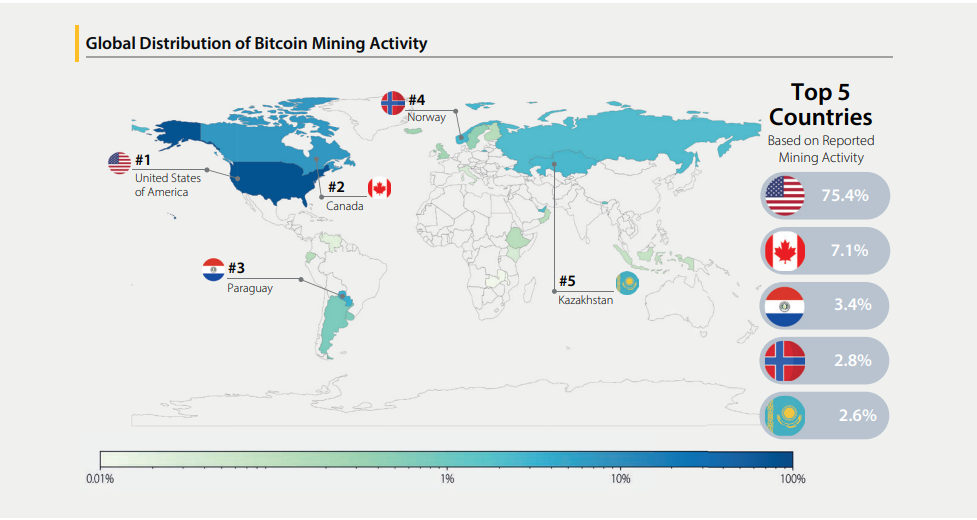
According to a report published by Cambridge earlier in the year, the US now accounts for 75% of all reported Bitcoin mining activity.
Bitcoin Crypto Hashrate

The distribution of the reported global BTC mining activity | Source: Cambridge Digital Mining Industry Report

While China may have locked itself out of crypto, the sector has still continued to thrive globally. With Bitcoin setting yet another record after crossing $118,000, perhaps the worldwide momentum may now be becoming too big for the nation to ignore.

Bitcoin Has Entered All-Time High Exploration Mode

Bitcoin saw a breakout to a new all-time high Wednesday, but the digital asset has taken it up a gear over the past day as its price has shot up over 6%.

Bitcoin Crypto Price Chart

Looks like the price of the coin has witnessed a rapid increase | Source: BTCUSDT on TradingView

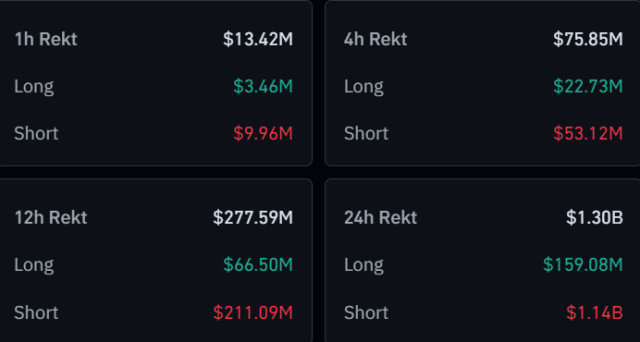
The run has ignited crypto-wide momentum, with the likes of Ethereum (ETH) and XRP (XRP) even printing larger profits than Bitcoin. This has resulted in short liquidations of more than $1.1 billion in the derivatives market, as per CoinGlass.
Crypto Liquidations

The data for the liquidations related to the crypto sector in the last 24 hours | Source: CoinGlass
Featured image from Dall-E, CoinGlass.com, chart from TradingView.com
Editorial Process for bitcoinist is centered on delivering thoroughly researched, accurate, and unbiased content. We uphold strict sourcing standards, and each page undergoes diligent review by our team of top technology experts and seasoned editors. This process ensures the integrity, relevance, and value of our content for our readers.

Keshav is a Physics graduate who has been employed as a writer with Bitcoinist since June 2021. He is passionate about writing and through the years, he has gained experience working in a variety of niches. Keshav holds an active interest in the cryptocurrency market, with on-chain analysis being an area he particularly likes to research and write about.

Related Reads

Ethereum Sheds Its Load? What Ethereum Supporters Think About the Lean Ethereum Upgrade and the Future Market

Ethereum is back in focus with the announcement of the "Lean Ethereum" upgrade roadmap, described by Vitalik Buterin as Ethereum's third major update. This proposal aims to fundamentally redesign the consensus, data, and execution layers from first principles, striving to make Ethereum **simpler, more secure (quantum-resistant), more verifiable, and more scalable.** The announcement comes amidst a broader restructuring within the ecosystem, including a 20% staff reduction at the Ethereum Foundation and the emergence of new organizations like EthLabs. This has sparked a debate among Ethereum supporters ("E-bizens"). **Optimists** view Lean Ethereum as a critical refocusing on core protocol fundamentals: * **sassal.eth** calls it the ultimate bullish catalyst, envisioning a future where running a node is so lightweight it could be done on a smartwatch, greatly enhancing decentralization. * **Ryan Sean Adams** sees it as Ethereum moving from "narrative expansion" to "protocol hardening," addressing long-term foundational issues like security and scalability. * Analysts like **BITWU** and **蓝狐 (Blue Fox)** frame it as a third-phase evolution towards a "minimal, durable, and credible base layer" designed for the next decade. * **gigi发财猪** interprets the organizational changes as Ethereum "shedding old baggage and forming new teams" for a lighter, more agile approach. * **Xiyu** notes that the roadmap itself provides a much-needed new narrative for market sentiment recovery. **Cautious voices** acknowledge the vision but emphasize execution and market timing: * **Ignas** warns that while the roadmap addresses key community requests, it overlooks tokenomics, and competitors are gaining ground in areas like RWA. Timely delivery is crucial; delays could be bearish. * **Dankrad Feist**, a former Ethereum Foundation researcher, agrees on direction but criticizes the proposed 3-4 year timeline as too slow for the current market pace, especially with AI-aided development available. **In summary,** optimists believe Lean Ethereum reaffirms Ethereum's long-term value proposition as a decentralized world computer, while the cautious argue that its success hinges on faster delivery and tangible results to maintain market relevance. Despite ongoing criticism, the move signals Ethereum's effort to regroup and reclaim initiative at the protocol level.

marsbit30m ago

Ethereum Sheds Its Load? What Ethereum Supporters Think About the Lean Ethereum Upgrade and the Future Market

marsbit30m ago

AI Folding: Fable 5 and GPT-5.6 Are Becoming the Privilege of a Few

【AI Accessibility Gap Widens: Elite Tools Like Fable 5 and GPT-5.6 Are Becoming Privileged】 We are witnessing a growing "AI divide." A stark reality is emerging: a tiny fraction of elites, primarily in tech, are using powerful next-generation models like Fable 5 or the upcoming GPT-5.6, while the vast majority of the public only has access to "toys" - free, limited models equivalent to ChatGPT's basic versions (8B to 30B parameters). This creates a massive experiential chasm and cognitive dissonance. Industry outsiders see AI as overhyped and ineffective, unable to grasp its transformative potential, while insiders leverage these advanced models for a decisive competitive edge. The gap isn't just about model quality but product functionality. Free users get a simple chatbot. Paying elites get integrated workflow systems—capable of creating specialized agents, processing complex data, and handling real-world tasks like management, coding, and planning. Demos showcasing AI planning weddings or building apps feel disconnected from everyday needs like managing bills, groceries, or health. The cost barrier is immense, with reports of engineers spending $1000 daily on Fable 5 inference. Elite users employ sophisticated multi-model workflows, combining different AIs for ideation, architecture, execution, and review, completing complex projects in minutes instead of weeks. This divide extends to critical areas like healthcare, where free models are dangerously unreliable for medical queries. However, some argue that for 90% of common business tasks, mid-tier models like GPT-5.5 are sufficient; the perceived limitation often stems from poor integration and lack of context, not model intelligence. Ultimately, unequal access to cutting-edge AI is creating a new form of social stratification, where the most powerful tools are becoming the exclusive privilege of a few.

marsbit1h ago

AI Folding: Fable 5 and GPT-5.6 Are Becoming the Privilege of a Few

marsbit1h ago

Cathie Wood's June $77M Investment: Are Crypto Stocks a True 'Substitute' for Bitcoin?

In June, Cathie Wood's ARK Invest purchased $77 million worth of publicly traded crypto-related stocks, including Coinbase, Circle, and Bullish, during Bitcoin's worst monthly performance in four years. This aligns with the investment thesis that such stocks offer a compliant way to gain exposure to the crypto cycle without directly holding Bitcoin. However, data analysis reveals significant drawbacks. A group of nine U.S.-listed crypto companies showed 30-day annualized realized volatility between 68% and 90%, nearly double Bitcoin's 37.6%. Over 90 days, Circle's volatility reached 103.6% versus Bitcoin's 37.8%. Drawdowns were also more severe for stocks like Circle (-51.4%) and MicroStrategy (-48.6%) compared to Bitcoin's -36.4% from its January high. Correlation analysis shows most stocks share only a moderate link to Bitcoin. For example, Circle, Robinhood, and Bullish have a 90-day correlation coefficient of just 0.55–0.58 with BTC, meaning only about one-third of their price movement is explained by Bitcoin's action. The rest stems from company-specific risks: earnings, competition, fundraising, and equity dilution. MicroStrategy (MSTR) is the notable exception, acting as a leveraged Bitcoin proxy with a beta of 1.59 and 0.85 correlation. Coinbase offers relatively balanced exposure. Circle exemplifies "crypto-wrapped" corporate risk, with its recent crash tied to stablecoin competition, not Bitcoin. Robinhood's diversified business insulates it from crypto downturns but also limits upside. Bitcoin miners like RIOT and MARA have posted significant gains year-to-date, driven primarily by their pivot to AI compute services, not Bitcoin's price. The article highlights that investing in crypto stocks often means accepting amplified volatility or layering on business-specific risks absent from direct Bitcoin ownership. For instance, MicroStrategy's recent challenges—its market value falling below its Bitcoin holdings (mNAV <1) and facing potential Bitcoin sales for liquidity—demonstrate equity-specific hazards like dilution and financing pressures not faced by a direct Bitcoin holder. ARK's buying spree represents a bet on a basket of different business models with varying crypto exposure, not a simple, lower-risk substitute for holding Bitcoin.

marsbit1h ago

Cathie Wood's June $77M Investment: Are Crypto Stocks a True 'Substitute' for Bitcoin?

marsbit1h ago

Trading

Spot
活动图片