流动性周期改道,你的资产跟上了吗?

深潮Published on 2025-07-11Last updated on 2025-07-11

我们还没到激增阶段。

撰文:hoeem

编译:Saoirse,Foresight News

世代传承的财富往往诞生于从紧缩周期转向宽松的阶段。因此,明确自身在流动性周期中的位置,是精准布局资产的关键。我们如今处于哪个阶段?且听我细细道来……

为何你必须关注流动性周期(即使讨厌宏观经济)

央行流动性如同全球经济引擎的润滑油:

注入过多会让市场「超速运转」;抽离过度则会导致「活塞卡死」,就像你精心打扮的约会对象突然离你而去。重点是:若能跟上流动性的节奏,你就能提前预判泡沫与崩盘。

2020-2025 年流动性的四个阶段:

1、激增阶段(2020-2021 年)

央行像开足马力的消防水枪疯狂注水:零利率落地、量化宽松(QE)规模创历史纪录,16 万亿美元财政救济砸向市场。

从背景看,全球货币供应量(M2)增速比二战以来任何时期都要快。

2、枯竭阶段(2021-2022 年)

利率飙升 500 个基点,量化紧缩(QT)启动,危机救助计划到期。

直观来说,2022 年债券市场创下史上最大跌幅(约 - 17%)。

3、平稳阶段(2022-2024 年)

政策保持紧缩,没有新动作。

决策者维持现有政策,让其充分发挥作用以压制通胀。

4、初步转向阶段(2024-2025 年)

全球开始降息并放松限制,尽管利率仍处于相对高位,但已开启下行趋势。

2025 年中期现状:我们一只脚还停留在平稳阶段,另一只脚试探着迈向初步转向阶段的第一步。当前利率高企,量化紧缩仍在持续,但除非新的冲击把我们拽回激增模式,否则下一步大概率会继续宽松。

更多细节可见下面的「交通信号灯速查手册」…

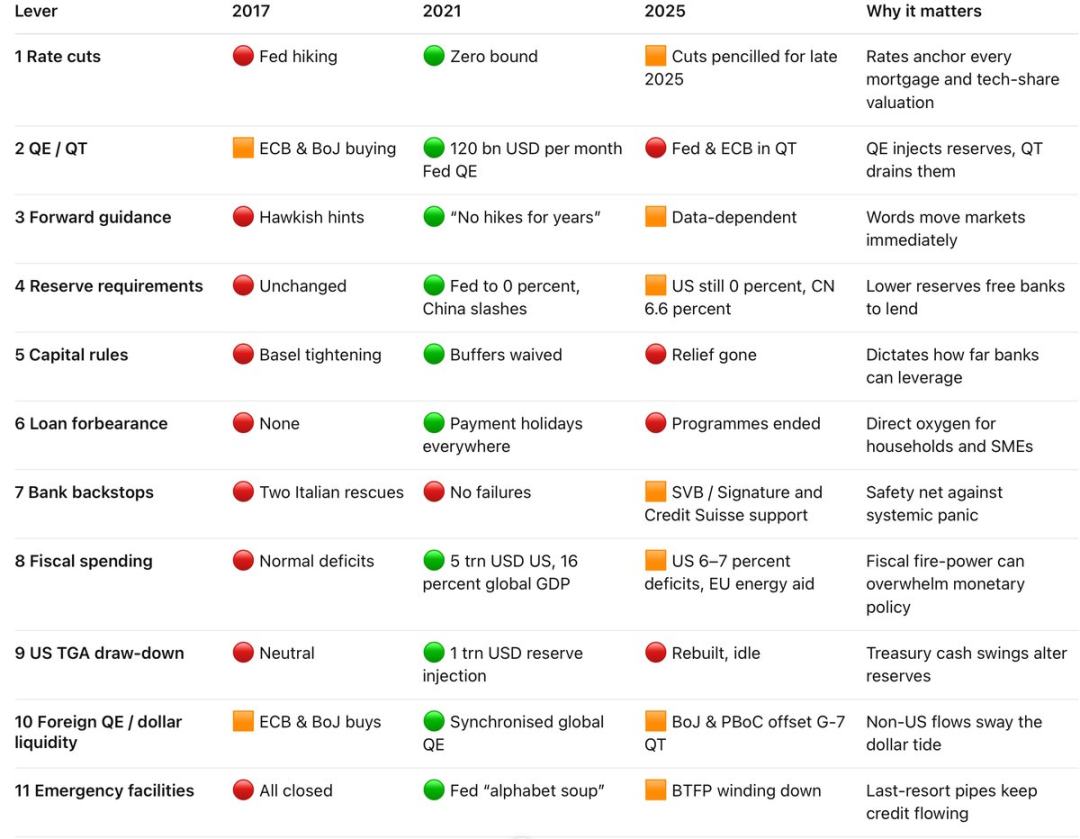
没错,我找 GPT 帮忙做了个超酷的表格!下面这张表能让你一眼看清 2017、2021、2025 这三个关键年份的情况:

十二大流动性杠杆交通信号灯速查手册:

🔴 未激活 🟧 轻度激活 🟢 强烈激活
🔑 能激活其他 11 个杠杆的总开关是哪一个?

逐步拆解:

降息方面——2017 年美联储加息,全球几乎没有宽松政策;2021 年全球紧急降息至接近零的水平;2025 年为维持抗通胀的公信力,利率保持高位,但美国和欧洲核心国家已计划在 2025 年底首次小幅降息。

量化宽松 / 紧缩(QE/QT)——2017 年美联储在缩减资产负债表,而其他大型央行还在买入债券;2020 到 2021 年全球各地都推出了创纪录的量化宽松政策;到 2025 年政策立场逆转,美联储继续实施量化紧缩,日本央行仍在无限制购买债券,中国则在有选择地注入流动性。

通俗来说:量化宽松就像给经济「输血」,量化紧缩则是「慢慢抽血」。

你得知道我们什么时候会进入量化紧缩或量化宽松阶段,以及当前处于流动性周期的哪个位置……

2025 年中期现状仪表盘:

  • 降息方面:政策利率仍处于高位;若进展顺利,可能在 2025 年第四季度首次降息。

  • 量化宽松 / 紧缩(QE/QT):量化紧缩(QT)仍在进行,目前尚未推出新的量化宽松(QE)政策,但已出现早期刺激信号。

需重点关注的信号:

信号 1:通胀率降至 2% 且政策制定者宣布风险平衡

  • 观察要点:美联储或欧央行声明明确转向中性措辞

  • 关键意义:为降息扫清最后一道舆论障碍

信号 2:量化紧缩(QT)暂停(上限设为 0 或 100% 再投资)

  • 观察要点:美联储公开市场委员会(FOMC)或欧央行宣布对到期债券全额再投资

  • 关键意义:将资产负债表缩减转为中性状态,增加市场流动性储备

信号 3:三个月期远期利率协议与隔夜指数掉期利差(FRA-OIS)超过 25 个基点或回购利率突然飙升

  • 观察要点:三个月期 FRA-OIS 利差(注:远期利率协议(FRA)利率与隔夜指数掉期(OIS)利率的差值,是衡量金融市场信用风险和流动性风险的重要指标。)或一般抵押品(GC)回购利率跳升至 25 个基点左右

  • 关键意义:预示美元融资压力,通常会迫使央行提供流动性支持

信号 4:中国人民银行(PBoC)全面下调存款准备金率(RRR)25 个基点

  • 观察要点:全国性存款准备金率降至 6.35% 以下

  • 关键意义:注入 4000 亿元基础货币,常成为新兴市场宽松政策的第一块多米诺骨牌

总结来说…

我们还没到激增阶段。

因此,在大量杠杆变为绿色之前,市场会继续反复出现风险偏好波动,不会真正进入狂热阶段。

Related Reads

Mysterious "Ox Alpha" Large Model Goes Viral with Limited-Time Free Access

A mysterious anonymous AI model named "Ox Alpha," nicknamed "Cow is Coming" by Chinese netizens, has appeared on OpenRouter, sparking widespread speculation. The model offers a 1 million token context, supports text, image, and video inputs, can call tools, and is currently free. Its standout feature is strong coding ability. Initial tests on the DeepSWE benchmark, which evaluates real-world software engineering tasks, showed an 80% pass rate on a subset of tasks, reportedly nearing top-tier code models. However, follow-up tests yielded a 63% score, with variations attributed to different task sets and configurations. The model's true developer is a major topic of debate. The prevailing theory points to Zhipu AI's unreleased GLM-5.3 Flash or its multimodal variant. Evidence cited includes identical visual token consumption patterns with GLM-5V-Turbo for videos, a consistent offset in text token counts compared to GLM-5.3, and similar behavioral traits like refusing audio processing. Zhipu has a precedent of anonymous testing. Simultaneously, another anonymous model, "korrine," appeared on Code Arena, with guesses ranging from Moonshot's Kimi K3.1 to models from Qwen or MiMo, adding to the industry's guessing game. This trend of anonymous "undercover" testing allows for unbiased performance evaluation in platforms like Arena and provides real-world, high-pressure testing through tools like OpenRouter before official release. It also serves as an effective marketing tactic, prolonging discussion through suspense. If Ox Alpha is indeed a "Flash" model, its performance raises expectations for the full-scale version's potential.

marsbit1h ago

Mysterious "Ox Alpha" Large Model Goes Viral with Limited-Time Free Access

marsbit1h ago

Breaking News: DeepSeek Announces All-Day Off-Peak Pricing on Weekends, Making Weekend Work More Cost-Effective?

DeepSeek has announced a significant change to its API pricing model, effective August 23. The new policy removes peak/off-peak distinctions on weekends (Saturdays and Sundays), charging the lower off-peak rate for the entire two-day period. This adjustment has sparked mixed reactions within the developer and professional communities. For developers and businesses heavily reliant on DeepSeek's V4-Flash and V4-Pro APIs, this is welcome news. It allows them to schedule bulk processing tasks on weekends without the higher peak-hour costs, potentially halving their API bills for such workloads. Some users have celebrated the move for making weekend work more cost-effective. However, the announcement has also raised concerns among employees. There is apprehension that companies, particularly in cost-sensitive sectors like AI-powered short drama production, might reorganize work schedules to align with these new cost incentives. Instances are already emerging where teams schedule high-token tasks during cheaper nighttime hours or adjust staff shifts. This has led to worries about a potential shift towards weekend workdays and weekday time-off, prioritizing cost savings over traditional work-life balance. Debate has ensued regarding the practicality of such schedule changes, with questions about increased communication overhead and overall efficiency. Speculation about DeepSeek's motives for the change includes theories that peak pricing correlates with internal model training schedules, though others counter that training is largely automated. The new pricing structure is now in effect, prompting users to reconsider their task scheduling strategies.

marsbit1h ago

Breaking News: DeepSeek Announces All-Day Off-Peak Pricing on Weekends, Making Weekend Work More Cost-Effective?

marsbit1h ago

Just Now, The World's First Human vs. Robot Tennis Match Begins, Robot's Desperate Save Leaves Zheng Jie Astonished

Just now, the world's first human vs. robot tennis match began, featuring stunning robotic saves that left tennis star Zheng Jie in awe. This historic event, part of the second World Humanoid Robot Games and broadcast live globally by China Media Group, marked a pivotal moment in Chinese technological innovation and embodied artificial intelligence. The match featured both mixed human-robot doubles and a groundbreaking singles match between Zheng Jie and the "Galaxy Xingzai" humanoid robot developed by Galaxy General. The robot demonstrated impressive skills including serving, forehands, backhands, and strategic court movement, with serves exceeding 100 km/h. It exhibited remarkable adaptability, recovering from a fall to continue play and handling slices and spins. The doubles match highlighted its ability to coordinate dynamically with a human partner. The event's significance extends far beyond a novelty match. Tennis represents an ultimate pressure test for embodied AI, demanding real-time integration of perception, decision-making, full-body motion control, and live博弈 within fractions of a second—a stark contrast to the discrete, contemplative environment of board games like Go mastered by AlphaGo. It directly confronts Moravec's paradox, showcasing AI's move from digital cognition to physical execution. This capability is powered by Galaxy General's proprietary "Galaxy Star Brain" (AstraBrain) model. Its key innovation is a unified architecture that integrates high-level task understanding/tactical decision-making ("brain") and dynamic whole-body motion control ("cerebellum") into a single model, eliminating latency and information loss between separate modules. The model was trained using a two-step process via the "Galaxy Star Workshop" platform. First, it learned foundational movement priors from "imperfect" human motion data (both amateur and professional). Second, it underwent massive-scale evolution in a virtual tennis simulator where multiple AI agents played millions of games against each other. Through this adversarial training, skills like极限救球and recovery from falls emerged autonomously without explicit programming, before being transferred to the physical robot. This "AstraTennis" moment symbolizes a major leap: a decade after AlphaGo conquered the digital world, embodied AI from China has now demonstrated it can operate under the extreme, unpredictable physical pressures of real-world competition.

marsbit1h ago

Just Now, The World's First Human vs. Robot Tennis Match Begins, Robot's Desperate Save Leaves Zheng Jie Astonished

marsbit1h ago

The Biggest Dark Horse in AI Payments Might Be Coinbase Giving Agents a Wallet

In the AI payments race, while most focus on traditional giants like Visa or AI platforms like OpenAI, Coinbase has quietly emerged as a key player. Data from 2026 shows over 90% of on-chain Agent transactions occur on Coinbase's Base network, with 99% settled in USDC and over 97% using the x402 protocol. Coinbase's pivotal move was launching "Agentic Wallets" in February 2026—a dedicated wallet infrastructure giving AI Agents their own financial identity. Unlike Visa or Stripe, which connect Agents to existing payment rails, Coinbase provides Agents with autonomous wallets to hold assets (like stablecoins), initiate transfers, and execute transactions under predefined rules. This solves core issues for machine-to-machine payments: high credit card fees for micropayments, the need for constant human authorization, and unclear transaction attribution. Coinbase's strength lies in its closed-loop ecosystem: the Base blockchain (low-cost, high-throughput), the x402 payment protocol, Agentic Wallets, and native assets like USDC. This integrated stack, built through years of infrastructure investment, positioned Coinbase to capture early Agent payment demand as the AI economy surged. The key insight is that AI payment adoption may depend less on whose standard wins and more on whose usable infrastructure is ready first. While debates over protocols and payment rails continue, real Agent transactions are already flowing—primarily through Coinbase's ecosystem. It may not be the ultimate winner, but for now, it's the frontrunner by being prepared.

marsbit2h ago

The Biggest Dark Horse in AI Payments Might Be Coinbase Giving Agents a Wallet

marsbit2h ago

Trading

Spot
活动图片