韩媒聚焦Web3信任重塑,CertiK首席商务官倡导动态安全新范式

Odaily星球日报Published on 2025-06-30Last updated on 2025-06-30

Abstract

6月19日,韩国知名科技媒体Korea IT Times重点报道了CertiK首席商务官Jason Jiang在Proof of Talk 2025大会上的主题演讲,聚焦其关于建立Web3信任的系统性洞察。

6 月 19 日,韩国知名科技媒体 Korea IT Times 重点报道了 CertiK 首席商务官 Jason Jiang 在 Proof of Talk 2025 大会上的主题演讲,聚焦其关于建立Web3信任的系统性洞察。Jason Jiang 指出,静态审计虽不可或缺,但远不足以支撑Web3所需的信任体系。“已审计绝不等同于安全”,真正的信任应建立在代码、行为、文化与合规的综合机制之上。
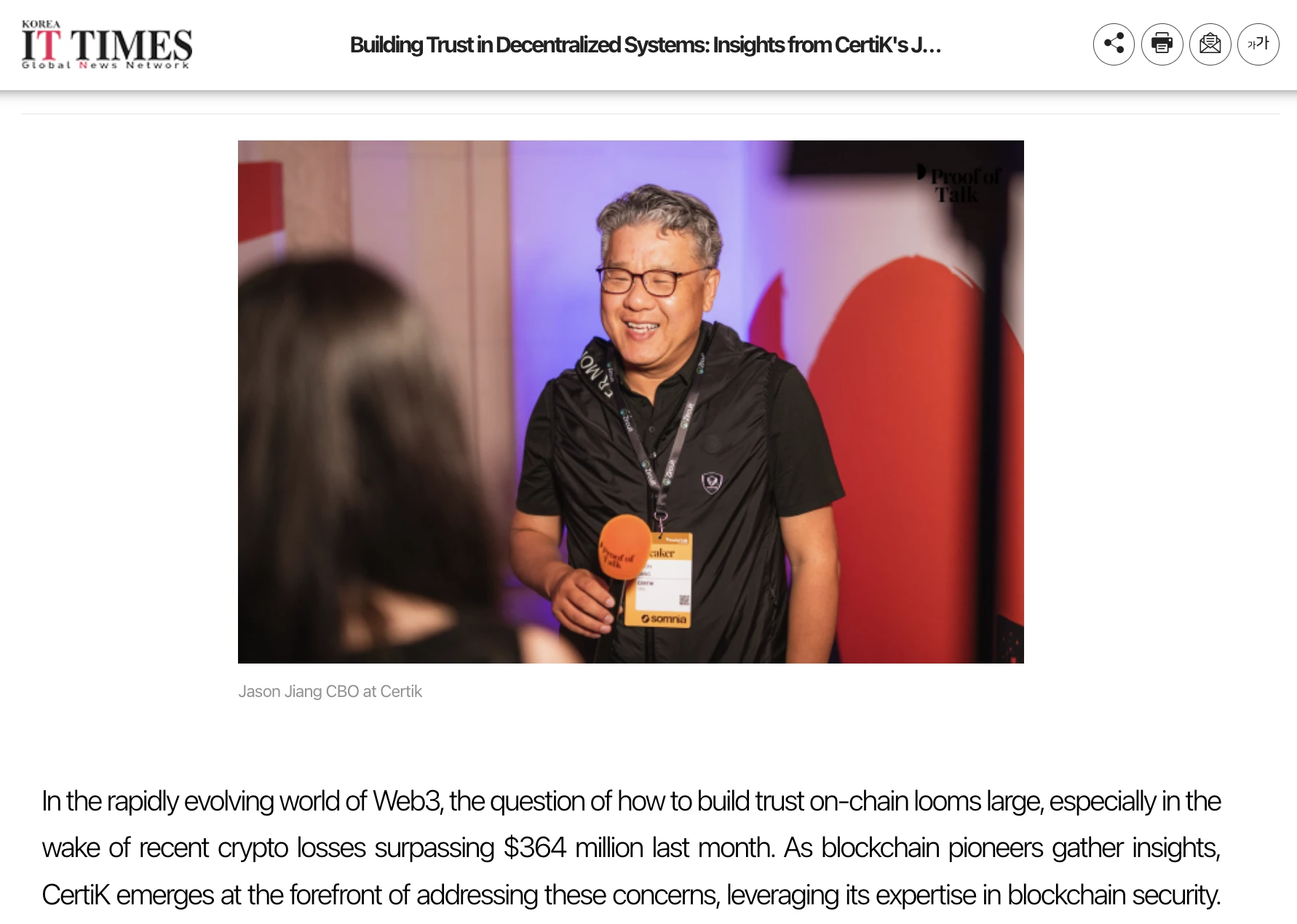
韩媒聚焦Web3信任重塑,CertiK首席商务官倡导动态安全新范式

Jason Jiang 表示,CertiK 正在推行动态的“安全即服务”模式,通过链上审计认证、实时安全监控与风险评分、AI 辅助审计等手段,持续推进安全基础设施建设。以 Skynet 为代表的技术产品,正在重塑行业对“信任”的标准。

Korea IT Times 认为,这种动态模式正是赢得用户与行业信赖的关键。CertiK 的前瞻性战略展示了如何通过主动和适应性强的安全方案,切实应对Web3安全挑战,推动行业迈向安全可信的未来。

以下为报道全文:

在去中心化体系中重塑信任:CertiK 首席商务官 Jason Jiang 在 Proof of Talk 2025 的深刻洞见

韩媒聚焦Web3信任重塑,CertiK首席商务官倡导动态安全新范式

在瞬息万变的Web3世界中,如何在链上建立信任,正成为一个核心议题。尤其是在上个月加密行业损失超过 3.64 亿美元的背景下,信任问题更显紧迫。在区块链行业不断探索新路径的过程中,CertiK 凭借其在区块链安全领域的专业能力,走在了应对这些挑战的最前沿。在 Proof of Talk 2025 大会上,CertiK 首席商务官 Jason Jiang 发表主题演讲,围绕“如何在Web3中建立信任”这一核心问题,提出了一系列引人深思的观点。

Jason Jiang 首先阐述了Web3安全的固有挑战,以及传统静态审计的局限。他强调:“正如 CertiK 一直倡导的,静态代码验证,即便标准再高,也只是安全模型中的一环。它是必要的,但远不足以构建真正的信任。许多风险恰恰是在审计之后才暴露出来。”他的这番话揭示了当前区块链安全体系日益增长的复杂性:可升级合约、治理机制的偏离、外部账户控制等因素,都会引发新的安全隐患。正如他所言:“已审计绝不等同于安全。”

他认为,Web3行业的变化速度前所未有。“在加密世界,一年的变化堪比传统行业的八年。”他指出,真正的信任不仅建立在时间的沉淀之上,更需要系统性的机制保障。“Web3中的信任,不只是代码本身,而是代码、行为、文化与合规的综合体。”他特别提到漏洞赏金计划的重要性,认为项目方应投入资源建立透明问责机制,同时在发生安全事件后及时发布详尽的复盘报告。

CertiK 正在推动一场信任机制的范式转变。Jason Jiang 在演讲中明确指出,CertiK 正将安全从静态的“审计即安全”模式,转向动态的“安全即服务”模式。他表示:“我们正在推动从传统的静态审计走向动态的安全运营。这包括推动链上审计认证、引入实时安全监控与风险评分、持续验证机制,以及 AI 辅助审计的技术演进。”

这一理念通过 Skynet 等实时监测与风险评分工具,以及 AI 辅助分析等产品落地,标志着 CertiK 在构建整体安全基础设施方面的持续投入。这种安全架构不仅为Web3项目提供坚实的技术保障,也正在重塑行业对于“信任”的标准。

透过 Jason Jiang 的分享可以看出,要在去中心化体系中建立真正的信任,必须采取全方位的策略:持续的安全评估、透明的行为准则、以及持续改进的文化。这种动态的方法,正是赢得用户与行业信赖的关键,也为构建更安全、更可信的Web3生态系统铺平了道路。随着行业迈入新阶段,CertiK 的前瞻性战略展示了如何通过主动和适应性强的安全方案,切实应对Web3安全挑战,推动行业向更加安全可信的未来迈进。

Related Reads

Ethereum Foundation Interim Executive Director Speaks Out: What Is Our Mission?

The Ethereum Foundation's core mission is to ensure Ethereum remains a truly permissionless, censorship-resistant, private, and open infrastructure for large-scale, sovereign coordination. The article clarifies the EF's focus and dismisses irrelevant objectives, such as pursuing institutional popularity or short-term speculation. Its core work centers on eliminating systemic weaknesses. This involves fortifying Ethereum across multiple layers—protocol, access, user, and institutional—against exploitation, control, or surveillance. Key initiatives include minimizing harmful MEV and preventing privileged control over transaction flow, making unconditional privacy a foundational default, ensuring staking remains permissionless and decentralized, and strengthening user-facing access points to uphold autonomy. Concurrently, the EF aims to seize strategic opportunities. These include leading the transition to post-quantum cryptography, achieving a fully verifiable protocol stack, establishing Ethereum as private digital cash, integrating user-owned AI agents with personal wallets, and demonstrating that trusted-neutral infrastructure can competitively handle disintermediated coordination at an institutional scale. The article also addresses recent organizational changes, stating that personnel departures were due to strategic realignment, role fit, or natural evolution. It clarifies the approach to spin-outs, emphasizing that external funding will be provided only for work critical to the EF's mission that reduces Ethereum's dependency without creating new risks or mission drift. Ultimately, the EF is committed to building an enduring, neutral system that reshapes global coordination, focusing relentlessly on the principles of censorship resistance, openness, privacy, and sovereignty (CROP).

链捕手18m ago

Ethereum Foundation Interim Executive Director Speaks Out: What Is Our Mission?

链捕手18m ago

STRC 跌破面值,比特币财库实验进入下半场

The price of STRC, Strategy's dividend-paying preferred stock, has fallen below its $100 face value, triggering a re-evaluation of the "bitcoin treasury" corporate model. This highlights a critical tension: the company's asset base consists of high-volatility, non-cash-flow-generating Bitcoin, while its capital structure requires continuous cash payouts for dividends and interest. The decline of STRC signals that market pressure is shifting from asset price volatility to the pricing of the company's financing tools. Strategy's core model involves a three-step conversion: turning equity into Bitcoin exposure, converting Bitcoin holdings into capital market credit, and packaging non-yielding BTC into cash-paying securities like STRC. While Strategy holds a massive 847,363 BTC, the focus is now on cash flow mismatches. The company faces annual preferred stock dividend obligations of approximately $1.7 billion, far exceeding the cash flow from its legacy software business. Its ability to meet these obligations relies on continued access to capital markets. The market is now scrutinizing which of three potential costs becomes untenable first: rising dividend costs to attract investors, dilution costs from issuing more common stock, or the reputational cost of selling BTC—a move contrary to its "hodl" narrative. For the broader crypto market, a constrained Strategy means the potential loss of a predictable, narrative-driven marginal buyer for Bitcoin. The STRC discount serves as a reminder that the longevity of such models depends not just on Bitcoin's price, but also on financing windows, cash reserves, and investor willingness to pay a "trust premium" for the structure.

marsbit54m ago

STRC 跌破面值,比特币财库实验进入下半场

marsbit54m ago

Standard Chartered Bank’s 50-Fold Fantasy: Predicting AAVE to Reach $3,500

Standard Chartered Bank has issued an optimistic research report predicting that the AAVE token could surge 50-fold to $3,500 by 2030. This forecast is based on the projection that the total value locked (TVL) in DeFi will grow 37x to approximately $2.7 trillion, driven by stablecoin expansion and the tokenization of real-world assets (RWA). The bank's model links Aave's potential valuation directly to its protocol revenue, which is primarily driven by net interest margins. The report highlights Aave's current dominant position, noting it captures over 80% of the net earnings ("protocol retained earnings") in the lending sector while holding only about half of its TVL. It also points to the recent launch of the Aave V4 architecture and a healthy revenue stream of $142 million in 2025 as positive fundamentals. Grayscale's separate analysis, applying traditional valuation metrics like DCF, concluded AAVE is currently undervalued. However, the article notes significant challenges. Aave's peer-to-pool lending model suffers from inherent capital inefficiency, with an estimated $52 million annual "deadweight loss" due to idle funds needed for liquidity buffers. This structural flaw was exposed during the April KelpDAO exploit, which locked a WETH pool at 100% utilization for days. Emerging protocols like Morpho, with more efficient point-to-point models, are cited as growing competitive threats. In summary, while institutional forecasts paint a macro picture of massive growth fueled by RWA adoption, Aave's path forward hinges on addressing its core structural limitations and competitive pressures within the evolving DeFi lending landscape.

链捕手1h ago

Standard Chartered Bank’s 50-Fold Fantasy: Predicting AAVE to Reach $3,500

链捕手1h ago

Trading

Spot
Futures
活动图片