Real Vision Predicts Bitcoin Blastoff, Altcoins To Erupt Shortly: Here’s Why

bitcoinistPublished on 2025-06-21Last updated on 2025-06-21

Abstract

Bearish exhaustion, neutral positioning, and a rare breakout in global liquidity are converging—setting the stage for what Real Vision’s Raoul...

Trusted Editorial content, reviewed by leading industry experts and seasoned editors. Ad Disclosure

Bearish exhaustion, neutral positioning, and a rare breakout in global liquidity are converging—setting the stage for what Real Vision’s Raoul Pal and chief crypto analyst Jamie Coutts describe as a potentially “violent” upside move across Bitcoin and crypto markets. In a data-heavy episode, the two analysts unpacked a sophisticated suite of models developed over the past year, culminating in a live dashboard that just flipped green on all major risk indicators.

“We’re not overheated. We’re not stretched. In fact, everything is behaving exactly as it should in a breakout regime,” said Coutts, referring to his global liquidity risk score, a framework built from central bank balance sheets, money supply aggregates, FX reserves, and US net liquidity. “And when these breakouts happen, Bitcoin’s sensitivity to liquidity can increase by a factor of five or more.”

Pal, echoing the conviction, added: “From my work, it’s straight up from here. I think we’ll be surprised to the upside—especially by how fast stuff runs.”

Bitcoin And Altcoins Set To Explode

At the heart of the discussion was Coutts’ triad of real-time market indicators: global liquidity, derivatives risk, and network profitability. These scores form the backbone of what Pal dubbed Real Vision’s “ultimate signal” for navigating crypto cycles. All three are currently sitting in a “neutral” zone, signaling neither overheating nor excessive risk—precisely the backdrop, they argue, that historically precedes massive upward repricing.

One key metric: the liquidity multiplier. Coutts explained that in typical macro regimes, Bitcoin rises roughly 7% for every 1% increase in global liquidity. But in rare post-contraction periods—like now—that multiplier jumps as high as 20%–30%. “Bitcoin becomes hypersensitive,” he said. “Every new dollar of liquidity sloshing into the system has an outsized impact.”

Importantly, the data confirms that the recent rally off April lows is supported by fundamentals. “Liquidity broke out in early April, and since then Bitcoin’s up 40%. Global liquidity is up about 2%. That’s consistent with prior breakout regimes,” Coutts observed. “People don’t realize how clean this setup is.”

Beyond Bitcoin, the conversation turned sharply toward altcoins. Using newly constructed indices—including an equal-weighted top 200 altcoin tracker—Coutts identified early signs of a “structural” alt season. His custom-built advance-decline line and MACD-style oscillator suggest breadth is quietly turning up across the crypto complex.

“Back in March and April I said the bottom was forming in alts,” he noted. “We’re now starting to see higher lows on the breadth charts. The alt season oscillator triggered in late April. It’s not explosive yet—but the structure is bullish.”

Pal concurred, pointing to the ISM and macro risk indicators as lagging but supportive. “Alt season is tightly linked to disposable income and the ISM,” he said. “Once earnings pick up and the Fed starts cutting, people will move out the risk curve. And that’s what ignites the full rotation.”

Coutts’ other key insight: on-chain data confirms that neither long-term holders nor leverage are pushing the market into frothy territory. “The derivatives risk score is low. The unrealized profit metrics are neutral. There’s no positioning blowout. If anything, the market’s underexposed,” he said.

One name that stood out across metrics was Hyperliquid, the permissionless derivatives exchange that’s drawing institutional attention. “It’s my chart of shame,” Coutts admitted. “The trend triggered at $17—I missed it—and now it’s at $42. But it has one of the cleanest product-market fits we’ve seen in crypto. The tokenomics are tight. It’s trading at a reasonable multiple. And it’s burning tokens like a growth stock.”

Other chains flagged for strong network activity and undervaluation included Tron, which generates $9 million in daily fees largely via stablecoin transfers; and L2 ecosystems that are increasingly driving Ethereum’s resurgence. While daily active addresses on Ethereum’s base chain have grown only 2% over four years, L2 adoption and ETF inflows have started to shift positioning. “Nobody owned ETH. But now flows are building,” said Coutts.

The bottom line? According to Real Vision’s top crypto minds, nearly all major signals are aligned for upside.

“Liquidity is breaking out. Positioning is clean. The altcoin breadth is improving. Fundamentals are ticking back up. The FOMO index—if we dare call it that—is low,” said Pal. “You don’t get setups like this very often. Just don’t f*** this up.”

Coutts closed with a warning and a nod to discipline: “The indicators help us know when to lean in—and when to hedge. But right now, they’re not telling us to step back. They’re telling us the runway is open.”

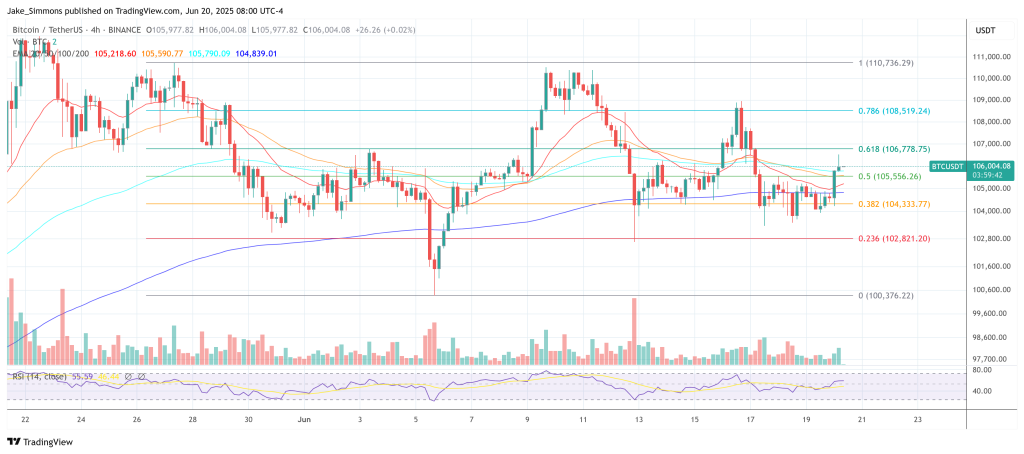
At press time, BTC traded at $106,004.
Bitcoin price
BTC rises back above the 0.5 Fib, 4-hour chart | Source: BTCUSDT on TradingView.com
Featured image created with DALL.E, chart from TradingView.com
Editorial Process for bitcoinist is centered on delivering thoroughly researched, accurate, and unbiased content. We uphold strict sourcing standards, and each page undergoes diligent review by our team of top technology experts and seasoned editors. This process ensures the integrity, relevance, and value of our content for our readers.

Jake Simmons has been a Bitcoin enthusiast since 2016. Ever since he heard about Bitcoin, he has been studying the topic every day and trying to share his knowledge with others. His goal is to contribute to Bitcoin's financial revolution, which will replace the fiat money system. Besides BTC and crypto, Jake studied Business Informatics at a university. After graduation in 2017, he has been working in the blockchain and crypto sector. You can follow Jake on Twitter at @realJakeSimmons.

Related Reads

Nearly a Hundred Players Rush into Embodied Data: With 4.47 Billion Yuan in Financing in One Year, Who Can Really Make Money by 'Selling Data'?

The domestic embodied AI data industry has attracted nearly 100 players, with 70 focused on data collection and 27 on data infrastructure. In the past year, 15 independent embodied data service providers raised approximately 4.47 billion yuan. Despite this growth, the sector remains early-stage, fragmented, and faces significant challenges. Data collection methods are diverse, categorized into four main routes: teleoperation of real robots, human demonstration without a robot (using motion capture, exoskeletons, etc.), simulation synthesis, and distillation from internet videos. Most companies (43%) adopt hybrid approaches, combining multiple routes, as no single method can meet all training needs. Teleoperation alone is pursued by 31% of players, often by state-owned platforms and robot companies, while newer firms favor asset-light, no-hardware human demonstration. Independent data service providers now form the largest player group (40%), indicating the emergence of a distinct industry segment rather than just a subsidiary function for robot makers. Two-thirds of all players are "embodied-native" startups, while one-third are companies that pivoted from fields like AI data annotation, which are more prevalent in the data infrastructure layer. Current annual industry capacity is estimated at 1.6-1.8 million hours plus 70-80 million data points, with a short-term goal to increase this 15-20 fold within 1-3 years. Data collection factories are spread across 20 provinces in China, concentrated in the Yangtze River Delta, Beijing-Tianjin-Hebei, and Pearl River Delta regions. Financially, the 4.47 billion yuan raised in the past year pales compared to the 43.8 billion yuan raised by the broader embodied intelligence sector in just the first half of 2026, highlighting that data remains a less "sexy" bet for investors. The 15 funded independent providers show clear stratification: a top tier led by a unicorn (Lightwheel Intelligence, 3.1 billion yuan), a middle tier of 11 firms raising tens to hundreds of millions, and an early-stage tier of 3 companies. Sixty-nine investment institutions have participated, but none have made concentrated bets, reflecting uncertainty about viable business models. Over half of these funded companies are less than a year old, most are at pre-A or A rounds, and profitability remains largely unproven. In summary, the embodied data industry has become an independent track creating jobs and local economic activity. However, it is still nascent, with unformed consensus, unsolved problems, and unproven business models. The coming 1-2 years will be a critical validation window to see if companies can build sustainable, profitable businesses purely by "selling data."

marsbit2h ago

Nearly a Hundred Players Rush into Embodied Data: With 4.47 Billion Yuan in Financing in One Year, Who Can Really Make Money by 'Selling Data'?

marsbit2h ago

Dialogue with Multicoin Partner: The Crypto Market Has Bottomed Out, Favoring Three Cryptocurrencies in This Cycle

In a recent interview, Multicoin Capital managing partner Tushar Jain shared his views on the crypto market. He believes the market has bottomed and is at an inflection point, citing that negative news no longer causes significant price declines and application adoption continues to grow. Jain remains highly bullish on Solana, viewing it as the correct architectural choice for internet capital markets, particularly for spot and tokenized security trading. He is also positive on Hyperliquid, noting its leadership in decentralized derivatives trading. His investment approach focuses on concentrating capital in top convictions rather than equal allocation. A distinct opportunity he highlights is Zcash (ZEC), which he sees as a return to the industry's cypherpunk ethos and a potential top-five asset by market cap. For assets like Zcash without cash flows, his valuation framework is based on relative market cap ranking. Regarding investment strategy, Jain employs a "three-part" entry method to avoid timing pitfalls and emphasizes long-term "active management" over "active trading." He outlines four sources of investment edge: informational, analytical, behavioral/psychological, and structural. On portfolio management, the fund uses Bitcoin as its "cash," selling assets into Bitcoin during market euphoria to reduce beta risk and using Bitcoin to buy dips. Sales occur only if a better opportunity arises, the investment thesis breaks, or valuations become excessively overheated. While respectful of Ethereum's resilience, he questions its unclear scaling roadmap. Finally, Jain reaffirms his commitment to the thesis that blockchains will form the foundational architecture for future capital markets.

marsbit2h ago

Dialogue with Multicoin Partner: The Crypto Market Has Bottomed Out, Favoring Three Cryptocurrencies in This Cycle

marsbit2h ago

Trading

Spot
活动图片