In The Shadows: Two-Thirds Of Crypto Miners Still Unregistered In Russia

bitcoinistPublished on 2025-06-20Last updated on 2025-06-20

Abstract

Russia’s Deputy Minister of Finance revealed that only one-third of crypto mining firms are operating legally despite the new law...

Trusted Editorial content, reviewed by leading industry experts and seasoned editors. Ad Disclosure

Russia’s Deputy Minister of Finance revealed that only one-third of crypto mining firms are operating legally despite the new law requiring mining entities to register with the Federal Tax Service (FTS).

Crypto Miners Operating In The Shadows

On Thursday, Russia’s state news agency TASS reported that more than half of crypto mining companies are still operating without registration with the Federal Tax Service. According to the report, Deputy Minister of Finance Ivan Chebeskov stated that only 30% of miners have registered since the new law came into effect in November 2024.

For context, the Russian government approved a law in August of last year to legalize crypto mining in the country. The legislation, enacted on November 1, 2024, aims to combat illegal mining activity and offer exclusive rights to entities registered with the FTS. By December 2024, over 100 mining companies had filed their application.

As reported by Bitcoinist, FTS’s Head Daniil Yegorov revealed that 150 firms had applied for registration just one month after the law was enacted. However, he considered the number was low and expected a larger number of applicants in the coming months.

Seven months later, the number is still low, as only one-third of mining entities have applied to register. Another two-thirds need to come clean and enter the register,” Chebeskov affirmed at the 28th St. Petersburg International Economic Forum (SPIEF).

The Deputy Minister of Finance asserted that the goal was to legalize the mining sector and “bring this industry out of the shadows as much as possible.” He also noted that they have not achieved their objective, adding that the Ministry will work to complete it.

We have not yet completed this process. So far, only 30% of all miners have been entered into the register maintained by the Federal Tax Service, and this process is still far from complete (…) Therefore, we will work to complete this process.

Russian Authorities To Tighten Rules

Notably, the Ministry of Digital Development is reportedly working on adding a new article to the Code of Administrative Offenses (CoAO) to provide fines for illegal mining and failure to provide information about mined crypto.

According to recent reports, the amendment, which is undergoing interdepartmental review, could introduce four types of offenses, three of which will be related to crypto mining.

Additionally, judges would gain the authority to confiscate crypto assets from anyone mining illegally, aiming to stop unregistered operations in Russia. The amendment would also tackle crypto payments, imposing fines on those who transact outside the Central Bank’s Sandbox.

In April, Russian Finance Minister Anton Siluanov announced a plan to establish a dedicated exchange for “highly qualified investors” alongside the Bank of Russia (BOR), aiming to “legalize crypto assets and bring crypto operations out of the shadows.”
crypto, Bitcoin, BTC, BTCUSDT

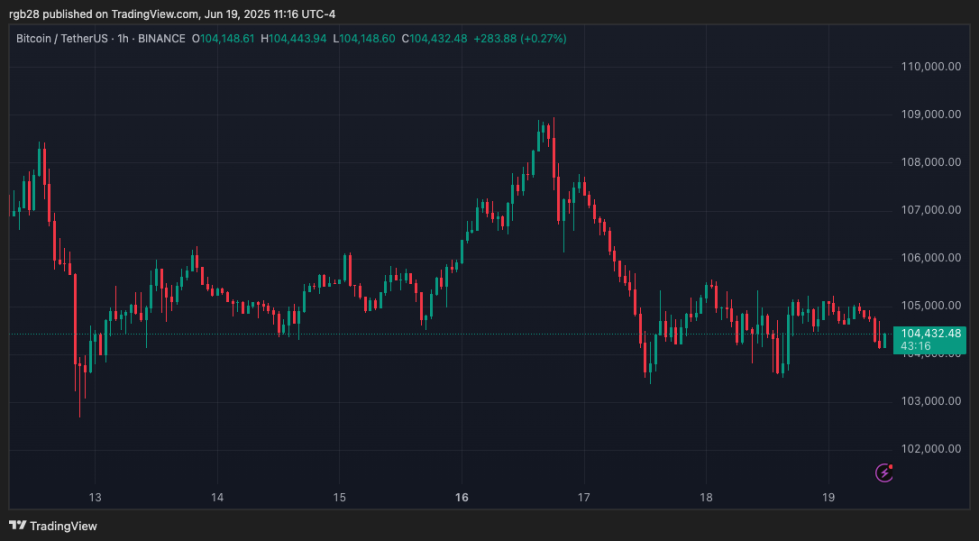
Bitcoin (BTC) trades at $104,432 in the one-week chart. Source: BTCUSDT on TradingView.
Featured Image from Unsplash.com, Chart from TradingView.com
Editorial Process for bitcoinist is centered on delivering thoroughly researched, accurate, and unbiased content. We uphold strict sourcing standards, and each page undergoes diligent review by our team of top technology experts and seasoned editors. This process ensures the integrity, relevance, and value of our content for our readers.

Rubmar is a crypto enthusiast who likes learning and improving constantly. She enjoys reporting on the latest news and developments in the crypto industry. Rubmar also enjoys scrapbooking, crafting, simulation games, and watching football.

Related Reads

Nearly a Hundred Players Rush into Embodied Data: With 4.47 Billion Yuan in Financing in One Year, Who Can Really Make Money by 'Selling Data'?

The domestic embodied AI data industry has attracted nearly 100 players, with 70 focused on data collection and 27 on data infrastructure. In the past year, 15 independent embodied data service providers raised approximately 4.47 billion yuan. Despite this growth, the sector remains early-stage, fragmented, and faces significant challenges. Data collection methods are diverse, categorized into four main routes: teleoperation of real robots, human demonstration without a robot (using motion capture, exoskeletons, etc.), simulation synthesis, and distillation from internet videos. Most companies (43%) adopt hybrid approaches, combining multiple routes, as no single method can meet all training needs. Teleoperation alone is pursued by 31% of players, often by state-owned platforms and robot companies, while newer firms favor asset-light, no-hardware human demonstration. Independent data service providers now form the largest player group (40%), indicating the emergence of a distinct industry segment rather than just a subsidiary function for robot makers. Two-thirds of all players are "embodied-native" startups, while one-third are companies that pivoted from fields like AI data annotation, which are more prevalent in the data infrastructure layer. Current annual industry capacity is estimated at 1.6-1.8 million hours plus 70-80 million data points, with a short-term goal to increase this 15-20 fold within 1-3 years. Data collection factories are spread across 20 provinces in China, concentrated in the Yangtze River Delta, Beijing-Tianjin-Hebei, and Pearl River Delta regions. Financially, the 4.47 billion yuan raised in the past year pales compared to the 43.8 billion yuan raised by the broader embodied intelligence sector in just the first half of 2026, highlighting that data remains a less "sexy" bet for investors. The 15 funded independent providers show clear stratification: a top tier led by a unicorn (Lightwheel Intelligence, 3.1 billion yuan), a middle tier of 11 firms raising tens to hundreds of millions, and an early-stage tier of 3 companies. Sixty-nine investment institutions have participated, but none have made concentrated bets, reflecting uncertainty about viable business models. Over half of these funded companies are less than a year old, most are at pre-A or A rounds, and profitability remains largely unproven. In summary, the embodied data industry has become an independent track creating jobs and local economic activity. However, it is still nascent, with unformed consensus, unsolved problems, and unproven business models. The coming 1-2 years will be a critical validation window to see if companies can build sustainable, profitable businesses purely by "selling data."

marsbit43m ago

Nearly a Hundred Players Rush into Embodied Data: With 4.47 Billion Yuan in Financing in One Year, Who Can Really Make Money by 'Selling Data'?

marsbit43m ago

Dialogue with Multicoin Partner: The Crypto Market Has Bottomed Out, Favoring Three Cryptocurrencies in This Cycle

In a recent interview, Multicoin Capital managing partner Tushar Jain shared his views on the crypto market. He believes the market has bottomed and is at an inflection point, citing that negative news no longer causes significant price declines and application adoption continues to grow. Jain remains highly bullish on Solana, viewing it as the correct architectural choice for internet capital markets, particularly for spot and tokenized security trading. He is also positive on Hyperliquid, noting its leadership in decentralized derivatives trading. His investment approach focuses on concentrating capital in top convictions rather than equal allocation. A distinct opportunity he highlights is Zcash (ZEC), which he sees as a return to the industry's cypherpunk ethos and a potential top-five asset by market cap. For assets like Zcash without cash flows, his valuation framework is based on relative market cap ranking. Regarding investment strategy, Jain employs a "three-part" entry method to avoid timing pitfalls and emphasizes long-term "active management" over "active trading." He outlines four sources of investment edge: informational, analytical, behavioral/psychological, and structural. On portfolio management, the fund uses Bitcoin as its "cash," selling assets into Bitcoin during market euphoria to reduce beta risk and using Bitcoin to buy dips. Sales occur only if a better opportunity arises, the investment thesis breaks, or valuations become excessively overheated. While respectful of Ethereum's resilience, he questions its unclear scaling roadmap. Finally, Jain reaffirms his commitment to the thesis that blockchains will form the foundational architecture for future capital markets.

marsbit1h ago

Dialogue with Multicoin Partner: The Crypto Market Has Bottomed Out, Favoring Three Cryptocurrencies in This Cycle

marsbit1h ago

Trading

Spot
活动图片