A group of eight crypto policy organizations has urged US Congress leaders to support a recently re-introduced bill to protect software developers by including it in market structure legislation.
Crypto Policy Groups Seek Software Developers’ Protection
On Thursday, eight crypto policy organizations shared a joint statement calling for the inclusion of the Blockchain Regulatory Certainty Act (BRCA) in market structure legislation, seeking to offer a safe harbor for software developers and infrastructure providers.
H.R. 3533 was first introduced in 2023 by Republican Representative Tom Emmer and has now been reintroduced on May 21, 2025, as a bipartisan effort, with Democratic Representative Ritchie Torres as a co-sponsor.
The BRCA is “critical for protecting software developers,” as it proposed that no blockchain developer or provider of a blockchain service “shall be treated as a money transmitter or as engaging in ‘money transmitting’, (…), unless the developer or provider has, in the regular course of business, control over digital assets to which a user is entitled under the blockchain service or the software created, maintained, or disseminated by the blockchain developer or provider.”
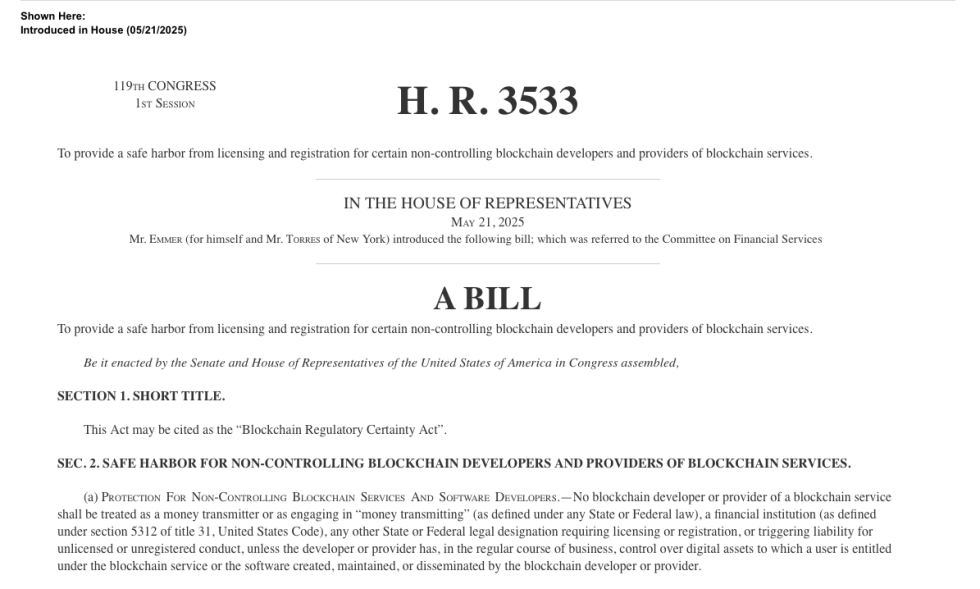
Excerpt from the Blockchain Regulatory Certainty Act. Source: Congress.Gov
The policy groups’ statement affirmed that developers creating peer-to-peer, non-custodial software and infrastructure providers who facilitate decentralized networks have “little in common” with traditional finance institutions. As such, they should not be treated as the same.
“The BRCA acknowledges this reality and ensures that when software developers or blockchain service providers do not control or custody customer funds, they are not inappropriately required to register as ‘money transmitting businesses’ or liable for failing to do so,” the joint statement reads.
A policy lead told journalist Eleanor Terret that “it’s critically important that we don’t treat open-source developers like traditional financial institutions,” adding, “The BRCA draws that line clearly and protects innovation.”
Congress Urged To Provide CLARITY
The crypto coalition, comprised of the DeFi Education Fund, Coin Center, Solana Policy Institute, The Digital Chamber, Blockchain Association, Crypto Council for Innovation, Paradigm, and Bitcoin Policy Institute, urged lawmakers to support the BRCA’s inclusion in the Digital Asset Market Clarity Act of 2025.
We strongly encourage the House of Representatives to include the BRCA in the Digital Asset Market Clarity Act of 2025, and ensure that innovators across America can safely build financial infrastructure here – at home.
The bill, also known as the CLARITY Act, was introduced on May 29 by French Hill, Chairman of the House Financial Services Committee. The bipartisan legislation aims to establish a regulatory framework for crypto assets in the US, providing the long-awaited clarity and protection for the industry.
“Our bill brings long-overdue clarity to the digital asset ecosystem, prioritizes consumer protection and American innovation, and builds off our work in the 118th Congress,” Hill stated. As Terret reported, the Financial Services Committee has scheduled a markup for the CLARITY Act for June 10, 2025, alongside multiple other bills.
The DeFi Education Fund, which has previously advocated for the protection of software developers, concluded on X that “Congress has an opportunity to protect developers of non-custodial peer-to-peer software protocols from being unreasonably targeted for regulation.”
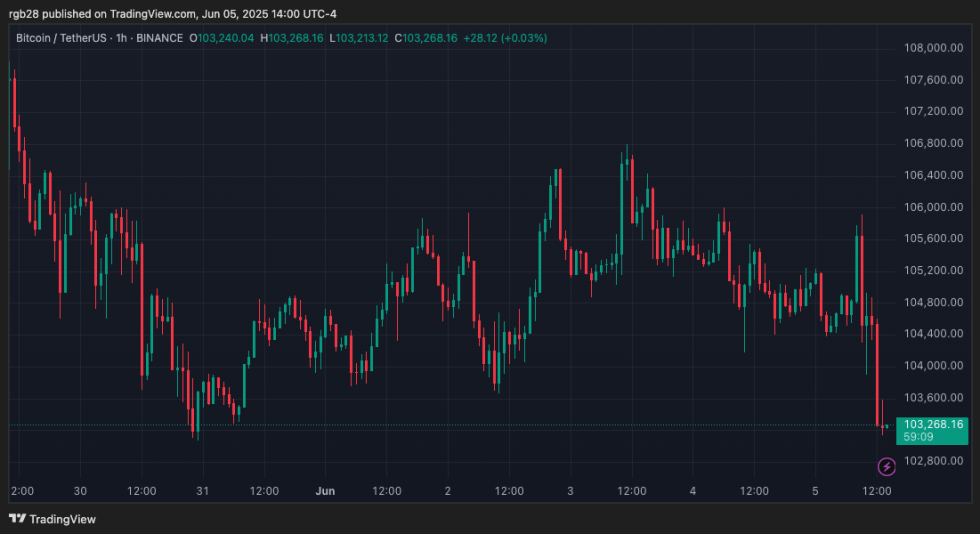
Bitcoin (BTC) trades at $103,266 in the one-week chart. Source: BTCUSDT on TradingView

Related Posts