Fact Check: Is Hasbulla’s BULLA Token Another Pump N Dump?

CoingapePublished on 2025-05-28Last updated on 2025-05-28

Abstract

After a brief hiatus, the broader crypto market is now seeing another surge in celebrity tokens including Hasbulla's BULLA token

Highlights

  • Hasbullah has joined the celebrity memecoin push with BULLA Token
  • There is a high likelihood of selloff in the market as typical to rug pulls
  • Eric Trump and even Microsoft have seen their brand names used in fake celebrity memecoin trends

A new market trend has spotlighted the Hasbulla BULLA token, which has quickly raised over $12.5 million from the industry. Despite the growing hype, many market participants are questioning whether or not it is just another pump-and-dump scheme. Notably, past projects linked to Hasbulla have failed, raising doubts about this new token’s future.

Past Scams Tied to Hasbullah Resurfaces With BULLA Token

The token in question is tied to Hasbulla Magomedov, an internet personality whose track record in Web3 is already a troubling reality. In 2021, he launched NFTs with vague perks and plans for a metaverse that never materialized. In early 2024, he introduced the Barsik token, which quickly became a pump-and-dump.

It is worth noting that over 60% of the supply was scooped up by insiders and bots at launch. Blockchain analysis showed wallets linked to the team selling off large amounts while public promotions continued.

The same pattern is unfolding with the BULLA token. Analysts say many presale wallets are new, unfunded before this project, and linked to past Hasbulla-related contracts. There is no Whitepaper, audit, or explanation of how the funds will be used. Promotions rely entirely on Hasbulla’s fame and meme content.

Meanwhile, Blockchain investigator ZachXBT has recently warned against a new BNB token sale tied to BULLA.

Notably, as the influencer posted about the BULLA token presale on Monday, the project have already received over $12.5 million in less than 24 hours. This adoption is not unique and generally common among celebrities.

Celebrity Tokens and the Caution to Note

Just as concerns around the BULLA token grow, Argentina’s President Javier Milei has shut down the task force investigating his role in promoting the failed Libra token. The scandal saw insiders walk away with funds and over $4 billion in market cap was wiped out.

It is essential to state that a government decree claimed the unit had completed its job. However, critics believe the move attempts to sweep the issue under the rug.

Still, Blockchain data showed massive cashouts during Libra’s brief run. The case has fueled growing suspicion around political figures and influencers like Hasbullah promoting unregulated products in the market.

Microsoft and Eric Trump In the Same Memecoin Impersonation Boat

Furthermore, the BULLA token comes at a time when trust in memecoins is already shaky. A fake Microsoft token recently surged to a market cap of $80 million before crashing.

According to the update, promoters claimed it was tied to Microsoft AI, but no connection existed. Wallets linked to the launch were shown dumping tokens after drawing in unsuspecting buyers.

Likewise, a new Eric Trump meme coin spiked by 8,500% within 24 hours before collapsing. Trump never confirmed involvement. The token’s rally and drawdown closely mirrors other coins that use a celebrity’s name without consent, creating quick profits for a few while others lose out.


Related Reads

Is Ethereum Truly a "World Computer"?

Title: Is Ethereum Really a "World Computer"? Ethereum, envisioned as a "world computer" by its founder Vitalik Buterin, aims to be a decentralized platform for global applications. However, a recent analysis by Four Pillars raises questions about whether it is more accurately a "Western computer," based on the geographical distribution of its validators. Currently, the United States dominates with 38.19% of all validators, followed by Germany at 13.04%. Combined, these two countries account for over half of the network. In contrast, Asian representation is minimal, with Singapore holding only 3.15%. The concentration is partly due to affordable cloud hosting services like Hetzner and OVH in Europe and North America, as well as the prevalence of residential validators in the U.S., where individuals run nodes via home internet connections. When examining professionally operated validators, the distribution becomes more balanced. The U.S. share drops to 25.81%, while Asian countries like Singapore (7.28%), Hong Kong (6.44%), Japan (6.38%), and South Korea (4.59%) collectively approach the U.S. level. This shift reflects strategic deployments by institutions to meet regulatory requirements and reduce latency for local users. However, regions like South America, the Middle East, and Africa remain underrepresented. Ethereum's peer-to-peer network mechanisms, such as gossipsub, disadvantage areas with low node density, creating a feedback loop where delayed message propagation reduces validator performance and rewards. This imbalance challenges Ethereum's promises of censorship resistance and global accessibility. Despite these issues, opportunities exist for growth in underrepresented regions. As demand for localized staking infrastructure rises, early entrants in areas like the Middle East could establish dominant positions by offering compliant, low-latency solutions. The evolving validator landscape highlights both the structural challenges and the potential for Ethereum to move closer to its "world computer" ideal.

Foresight News41m ago

Is Ethereum Truly a "World Computer"?

Foresight News41m ago

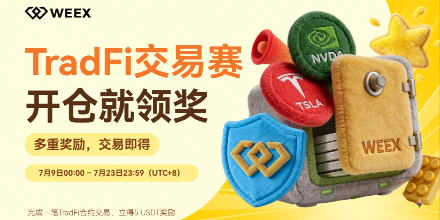
WEEX TradFi Trading Competition Kicks Off, 50,000 USDT Prize Pool First-Come, First-Served, Open a Position and Get 5 U

WEEX Exchange Launches "TradFi Trading Competition" with a 50,000 USDT Prize Pool Amidst a crypto market downturn, WEEX Exchange highlights the growth of tokenized traditional finance (TradFi) assets as a key trend, allowing users to trade stocks, ETFs, and commodities using crypto. The platform has launched a "TradFi Trading Competition" from July 9th to 23rd, featuring a 50,000 USDT prize pool. The campaign offers three reward tiers: 1. **New User Bonus (25,000 USDT pool):** New users depositing ≥100 USDT, completing a specified spot trade, and one TradFi contract trade (margin ≥10 USDT) receive 200 USDT. 2. **Volume-Based Rewards (20,000 USDT pool):** All users can earn tiered bonuses for achieving TradFi contract trading volumes of 5,000 USDT (3 USDT), 20,000 USDT (10 USDT), and 100,000 USDT (50 USDT). Rewards are stackable. 3. **Participation Reward:** Any user opening a TradFi contract trade during the event receives 5 USDT instantly. The article promotes WEEX's TradFi features, which include trading tokenized shares of companies like NVIDIA and Tesla using USDT, 24/7 trading, fractional share investing starting from $5, and high leverage up to 100x for hedging. It positions these features as solutions to traditional investing barriers like high fees, strict trading hours, and high share prices. The summary concludes by encouraging users to join the competition and leverage WEEX's platform to access global TradFi markets.

marsbit2h ago

WEEX TradFi Trading Competition Kicks Off, 50,000 USDT Prize Pool First-Come, First-Served, Open a Position and Get 5 U

marsbit2h ago

Trading

Spot
活动图片