Pi Network Price Crash Concerns Rise as Investors Deposit 2M Tokens

CoingapePublished on 2025-05-27Last updated on 2025-05-27

Abstract

Explore why the Pi Network price may be at risk of a big dive as exchange inflows rise and it forms a bearish flag chart pattern.

Highlights

  • Pi Network price is at risk of a big crash as exchange inflows rise.
  • Investors moved a net 2 million Pi coins to exchanges in the last 24 hours.
  • Pi coin has formed a bearish flag pattern, pointing to further downside.

Pi Network price remains under intense pressure today, May 26, even as Bitcoin moved back above $110,000. The token trades at $0.7752, down by over 53% from its highest level this month, making it one of the worst-performing major coins. Pi Coin price is at risk of a big drop as investors move 2 million tokens to exchanges.

Pi Network Price Technical Analysis Points to a Deeper Dive

The eight-hour chart shows that the value of Pi has suffered a big reversal after soaring to a two-month high of $1.6692 on May 12. It has dropped by over 53% to the current $0.7773 even as Bitcoin hovers near its all-time high.

Pi Coin has moved slightly below the 50-period Exponential Moving Average (EMA) at 0.7910. It has also formed a bearish flag chart pattern, which happens after an asset crashes and then consolidates or moves upwards in a channel formation.

It has already moved below the lower side of the flag section of this pattern. Therefore, there is a risk that the coin will drop to $0.6584, its lowest point on May 17. A drop below that level will point to more downside, potentially to this month’s low of $0.5545, down by 30% below the current level.
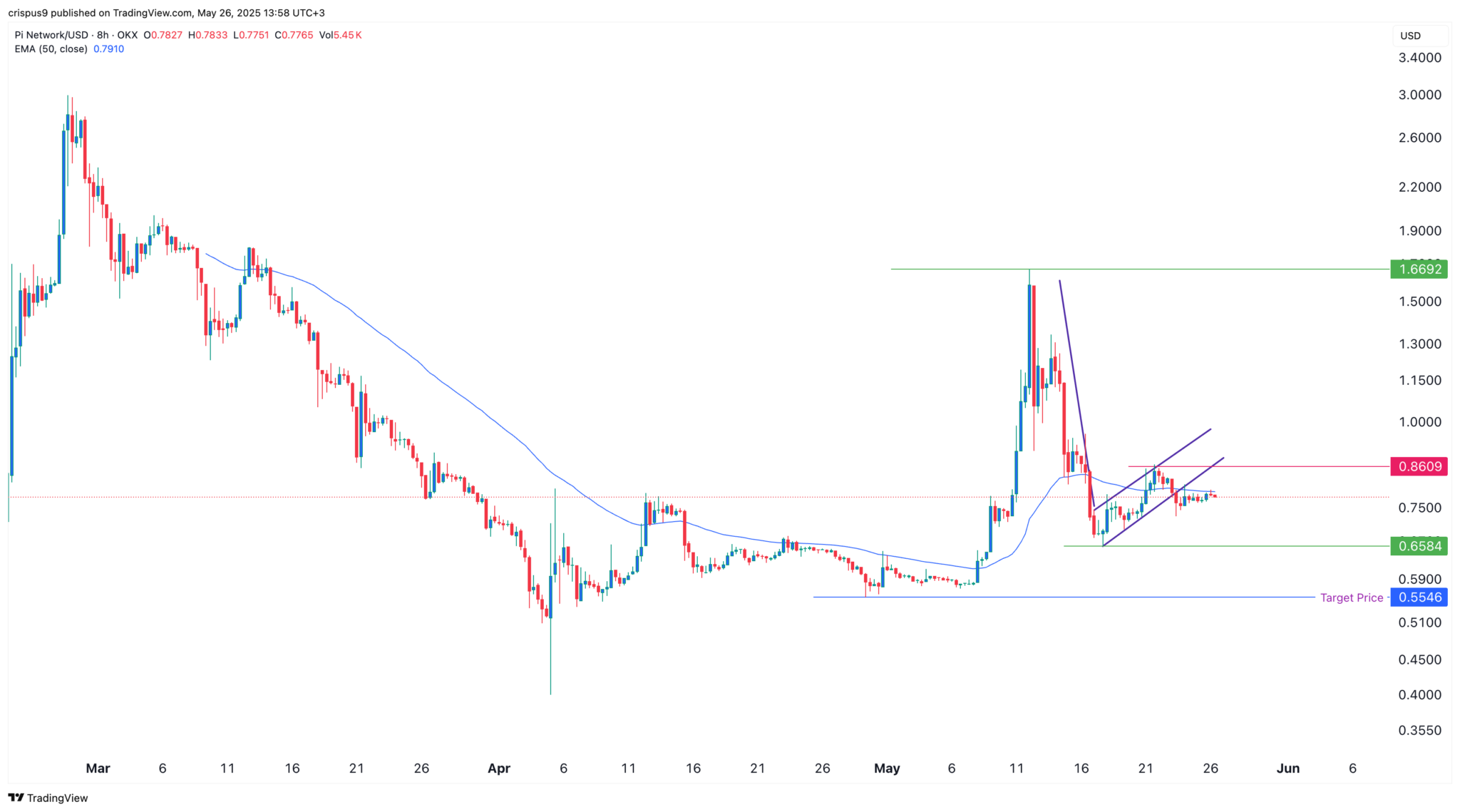
The bearish Pi Coin price forecast will become invalid if the coin rises above $0.8600, the highest point last week. A move above that level will point to more gains, potentially to the psychological point at $1.

Pi Coin Price Could Crash as Exchange Inflows Rise

PiScan data shows that Pi Network price may be at risk of a big crash as investors move tokens into exchanges. Investors moved 4.1 million coins into OKX in the last 24 hours, while withdrawals stood at 2.2 million, bringing the net flow to 1.88 million.

The netflow to Bitget was 712,097 coins, and on Pionex was 2,176. Only MEXC and Gate had net outflows in the past 24 hours. Altogether, the total inflows into exchanges stood at over 2.04 million.
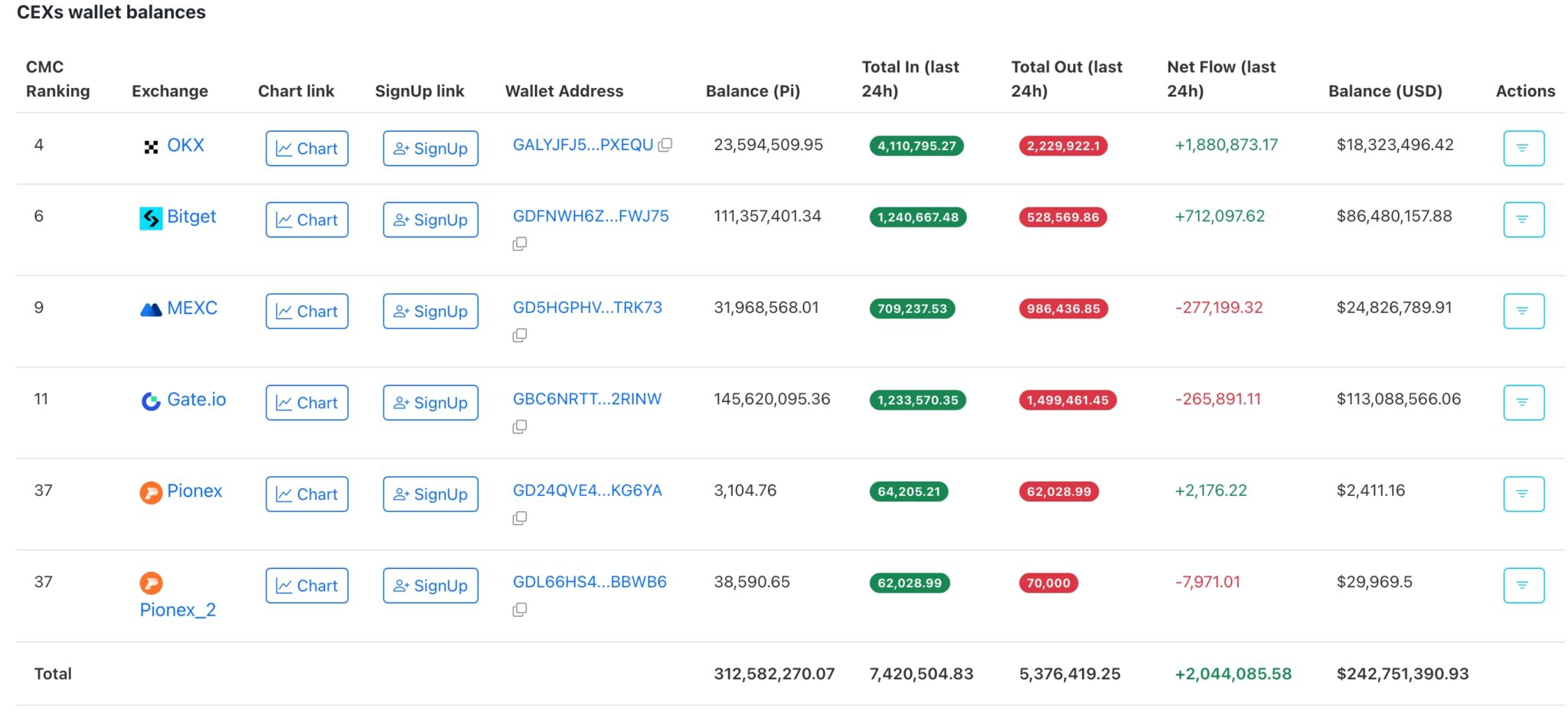
Exchange inflows are one of the top red flags in crypto analysis. That’s because they signal that investors are moving them from their self-custody wallets and selling them. This data is a sign that demand for the coin remains limited after its recent crash.

Pi Coin price crash could continue falling this week as more coins are set to be unlocked this week. 9.9 million coins will be unlocked today, while 12 million, 15.2 million, and 13.2 million will be unlocked in the next three days. Over 72 million coins valued at over $50 million will come online this week, and 280 million in the next 30 days.

This unlock trend will continue for a while since there are now 11.1 billion in circulation against a circulation cap of 100 billion. These unlocks may affect its price if there is no corresponding demand on the other side. For a detailed price prediction for Pi Coin 2025-2023 -


Related Reads

White-Label Stablecoins: More Than Just a Logo Change

"White-Label Stablecoins: Beyond a Logo Change" The article clarifies the often-misunderstood concept of "white-label stablecoins," which refers to businesses leveraging established providers like Circle or Coinbase to offer stablecoin functionality under their own brand. It details four distinct models, emphasizing that this is not a simple branding exercise but involves complex legal and operational responsibilities split across issuance, reserves, custody, and distribution. The four primary models are: 1. **Circle xReserve**: Enables blockchains (L1/L2) to launch their own stablecoin backed 1:1 by USDC locked in a Circle smart contract. The chain deploys and operates the token contract. 2. **Circle Partner Stablecoins**: Connects existing regional stablecoin issuers to Circle's global payment and liquidity network (e.g., StableFX). The local issuer remains responsible for issuance, reserves, and compliance. 3. **Circle Digital Asset Accounts**: Provides businesses with branded digital asset accounts where users hold established stablecoins (like USDC). Circle handles custody, conversion, and compliance; the business manages the front-end user experience. 4. **Coinbase Custom Stablecoins**: The model closest to a true "white-label" stablecoin. Coinbase manages the issuance, reserves, smart contracts, and redemption for a new, custom-branded stablecoin (e.g., Flipcash's USDF), while the partner business handles branding, distribution, and user-facing scenarios. The article stresses that legal and regulatory risks depend heavily on the specific model and the partner's role. Key concerns include clear user disclosure about the issuer and redemption rights, managing consumer perceptions, careful structuring of any revenue-sharing or yield features, and navigating local regulatory frameworks for payments, distribution, and marketing—responsibilities that cannot be outsourced simply by using a "white-label" service.

marsbit16m ago

White-Label Stablecoins: More Than Just a Logo Change

marsbit16m ago

Farewell to Speculation: The Graham Moment of the Crypto Industry

"Farewell to Speculation: The Graham Moment for the Crypto Industry" The article draws a parallel between today's cryptocurrency market and the speculative, unregulated US stock market of the 1920s. That era lacked mandatory corporate disclosure, enabling rampant manipulation and turning stocks into gambling tools. The 1929 crash led to foundational reforms: the Securities Acts of 1933/34 mandated transparent, audited financial reporting, and Benjamin Graham's "Security Analysis" provided a framework for fundamental valuation. Together, they created modern investing, requiring both reliable data and a methodology to value assets. Similarly, the crypto market is currently driven by narratives and speculation. However, it possesses a key advantage: unlike 1920s corporations, blockchain protocols have inherently transparent, on-chain data for revenue, treasury, and activity. The core obstacle is not transparency, but the lack of legal claim to that value. Due to regulatory uncertainty (primarily the Howey Test), most tokens are deliberately stripped of economic rights like profit-sharing to avoid being classified as securities. This creates a paradox where protocols generate revenue, but token holders have no right to it. The turning point, argues the author, is imminent US legislation. The already-passed GENIUS Act provides a framework for stablecoins. The crucial CLARITY Act, currently in advanced legislative stages, aims to clearly categorize digital assets and define their regulatory treatment (SEC vs. CFTC). This would allow developers to legally design tokens with enforceable economic rights, such as profit distribution. If passed, this would enable a shift from speculation to fundamental investment. Analysis would focus on protocol revenue sustainability, network effects, valuation multiples, and the specific rights encoded in a token's contract—mirroring traditional equity analysis. The article notes significant legislative hurdles and timelines (1-3 years for rulemaking post-passage), but emphasizes the direction is set. A deeper challenge remains: building decentralized, legally enforceable governance and ownership structures to protect token holder rights, akin to corporate law. This will be a core development focus. The transformation applies mainly to revenue-generating protocol tokens, not to assets like Bitcoin (digital gold). The article concludes that the industry's question has evolved from "can tokens create value?" to "who gets to allocate that value?". Solving the latter, as in the 1920s, will mark crypto's transition to a legitimate asset class for fundamental investment.

Foresight News38m ago

Farewell to Speculation: The Graham Moment of the Crypto Industry

Foresight News38m ago

Trading

Spot
Futures
活动图片