«Ультимативный болотный актив». Журналисты The Economist разочаровались в криптовалютах

cryptonews.ruPublished on 2025-05-16Last updated on 2025-05-17

Цифровые активы, которые задумывались как аполитический инструмент, стали синонимом взяточничества и жадности. Об этом говорится в статье The Economist.
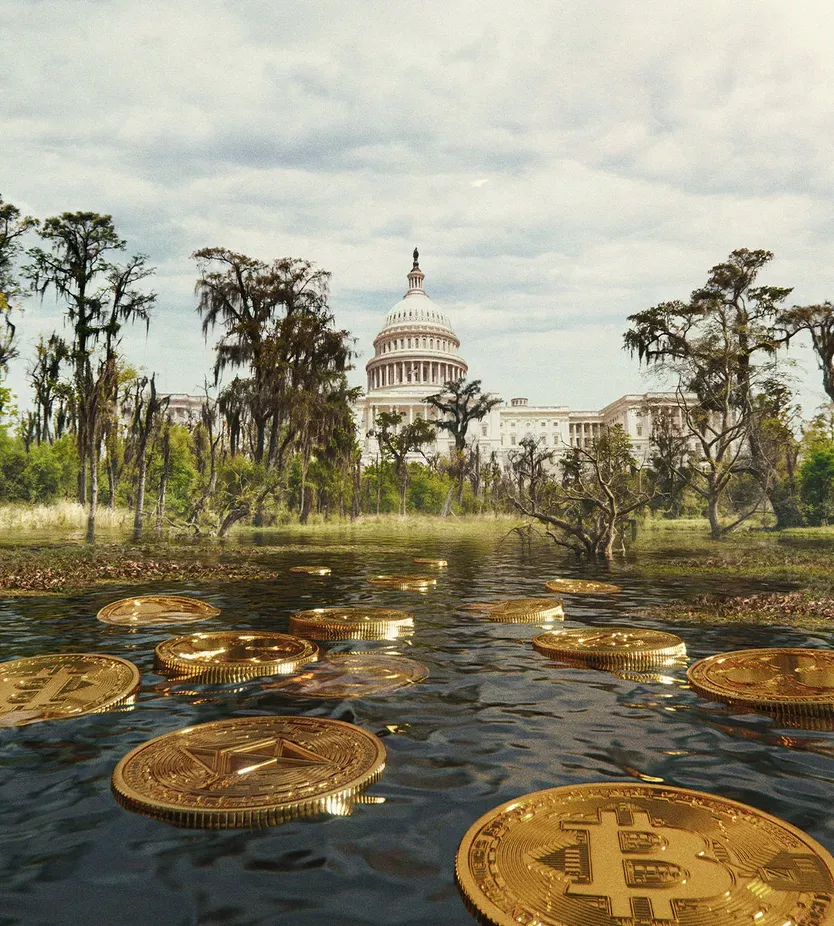
Обложка к статье. Данные: The Economist.

Заметка вышла под заголовком «Криптовалюта стала ультимативным болотным активом». Авторы отметил, что за последние несколько лет новое финансовое направление плотно укрепилось в американской общественной жизни.

«Криптоэнтузиасты помогают управлять регулирующими органами. Ведущие предприятия отрасли входят в число крупнейших доноров избирательных кампаний […]. Сыновья президента [США Дональда Трампа] рекламируют свои криптовалютные предприятия по всему миру. Крупнейшие инвесторы в мем-коины Трампа могут поужинать с ним. Активы первой семьи теперь оцениваются в миллиарды, что делает криптовалюту, возможно, крупнейшим источником ее богатства», — обратили внимание в издании.

Журналисты усмотрели в сложившейся ситуации иронию, поскольку биткоин изначально задумывался как «революция в финансах». Его последователи имели «высокие цели» по защите людей от инфляции и передаче власти розничным инвесторам.

«[Биткоин] был больше, чем актив: это была технология свободы», — заявили в The Economist.

Теперь изначальные идеи забыты, а криптовалюта способствует мошенничеству, отмыванию денег и другим преступлениям. По мнению авторов, индустрия также развила «грязные отношения» с исполнительной властью американского правительства, которые превосходят возможности Уолл-стрит или любой другой отрасли.

При этом различные юрисдикции вроде Евросоюза, Японии, Сингапура, Швейцарии и ОАЭ сумели в последние годы придать цифровым активам нормативную ясность без «безудержных конфликтов интересов». Кроме того, в некоторых частях развивающегося мира с высокой инфляцией и слабым банковским сектором криптовалюта по-прежнему выполняет «нечто вроде той роли, на которую когда-то надеялись ранние идеалисты».

«Все еще много спекуляций. Но криптовалюта постепенно начинает восприниматься более серьезно основными финансовыми фирмами и технологическими компаниями», — говорится в материале.

В качестве перспективного направления журналисты указали на токенизацию активов реального мира, которым уже занимаются крупные американские игроки, включая BlackRock и Franklin Templeton.

Наиболее распространенным вариантом использования цифровых активов по-прежнему остаются платежи — многие отраслевые фирмы уже применяют стейблкоины в некоторых расчетах.

Однако США рискуют упустить возможности, считают в издании. SEC под руководством Гэри Генслера скептически относилась к сектору, впутав криптокомпании в судебные разбирательства и запугав банки.

«Результатом является то, что криптовалюта в Америке нуждается в спасении от самой себя. Новые правила по-прежнему необходимы для гарантий того, что риски не выплеснутся на финансовую систему. Если политики, напуганные электоральной мощью отрасли, не смогут должным образом регулировать криптовалюту, долгосрочные последствия окажутся пагубными», — предупредили журналисты.

Напомним, сформированная Трампом в январе рабочая группа по рынкам цифровых активов обозначила в числе приоритетов разработку нормативно-правовой базы для стейблкоинов.

В мае законопроект о «стабильных монетах» (GENIUS Act) провалился на ключевом голосовании в Сенате США.

Related Reads

The Entire Internet Hails Noam's Joining, But OpenAI's Loss Bill Just Got Thicker

While the AI community celebrates Noam Shazeer, co-author of the "Attention Is All You Need" paper, joining OpenAI as Head of Architectural Research, the company's audited financials reveal a starkly different reality. In 2025, OpenAI reported $13.07 billion in revenue but a massive $20.92 billion operating loss. Even excluding a one-time accounting charge, the cash burn is severe, with $3.7 billion consumed in Q1 2026 alone. This high-profile hiring occurs against a backdrop of significant internal research talent drain, with key founders and researchers departing as the company's focus shifts from exploratory research to product iteration. Meanwhile, OpenAI's fundamental business model faces a deep crisis. It paid Microsoft $10.59 billion for compute in 2025, while its vast user base of 9 billion weekly actives includes only 50 million paying customers, making growth a direct driver of escalating costs. The article argues Shazeer's recruitment is less about technical necessity and more about crafting a compelling narrative for OpenAI's upcoming IPO, aiming to justify a rumored $1 trillion valuation to future public market investors. It contrasts OpenAI's strategy with Anthropic's reported path to profitability, which relies on a strong enterprise customer base and cost control, rather than star-powered narratives. Ultimately, the piece concludes that while Shazeer's architectural work may take 1-2 years to materialize, OpenAI's financial clock is ticking much faster, with its massive losses undercutting the celebratory headlines.

marsbit7m ago

The Entire Internet Hails Noam's Joining, But OpenAI's Loss Bill Just Got Thicker

marsbit7m ago

Market Trend (June 19): US-Iran Deal Drives Out Geopolitical Premium; Chip Stocks Soar to New Highs; Energy Sector Leads Declines

U.S. Market Trends (June 19): U.S.-Iran Deal Eases Tensions, Chip Stocks Soar, Energy Sector Leads Declines. U.S. stocks rallied on Thursday as the signing of a temporary U.S.-Iran deal in Geneva de-escalated Middle East tensions, with Saudi oil tankers transiting the Strait of Hormuz. This geopolitical relief helped markets recover from recent Fed-driven volatility. The S&P 500 rose over 1%, the Nasdaq gained nearly 2%, and the Dow Jones Industrial Average closed at another record high. The Philadelphia Semiconductor Index surged over 6% to a historic peak. Chip stocks were the standout performers. Reports of an Apple-Intel design and foundry deal for certain products, alongside mentions of potential Nvidia and SpaceX collaborations with Intel, propelled the sector. Intel surged ~10.5%, while memory chip makers like Micron also saw significant gains, highlighting sustained confidence in long-term AI capital expenditure. In contrast, the energy sector was the day's sole loser, with the S&P 500 energy sub-index declining as WTI crude fell ~2% to around $74.29/barrel. The reopening of key shipping routes erased prior geopolitical risk premiums. SpaceX extended losses for a second day on news of a potential large bond offering. Market volatility (VIX) dropped sharply, indicating a swift reversal of post-Fed jitters. Treasury yields dipped slightly but remained elevated. The focus now shifts to upcoming economic data, including next week's PCE inflation report and Micron's earnings, which will serve as a key test for the AI trade's durability.

marsbit29m ago

Market Trend (June 19): US-Iran Deal Drives Out Geopolitical Premium; Chip Stocks Soar to New Highs; Energy Sector Leads Declines

marsbit29m ago

Will MicroStrategy Fall Into a Death Spiral? How Will the Macro Outlook Evolve in the Second Half of the Year?

**Summary:** The discussion centers on recent Bitcoin price declines and the evolving financial strategy of MicroStrategy (MSTR). The core argument is that the primary pressure is not from one-off Bitcoin sales by MSTR, but from the market's new expectation that MSTR may need to engage in *sustained, small-scale* Bitcoin sales to cover cash flow obligations for its growing portfolio of preferred shares and debt instruments (like STRC). This shift is driven by its stated goal of maintaining "bitcoins per share neutrality." The market is now testing whether it can absorb this potential ongoing selling pressure without entering a severe "death spiral" with Bitcoin's price. A resolution may involve MSTR softening its approach to avoid damaging both its stock and Bitcoin. The conversation then explores the parallel rise of AI-related stocks. The guest posits that AI is fundamentally restructuring labor, with "tokens" (representing access to AI models/compute) becoming a new form of capital and a substitute for human execution. This drives corporate efficiency and profits, benefiting upstream hardware providers (semiconductors, data centers), which explains the sustained rally. This represents the early stages of a "machine economy." Regarding crypto exchanges offering US stock trading, this is seen as a natural evolution. With few crypto-native assets generating lasting value, exchanges are pivoting to distribute valuable real-world assets (RWAs). This doesn't necessarily harm crypto's long-term prospects, as blockchain infrastructure may become crucial for future machine-to-machine economies. The analysis concludes that the era of rampant altcoin speculation is likely over, heavily damaged by the liquidity shock of the "1011" event (likely referring to a major market crash). Meme-driven capital has largely migrated to US equities. Looking ahead, macroeconomic uncertainty is rising due to potential large IPOs (e.g., SpaceX) and the US elections. While short-term market corrections are possible, the long-term trends of AI-driven productivity gains and the maturation of blockchain towards real-world utility and institutional adoption remain intact.

marsbit33m ago

Will MicroStrategy Fall Into a Death Spiral? How Will the Macro Outlook Evolve in the Second Half of the Year?

marsbit33m ago

Will MicroStrategy Fall into a Death Spiral? What Will the Macro Trend Be in the Second Half of the Year?

The podcast features investor Didier discussing the recent Bitcoin downturn and the evolving strategy of MicroStrategy (MSTR). He argues the core pressure is not macro factors or ETF outflows, but the market pricing in an expectation that MSTR will engage in continuous, small-scale Bitcoin sales to fund its increasing preferred stock and debt obligations under its "bitcoin-per-share neutrality" principle. This creates a structural headwind. However, he is cautiously optimistic a "death spiral" is avoidable without new major shocks, as market support is likely to emerge at a certain price point. Didier then posits that the AI-driven bull market in US stocks (semiconductors, data centers) is fundamentally driven by AI agents and tokens becoming the "new labor force," displacing human roles and boosting corporate margins. This shift toward a machine economy is still in its early stages. He comments on crypto exchanges adding US stock trading, viewing it as a natural move toward valuable real-world assets as truly valuable crypto-native assets remain scarce. For crypto-native traders, he suggests existing strategies (e.g., meme-chasing or value investing) can translate to similar assets in US markets. The discussion notes the severe liquidity damage from the "1011 event" (likely referring to a major market crash) has essentially ended the altcoin cycle, with speculative momentum shifting to the more liquid US stock market. Regarding the macroeconomic outlook for H2 2024, Didier expresses increased caution due to potential market pressure from upcoming mega-IPOs (e.g., SpaceX) and US midterm election risks. Long-term, he remains bullish on AI's productivity gains and its convergence with blockchain/Web3, which he sees maturing into a more institutional, real-asset-focused phase.

链捕手36m ago

Will MicroStrategy Fall into a Death Spiral? What Will the Macro Trend Be in the Second Half of the Year?

链捕手36m ago

Trading

Spot
Futures
活动图片