Trump Advisor Follows MicroStrategy & Launches $BTC Investment Firm – BTC Bull Token Could Explode

bitcoinistPublished on 2025-05-09Last updated on 2025-05-09

Abstract

Buzz surrounding Bitcoin ($BTC) never ends. David Bailey, one of Donald Trump’s leading crypto advisors, recently raised a hefty $300M...

Trusted Editorial content, reviewed by leading industry experts and seasoned editors. Ad Disclosure

Buzz surrounding Bitcoin ($BTC) never ends. David Bailey, one of Donald Trump’s leading crypto advisors, recently raised a hefty $300M to invest in Nakamoto, a brand new $BTC investment firm.

Amid the $BTC-happy news, Bitcoin Bull Token ($BTCBULL) stands to thrive – and so can you.

Nakamoto Joins $BTC Giants, Fuels the OG Coin’s Future

Taking a leaf out of MicroStrategy and Metaplanet’s books, Nakamoto uplifts Bitcoin’s future by acquiring and holding sizable amounts of $BTC.

MicroStrategy holds 555,450 $BTC, which is now worth around $57.5B. Meanwhile, Metaplanet owns a sizable 4,855 $BTC (~$504M) and aims to double this amount by next year.
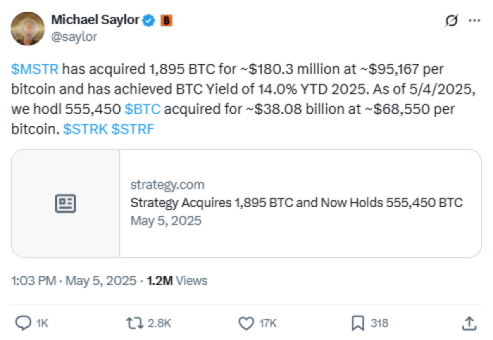
MicroStrategy Bitcoin holdings
Source: X (Michael Saylor, MicroStrategy’s founder)

And now there’s Nakamoto, which has secured $200M worth of $BTC in equity plus an additional $100M in convertible notes.

Alongside this significant institutional interest, more entrepreneurs worldwide are eyeing Bitcoin to build wealth.

Seizing this moment, Nakamoto aims to inject $BTC into firms worldwide, with ones based in Brazil, Thailand, and South Africa strategically at the top of its radar.

As the appetite for $BTC grows, projects like $BTCBULL offer crypto bulls a timely opportunity to capitalize on the OG coin’s highly anticipated surge.

BTC Bull Token Airdrops Free $BTC as Its Value Climbs

Imagine being airdropped the world’s largest cryptocurrency when $BTC reaches $150K and $200K. Well, $BTCBULL does precisely that.

Given that Nakamoto, MicroStrategy, and Metaplanet own over $58.2B $BTC combined, and thus reinforce trust in the asset across the board, $BTC hitting these targets aren’t out of the equation.

Beyond receiving free $BTC, you can also anticipate winning $BTCBULL when $BTC reaches $250K.

As $BTC nears $103K, this is another milestone that’s within reach, primarily considering that American entrepreneur Arthur Hayes foresees it rocketing to $1M.

Also turning heads to BTC Bull Token is that it burns a portion of its total token supply every time $BTC jumps $50K. Based on the fundamental supply and demand formula, it creates a deflationary effect that could boost the value of the remaining coins.

BTC Bull Token burn milestones
Source: BTC Bull Token

Straight after buying $BTCBULL, you can also stake the token to enjoy passive income at a commendable 75% APY.

Capitalize on Bitcoin’s Bullish Trend With $BTCBULL

Exemplified by firms like Nakamoto, MicroStrategy, and MetaPlanet, $BTCBULL hinges on the increasing institutional interest in $BTC.

By joining the ranks of $BTCBULL early investors, you can take advantage of Bitcoin’s future price appreciation without directly purchasing the asset.

One $BTCBULL currently only costs $0.0025. It’s predicted to spike by over 158% to $0.006467, so there’s no better time to join.

For eligibility, all you need to do is buy $BTCBULL on Best Wallet, our #1 anonymous crypto wallet. You can also save on transaction fees by purchasing $BEST, its native token.

However, this isn’t investment advice. You must always DYOR and never spend more than your piggy bank allows. Even the best crypto to buy now can tumble as quickly as they rocket.

Editorial Process for bitcoinist is centered on delivering thoroughly researched, accurate, and unbiased content. We uphold strict sourcing standards, and each page undergoes diligent review by our team of top technology experts and seasoned editors. This process ensures the integrity, relevance, and value of our content for our readers.

Bitcoinist is the ultimate news and review site for the crypto currency community!

Related Reads

Zuckerberg Begins Betting on Prediction Markets, While Asian Countries Still View Them as Gambling

Mark Zuckerberg is backing prediction markets, with Meta developing its own app "Arena," signaling major tech validation. This industry now sees over $14 billion in monthly volume. These markets function as binary contracts (payout $1 if an event occurs, $0 if not), with trading prices reflecting real-time event probabilities. Results are settled by oracles. Prediction markets originated from informal political betting and academic experiments like the Iowa Electronic Markets. Their core mechanism relies on "skin in the game"—participants risk their own money, making aggregated information more reliable than polls or expert opinions. They have proven accurate in forecasting areas like monetary policy, elections, and market events. While Western markets are integrating them into regulated financial systems, many Asian jurisdictions still classify them as gambling, leading to regulatory divergence. This stance creates three major issues for Asia: regulatory arbitrage and capital outflow, loss of informational sovereignty as valuable social data accumulates offshore, and a lack of user protection within a formal framework. The article argues that Asia's focus should shift from blocking these markets to responsibly harnessing the data they generate within a regulated system. The current avoidance of discussion cedes leadership and advantages to foreign entities.

Foresight News12m ago

Zuckerberg Begins Betting on Prediction Markets, While Asian Countries Still View Them as Gambling

Foresight News12m ago

Beyond Private Keys: From Wallets and L2 to Supply Chains, How to Guard the Security Perimeter of Web3?

Beyond Private Keys: Securing Web3's Expanding Attack Surface from Wallets to L2s and Supply Chains The crypto space faced a wave of security incidents in June, with over $75 million lost across 40 major attacks. These breaches highlighted risks beyond private key theft, exposing vulnerabilities across the entire user interaction chain. Wallet security was compromised not through stolen seed phrases, but via a critical flaw in the Cardano wallet SecondFi's signing implementation. This bug allowed attackers to potentially derive private keys from publicly visible signature data, emphasizing that wallet security depends on correct cryptographic implementation, ideally in open-source, auditable code. Layer-2 networks also revealed complex trust chain risks. Attacks on legacy Aztec deployments exploited inconsistencies in proof systems, showing that a valid zero-knowledge proof is only as secure as its underlying rules. Another attack on Taiko's SGX-based prover stemmed from a leaked signing key and inadequate verification checks. Furthermore, a technical glitch halted Base's block production, underscoring that L2 security encompasses network availability and reliable user exit paths as much as asset safety. Finally, the Polymarket incident demonstrated that even audited smart contracts are not immune. A compromised third-party supplier led to a malicious script being injected into the platform's frontend, resulting in user fund losses. This "supply chain attack" shows that the security of the entire interaction path—from the webpage to the wallet signature—is critical. The conclusion is clear: Web3 security now involves safeguarding the entire journey from transaction intent to on-chain settlement. Users must adopt layered security habits: isolating long-term holdings, using dedicated wallets for daily interactions, scrutinizing transaction details before signing, and managing authorizations cautiously. Defense must evolve from protecting a single point (the private key) to securing a complete chain of interactions.

marsbit1h ago

Beyond Private Keys: From Wallets and L2 to Supply Chains, How to Guard the Security Perimeter of Web3?

marsbit1h ago

Robinhood Chain Goes Viral in One Week: Memes Drive Traffic, Stablecoins Support TVL

Robinhood Chain, an Arbitrum-based Layer 2 network launched on July 1st, experienced explosive growth in its first week. While meme coin hype drove user activity, stablecoin deposits fueled its surge in Total Value Locked (TVL). The chain's rapid adoption was driven by multiple factors. CEO Vlad Tenev reversed his initial stance, endorsing the chain for meme coins despite its original focus on Real-World Assets (RWA). The integration of the popular Solana-based launchpad Pump.fun significantly lowered the barrier for meme trading. Furthermore, the prediction market application World announced a migration from Solana to Robinhood Chain. Meme coin mania, led by tokens like CASHCAT, generated massive trading volume, with daily active addresses skyrocketing from near zero to hundreds of thousands. However, the primary driver of the chain's TVL, which soared past $234 million, was a major institutional deposit. Ethena injected approximately $50 million in stablecoins into the Morpho lending protocol, which underpins Robinhood's Earn product, accounting for the bulk of locked value. This highlights two concurrent narratives: retail-driven meme speculation boosting transactions, and institutional stablecoin deposits building foundational liquidity. In contrast, the chain's flagship RWA offerings, like tokenized stocks, remain a minor part of the ecosystem at around $12.8 million. The first week demonstrates a path where speculative trading and yield-seeking capital provide initial momentum, while the core RWA vision is still in early development.

Foresight News1h ago

Robinhood Chain Goes Viral in One Week: Memes Drive Traffic, Stablecoins Support TVL

Foresight News1h ago

Trading

Spot
活动图片