Institutional Players Bet an Extra $509.9M on Solana Treasury – Solaxy Might Help Solana Top Ethereum

bitcoinistPublished on 2025-04-25Last updated on 2025-04-25

Abstract

Two major institutional players – SOL Strategies and DeFi Development Corp – recently injected $509.9M combined into their Solana treasury...

Trusted Editorial content, reviewed by leading industry experts and seasoned editors. Ad Disclosure

Two major institutional players – SOL Strategies and DeFi Development Corp – recently injected $509.9M combined into their Solana treasury incentives. The investment strategy echoes MicroStrategy, but this time, it’s Solana ($SOL) rather than Bitcoin ($BTC).

These sizable capital inflows into $SOL suggest a bright future for Solaxy, the world’s first Solana Layer-2 (L2) network that’s designed to give the network a leg up during heightened demand.

Its native token, $SOLX (a new meme coin on presale), might even be the catalyst Solana needs to outpace Ethereum in market dominance.

SOL Strategies’ Solana Treasury Grows to $540M+

SOL Strategies currently holds $40.4M worth of $SOL and secured an additional $500M on Wednesday, bringing its total holdings to $540.4M.

Much of this $SOL will be locked into the network. It’ll enhance Solana’s stake participation, boost network security, and lower the token float – each of which could significantly raise the token’s price.

On the same day, DeFi Development Corp purchased $9.9M worth of locked $SOL through BitGo’s over-the-counter desk. While not yet transferable on-chain, the assets were acquired at a discount. This way, the firm was able to expand its long-term Solana treasury to a commendable $48M.

$SOL Jumps 20% as Buying Pressure Heats Up

Supported by these recent institutional inflows and buoyed by favorable market sentiment, $SOL is up by 20% in the past two weeks, outpacing both $BTC and $ETH.

These large-scale capital commitments signal strong confidence in Solana’s long-term potential. Given Ethereum’s lagging performance, some investors and firms even say that $SOL could outperform $ETH as the second-largest crypto.

‘Solana looks to be eating Ethereum’s lunch. As more investors tire of waiting for Ethereum to perform, they’ll likely defect to Solana, and that will increase demand for the coin.’Nasdaq.

With $SOL’s Relative Strength Index (RSI) at 66.54, this viewpoint might not be a far cry. The technical indicator reflects intense buying pressure and market confidence as the asset edges close to overbought territory (70).
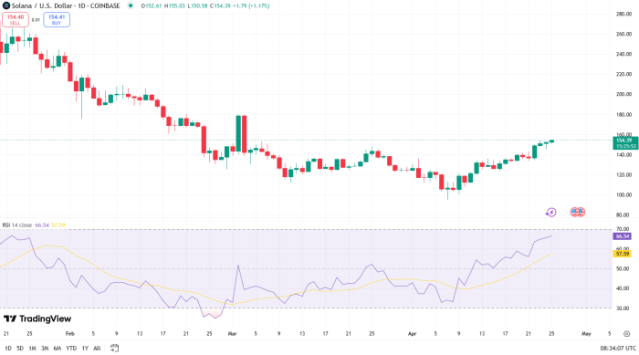
Solana Relative Strength Index (RSI) on TradingView
Source: TradingView

Solana’s Network Speed Isn’t Without Its Woes

But despite Solana being broadly known for its high speed and low fees, it isn’t immune to a common key vulnerability: Network congestion during peak demand.

As adoption grows, often driven by the best meme coins, DeFi protocols, and – now – major institutional investment, Solana’s throughput might hit its limits (again!).

Look at when Donald and Melania Trump launched their official meme coins – $TRUMP and $MELANIA – in mid-January, for instance. No new transactions were recorded on SolScan for thirty minutes, which highlighted significant network congestion.

Such an incident suggests that Solana needs stronger infrastructure to handle unpredictable traffic surges. Thankfully, Solaxy is being built to solve this problem.

Solaxy to Step In When Solana Stalls

By offloading transactional volume and processing micro-transactions off-chain, Solaxy will prevent congestion-related failures like those seen during the Trump token launches.

Its native token, $SOLX, is the gateway to this upcoming L2 network.

It’ll also enable seamless cross-chain transfers between Solana and Ethereum. This way, you can easily move your assets across two major platforms and gain access to a wider user base.
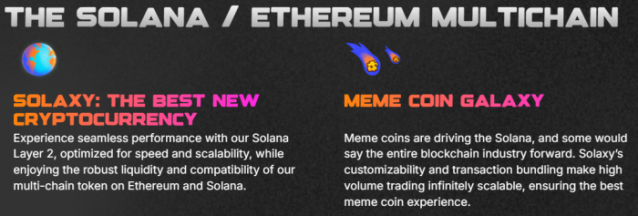
 Solaxy is a multichain network
Source: Solaxy

Consequently, $SOLX is currently one of the best crypto presales to invest in right now, having already attracted over $31.5M.

Beyond its L2 innovation, the $SOLX presale attracts attention with its high-yield staking opportunity, which offers 129% APY. A substantial 25% of the token supply is set aside for such rewards.

Considering that an additional 30% of its supply cap is also allocated for development, sustained growth for the Solaxy ecosystem is in sight.

Buy $SOLX to Help Solana Flip Ethereum

As institutional confidence in Solana grows, and an additional $509.9M pours into Solana treasury incentives, it’s evident that $SOL is becoming a serious contender against $ETH.

However, with greater momentum comes greater demand, and the Solana network has a history of feeling the pressure.

Luckily, this is where Solaxy enters the picture. As the first Solana L2, it could be the gateway to Solana’s long-term resilience and overtaking $ETH in market dominance.

But for Solana to reach this next level, scaling efficiently while maintaining top performance under pressure, supporting the Solaxy ecosystem matters.

To actively participate in the infrastructure that has what it takes to boost Solana’s future, you can buy $SOLX on presale for just $0.001704.

Solaxy’s launch is predicted to push its price to $0.032 by the end of the year, a 17x increase compared to its current value, so there’s no better time to join.

Disclaimer: This is not financial advice. Crypto investments are volatile and carry risks. You should never invest more than you’d be sad to lose.

Editorial Process for bitcoinist is centered on delivering thoroughly researched, accurate, and unbiased content. We uphold strict sourcing standards, and each page undergoes diligent review by our team of top technology experts and seasoned editors. This process ensures the integrity, relevance, and value of our content for our readers.

Bitcoinist is the ultimate news and review site for the crypto currency community!

Related Reads

Topping GitHub's Trending, the Essential Guide for Claude Code Users

The CLAUDE.md file, trending on GitHub, is a project-level guide for Claude Code designed to dramatically improve its accuracy and efficiency. It addresses key issues like repetitive context explanations, unauthorized code changes, and forgotten decisions across sessions. By placing this plain-text file in a project root, Claude Code reads it automatically at the start of each session. The guide includes rules to eliminate redundant explanations, enforce strict behavioral constraints (e.g., no modifications outside the requested scope without confirmation), and establish a "memory" system using companion files like MEMORY.md and ERRORS.md to log past decisions and failures. It also locks in the project's specific tech stack to prevent inappropriate tool recommendations. Highlighted are four foundational rules from Andrej Karpathy that reportedly increased coding accuracy from 65% to 94%: always ask for clarity first, implement the simplest solution, never touch unrelated code, and explicitly flag uncertainties. The article quantifies significant weekly cost savings for developers and teams by eliminating wasted time on re-explaining context, rolling back unauthorized edits, and re-evaluating previously rejected solutions. The core message is that a small, upfront investment in creating a CLAUDE.md file leads to a more predictable, controlled, and cost-effective AI programming assistant.

marsbit25m ago

Topping GitHub's Trending, the Essential Guide for Claude Code Users

marsbit25m ago

When Computing Power Becomes Commoditized, How Long Until a GPU Futures Market Emerges?

"When Will GPU Futures Arrive? A Framework for Assessing Compute as a Commodity" The article explores the potential for a robust futures market for compute power (GPUs), arguing that such a market is not yet mature but may emerge. It analyzes the landscape using a five-part framework developed for new commodity futures markets. The analysis scores the current state: * **Fragmented Supply (Red)**: Supply is highly concentrated among hyperscale cloud providers (AWS, Azure, GCP, Oracle), limiting the need for price discovery. * **Price Volatility (Green)**: GPU pricing is already highly volatile due to uncertain supply and surging demand. * **Physical Settlement Infrastructure (Green)**: Early infrastructure exists via OTC brokers and price indices (e.g., Ornn, Silicon Data) standardizing contracts. * **Standardized Unit (Red)**: A lack of standardized, tradable units hinders markets; a GPU instance hour varies by region, configuration, and contract terms. * **Lack of Alternatives (Yellow)**: Large players hedge internally via vertical integration, while smaller players bear spot market risk. Overall, the market shows promise (volatility, early infrastructure) but lacks the fragmented supply and standardization needed for large-scale futures trading. Most activity remains OTC. Key open questions and hypotheses: 1. Supply is expected to fragment moderately in 1-2 years, driven by new cloud providers, cheap power locations, and demand from non-frontier labs and AI startups using open-source models. 2. Standardization is most likely to emerge around inference workloads (forecast to be >65% of AI compute demand by 2029), which have simpler, more homogeneous hardware needs than training. Widespread adoption of open-source model weights could accelerate this by democratizing inference and creating demand for optimized, standardized infrastructure. 3. The primary traded unit will likely be the **"chip instance hour"** (akin to electricity, traded regionally), not the physical chip or the downstream AI output (tokens).

marsbit54m ago

When Computing Power Becomes Commoditized, How Long Until a GPU Futures Market Emerges?

marsbit54m ago

When Computing Power Becomes Commoditized, How Long Until a GPU Futures Market?

When Compute is Commoditized: How Far Away is a GPU Futures Market? The article explores the potential emergence of a futures market for computing power ("compute"), akin to markets for commodities like oil or electricity. It uses a five-dimension framework to assess the market's maturity for sustaining robust futures trading. **Current Market Assessment (Scorecard):** * **Supply Fragmentation:** 🔴 **Red.** Supply is highly concentrated, dominated by a few hyperscale cloud providers. * **Price Volatility:** 🟢 **Green.** GPU pricing is already highly volatile. * **Physical Settlement Infrastructure:** 🟢 **Green.** Early infrastructure exists at the OTC/broker level. * **Standardization:** 🔴 **Red.** Compute lacks a standardized, tradable unit (e.g., an H100 hour is not uniform). * **Lack of Substitutes:** 🟡 **Yellow.** Vertically integrated players can hedge internally, while others are forced to be long. **Conclusion:** The overall scorecard suggests a robust futures market is premature. The market has volatility and early settlement infrastructure but lacks the necessary supply fragmentation and standardization for large-scale price discovery. Most activity remains OTC. **Key Unanswered Questions & Hypotheses:** The article posits that the market could evolve in the next 1-2 years: 1. **Supply:** May become *moderately more fragmented* due to new cloud providers, cheaper power locations, and demand from long-tail users (e.g., startups running open-source model inference). 2. **Standardization:** Could emerge from the growing **inference** workload (expected to be >65% of AI compute demand by 2029), which has more homogeneous hardware requirements than custom training workloads. Widespread adoption of **open-source model weights** is seen as a key catalyst for democratizing inference and driving infrastructure standardization. 3. **Traded Unit:** The most viable layer for trading is likely the **"chip-instance-hour"** (powered, usable compute time), traded similarly to electricity in regional contracts with spot/futures overlays. Trading at the upstream "chip" layer is unlikely due to supply concentration, while the downstream "token" layer faces challenges due to lack of uniformity across AI models.

链捕手59m ago

When Computing Power Becomes Commoditized, How Long Until a GPU Futures Market?

链捕手59m ago

Trading

Spot
Futures

Hot Articles

Discussions

Welcome to the HTX Community. Here, you can stay informed about the latest platform developments and gain access to professional market insights. Users' opinions on the price of ETH (ETH) are presented below.

活动图片