Цена биткоина сегодня: стабильно на уровне 84 тыс. $ на фоне ограниченных тарифных послаблений

investing.ruPublished on 2025-04-14Last updated on 2025-04-14

Investing.com — Биткоин стабилизировался в понедельник на фоне незначительного улучшения аппетита к риску после объявления о некоторых исключениях из торговых тарифов США против Китая, хотя опасения по поводу усиления торговой войны продолжают держать трейдеров в напряжении.

Криптовалютные рынки переживали резкие колебания в течение последних нескольких недель, поскольку торговая война между крупнейшими экономиками мира резко обострилась, нанося удар по глобальным рисковым рынкам.

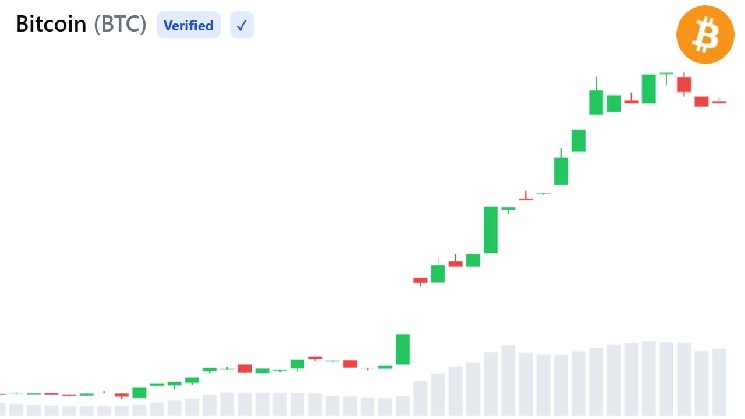
Биткоин падал до отметки 74 000 $, хотя быстро восстановился от этих минимумов после того, как президент США Дональд Трамп сделал масштабные уступки в планах по введению торговых тарифов для основных торговых партнеров. Однако Китай не был включен в эти уступки.

Крупнейшая криптовалюта мира снизилась на 0,2% до 84 447,0 $ к 09:13 по московскому времени.

Биткоин стабилизируется на фоне некоторых тарифных послаблений

Биткоин в значительной степени отставал от сильного роста более широких рисковых активов в понедельник. Но криптовалюта все же стабилизировалась после недавних потерь после того, как Белый дом заявил, что электронные импортные товары из Китая, которые составляют основную часть торгового профицита страны с США, будут освобождены от ответных тарифов Трампа.

Это помогло смягчить некоторые непосредственные опасения по поводу влияния тарифов Трампа на экономику США.

Однако в воскресенье Трамп заявил, что это временная мера, и что скоро он объявит отдельные тарифы на электронику и полупроводники.

Трамп увеличил свои тарифы на Китай до совокупных 145%, что вызвало ответные тарифы в размере 125% со стороны Пекина на фоне быстро обостряющейся торговой войны между крупнейшими экономиками мира.

Эта ситуация по-прежнему держит трейдеров в напряжении, ограничивая привлекательность рисковых активов, таких как криптовалюты. Спекулятивные активы, такие как криптовалюты, как правило, показывают низкие результаты в периоды экономической неопределенности, в то время как защитные активы, такие как золото и японская иена, демонстрируют лучшие показатели.

Также было замечено, что трейдеры обеспокоены возросшими ожиданиями рецессии в США, что еще больше подрывает аппетит к риску.

Майкл Сэйлор намекает на дополнительные покупки биткоина

Майкл Сэйлор, председатель Strategy (NASDAQ:MSTR), крупнейшего корпоративного держателя биткоина, намекнул, что компания может приобрести больше монет, особенно на фоне недавнего падения цен.

Сэйлор сделал несколько загадочных публикаций в социальной сети X (ранее Twitter (NYSE:TWTR), заблокирован на территории РФ), включая трекер владения BTC, что в прошлом предвещало покупки биткоина компанией Strategy.

Публикации Сэйлора появились всего через несколько дней после того, как Strategy раскрыла нереализованный убыток в размере 5,9 млрд $ по своим цифровым активам.

Strategy приобрела 80 715 биткоинов в течение первого квартала 2025 года.

Цены на криптовалюты сегодня: альткоины стабильны на фоне торговой напряженности

Цены на более широкий спектр криптовалют двигались в узком диапазоне в понедельник. Вторая по величине криптовалюта мира Ether выросла на 0,4% до 1 622,57 $, в то время как XRP упал на 0,4% до 2,1331 $.

Solana выросла на 2,7%, в то время как Cardano и Polygon упали на 0,6% и 3,2% соответственно.

Среди мем-токенов Dogecoin остался без изменений, в то время как $TRUMP упал на 3,1%.

Эта статья была переведена с помощью искусственного интеллекта. Для получения дополнительной информации, пожалуйста, ознакомьтесь с нашими Условиями использования.


Related Reads

Precious Metals Decline Alongside, What Signal is Gold Sending to the Market?

Gold and silver prices have declined recently, moving in tandem with a sell-off in risk assets like South Korean semiconductor stocks. This is unusual, as gold typically rises when equities fall due to its safe-haven status. The synchronized drop signals a shift in market focus: it's not about finding safety, but about the rising cost of holding assets that do not yield interest. This cost is the real interest rate. The key driver is a change in Federal Reserve policy expectations under new Chair Kevin Warsh. Despite holding rates steady, the Fed's rhetoric has turned more hawkish, emphasizing persistent inflation risks. This has led markets to price in a "higher for longer" rate environment, increasing the appeal of cash and bonds while pressuring zero-yield assets like gold and tech stocks with high future cash flow valuations. Technically, gold breached the $4,100/oz support level, approaching the critical $4,000 psychological and technical zone. A break below could trigger accelerated selling from momentum traders and ETFs. While long-term supportive factors like central bank buying and geopolitical risks remain, short-term price action is dominated by liquidity and opportunity cost dynamics. The South Korean market meltdown, driven by crowded AI-trade unwinding, is a symptom—not the cause—of this broader macro repricing. Both markets are reacting to the same pressures: higher real rates and a stronger US dollar. In summary, the concurrent decline in equities and precious metals highlights that diverse assets can share exposure to a common macro variable—the price of money. The near-term path for gold and silver depends primarily on the persistence of Fed hawkishness, dollar strength, and real yields, which currently override their traditional safe-haven narratives.

marsbit7m ago

Precious Metals Decline Alongside, What Signal is Gold Sending to the Market?

marsbit7m ago

Chip Stocks Lead U.S. Market Decline: Is AI Trading Being Hit by Both Interest Rates and Returns?

Chip stocks led a broad decline in US markets, with the Nasdaq dropping 2.2% and the S&P 500 falling 1.4%. This selloff reflects a dual challenge for the once-high-flying AI hardware trade: rising interest rate expectations and growing investor impatience for clear returns from massive AI capital expenditures. The pressure was most acute on hardware leaders. Nvidia fell about 4%, dipping below a $5 trillion market cap, while Micron plunged 13.2% ahead of its earnings report. Declines across memory, storage, AI, and mobile chips indicated a sector-wide retreat. The selloff spread globally, with South Korea's KOSPI index dropping nearly 10% as key suppliers SK Hynix and Samsung recorded double-digit losses. Investors appeared to be taking profits from the most crowded trades first. Macro headwinds intensified as market expectations shifted toward a more aggressive Federal Reserve. Forecasts for multiple rate hikes in 2026 pressured high-valuation tech stocks, which rely on long-term growth projections that become less attractive as discount rates rise. Concurrently, investors are scrutinizing the profit potential of the immense AI spending by cloud giants like Alphabet, Amazon, and Meta. While these expenditures drive demand for chips and hardware, the market is now questioning whether AI services will generate sufficient returns to justify the ongoing costs. This adjustment is not necessarily a bubble burst but a recalibration. AI demand fundamentals remain, but the narrative of endless growth can no longer fully offset concerns over higher interest rates and a longer path to profitability. Near-term direction may hinge on Micron's upcoming earnings guidance and incoming inflation data, which will influence both the AI demand outlook and the Fed's policy path. The market is transitioning from blindly buying growth to demanding clearer visibility on returns.

marsbit1h ago

Chip Stocks Lead U.S. Market Decline: Is AI Trading Being Hit by Both Interest Rates and Returns?

marsbit1h ago

OpenAI's New Paper: How to Train an AI that "Doesn't Deteriorate Under Pressure"?

OpenAI's new paper "Reinforcement Learning Towards Broadly and Persistently Beneficial Models" explores training AI to maintain safe, helpful, and honest behavior even under pressure, in unseen scenarios, or after being fine-tuned for harmful purposes. Moving beyond simple rule-based "don'ts," the research focuses on cultivating "beneficial traits" like honesty, risk-awareness, corrigibility, and transparency. It investigates if reinforcement learning (RL), often prone to "reward hacking" where models exploit loopholes, can instead be used to instill robust, generalized positive behaviors. Researchers created a multi-domain synthetic dialogue dataset covering areas like healthcare and law. They trained a model by replacing 5% of standard RL data with "beneficial trait" data. This model outperformed the baseline in 83% of 53 evaluations, showing average gains of 9.1% in alignment, safety, and helpfulness. Crucially, improvements generalized: a model trained only on healthcare "good behavior" data also performed better in 17 out of 19 non-healthcare alignment tests. The paper also tests "alignment persistence." When subjected to adversarial prompts or harmful fine-tuning, the beneficial trait model showed greater resilience, with smaller performance drops and less "spillover" of bad behavior to unrelated tasks. While not a complete solution, this work suggests a shift from post-hoc correction to proactively shaping robust, principled AI behavior, a critical step for deploying models in high-stakes, complex decision-making scenarios.

marsbit1h ago

OpenAI's New Paper: How to Train an AI that "Doesn't Deteriorate Under Pressure"?

marsbit1h ago

Trading

Spot
Futures
活动图片