Magic Internet Money token depegs as Terra (LUNA) domino effect persists

CointelegraphPublished on 2022-06-18Last updated on 2022-06-18

Abstract

Citing an insider scoop, Autism Capital claimed that Abracadabra accrued $12 million in bad debt as a direct result of Terra’s sudden downfall, which has been refuted by founder Daniele Sestagalli.

Magic Internet Money (MIM), a US dollar-pegged stablecoin of the Abracadabra ecosystem, joins the growing list of tokens losing their $1 value amid an untimely crypto winter. The sudden de-pegging of the MIM token commenced roughly on June 17, 7:40 pm ET, which saw the token’s price drop to $0.926 in just three hours.

Terra’s LUNA and TerraUSD (UST) death spiral not only affected the investors but also had a negative impact on numerous crypto projects, including Abracadabra’s MIM token ecosystem — as alleged by Twitter handle @AutismCapital.

Depegging of Magic Internet Money (MIM) token price chart. Source: CoinMarketCap

Citing an insider scoop, AutismCapital claimed that Abracadabra accrued $12 million in bad debt as a direct result of Terra’s sudden downfall “because liquidations couldn't happen fast enough to cover the protocol's MIM liabilities.”
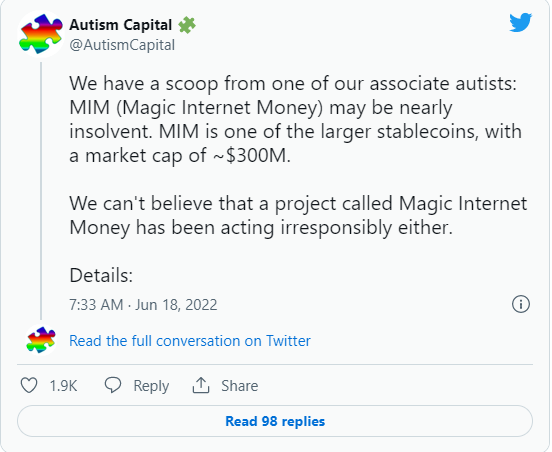
Daniele Sestagalli, the founder of Abracadabra, however, refuted the claims of insolvency by ensuring to have enough funds to pay back the piling debts — which has been attributed to the falling MIM prices. Sestagalli stated: “[The Abracadabra] Treasury has more money than the debt and $CRV are valuable for the protocol.”

Doubling down on his stance, Sestagalli further publicly shared the treasury address holding $12 million in assets while asking concerned investors to verify the same using on-chain data.

On the other hand, Autism Capital alleged that Sestagalli’s bad debt was created five days ago and shared the below screenshot showing his conversation about the same on MIM’s Discord group.

Sestagalli’s conversation on MIM Discord group. Source: @AutismCapital

While the risk of insolvency continues to threaten the Abracadabra protocol, either through the MIM treasury continuing to dump in value or more bad debt created, investors are advised to keep track of market fluctuations and do their own research (DYOR) before making investment decisions. 

Five days ago, on June 13, Stablecoin protocol USDD’s price dipped to $0.97 on major crypto exchanges.
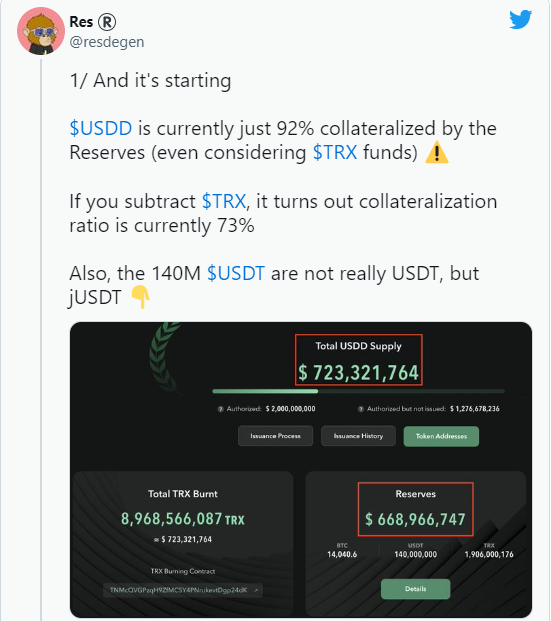
To help out during the market fluctuations, the Tron DAO Reserve announced that it received 700 million USD Coin (USDC) to defend the USDD peg. As a result of the fund infusion, the team behind the stablecoin explained that the collateralization ratio of USDD is now boosted to 300%.


Related Reads

$9.4 Billion: The Largest Robotics Funding This Year Has Emerged

Munich-based humanoid robotics company Neura has completed a $1.4 billion (approximately RMB 94.9 billion) Series C funding round, valuing the company at around $7 billion and positioning it among the global leaders in the sector. The investment round is notable not just for its size—reportedly the largest in robotics this year—but also for its strategic backers, which include tech giants like NVIDIA and Amazon, alongside established industrial players such as German engineering firms Bosch and Schaeffler. This mix of investors signals a significant shift in the industry's focus from technological demonstrations and general-purpose narratives toward practical, industrial deployment and commercialization. Neura's approach centers on developing humanoid robots for defined, high-value industrial tasks rather than pursuing a general-purpose model. Its early validation comes from a partnership with BMW, where its robots are being tested on actual production lines. The involvement of Bosch and Schaeffler, companies deeply embedded in global manufacturing, underscores a growing belief that humanoid robots are transitioning from labs to viable factory-floor solutions. The article highlights two converging trends driving investment: advancements in AI and large language models, which enhance robots' perception and decision-making in unstructured environments, and mounting pressure from labor shortages and rising costs in major manufacturing regions. The funding landscape is now bifurcating between companies like Figure AI, focusing on versatile general-purpose robots, and firms like Neura, targeting specific vertical industrial applications with clearer, shorter paths to ROI. While technical hurdles remain, the core challenges for widespread adoption are increasingly seen as engineering and commercial in nature: managing the high integration and customization costs for different factory environments and establishing robust, localized maintenance and service networks. The record investment in Neura, particularly from industrial capital, indicates the industry's growing confidence in moving from proving feasibility to solving the practical problems of scalability, reliability, and building sustainable business models around humanoid robots in real-world settings like automotive manufacturing and hazardous labor environments.

marsbit9h ago

$9.4 Billion: The Largest Robotics Funding This Year Has Emerged

marsbit9h ago

Trading

Spot
Futures
活动图片