Сбудется ли обещание Altseason? Сопротивление биткоина и тревожное ожидание альткоинов

cryptonews.ruPublished on 2022-01-22Last updated on 2025-03-22

  • Сокращение притока биткоинов и ослабление импульса могут задержать сезон альткоинов до 2026 года.
  • Капитализация рынка криптовалют сталкивается с сопротивлением в $2,74 трлн на фоне ухудшения настроений инвесторов.
  • Эфириум и основные альткоины испытывают трудности, что вызывает сомнения относительно прорыва сезона альткоинов в ближайшем будущем.

Аналитики в настоящее время отслеживают рынок криптовалют, пытаясь оценить, когда может начаться следующий «альтернативный сезон». CryptoBullet указывает на типичный четырехлетний рыночный цикл, ожидая, что он завершится где-то в октябре или ноябре 2025 года.

Эта временная шкала предполагает, что альткоины могут увидеть всплеск в течение следующих восьми месяцев. Однако текущий рынок демонстрирует некоторую нерешительность, особенно с учетом того, что Ethereum и другие альткоины не демонстрируют сильного импульса, что приводит к вопросам о возможной задержке до 2026 года.

According to the 4-year cycle theory, this cycle should end in October-November 2025. So we basically have 8 months to see #Altseason ⌛️

Given the poor performance of $ETH & $ALTs that we have seen so far, do you believe this cycle can break the classic 4-year cycle and last… pic.twitter.com/kbElQBHZIB

— CryptoBullet (@CryptoBullet1) March 20, 2025

Ожидаемые сроки Altseason и какие рыночные сигналы указывают на обратное?

Али Мартинес проанализировал индикатор Altseason Bitcoin. Он отметил пик Bitcoin в $96 715,57 10 декабря 2024 года, когда Bitcoin привлек $0,13 млн капитала, Ethereum $0,06 млн и стейблкоины $0,10 млн. К 16 марта 2025 года Bitcoin упал до $82 599,04. Приток также упал: Bitcoin получил всего $0,007 млн, Ethereum $0,024 млн и стейблкоины $0,020 млн.

Родственный: Altseason приближается? Уровни прорыва для крупного ралли альткоинов — аналитик

Индикатор альтсезона снизился с 1 до 0,33, сигнализируя об ослаблении импульса. Это говорит о том, что альтсезон может застопориться, если биткоин не начнет значительное восстановление. Мартинес предупреждает, что если биткоин пробьется ниже 80 000 долларов, это может указывать на дальнейшее снижение. И наоборот, подъем выше $90 000 может возродить доверие инвесторов.

No signs of altseason yet! pic.twitter.com/RYkeIoYaRm

— Ali (@ali_charts) March 20, 2025

По теме: Altseason Watch: XRP, ADA, SUI лидируют в ценовом скачке плюс еще пять, за которыми стоит следить

Какие инсайты дают индикатор Bitcoin Alt Season?
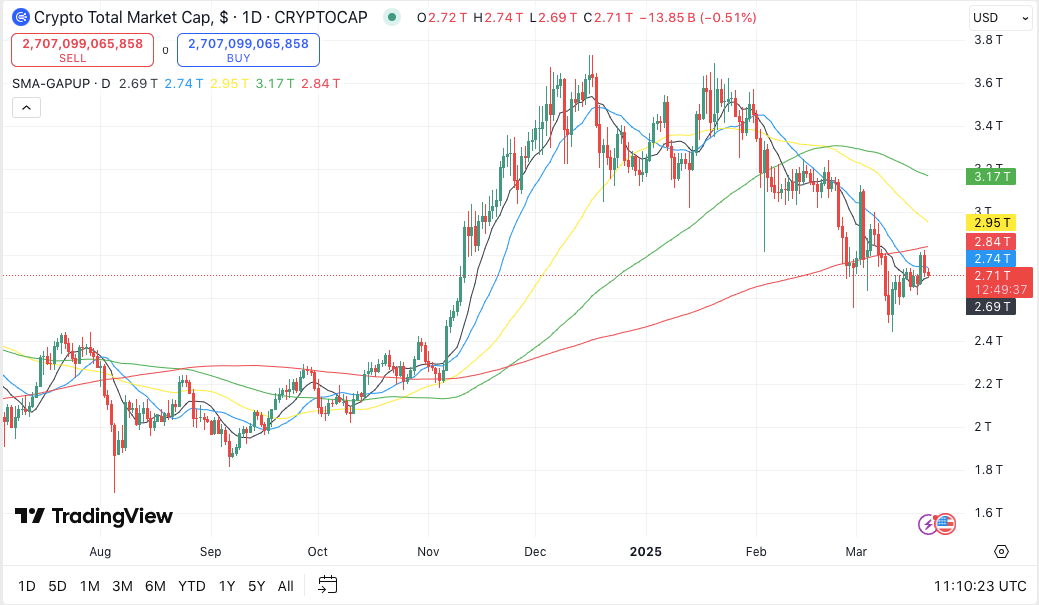
Общая рыночная капитализация криптовалют Источник: TradingView

Общая капитализация рынка криптовалют в середине 2024 года имела тенденцию к росту, достигнув пика выше $3,6 трлн. Затем коррекция отбросила ее до $2,69 трлн. Пока рынок пытается восстановиться, уровни сопротивления ограничивают его прогресс.

Отметка в $2,69 трлн теперь выступает в качестве немедленной поддержки. Краткосрочная поддержка находится на уровне $2,71 трлн, в то время как более сильная зона спроса находится между $2,6 трлн и $2,55 трлн. Следующее ключевое сопротивление находится на уровне $2,74 трлн, что соответствует 50-дневной скользящей средней. Более существенный потолок существует на уровне $2,84 трлн, около 200-дневной скользящей средней.

Ключевые уровни поддержки и сопротивления альткоинов

В настоящее время Ethereum торгуется на уровне $1 967,74, снизившись на 0,86% за последние 24 часа. Avalanche находится на уровне $18,58, снизившись на 1,22%, а Solana оценивается в $126,61, потеряв 3,02% за тот же период. Это снижение отражает более широкую тенденцию борьбы альткоинов за восходящее движение, что усиливает неопределенность вокруг ближайшего альтернативного сезона.


Related Reads

Uniswap v4 Hook Analysis: Architecture Design, Common Vulnerabilities, and Protection Practices

Uniswap v4's Hook mechanism is a major innovation, enabling custom logic injection into liquidity pool lifecycle events like swaps and liquidity provisioning. This transforms the AMM into programmable infrastructure, shifting the security model from protocol-level to pool-level, as each pool's safety now depends on its bound Hook contract. The core architecture revolves around the singleton PoolManager contract, which manages all pools via a flash accounting system. State changes are tracked in transient storage and must be settled by the end of a transaction. Hook contracts are permanently bound to pools via a PoolKey, with their permissions encoded directly into their address via specific low-order bits. This design introduces unique security considerations and challenges for future upgrades. Key vulnerabilities and best practices identified include: - **Access Control Gaps:** Early versions of the BaseHook abstract contract only protect `unlockCallback()`, leaving other lifecycle functions (`beforeSwap`, `afterSwap`, etc.) exposed unless explicitly secured by developers. - **Unrestricted Pool Binding:** The `initialize()` function does not validate if a Hook "consents" to a new pool. Hooks must implement their own whitelisting in `beforeInitialize` to prevent unauthorized pool creation. - **Async/Custom Curve Hooks:** These high-risk Hooks can completely replace Uniswap's swap logic. Their security depends entirely on their own implementation, as they operate outside the native protocol's pricing safeguards. - **Delta Accounting Risks:** The system ensures final balance (NonzeroDeltaCount == 0) but cannot guarantee the *correctness* of intermediate delta states, which attackers could manipulate. - **Token Confusion:** Protocols must implement semantic validation for tokens in user-created markets, not just interface checks, to prevent cross-market confusion attacks. The article emphasizes that Hook auditing requires a "sub-protocol" approach due to extended interaction chains, highlighting a significant shift in security methodology for the v4 ecosystem.

marsbit53m ago

Uniswap v4 Hook Analysis: Architecture Design, Common Vulnerabilities, and Protection Practices

marsbit53m ago

Chips, Open-Source Models, and $50 Trillion: Joe Tsai Reassesses Alibaba Once Again

Alibaba Executive Chairman Joe Tsai recently outlined the company's comprehensive AI strategy in a public discussion. He believes AI represents a massive opportunity, estimating its potential economic impact at up to $50 trillion, stemming from the automation of human intelligence and productivity. Tsai detailed Alibaba's four-layer investment approach across the AI stack: starting from the chip level, moving to cloud infrastructure (Alibaba Cloud), then the model layer with its open-source Qwen model, and finally applications within its vast digital ecosystem (e-commerce, logistics, etc.). The company avoids the energy layer due to China's efficient infrastructure. This broad strategy is designed to ensure Alibaba captures value regardless of where it ultimately concentrates in the AI value chain. He dismissed concerns about an AI investment bubble, pointing to the enormous $50 trillion opportunity. While acknowledging U.S. cloud giants' higher capital expenditure, he argued Chinese firms, including Alibaba (funded by its cash-generative e-commerce core), need to invest more in AI infrastructure. A key theme was technological sovereignty. Tsai positioned open-source models like Qwen as a solution for companies, especially in Europe, seeking independence from proprietary U.S. models and greater data privacy control. He contrasted this with the trend of U.S. giants keeping their models closed-source. Tsai highlighted Alibaba's collaborations with European manufacturers like Bosch and Siemens, using AI for design and quality control. He concluded with an optimistic vision of AI agents enhancing productivity, ultimately freeing up human time for leisure, family, and experiences like live entertainment.

marsbit1h ago

Chips, Open-Source Models, and $50 Trillion: Joe Tsai Reassesses Alibaba Once Again

marsbit1h ago

Trading

Spot
Futures
活动图片