Разработчик THORChain покинет проект на фоне отмывания активов Bybit

cryptonews.ruPublished on 2023-11-28Last updated on 2025-02-28

Abstract

Напомним, в начале февраля валидаторы протокола одобрили предложение по урегулированию долгового кризиса на ~$200 млн посредством конвертации обязательств в новый токен.

Основной разработчик протокола THORChain под ником Pluto заявил об уходе. Этот шаг последовал за отменой голосования касательно блокировки транзакций хакеров Lazarus Group, причастных к недавнему взлому Bybit.
**Moving on from THORChain**

Validators, developers, members of the community: effectively immediately, I will no longer be contributing to THORChain. I will remain available to Nine Realms as long as I am needed and to ensure an orderly hand-off of my responsibilities. It has…
— Pluto (9R) (@Pluto9r) February 27, 2025
«С этого момента я больше не буду участвовать в работе над THORChain», — написал программист.

Он добавил, что останется доступен на время передачи обязанностей.
Комментируя решение Pluto, валидатор под псевдонимом TCB также заявил о готовности уйти, если протокол не примет меры по пресечению потоков незаконных средств. Оператор ноды был одним из трех участников, проголосовавших за блокировку.
Halting a chain is an operational setting. It requires 3 node votes to be effective. 4 for be reversed. The vote was reverted within minutes. Decentralization in action.

I don't run a node, so I don't get to vote.

I only wrote code: https://t.co/ffB3vJGK2u
— Oleg Petrov (@ol3gpetrov) February 27, 2025
«Остановка цепочки — это операционная настройка. Для ее вступления в силу требуется три голоса. Для отмены — четыре. Голосование было отменено в течение нескольких минут. Децентрализация в действии», — пояснил разработчик THORChain Олег Петров.

Наряду с Pluto и TCB, программист выступал за блокировку хакерских средств. По его словам, он не управляет нодой и не мог участвовать в принятии управленческого решения, но создал необходимый код.
Lazarus Group активно использовала THORChain в процессах отмывания украденной у биржи Bybit криптовалюты на сумму $1,46 млрд. По данным Lookonchain, хакеры отправили в протокол ~270 000 ETH стоимостью около $605 млн.
The #Bybit hacker is laundering funds via #THORChain!

So far, the #Bybit hacker has laundered 270K $ETH($605M, 54% of the stolen funds) and still holds 229,395 $ETH($514M). pic.twitter.com/NtcKUpxsxc
— Lookonchain (@lookonchain) February 28, 2025
Один из комментаторов справедливо заметил, что протокол не отмывает средства, а только позволяет их обменять. Дальнейшее движение активов можно отследить, добавил он.
Суточные объемы свопов на THORChain после атаки на Bybit резко выросли. 26 февраля показатель приблизился к $860 млн, на следующий день он достиг $705 млн.
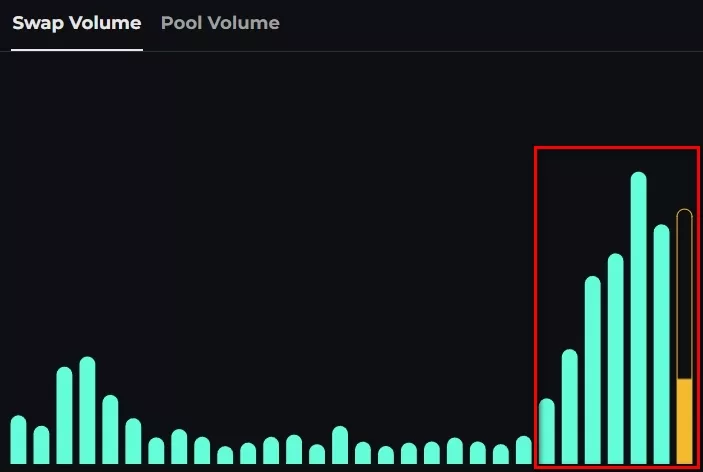
Данные: THORChain Explorer.

Федеральное бюро расследований США подтвердило причастность Lazarus к взлому биржи. Агентство опубликовало список Ethereum-адресов группировки и рекомендовало криптоплатформам воздерживаться от взаимодействия с этими кошельками.
«Когда подавляющее большинство ваших потоков — это украденные северокорейцами средства, полученные в результате крупнейшего в истории человечества ограбления, это становится проблемой национальной безопасности и перестает быть игрой», — написал TCB.

В другом сообщении валидатор отметил, что в текущей ситуации можно не рассчитывать на масштабирование протокола за счет притоков институционального капитала. Учреждения не позволят смешивать свои деньги с незаконными доходами, подчеркнул он.
Согласно DeFi Llama, TVL в пулах ликвидности THORChain упал с декабрьского пика в ~$446 млн до $186 млн на момент написания.
Напомним, в начале февраля валидаторы протокола одобрили предложение по урегулированию долгового кризиса на ~$200 млн посредством конвертации обязательств в новый токен.


Related Reads

You Use Claude and Codex Every Day, but Meta Has Restricted Internal Use

In May, Meta imposed internal restrictions on its engineers regarding the use of Claude Code and Codex, two widely used AI programming tools. Despite being a major client, Meta's guidelines, still in effect, prohibit these external models from being used for specific tasks to prevent potential "escalations with partners." The core concern is "distillation"—the risk that outputs from Claude or Codex could inadvertently contaminate the training data and evaluation processes for Meta's in-house AI coding assistant, MetaCode. If MetaCode is trained or evaluated using data generated by these external models, it risks learning their capabilities rather than developing its own, blurring the line of intellectual origin. The restrictions are precise: engineers cannot use the external models to generate test questions, debug source code, or suggest test cases. AI-generated content is also barred from environments accessible to MetaCode. However, AI can still assist with peripheral tasks like workflow setup and code organization, provided all outputs are manually reviewed. This caution reflects a broader industry dilemma. While distillation is a common technique, using a competitor's model output for training raises legal and ethical questions about the ownership of derived capabilities. Contractual terms from companies like OpenAI and Anthropic explicitly forbid using their outputs to build competing products, putting enforcement power in the hands of rivals. The move is also financially motivated, as Meta seeks to reduce its hefty internal AI spending, estimated in the billions this year. Meta's policy illustrates the delicate balance companies must strike: leveraging powerful external AI tools while safeguarding the integrity and independence of their own AI development. As AI systems increasingly help build other AIs, distinguishing the origin of capabilities becomes a fundamental challenge for the entire industry.

marsbit1h ago

You Use Claude and Codex Every Day, but Meta Has Restricted Internal Use

marsbit1h ago

Why Do We Need an AI Content Perspective Today?

The article "Why Do We Need an AI Content Perspective Today?" explores the complex and often contentious integration of AI into the cultural and creative industries, particularly film and television. It begins with the cancellation of Amazon's AI-generated animation "Punky Duck," highlighting the ethical debates surrounding AI content. AI's rapid advancement is transforming video production, enabling cost-effective, full-length AI films (e.g., "RAPHAEL," "Dreams of Violets") while sparking industry resistance over issues like "synthetic actors." The core debate has shifted from whether to use AI to how to use it responsibly. The article analyzes why AI's entry into film is uniquely unsettling. It distinguishes between "cultural fast food" (short-form, fast-paced content like micro-dramas) and "cultural main courses" (traditional, long-form film/TV). AI currently excels at the former, matching its fragmented narratives, shallow emotional needs, and free-to-consumer models. However, venturing into the latter challenges the human-centric essence of storytelling—creativity, emotional depth, and the unique value of human labor and experience. While AI can generate massive volumes of content and lower costs, it risks devaluing human creativity, leading to homogenized output, and creating unfair competition through potential intellectual property infringement. Its efficiency also amplifies content safety risks, making preemptive governance crucial. To counter these risks, the article proposes establishing clear boundaries guided by a human-centered AI content perspective. It outlines four principles: 1) Amplify, rather than displace, human creative space; 2) Respect and protect human creative output; 3) Ensure human creative control and responsibility remain paramount; and 4) Guarantee transparency and traceability in AI creation. The conclusion emphasizes that humans must act as the "helmsmen" of technology, steering AI development to enhance, not replace, the core human values at the heart of cultural expression.

marsbit2h ago

Why Do We Need an AI Content Perspective Today?

marsbit2h ago

Trading

Spot
活动图片