Donald Trump, the President of the United States, is thinking of a bold idea that might directly put money in the pockets of American people.
According to multiple reports, under the concept referred to as the “DOGE Dividend,” 20% of government savings from efficiency cuts is being considered to be returned to taxpayers. This unusual strategy has generated an equal measure of enthusiasm and doubt.
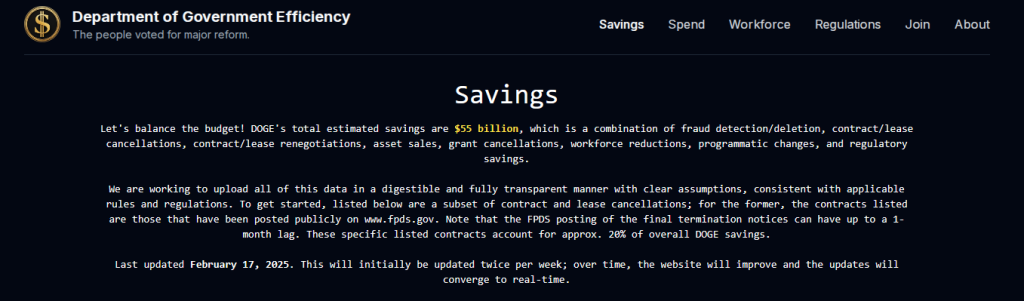
Source: Department of Government Efficiency
The $55 Billion Savings Claim
At the heart of this proposal is the Department of Government Efficiency (DOGE), an initiative backed by billionaire Elon Musk. By cutting unnecessary expenditure, renegotiating contracts, and streamlining bureaucracy, the agency has reportedly saved the government about $55 billion.
If the dividend plan moves forward, a fifth of these savings—approximately $11 billion—would be distributed to citizens.
🚨 PRESIDENT TRUMP: “There’s even under consideration a new concept where we give 20% of the @DOGE savings to American citizens.” pic.twitter.com/fV8cXCtUQ9
— Rapid Response 47 (@RapidResponse47) February 19, 2025
However, these figures remain under scrutiny. While proponents of the plan champion it as a taxpayer-friendly move, critics argue that verifying the true extent of these savings is difficult. Questions also remain about how the government would handle payouts and who would be eligible to receive them.
A Plan With Political And Legal Hurdles
Though Trump seems receptive to the concept, applying the DOGE Dividend would not be easy. Congress owns the purse, hence legislators would have to authorize any such payment. Given Washington’s political divide, implementing a new financial plan on this kind of magnitude would not be a walk in the park.
DOGE market cap currently at $37 billion. Chart: TradingView.com
Legal professionals also point up possible difficulties. The DOGE Dividend is linked to government cost-cutting policies unlike stimulus cheques, which are distributed during economic crises or downturns. This difference can generate constitutional and policy questions, thereby making the passage of the proposal more difficult.
Cutting The National Debt—But At What Cost?
Beyond distributing money to citizens, the plan includes another key component—using an additional 20% of DOGE savings to reduce the national debt. That would amount to another $11 billion set aside for debt payments.

Trump and Musk with the Dogecoin logo. Image: Illustration: Andrés Tapia; Source: Shutterstock
Although lowering national debt is generally considered to be advantageous, some contend that $11 billion is little compared to the US debt, which right now stands at $34 trillion. Others fear that excessive cost-cutting could affect government services, therefore compromising the same efficiency improvements DOGE promises to bring about.
President Trump and @ElonMusk should announce a ‘DOGE Dividend’—a tax refund check sent to every taxpayer, funded exclusively with a portion of the total savings delivered by DOGE. 🧵 pic.twitter.com/p5AZZj3Ttc
— James Fishback (@j_fishback) February 18, 2025
The Road Ahead For The DOGE Dividend
Despite the challenges, the idea of a taxpayer dividend is gaining traction in political and economic circles. Businessman James Fishback, who initially proposed the concept, compared it to private-sector customer rebates, where companies return savings to their clients.
For now, the DOGE Dividend remains a discussion rather than a concrete policy. But with Trump signaling interest, it could become a major talking point in the coming months.
Whether it turns into actual financial relief or fades into political rhetoric is a question that only time—and Congress—can answer.
Featured image from ABG Australia, chart from TradingView

Related Posts