Pi Community Seeks Elon Musk’s Attention for Pi Network

mediumPublished on 2025-02-18Last updated on 2025-02-18

Abstract

Pi Network community members recently reached out to Elon Musk, attempting to catch his attention and explore Pi Network.

Pi Network community members recently reached out to Elon Musk, attempting to catch his attention and explore Pi Network.

In post X, one community member of the Pi Network named Dr. Picoin said that Musk asked for a combination of Web3 and blockchain; the solution is here, PI network.
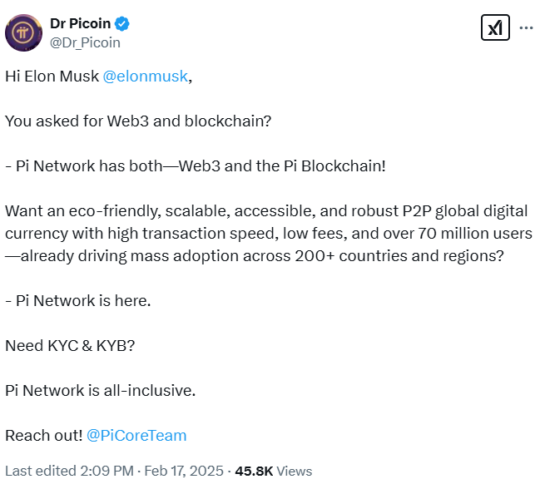
He also heightened Pi’s strengths like high transaction speed, low fees, scalability, and accessibility, positioning it as a potential mass-adopted peer-to-peer (P2P) digital currency. This engagement comes as the Pi Network approaches the long-anticipated Open Network launch.

He pointed out that Pi Network boasts over 70 million users across 200+ countries and regions. The message also highlighted Pi Network’s Know Your Business (KYB) and Know Your Customer (KYC) procedures, which help create a secure and inclusive digital space.

Elon Musk is known to respond to projects that intrigue him. His eccentric tweets to connect random situations to DOGE is well known.

Though he has not responded to the Dr.Pi coin’s post. Nonetheless, this outreach is a reflection of the Pi Network community’s continuous attempts to become well-known and draw in prominent tech people.

The Pi Network community has previously speculated about Musk’s potential interest in Pi, especially after misconceptions arose regarding his engagement with Pi-related accounts. In reality, no confirmed connection exists between Musk and Pi Network.

Source:cryptotimes

Related Reads

TechFlow Intelligence Report: Huawei Unveils "Tao" Law, Semiconductor Sector Surges; Meta Cuts 10% of Workforce

"TechFlow Intelligence Brief": Huawei's new "Tau Law" in semiconductors and Meta's 10% layoffs headline today's tech landscape. In AI, breakthroughs include an AI solving 9 high-difficulty pure math problems for just a few hundred dollars each, and DeepSeek's new Reasonix programming agent challenging commercial models. However, research highlights a "constraint decay" issue in LLM-generated backend code. Open-source model Qwen 3.6 27B achieves high speeds on older GPUs, sparking debate on NVIDIA's future dominance. In Crypto/Web3, Ethereum Foundation plans to downsize, possibly reducing ETH selling pressure. Fake news about CZ ignited a meme coin frenzy, showing the market's sensitivity to celebrity narratives. DeFi sees a new trend in HELOC-backed Real World Asset (RWA) pools. The chip sector is stirred by Huawei's proposed "Tau (τ) Law," aiming for 1.4nm-equivalent performance by 2031 through architectural innovation, causing related stocks to surge. A report notes memory now constitutes nearly two-thirds of AI chip cost. Meanwhile, executives at 7 Chinese semiconductor firms sold shares after price peaks. Meta announces 10% layoffs as it pivots to AI. Google's CEO faced student protests over AI ethics during a speech, and the company controversially published a Chromium exploit before patching was complete. Xiaomi permanently banned installers for AC installation fraud. In US stocks, AMD is seen as a potential challenger to NVIDIA, while a survey reveals 99% of CEOs expect AI-driven layoffs within two years. Palantir secured a government contract for employee monitoring, raising privacy concerns. Macro developments include a 6% drop in WTI crude oil on hopes for reopened Hormuz Strait, and silver prices rising over 4%. Global oil inventories are nearing critical lows. New trends highlight a "audio prompt injection" attack targeting AI voice assistants via hidden commands, and CBS pausing takedowns of pirated Stephen Colbert episodes after public pushback. The underlying narrative connects AI's cost-effective problem-solving, widespread planned job displacement, and Huawei's challenge to Western tech hegemony, framing the AI and chip race as a broader contest over employment, geopolitics, and the very definition of intelligence.

marsbit21m ago

TechFlow Intelligence Report: Huawei Unveils "Tao" Law, Semiconductor Sector Surges; Meta Cuts 10% of Workforce

marsbit21m ago

NeoCloud Three Giants: NBIS, IREN, CRWV – Which One Has More Investment Value?

This conversation analyzes the three leading "Neocloud" companies—NBIS (Nebius), IREN, and CRWV (CoreWeave)—in the context of the AI compute boom. The core thesis is that a severe GPU shortage will persist for 3-5 years, creating a massive, durable opportunity for specialized GPU cloud providers to supplement hyperscalers like AWS and Azure. Key differentiators are highlighted: CoreWeave is the early leader with the highest activated power and revenue, focusing on high-value AI training. IREN possesses the largest locked-in power capacity (4.5 GW) but has only secured Microsoft as a major customer so far. Nebius is positioned as the long-term pick due to its unique focus on building an inference-focused software stack ("token factory") and its exceptional engineering-centric team, led by a mathematician CEO with a proven track record. The discussion debunks bearish narratives, noting that Nebius recently raised prices for H100/B200 GPUs by 30-70%, indicating strong pricing power and contradicting fears of rapid GPU depreciation. A simple revenue model is presented: 1 MW of power equates to ~$10M in annual revenue. Nebius's guidance of 5 GW by 2030 implies $50B in revenue, vastly exceeding current consensus. All three companies are expected to succeed in the near-to-medium term due to overwhelming demand. However, for long-term (5+ year) investment, the preference is for Nebius due to its team, software strategy, and valuable stakes in subsidiaries like ClickHouse. The conversation also identifies the networking layer (e.g., Arista Networks) as a critical, underappreciated adjacent opportunity in the AI infrastructure build-out.

marsbit43m ago

NeoCloud Three Giants: NBIS, IREN, CRWV – Which One Has More Investment Value?

marsbit43m ago

Trading

Spot
Futures
活动图片