Биткоин штурмует $97 000: анализ ключевых уровней

cryptonews.ruPublished on 2021-09-03Last updated on 2025-01-03

Цена биткоина поднимается выше $97 000, преодолевая ключевые уровни сопротивления. Аналитики внимательно следят за движением криптовалюты, которая начала год с уверенного роста.
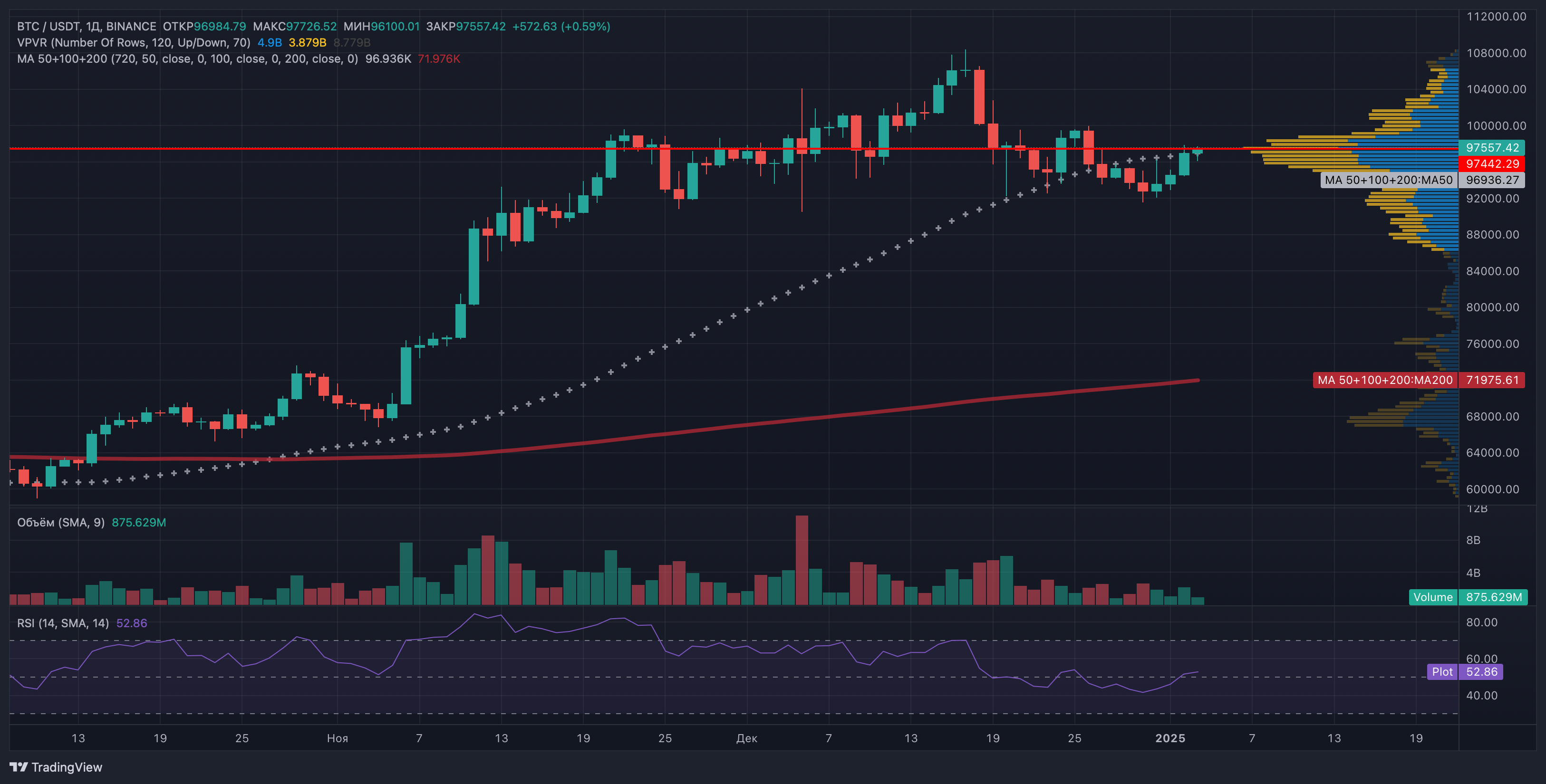
1-дневный график BTC/USDT. Источник: скринер криптовалют Cryptovizor

Борьба за поддержку

На момент открытия торгов на Уолл-стрит биткоин тестировал важный уровень сопротивления. По данным скринера криптовалют Cryptovizor, BTC/USDT преодолел отметку в $97 000. После стремительного роста в начале года и повторного тестирования уровня $96 000 в качестве поддержки, биткоин нацелился на возвращение выше 50-дневной скользящей средней (SMA).

«Отличное продолжение прорыва нисходящего клина», — написал в своем анализе на X популярный трейдинговый аккаунт SuperBro, комментируя дневной график. «Не стоит агрессивно открывать длинные позиции при подходе к потенциальному сопротивлению. Теперь нам нужно вернуться выше 20- и 50-дневных SMA и превратить их в поддержку».
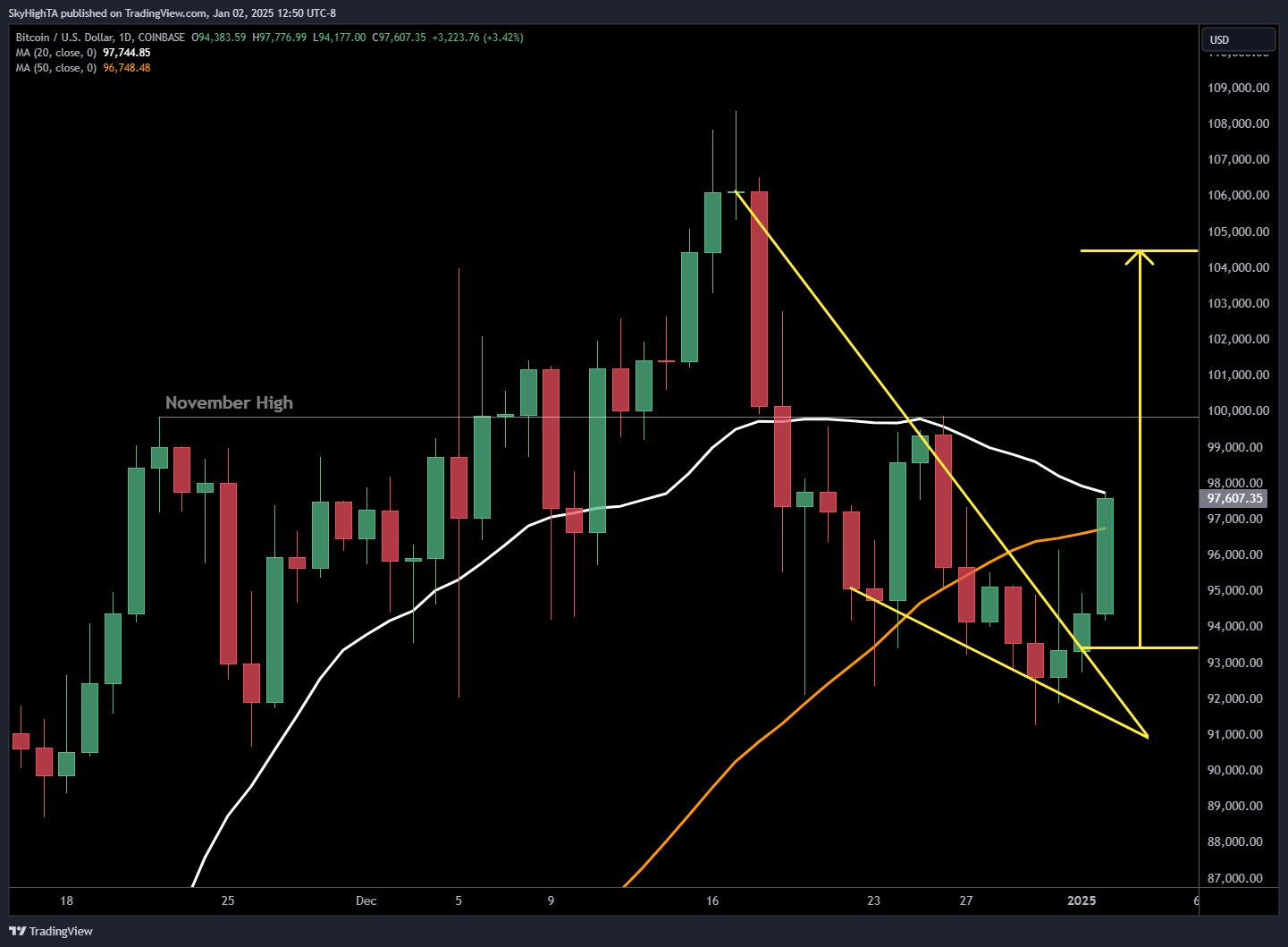
1-дневный график BTC/USDT. Аналитика: SuperBro

Технические индикаторы предупреждают

Трейдер Roman призывает к осторожности, анализируя 4-часовой график. «Думаю, некоторые из вас слишком рано радуются», — отмечает он. «У нас рост на низких объемах с максимальным значением стохастического RSI. Обычно это означает, что нас ждет небольшое снижение».
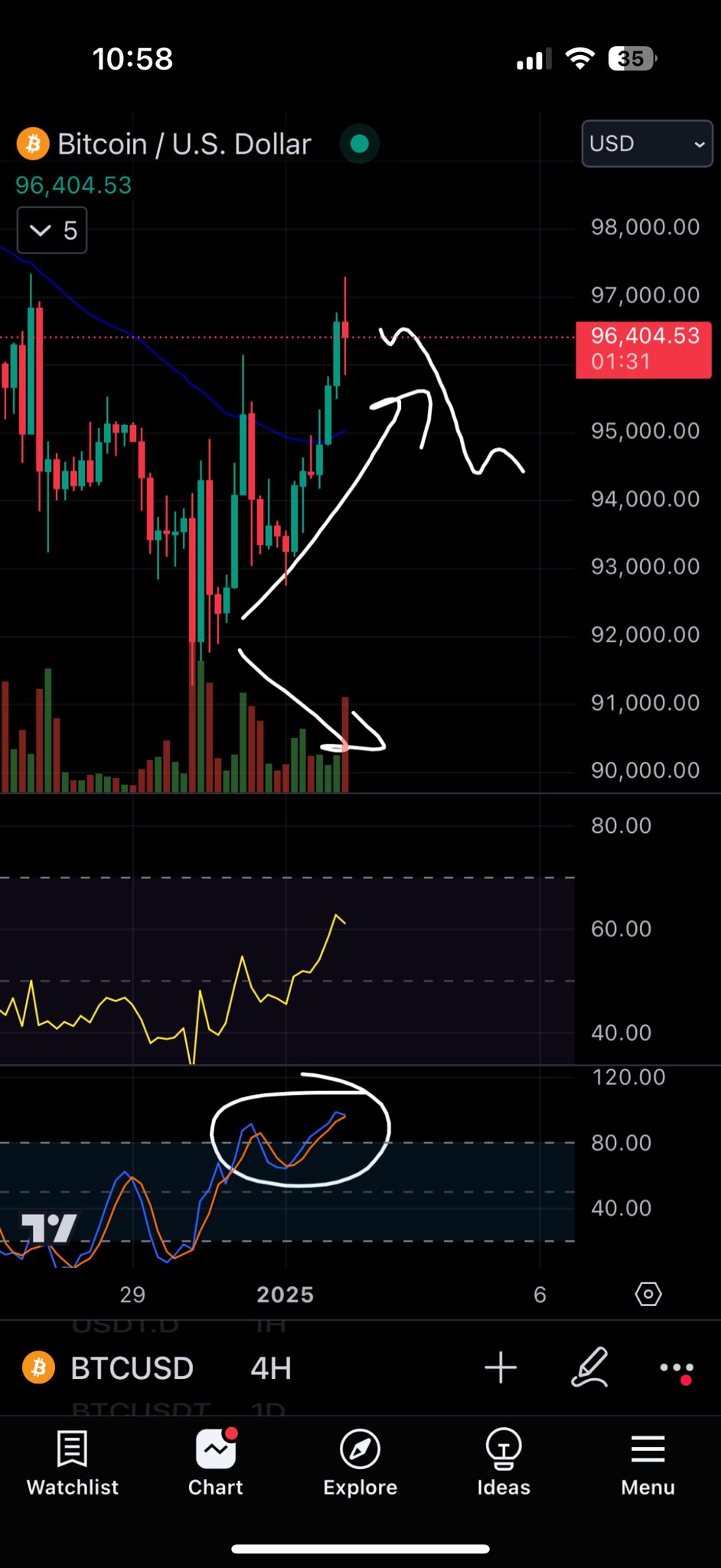

4-часовой график BTC/USD. Аналитика: Roman

Трейдер Daan Crypto Trades обращает внимание на еще один уровень сопротивления — 200-периодную SMA на 4-часовом графике. «Цена движется вокруг узла высокого объема. Это означает, что большинство сделок совершается именно в этом ценовом диапазоне. Как правило, цене легче двигаться, когда она отрывается от такой зоны высокого объема», — поясняет он.
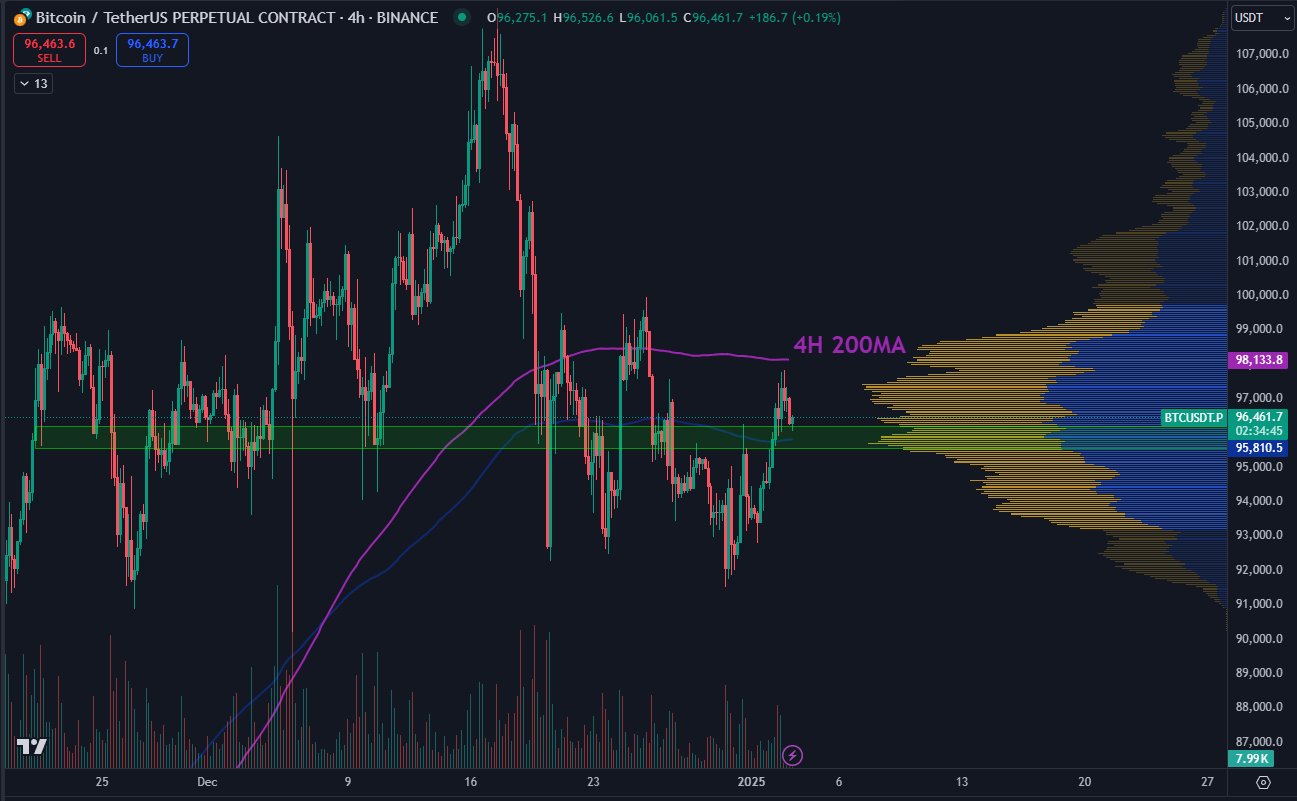
4-часовой график BTC/USD. Аналитика: Daan Crypto Trades

На бычьем рынке откаты — для покупки

Аналитик BitQuant использует сигналы социальных сетей и для прогнозирования предстоящего отката из-за чрезмерного оптимизма на рынке. «Скоро начнется снижение и об этом будут говорить повсюду. Не поддавайтесь панике, — предупреждает он. «Нужно покупать на откате, а не продавать».


Related Reads

The "Impossible Triad" Is Fundamentally a Pseudo-Problem

The article argues that blockchain's fundamental limitation is not the scalability trilemma (decentralization, scalability, security), which has been largely solved, but the lack of **privacy** and, until recently, clear **legitimacy**. Blockchain is described as a slow, expensive, globally shared computer whose core value is censorship resistance and verifiability. While ideal for native digital assets like money (e.g., stablecoins), its default transparency acts as a **tax**, exposing all transactions and enabling MEV extraction, which deters serious institutional capital. Simultaneously, its permissionless nature created regulatory ambiguity. The piece contends that **privacy** is the missing critical feature. It rejects the false choice between total transparency and complete anonymity. Modern cryptography (like zero-knowledge proofs) enables **compliant privacy**: users can prove facts (solvency, KYC status, compliance) without revealing the underlying sensitive data (specific holdings, identities). This preserves auditability for regulators and eliminates the leak of financial information. With recent regulatory progress (e.g., the GENIUS Act) addressing legitimacy, adding default, provably compliant privacy becomes a pure upgrade. It transforms blockchain from a costly, public ledger into a confidential settlement layer, finally bridging the gap to mainstream institutional and individual adoption of on-chain finance.

链捕手11h ago

The "Impossible Triad" Is Fundamentally a Pseudo-Problem

链捕手11h ago

Optical Chips: Collective Capacity Expansion

The global optical chip industry is experiencing a massive wave of expansion driven by surging AI data center demand. Major players across the US, Japan, Europe, and China are aggressively investing to ramp up production capacity. In the US, Coherent is expanding its 6-inch Indium Phosphide (InP) semiconductor fab in Texas, supported by CHIPS Act funding and a $2 billion strategic investment from NVIDIA. Lumentum is building a new factory for InP optical devices, and Nokia is scaling its advanced photonic chip packaging and testing capabilities. NVIDIA's investments aim to secure future supply of critical lasers and optical interconnect products for AI infrastructure. Japan's JX Advanced Metals, a leading InP substrate supplier, plans a multi-billion yen investment to increase its capacity 7-10 times, strengthening its grip on the crucial upstream materials market. In Europe, IQE and Tower Semiconductor settled a patent dispute and signed a multi-year InP epitaxial wafer supply agreement, highlighting that next-generation silicon photonics platforms will integrate high-performance InP components. STMicroelectronics and Sivers Semiconductors are also expanding silicon photonics production and partnerships. China is rapidly building out its domestic supply chain. Dongshan Precision's subsidiary, Source Photonics, announced a $12 billion project to expand optical chip and module production. Companies like Sanan Optoelectronics and Yunnan Germanium are scaling up InP chip manufacturing and substrate production, moving towards vertical integration from materials to modules. While debate continues around the exact future architecture—whether CPO (Co-Packaged Optics), NPO, or pluggables will dominate—analysts like Morgan Stanley argue the underlying driver is unchangeable: the explosive growth in bandwidth demand. This will inevitably increase the volume of optical engines, lasers, and related content per GPU, regardless of the final technical path. The competition for "more light" in the AI era has intensified into a global, full-chain capacity race.

marsbit14h ago

Optical Chips: Collective Capacity Expansion

marsbit14h ago

Trading

Spot
Futures
活动图片