New York Stock Exchange signals move to build an NFT marketplace

BitcoinistPublished on 2022-02-16Last updated on 2022-05-26

Abstract

The New York Stock Exchange (NYSE) is catching many off guard this week with an interesting and unique trademark filing that is signaling the exchange’s intent to build it’s own NFT marketplace.

The New York Stock Exchange (NYSE) is catching many off guard this week with an interesting and unique trademark filing that is signaling the exchange’s intent to build it’s own NFT marketplace.

A patent from the NYSE has been filed within the past week with the United States Patent and Trademark Office (USPTO) has suggested that the exchange is making it’s first ‘metaverse’ move. Let’s look at what we know from early reports, and what it could mean moving forward.

New York, New York

According to the USPTO filing, the New York Stock Exchange is registering “NYSE” for utilization of several different blockchain and crypto-adjacent goods and services, including areas like “virtual reality and augmented reality software, non-fungible tokens, and/or NFTs, and online marketplaces.”

The exchange could be looking to provide “downloadable virtual goods,” according to reports, and could be looking to build “authentication of data in the field on NFTs using blockchain technology.”

It’s the latest twist in the unexpected road of stock exchange and NFT crossovers, after the NYSE minted six commemorative NFTs last year – celebrating major public listings as part of a series titled “First Trade.”
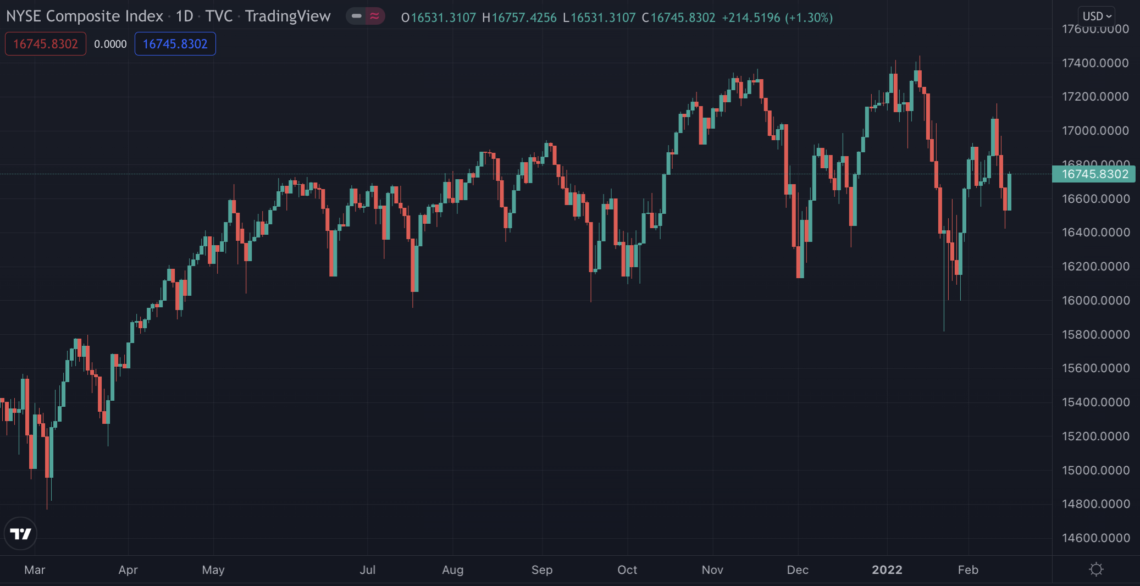
The New York Stock Exchange's flagship composite index, NYA, has had a strong performance over the past year. | Source: NYSE: NYA on TradingView.com

The “State” Of Affairs

The New York Stock Exchange is the world’s largest stock exchange by market cap, with average trading volumes that are often estimated in the hundreds of billions of dollars each day.

Unlike last April’s NFT release, this latest endeavor from the NYSE signals a much broader and bigger investment into the blockchain territory; while details are still spotty, it seems that the exchange will be creating a full-fledged NFT marketplace. It comes at a time when competition from market leader OpenSea has becoming increasingly fierce. Coinbase is now seemingly weeks away from their NFT marketplace, and growing marketplace LooksRare has been increasingly mentioned in recent weeks (despite a rough week in the headlines this week) – and these are just two names among many.

The trademark application also includes APIs and “cryptocurrency trading services” as well. Could this move be the first signal that the NYSE could be moving towards supporting crypto trading more broadly? With minimal U.S. regulation that has been implemented to date, the territory can easily be described as a ‘grey area’ at best for the exchange – but innovation isn’t known to wait. While ‘metaverse’ is the “flavor of the month” lately, the New York Stock Exchange utilizing blockchain APIs in stock tracking, or adopting NFTs at a much more substantial level is nothing to scoff at.


Related Reads

Can DeepSeek Save China One Trillion Dollars?

"DeepSeek and the $1 Trillion Infrastructure Question" The article examines whether DeepSeek's AI optimization breakthroughs could potentially save China $1 trillion in future AI infrastructure costs. The analysis begins with Nvidia's upcoming Vera Rubin AI platform, costing ~$7.8 million, where memory (HBM4/LPDDR5X) constitutes $2 million—a 435% cost increase in one year, highlighting how AI hardware spending is shifting toward expensive memory components. DeepSeek's approach works in the opposite direction. Through three key technical innovations showcased in DeepSeek V4, the company dramatically improves hardware efficiency: 1. **Memory Compression (MLA)**: Re-engineers the attention mechanism to compress long-context memory (KV Cache) by over 90%, drastically reducing expensive HBM usage. 2. **Selective Activation (MoE)**: Employs Mixture-of-Experts architecture where only a small fraction of parameters (e.g., 49B out of 1.6T in V4-Pro) are activated per token, allowing most parameters to reside in cheaper memory/SSD. 3. **Computation Caching**: Reuses previously computed results via cache hits, replacing expensive GPU computations with cheap memory reads. Combined, these optimizations allow the same hardware to produce approximately 4x more tokens, effectively reducing required hardware investment by 75%. DeepSeek's pricing reflects this: a 10-billion token workload costs ~$522 monthly versus ~$9,000-$10,000 for competitors. The $1 trillion savings projection stems from McKinsey's estimate that global AI infrastructure will require ~$5.2 trillion investment by 2030. As China's daily token consumption grows toward quadrillions, even marginal efficiency gains scale massively. With a conservative 4x throughput improvement, China could avoid building tens of thousands of AI data centers equivalent to ~7 trillion RMB ($1 trillion) in saved investment. Critically, this strategy shifts dependency from scarce, expensive GPU/HBM—where China lags—toward more accessible storage, caching, and systems engineering where domestic suppliers like CXMT are gaining strength. Rather than "replacing Nvidia," DeepSeek rebalances AI's value chain away from monolithic hardware dependency. Ultimately, DeepSeek's technical breakthroughs could lower the barrier to AI adoption across Chinese industries by making advanced capabilities affordable at scale—transforming who can access next-generation AI.

marsbit5m ago

Can DeepSeek Save China One Trillion Dollars?

marsbit5m ago

Overturning the Mainstream Approach to Hallucinations: Metacognition is the New Solution for Large Models to Break the Hallucination Barrier

This paper, "Hallucinations Undermine Trust; Metacognition is a Way Forward," proposes a paradigm shift in combating AI hallucination. It argues that the current mainstream approaches—striving for omniscience by scaling data/models or having AI abstain from uncertain answers—are fundamentally flawed. The former has inevitable knowledge gaps, while the latter imposes a crippling "utility tax," requiring the rejection of many correct answers to achieve high accuracy, due to models' poor "discrimination" (the ability to distinguish correct from incorrect answers internally). The core contribution is redefining hallucination not as "being wrong," but as "expressing false information with unwarranted certainty." The proposed solution is **Faithful Uncertainty** or **Metacognition**: enabling AI to accurately perceive its internal uncertainty and honestly express it in its language (e.g., using hedging phrases when unsure). This creates a more reliable assistant that provides useful information while signaling its confidence, minimizing harm from errors. The paper emphasizes that metacognition is critical for the era of AI Agents. Without it, Agents cannot intelligently decide when to use tools like search engines, leading to inefficiency and misuse. Key implementation challenges are highlighted: the "bootstrapping paradox" of training with static uncertainty data, the "alignment distortion signal" where human preference training suppresses internal uncertainty cues, and the difficulty of causally evaluating true metacognition vs. its superficial imitation. The paper concludes that the goal should not be an infallible AI, but one that is honest about the limits of its knowledge, thereby building user trust through transparent communication of its certainty.

marsbit9m ago

Overturning the Mainstream Approach to Hallucinations: Metacognition is the New Solution for Large Models to Break the Hallucination Barrier

marsbit9m ago

Hedge by Buying Gold and Oil, Chase Soaring Returns with AI. ‘Dated’ Bitcoin Enters a Bear Market

Bitcoin has recently declined, hitting a two-month low near $66,123, while Ethereum fell to a three-month low around $1,837. Analysts suggest the drop is not merely due to factors like ETF outflows or MicroStrategy's selling but reflects a deeper issue: Bitcoin is losing a broader asset competition. In a near-zero interest rate environment, Bitcoin previously thrived as an outlet for investor dissatisfaction with inflation and limited options. However, the market landscape has shifted. Bitcoin now occupies an "awkward middle ground," facing competition on three fronts. For inflation hedging, investors prefer gold, energy stocks, and commodity producers—assets with tangible backing and clearer pricing power. For growth exposure, AI-related companies with actual revenues and profits are more attractive. Even within crypto, investors can choose stablecoins, exchanges, or infrastructure firms tied directly to adoption, offering clearer business models and leverage. Thus, Bitcoin is no longer the top choice for hedging, growth, or crypto exposure. This shift is evident in market reactions: despite recent warnings about persistent inflation from a Fed official, Bitcoin did not rally as it might have in the past. Instead, capital flowed to assets with direct commodity or energy exposure. The recent ETF outflows and MicroStrategy sales are symptoms, not causes, of this new reality. Investors are becoming more selective, demanding clearer value propositions beyond mere scarcity. The emerging bear case for Bitcoin is not about it being a bubble or failed technology, but that scarcity alone is no longer sufficient.

华尔街日报12m ago

Hedge by Buying Gold and Oil, Chase Soaring Returns with AI. ‘Dated’ Bitcoin Enters a Bear Market

华尔街日报12m ago

Trading

Spot
Futures
活动图片



