MicroStrategy 的模式是骗局吗?

深潮Published on 2024-09-23Last updated on 2024-09-23

超过80%的人认为,这是一场骗局...

作者:Crypto_Painter

冷知识:Michael Saylor的微策略在2000年互联网危机期间是市值缩水及亏损最为严重的一批公司,他本人的财富也在那轮泡沫破裂中遭遇了巨大的回撤。

而现在,微策略的主营业务为一款在线AI及数据分析,官网界面仍停留在传统互联网ToB企业的层面;

除了该公司持有大量BTC以外,从我个人看来,几乎没有什么产品或技术足以支持微策略当前200多亿美元的市值...

所以我们可以大致将微策略的股票理解成一个基于BTC价格的企业“ETF”;

即使如此,如果将其手中持有的BTC折合当前63000美元的价格来计算,这些BTC的市值仅有158.9亿美元,而其股票市值却超过200亿美元。

同时微策略据说仍有2000名员工,我很好奇,如果公司的价值来自于BTC,那么这些员工的开销来自哪里?毕竟微策略的自营业务貌似是亏损的。

于是这就引出了网络上曾经盛传的一个“新式旁氏骗局”,也就是“反向旁氏骗局”;

传统庞氏骗局依靠的是大量新用户入场来支付少量老用户的收益回报,从而形成金字塔式的骗局结构;

而“反向庞氏骗局”则是自己既做新用户又做老用户,通过吸引外界投资或贷款来抬高整体资金盘的市值,这是一种类似于“立棍法”的结构,也就是“左脚踩右脚,螺旋升天”的内循环模式;

再来看微策略的行为是否符合呢?

首先,自2020年开始,微策略就在持续不断购买BTC,最近一次购买实际发生在9-13日,目前持有252220枚BTC,均价约38585美元。

购买BTC的资金并不是来自公司存款,而是通过类似可转债的方式从市场中募集,借款方可以获得同等金额或协商价格下微策略的股票;

简单来说,就是微策略卖掉了自己的股票,用换来的钱购买BTC,因为购买了BTC,使得公司股票价格从2020年后越发保持与BTC价格之间的高度相关性,尤其是最近半年里几乎达到了完全一致的价格走势;

从投资者或借款方来说,这就等于购买了BTC的等价物,因此如果存在风险,那么风险也仅仅停留在BTC的价格波动上,并且整个过程完全合法。

但事实真的如此吗?

我在昨天以类比的方式发起了一场投票,结果如下:
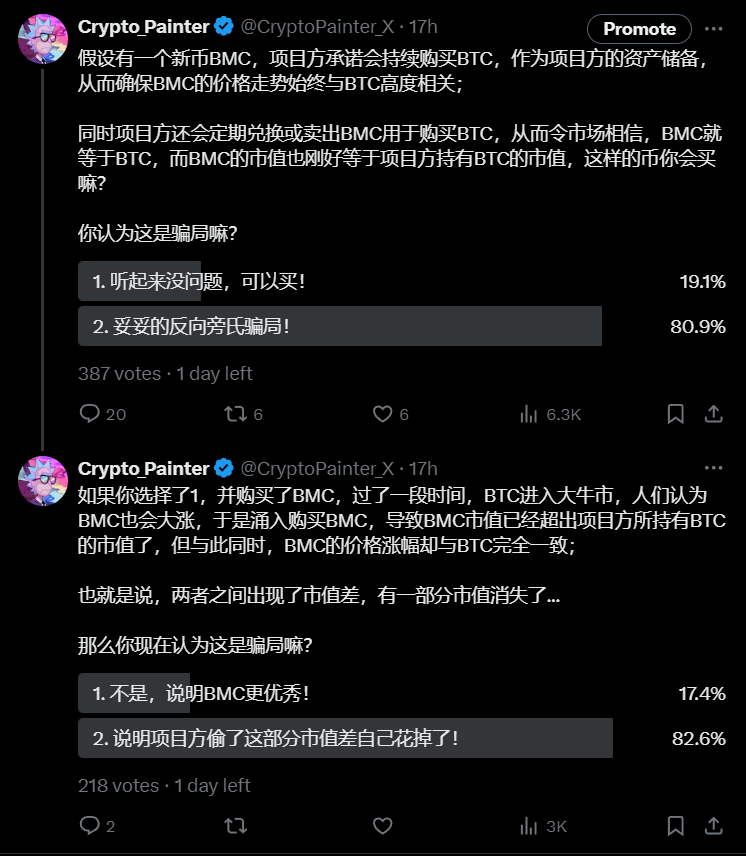
超过80%的人认为,这是一场骗局...

因此我也在思考这种将BTC大量纳入公司资产负债表的行为最终会怎样收场?

第一个问题是:流入资金与资产估值之间的漏洞;

假设微策略从市场中募集了20亿美元用于购买BTC,购买之后公司股价与BTC均出现上涨,那么换算下来,其实微策略背后的收益其实翻倍了,也就是说,如果只持有BTC或只持有微策略股票,那么价格上涨只能带来1:1的收益,而作为微策略来说,则可以获得币价上涨加上股票上涨的2份收益,即1:2的回报;

从投资人或借款方的角度来说,确实等于买了BTC现货并享受收益,但对于微策略来说,币在自己手里,股价还在上涨,账面财富的增加速度是前者的2倍。

更不用说,借出、抵押股票这一行为背后还存在操作可能。

第二个问题:BTC无法增发,但股票可以...

只要持续购买BTC确保市场相信微策略股价会永远跟随BTC,那么即使当股价略低于BTC时,也会有大量套利资金入场来修复这个短期负溢价,具体操作就是做空BTC的同时做多股票,等到差价恢复后即可平仓获得利润(不过我认为这种操作实际很难执行);

不过这只要能解释为何微策略股价与BTC价格高度一致即可;

问题回到微策略的股票上,请问其股票发行数量有总量上限吗?微策略在未来可以拆股或增发吗?

如果答案是可以,那么这里就出现了明显的套利空间;

用表面上看似与BTC等价的资产换取真实的BTC,即使未来BTC大跌或股票大跌,投资者亏损离场时卖出的是股票,但微策略可没必要卖出BTC呀?

如果BTC的价格跌破38500,那么是否有可能出现股价相对BTC出现大额负溢价的情况?

也就是投资者或借款方承受了远超BTC下跌带来的亏损呢?

这个问题我也没有想清楚,但从逻辑上来分析,微策略的模式可能并不是严格意义上的骗局,更多的则是一种将风险转嫁给借款方或投资方的手段;

对于Michael Saylor来说,BTC继续走牛,他早晚会成为世界上最富有的人,而若BTC走熊暴跌至38500以下,他始终还是世界上除中本聪以外持有BTC最多的个人或实体,不管怎样,都是赢。

除非他在股价出现负溢价的时候愿意卖出BTC来回购股票稳定差价,并导致BTC及股票进一步的下跌,否则他这个模式,理论上可以永远玩下去。

你认为可能吗?

Related Reads

From Mining Pool to Mars: Why Is Wang Chun in the SpaceX Cockpit?

Title: From Mining Pool to Mars: Why Wang Chun is in the SpaceX Cockpit? When SpaceX announced that Wang Chun, co-founder of F2Pool, would command the first commercial crewed interplanetary mission, many were shocked. Why would a Bitcoin mining pool founder be on a Mars mission roster? However, understanding Wang Chun's journey over the past decade and the deepening ties between the crypto industry and SpaceX reveals this is not accidental, but an inevitable result of a new era taking shape. Today's Mars plan is no longer just a space engineering project; it is evolving into a civilization-upgrading experiment driven by global tech capital, AI, computing power, energy, and the crypto economy. Wang Chun stands precisely at the intersection of these forces. Part 1: From F2Pool to SpaceX – Wang Chun's Leap F2Pool, founded when Bitcoin was still niche, is one of the earliest large-scale mining pools and once held a significant share of global Bitcoin hash rate. Wang Chun belongs to the first generation of Chinese Bitcoin advocates and infrastructure builders—idealists and engineers who believed in a new value network independent of traditional finance. Miners like him built the hardware, energy, and computing power foundational to decentralized networks. This aligns with the long-term, high-engineering, future-oriented vision required for space civilization. Elon Musk’s space endeavors value such long-term builders over mere capital players, which explains Wang Chun's entry into the SpaceX ecosystem. Part 2: Why Crypto and SpaceX Are Growing Closer The core of global tech competition is shifting from internet applications to next-generation infrastructure. Both crypto and SpaceX are part of this. SpaceX's goal is to drastically reduce space access costs. If successful, it could enable orbital servers, space-based energy, global satellite internet, and Martian bases. These new frontiers will require new payment systems, value networks, and global financial architectures. Cryptocurrencies, inherently global and trustless, are poised to become key to off-planet economies. Moreover, crypto and SpaceX share a high-risk, long-termist ethos—believing in ambitious, world-changing goals despite early skepticism. Part 3: Human Spaceflight Enters the Commercial Era Space exploration, long dominated by state actors, is now being transformed by commercial entities like SpaceX. Wang Chun's involvement signifies that future deep-space participants may include not just career astronauts, but also entrepreneurs, engineers, and AI researchers. This mirrors the Age of Exploration, where commercial capital eventually drove global expansion. Wang Chun has emphasized that Mars colonization must not be delayed for future generations, countering a potential over-focus on nearer-term, commercial lunar projects. His presence symbolizes how new capital, technical communities, and idealists from the crypto world are now entering the interstellar age. In summary, the true significance is not an individual's journey to Mars, but the shift in the driving force of human civilization expansion from state machinery to tech companies, AI systems, and global technology capital. Wang Chun's path—from mining pool to Mars, from the Bitcoin network to starships—may be a preview of technological civilization's evolution in the coming decades.

marsbit3h ago

From Mining Pool to Mars: Why Is Wang Chun in the SpaceX Cockpit?

marsbit3h ago

Trading

Spot
Futures
活动图片