Альткоины отстают, биткоин лидирует: неделя ФРС определит дальнейший тренд

cryptonews.ruPublished on 2023-06-16Last updated on 2024-09-16

Первая криптовалюта начинает неделю с попытки закрепиться выше ключевого уровня сопротивления в $60 000 на фоне ожидания решения Федеральной резервной системы (ФРС) США по процентной ставке.
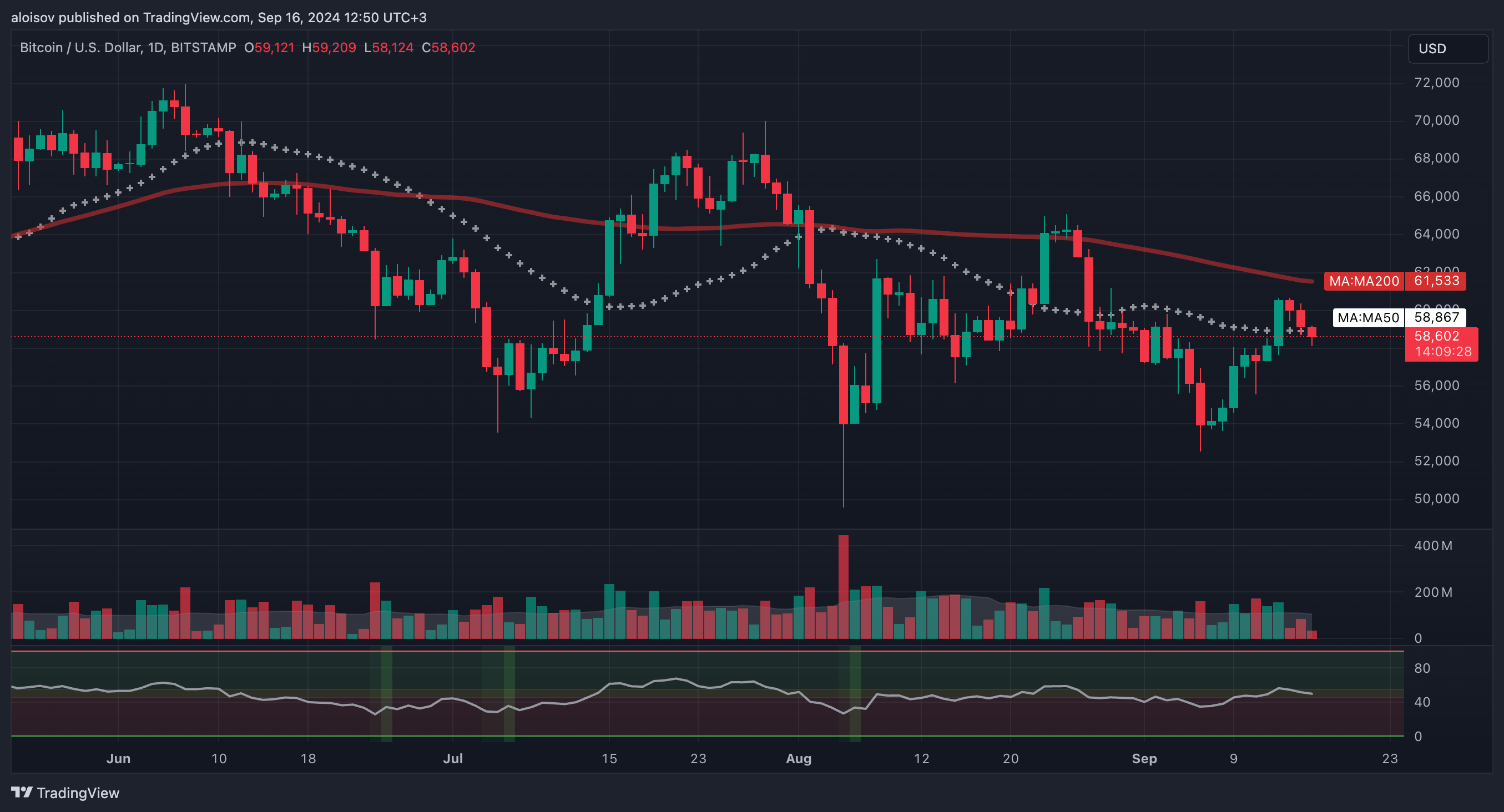
1-дневный график BTC/USD. Источник: Bitstamp/TradingView

На момент написания статьи курс биткоина колеблется около отметки $58 600, показав рост на 7,8% за последнюю неделю. Однако закрытие недельной свечи 15 сентября оказалось ниже психологически важного уровня $60 000, что несколько ослабило позиции «быков».

Популярный в соцсети X трейдер Марк Каллен (Mark Cullen) предупреждает: «Это будет волатильная неделя для биткоина». Основное внимание участников рынка приковано к заседанию Комиссии по ценным бумагам и биржам (SEC) 18 сентября, на котором будет принято решение о первом за четыре года снижении ключевой ставки.

Калеб Францен (Caleb Franzen), основатель Cubic Analytics, обращает внимание на то, что 365-дневные простая (SMA) и экспоненциальная (EMA) скользящие средние выступают в качестве поддержки. «С момента первоначального прорыва в марте и апреле 2023 года BTC смог оставаться выше своего годового среднего и даже несколько раз превращал его в поддержку, даже во время недавнего отката в августе и сентябре», — отметил он в своем блоге 14 сентября.
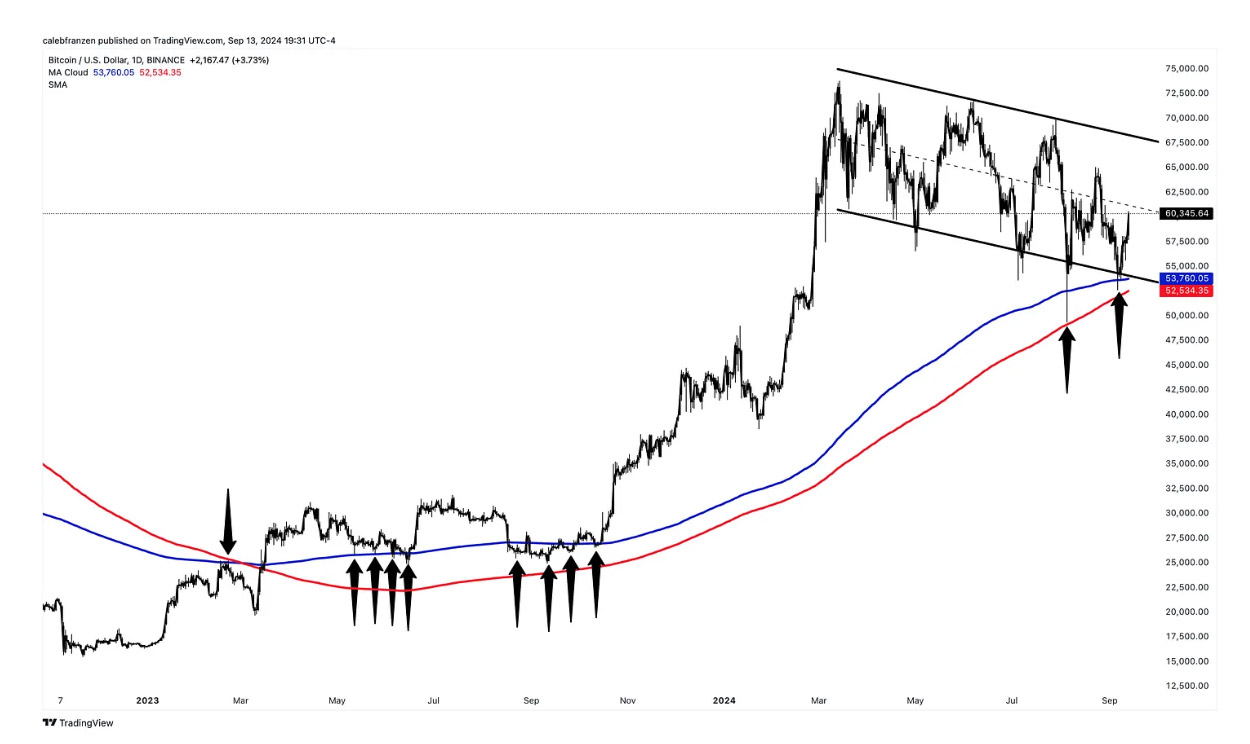
График BTC/USDT. Аналитика: Cubic Analytics

Рынок ставит на смягчение политики ФРС

Предстоящее решение ФРС по ставке станет ключевым фактором макроэкономической волатильности на этой неделе. Хотя снижение ставки уже давно учтено рынками, остается вопрос о его масштабах.

По данным Fedwatch, вероятность снижения ставки сразу на 0,5 процентных пункта оценивается ниже, чем уменьшение на стандартные 0,25 п.п.
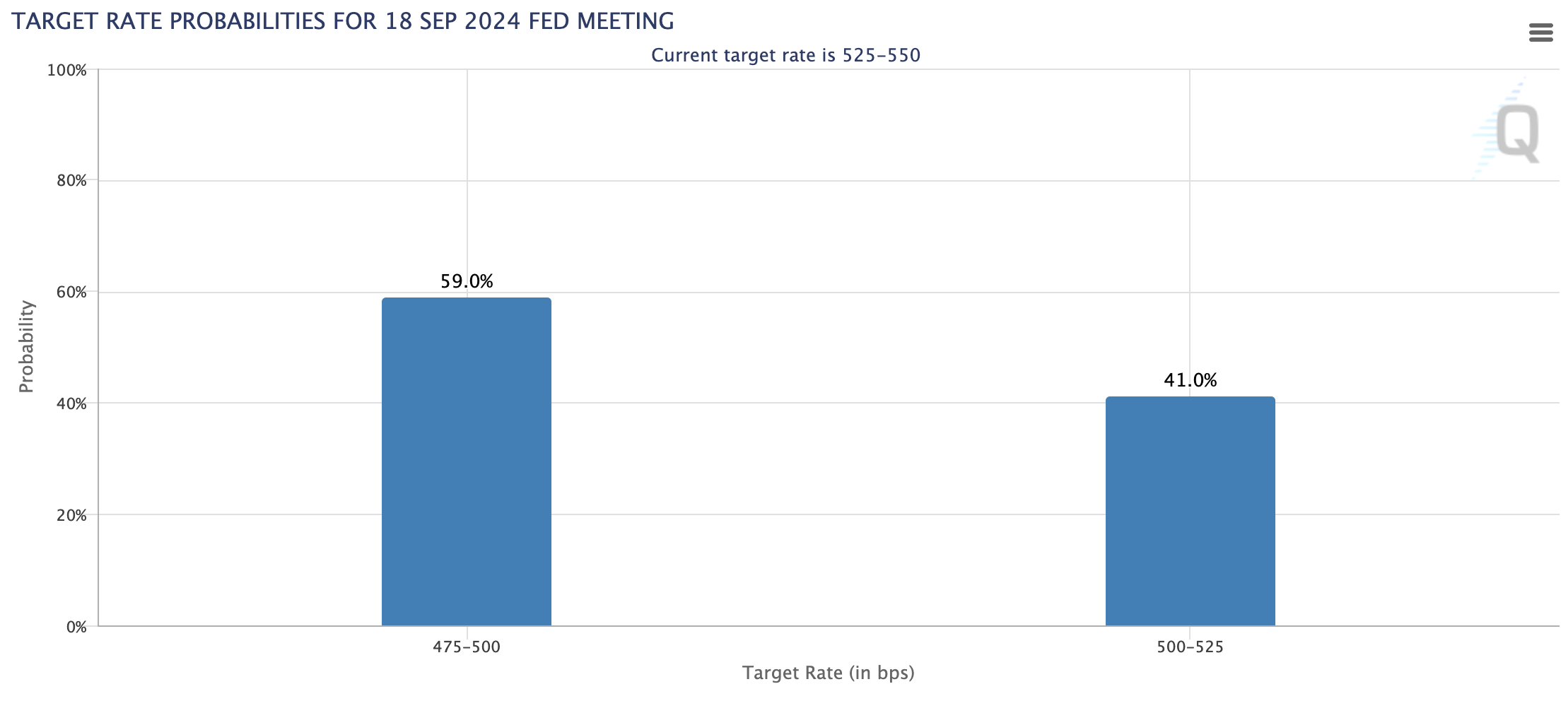
Вероятность изменения ставки ФРС. Источник: Fedwatch

Финансовый аналитик и инвестор Джейкоб Кинг (Jacob King) предупреждает, что резкое снижение ставок исторически предшествовало рецессиям. Он проводит параллели с ситуацией перед глобальным финансовым кризисом 2008 года, отмечая схожие признаки в виде роста безработицы и падения экономической активности.

«Хотя снижение ставок может звучать позитивно, это сигнализирует о более глубоких проблемах — таких как коллапс заимствований, расходов и инвестиций», — пояснил Кинг своим подписчикам в соцсети X.

Другие эксперты более оптимистичны. Популярный трейдер Рикус (Rickus) считает, что первое снижение ставки может оказаться «очень бычьим» для биткоина, особенно если не будет паники на фондовом рынке. В своем анализе на платформе X он заявил:

«Если вы думаете, что снижение ставок каким-то образом вызовет распродажу BTC на этой неделе, то вас может ждать сюрприз. Оно не вызовет панику, если изначально не будет паники на фондовом рынке. Если произойдет снижение ставок, то обычно первые снижения могут быть очень бычьими и, как известно, совпадают с ростом цен в зависимости от фона».

Поведение цены биткоина показывает «зловещие» паттерны

С момента последнего циклического минимума в конце 2022 года, BTC/USD с «поразительной» точностью повторяет историю. Об этом заявил популярный аналитик Checkmate, создатель ресурса онchain-данных Checkonchain.

Анализируя график активности индекса биткоина, Checkmate выявил паттерн движения цены BTC с момента достижения дна последнего медвежьего рынка.

«Поразительно. Биткоин находится точно в том же месте, что и в два предыдущих цикла с момента достижения минимума», — резюмировал он.
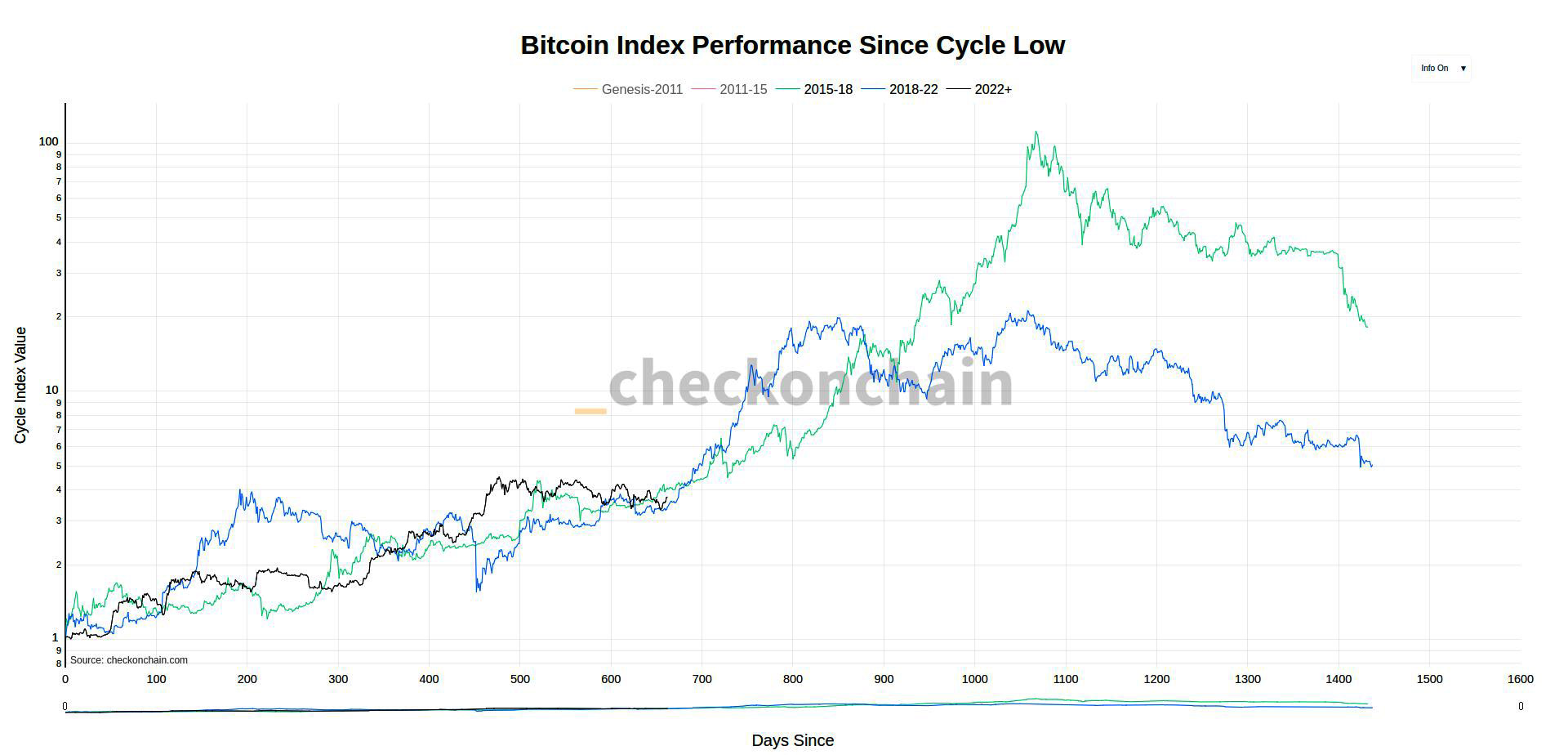
Рост изменение цены биткоина после достижения минимума каждого цикла. Источник: Checkmate

«Я предпочитаю сравнение с циклическим минимумом, поскольку оно дает точку отсчета психологическому периоду, необходимому инвесторам для восстановления после медвежьего рынка. Меры роста не имеют значения, в отличие от продолжительности».

Ethereum страдает на фоне роста доминирования биткоина

Несмотря на некоторые трудности биткоина, альткоины переживают еще более сложные времена. Курс Ethereum по отношению к биткоину (ETH/BTC) достиг минимумов с апреля 2021 года, опустившись до 0,0387 16 сентября.

Алекс Торн (Alex Thorn), глава исследовательского отдела Galaxy Research, отмечает, что с момента перехода Ethereum на Proof-of-Stake два года назад пара ETH/BTC потеряла более 50% стоимости.
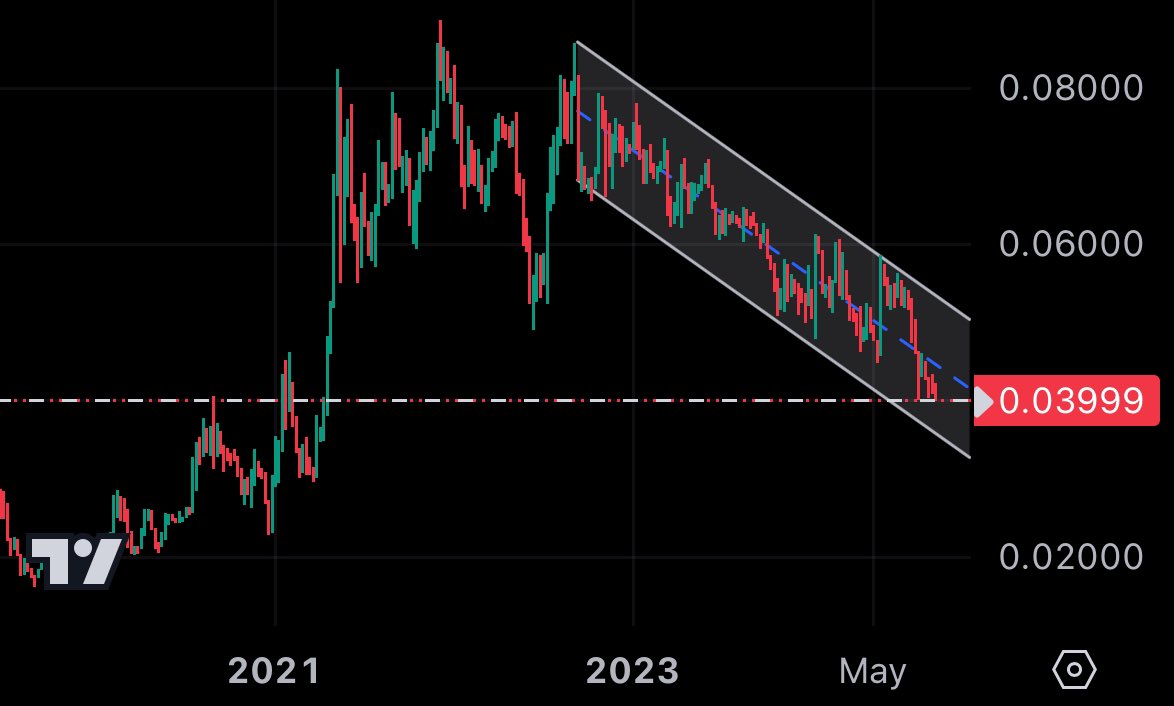
График ETH/BTC. Аналитика: Алекс Торн

На этом фоне доля биткоина в общей капитализации крипторынка продолжает расти, достигнув 16 сентября максимума за последние 3,5 года на уровне 58,07%.

Популярный в соцсети X криптотрейдер и аналитик Михаэль ван де Поппе (Michaël van de Poppe) считает, что доминирование биткоина в ближайшее время достигнет максимума. «Я ожидаю, что доминирование биткоина достигнет пика в этой области», — прогнозирует он. «Все зависит от Ethereum, но похоже, что мы уже близки, учитывая текущие настроения».
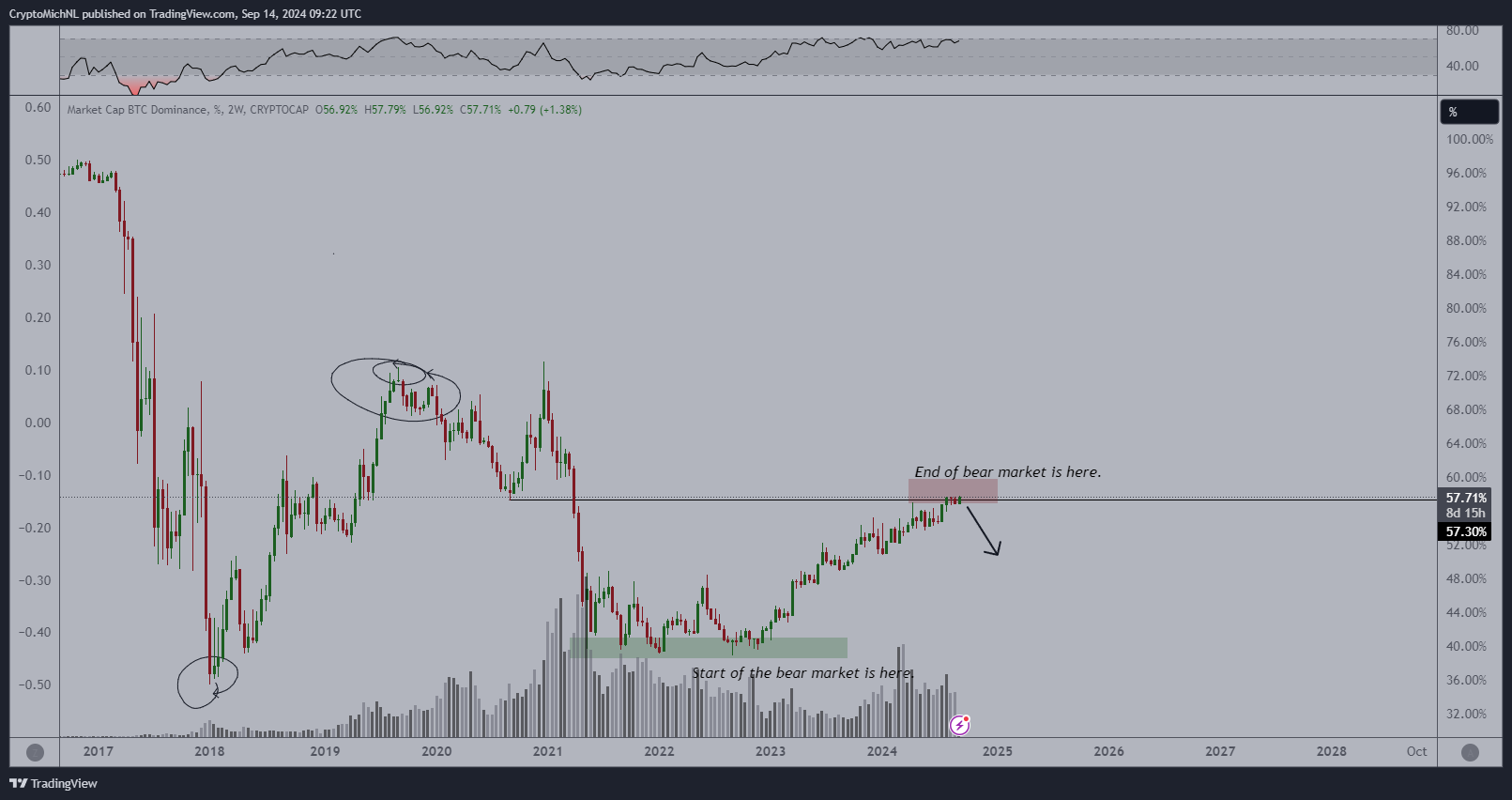
2-недельный график доминирования биткоина. Аналитика: Михаэль ван де Поппе

Ван де Поппе также видит, что как альткоины, так и сам биткоин достигли дна, и ожидает нового исторического максимума для первой криптовалюты уже в следующем месяце.

«Золото устанавливает новые исторические максимумы, и ожидается, что биткоин последует этому пути», — написал он поста в другом посте в соцсети X, ссылаясь на недавние показатели золота. «Новый исторический максимум в октябре».
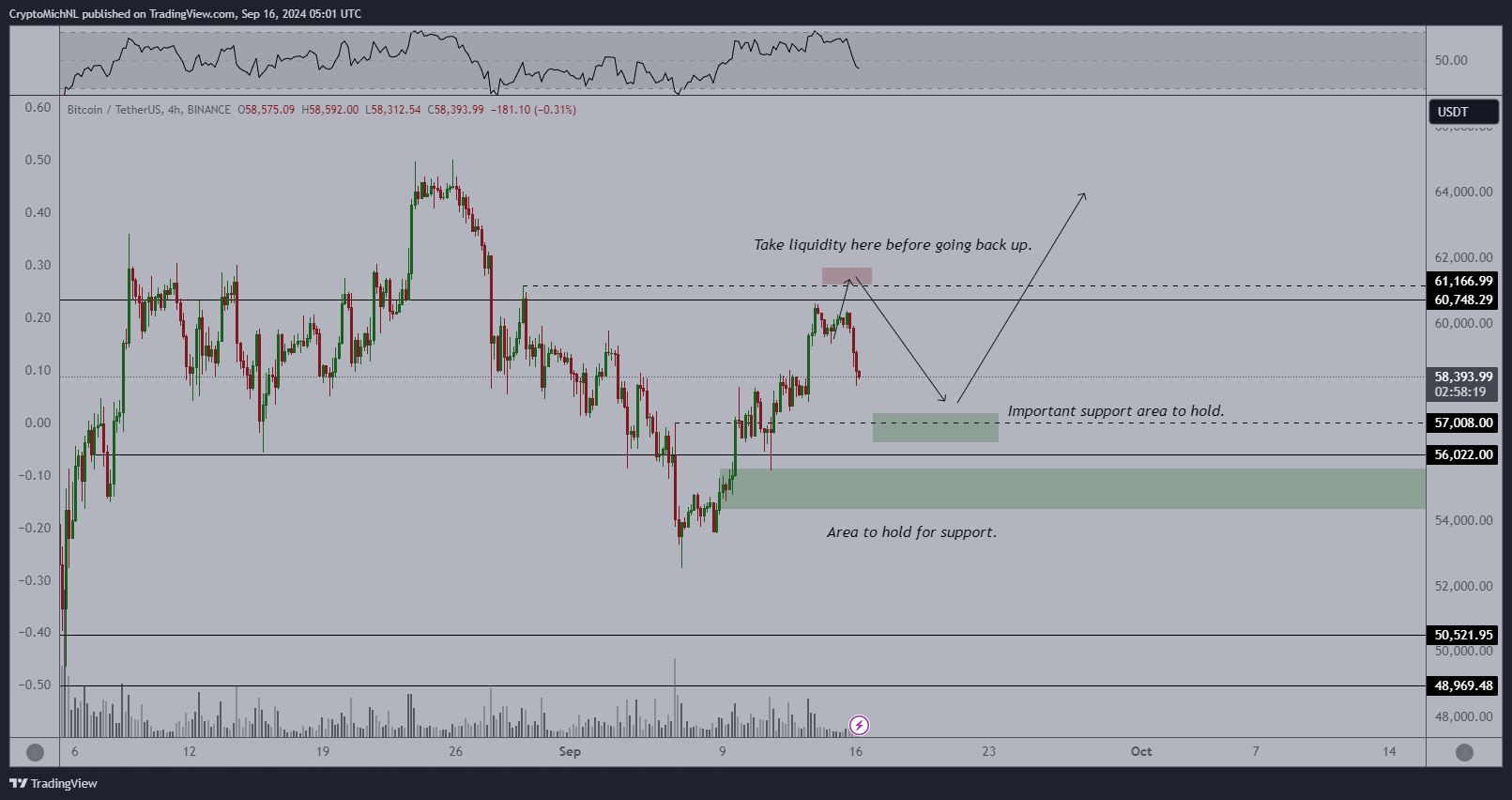
4-часовой график BTC/USDT. Аналитика: Михаэль ван де Поппе

В целом, рынок криптовалют находится на пороге важных событий. Решение ФРС по ставке может стать катализатором для дальнейшего движения биткоина. При этом техническая картина остается неоднозначной, а альткоины продолжают отставать от лидера рынка. Инвесторы внимательно следят за развитием ситуации, ожидая, что ближайшие дни могут определить направление движения цены биткоина на несколько недель вперед.

Related Reads

A Group of Suzhou Engineers Unexpectedly Attain Financial Freedom

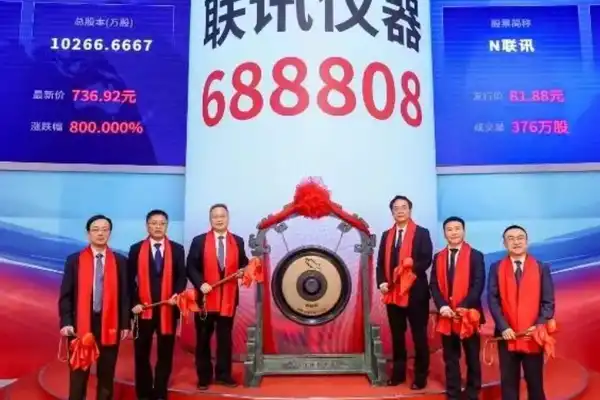
In Suzhou, a group of engineers from Lianxun Instruments, a leader in optical communication testing equipment, have achieved remarkable wealth after the company's IPO. Listed just two months ago on the STAR Market, the company's stock price surged approximately 30 times, making it the only A-share stock priced above 2,000 yuan. This surge created substantial fortunes for nearly 100 technical employees who held a collective 15.91% stake through employee stock ownership platforms, valued at over 36 billion yuan at the current market cap. Among them, nearly 40 became billionaires, while even the smallest holdings exceeded 5 million yuan in value. Founded in 2017 by Hu Haiyang, Yang Jian, and Huang Jianjun, Lianxun Instruments was established to address China's reliance on foreign high-end testing instruments. The company grew rapidly with a strong focus on R&D, where technical staff make up nearly 80% of its workforce. Early implementation of employee stock plans helped retain this core talent. The company's explosive growth is fueled by booming AI computing demand, with clients including major global optical module leaders. Its revenue skyrocketed from 276 million yuan in 2023 to 1.194 billion yuan in 2025, turning a profit in 2024. The IPO has also generated massive returns for early investors, including Suzhou's state-owned capital, which saw a hundredfold return. This story reflects a broader trend in China's markets, where technology firms in AI, semiconductors, and optics are creating new wealth, rewarding engineers and technical teams who are now central to modern capital-driven success stories, marking a shift from previous eras dominated by internet and real estate tycoons.

marsbit7m ago

A Group of Suzhou Engineers Unexpectedly Attain Financial Freedom

marsbit7m ago

NVIDIA's Annual 'Most Dangerous' Paper: AI Self-Replicating Code, Unlimited Leveling and Evolution

NVIDIA's "Red Queen Gödel Machine" (RQGM) paper proposes a potentially groundbreaking AI self-evolution framework. It breaks from the long-stalled concept of the "Gödel Machine," which required mathematically proven beneficial self-modifications, by adopting an evolutionary approach. The core, and most striking, innovation is that the AI does not just evolve its own code in a static environment. Instead, it co-evolves both the "student" (the task-performing agent) and the "examiner" (the evaluation system that judges it). This creates a dynamic, recursive self-improvement loop inspired by the biological "Red Queen Hypothesis"—where continuous adaptation is needed just to maintain relative fitness. The mechanism operates in epochs. Within an epoch, a fixed examiner evaluates all candidate code variants. At epoch boundaries, a new, potentially more rigorous examiner can replace the old one, but only if it proves statistically superior on a held-out "ground truth" dataset. This "controlled utility evolution" aims to ensure progress is measurable and grounded. The paper demonstrates RQGM's effectiveness across three domains: 1. **Code Generation:** It achieved a 71.7% test-set pass rate (improving over a 69.9% SOTA) while using 1.35-1.72x fewer computational tokens. 2. **Paper Writing:** In a subjective task, the co-evolved writer and reviewer achieved a 40.5% acceptance rate by a fixed human panel, up from 21.8%. 3. **Math Proofs:** It evolved more accurate graders (at 3x lower cost) and higher-scoring provers. Notably, RQGM also mitigated a known LLM bias where AI reviewers favor AI-generated content. By specifically rewarding reviewers that correctly rejected AI-written papers from a historical pool, the evolved system achieved impartiality while maintaining 80% accuracy. The research has sparked significant discussion about the acceleration of Recursive Self-Improvement (RSI). Some, like Anthropic's Jack Clark, have predicted a high probability of highly autonomous, self-evolving AI emerging by 2028. The paper suggests that when an AI begins to design its own evaluators and push itself toward ever-higher standards in a recursive loop, it may be taking a fundamental step toward redefining intelligence and autonomy.

marsbit32m ago

NVIDIA's Annual 'Most Dangerous' Paper: AI Self-Replicating Code, Unlimited Leveling and Evolution

marsbit32m ago

Apple and the Power Rebalancing with 'The Microns': Dissecting the Profit Ledger Behind the iPhone

The article analyzes the shifting profit dynamics and power balance between Apple and memory suppliers like Micron within the iPhone supply chain. It highlights a social media post criticizing Apple for raising iPhone prices while blaming memory chip cost increases, despite historically paying suppliers like Micron very little. An estimated iPhone 18 cost breakdown is referenced. Historically, memory was a minor cost component. In 2017's iPhone X, memory accounted for only about 1.6-2.3% of the price, with Apple capturing nearly 50% net profit. Over time, memory's share of the Bill-of-Materials (BOM) cost has grown significantly, reaching an estimated 12-15% for the iPhone 17 series. The core driver of this change is soaring demand for memory from the AI industry, particularly for High Bandwidth Memory (HBM) and AI servers, which is diverting production capacity and squeezing supply for consumer electronics. Memory manufacturers, after enduring periods of low profits, now hold greater pricing power. This is reflected in their recent strong financials, like Micron's 84.6% gross margin. Apple CEO Tim Cook initially described the memory price pressure as unprecedented in his 40-year career, later calling it a "once-in-a-century flood," before Apple announced price hikes across several product lines, causing a significant stock drop. Elon Musk echoed Cook's sentiment about the dramatic cost surge. The article concludes that the era of memory suppliers being at the mercy of Apple's pricing power has temporarily reversed, thanks to AI-driven demand. It notes Apple is reportedly seeking to diversify its supply chain, including exploring chips from China's CXMT.

Odaily星球日报2h ago

Apple and the Power Rebalancing with 'The Microns': Dissecting the Profit Ledger Behind the iPhone

Odaily星球日报2h ago

Conversation with the Founder of 42 Macro: The Fed's 'Boiling the Frog Slowly' and the K-Shaped Economy

In a conversation with Anthony Pompliano, Darius Dale, founder of 42 Macro, discusses the Federal Reserve's monetary policy and the K-shaped U.S. economy. Dale characterizes new Fed Chair Kevin Warsh as a "dove in hawk's clothing," expecting the Fed to signal or enact policy tightening in the coming quarters to create room for later easing. He argues current economic signals, including high deficit spending, debt monetization, and credit growth, strongly indicate inflation is not on a credible path back to 2%, forcing the Fed to act. The discussion highlights the stark "K-shaped" economic reality. While top earners, buoyed by massive cash savings (up ~$8 trillion since pre-pandemic), continue robust spending, those at the bottom face severe financial strain, with delinquency rates on consumer loans reaching crisis-era highs. Dale attributes much of the current social and political anxiety to this divergence, driven by the "Cantillon effects" of monetary expansion, which disproportionately benefits asset owners. He emphasizes that in this environment of "financial repression," individuals must participate in asset markets to avoid being left behind. On equities, Dale notes a rotation from the "Magnificent Seven" tech giants into broader AI-exposed companies, while warning that the tech giants' massive capital expenditure cycles could eventually puncture over-optimistic cash flow projections. Dale concludes by stressing that the core desire across all economic strata is simply the dignity to provide for one's family, a goal currently undermined by systemic policies that act as a "wealth siphon" from the bottom to the top.

marsbit2h ago

Conversation with the Founder of 42 Macro: The Fed's 'Boiling the Frog Slowly' and the K-Shaped Economy

marsbit2h ago

Trading

Spot
活动图片