DeFi лидирует по ежемесячным уникальным кошелькам за август

cryptonews.ruPublished on 2024-01-06Last updated on 2024-09-06

Согласно отчету DappRadar, у DeFi и социальных приложений в августе заметно выросло количество ежедневных уникальных активных кошельков (dUAW), поскольку в целом по индустрии DApp средний показатель составил 17 миллионов бесплатных подключений, что на 9% больше, чем в предыдущем месяце.

DeFi

У децентрализованных бирж Raydium и Uniswap v2 в августе было 18,8 млн и 4,8 млн уникальных активных кошельков в месяц соответственно, что позволило им занять второе и четвертое место по активности приложений в секторе блокчейна за этот период.

Примечательно, что активность Raydium выросла на 107% в месяц, в то время как Uniswap v2 упала на 9%, что подчеркивает тенденцию роста активности пользователей на Solana.

Несмотря на наличие двух из пяти наиболее активных платформ в прошлом месяце и почти 10%-ный рост числа уникальных пользователей в месяц, приложения DeFi собрали в среднем 2 миллиона dUAW и составили только 12% от всей активности, замеченной в прошлом месяце.

Общение

Между тем, на социальный сектор пришлось 23% активности отрасли с 3,9 млн dUAW в августе, уступив лишь 24%-му доминированию игровых приложений.

Социальная платформа CARV на базе opBNB была самым популярным приложением в прошлом месяце с 28 миллионами уникальных активных кошельков — ежемесячный рост на 2331%.

Более того, приложение для покупок на базе Web3 KAI-CHING ежемесячно посещало 16,7 миллиона уникальных активных пользователей, что делает его вторым по количеству использований приложением в августе. Это значительное число, поскольку приложению, развернутому на Near Protocol, удалось добиться этого, несмотря на потерю 4% своей пользовательской базы.

HOT Game, также развернутая в Near infrastructure, пополнила пятерку самых используемых блокчейн-приложений в августе с 4,1 миллионами уникальных активных кошельков в месяц.

Падение TVL и выручки

Хотя активность приложений DeFi ежемесячно увеличивалась, общая заблокированная стоимость в секторе (TVL) и доход от приложений не росли одновременно.

В августе количество приложений DeFi dapps упало на 15%, до $ 124 млрд, поскольку на более широком рынке криптовалют наблюдался спад.

Что касается доходов, приложения DeFi показали один из худших месяцев с начала года, зарегистрировав 65,4 миллиона долларов, согласно данным TokenTerminal. Это сокращение на 13% по сравнению с доходом в июле примерно в 75 миллионов долларов, что контрастирует с ростом активности, наблюдавшимся в прошлом месяце.


Related Reads

Xing Bo Strikes Again: Last Time 'Critiquing' World Models, This Time It's Agents' Turn

Xing Bo, President of MBZUAI and professor at Carnegie Mellon University, along with co-authors Mingkai Deng and Jinyu Hou, has released a new paper, "Critique of Agent Model," critiquing the current state of artificial intelligence agents. The paper draws a crucial distinction between "agentic" systems, which rely on external toolchains, prompts, and workflows, and truly "agentive" systems capable of genuine autonomy driven by internal decision-making structures. To illustrate this, it references a real-world incident where an AI programming assistant, following an external prompt but lacking internalized judgment, caused a catastrophic data deletion. The authors propose a detailed analysis and a new framework, "Goal-Identity-Configurator" (GIC), for building truly autonomous agents. This framework systematically addresses five key dimensions where current "Agent" designs fall short: 1. **Goal:** Moving from step-by-step human instruction to a system capable of autonomously decomposing a single long-term goal and adapting sub-goals based on new information. 2. **Identity:** Evolving self-assessment updated by experience, rather than a static description in a system prompt. 3. **Decision Making:** Replacing textual Chain-of-Thought reasoning with "simulative reasoning" that uses a dedicated world model to predict real-world consequences before selecting actions. 4. **Cognitive Control:** Introducing a separate "System III" metacognitive module that dynamically decides when to deliberate, stick to a plan, or act quickly. 5. **Learning:** Enabling "continual autonomous learning," where the agent itself decides when to act, practice in simulation, or update its world model and self-perception. The GIC architecture integrates six components—a belief encoder, goal decomposer, identity evolver, configurator (System III), simulation-based planner (System II), and executor (System I)—to embody these principles. The paper argues that a growth path akin to pilot training (ground theory, simulator practice, real deployment) should be underpinned by a unified cognitive architecture, not separate workflows. On safety, the authors contend that the GIC framework's modular, explicit design enhances inspectability, allowing problematic behavior to be traced to specific components (e.g., flawed goal or poorly trained module) rather than emerging opaquely. However, they acknowledge that ultimate safety depends on correctly training these modules in the first place. In conclusion, the paper challenges the loose application of the term "Agent," asserting that task completion alone does not equal true autonomy. True autonomy requires goals, identity, and judgment to be genuinely internalized within the agent's architecture, not merely enforced by external scripts.

marsbit4m ago

Xing Bo Strikes Again: Last Time 'Critiquing' World Models, This Time It's Agents' Turn

marsbit4m ago

How Collector Crypt Uses 'Recirculating Buybacks' to Create an Illusion of Growth

Title: How Collector Crypt Creates a Growth Illusion with "Buyback Loops" Key Findings: Collector Crypt's (CC) net take rate has halved from 11.2% in Q3 2025 to 5.6% in Q2 2026, while GMV grew 4.7x. This growth is driven by higher-tier card packs ($250, $1,000, $2,500) which have lower platform dollar retention rates. The newly launched $2,500 Mythic tier captured 36.7% of June GMV within 13 days. Growth is fueled by a small cohort of high-spending, high-frequency wallets rather than broad user base expansion. The economic model faces pressure from three key areas: 1) **Shifting GMV Mix**: Pushing users towards larger, lower-retention card packs increases GMV but reduces overall profitability. 2) **Physical Redemptions**: Card redemptions for physical items remove reusable inventory from the system, creating costly replenishment needs. In May, redemptions consumed 41.6% of pre-redemption net income. Only 75 wallets drove redemptions in June. 3) **B2B/API Strategy**: Partner revenue remains negligible (cumulatively $1.83M) and dependent on CC for inventory, vaulting, and buyback services, failing to create a scalable, asset-light recurring revenue stream. The core product is a repetitive pack-buyback loop with limited secondary market activity and token value accrual. Sensitive modeling shows CC's economics turn negative when any two of the following pressures coincide: replenishment costs near market price, redemption rates exceeding 9%, or high-tier buyback rates around 93%. While CC operates in a large and growing collectibles market, its current growth levers—bigger packs, high buyback rates, and capital recycling by a few wallets—create a volume illusion without demonstrating sustainable collector engagement, deep secondary markets, or a viable path to improved margins. Future proof points include broadening collector participation, deepening secondary trading, and developing true asset-light B2B revenue channels.

Foresight News27m ago

How Collector Crypt Uses 'Recirculating Buybacks' to Create an Illusion of Growth

Foresight News27m ago

Grayscale's Latest Research: What is Solana's Next Growth Engine?

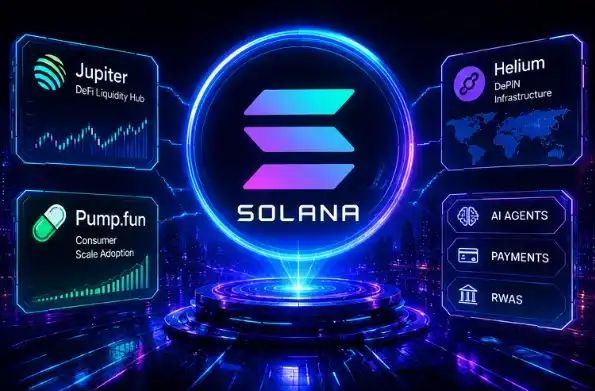
Grayscale's latest report, "Solana: Crypto's Financial Bazaar," signals a shift in how the market views Solana, moving beyond its high-performance and meme-centric reputation. The report frames Solana as an evolving application platform for large-scale economic activity, akin to a bustling digital marketplace. The analysis highlights that public chain competition has moved past raw throughput (TPS) to focus on genuine economic activity—daily users, transaction volume, and real revenue. Solana's metrics, such as over 1,000 dApps, 100M+ daily transactions, and ~4.3M daily active users, showcase this shift toward application-layer prosperity. The report identifies three key growth drivers: 1. **Jupiter**: Evolving from a DEX aggregator to a core liquidity hub and comprehensive financial platform for Solana's DeFi. 2. **Pump.fun**: Demonstrates Solana's capacity for consumer-scale applications, attracting millions of users and generating significant, sustainable revenue, validating network stability under high load. 3. **Helium & DePIN**: Represents expansion into real-world infrastructure, connecting blockchain to physical resources like wireless networks and positioning services, opening new long-term use cases. Solana Foundation's recent focus aligns with this broader vision, emphasizing AI Agents (for machine-to-machine transactions), payments, stablecoins, and Real-World Assets (RWA) to build a sustainable growth model beyond cyclical trends. While challenges remain—such as value capture for SOL and maintaining ecosystem sustainability beyond hot trends—institutional interest is growing due to Solana's maturing application business models, expanding payment/stablecoin ecosystem, and persistent developer activity. The competition is no longer about speed alone, but about which network can foster the most vibrant and valuable digital economy.

marsbit48m ago

Grayscale's Latest Research: What is Solana's Next Growth Engine?

marsbit48m ago

Trading

Spot
活动图片