AIP 41 Vote: Majority Of Apecoin Holders Are Not In Favor Of The Token’s Migration To Another Sidechain

Ethereum World NewsPublished on 2022-06-07Last updated on 2022-06-07

Abstract

The current AIP-41 voting poll suggests that the majority of Apecoin holders do not want the token to migrate to another chain.

The current AIP-41 voting poll suggests that the majority of Apecoin holders do not want the token to migrate to another chain.

At press time, the AIP-41 proposal has attracted nearly 66% that are in favor of Apecoin sticking with the Ethereum blockchain.

It seems that the majority of ApeCoin DAO members are not in favor of Apecoin’s migration to another blockchain. The current AIP-41 proposal that suggests that the token should stay on the Ethereum blockchain has attracted nearly 66% of votes at the time of writing.

AIP-41 Proposal Voting Is Now Live

AIP-41 is a proposal that was drafted by an Apecoin community member ASEC on June 3rd, which suggests that the token should stay on Ethereum Blockchain. The following proposal was introduced in response to Yuga Labs’ tweet to shift Apecoin to another independent chain that could support its growing ecosystem.
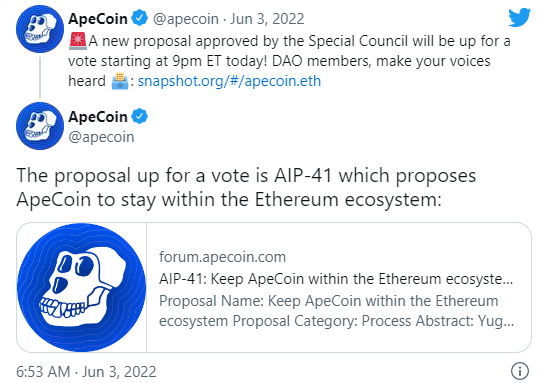
The idea of shifting Apecoin to a new side chain was first introduced during the sale of Yuga Labs’ Otherdeed NFT project. During that time several community members had faced a lot of friction due to frequent network crashes caused by an overwhelming surge of people trying to purchase the Otherdeed NFT. In addition to this, Ethereum’s high processing fee was another cause that propelled Yuga Labs to consider shifting Apecoin to its own independent chain.
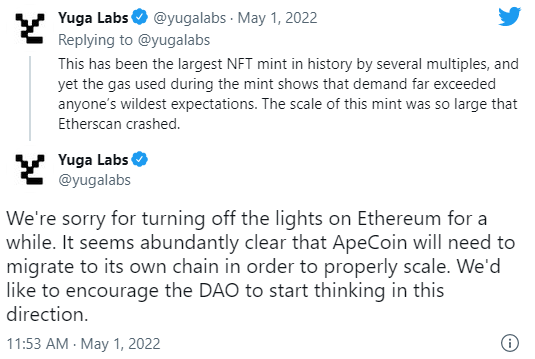
However, the recent AIP-41 proposal counters the suggested Apecoin migration. As per the proposal abstract, the community members are in favor of sticking to the Ethereum blockchain for the time being due to the blockchain’s top-notch security benefits.

“Yuga Labs stated in a tweet 51 that they believed ApeCoin needed to move to its own chain in order to scale. We the ApeCoin DAO believe that, at least for the time being, ApeCoin should remain within the Ethereum ecosystem, and not migrate elsewhere to an L1 chain or sidechain not secured by Ethereum.”

The proposal abstract further noted how migrating to a different chain comes with its own set of risks and complexities that may affect Apecoin and its general credibility.

“Migrating to a different chain is a costly, risky, and complex endeavor with many moving parts that may if not thoughtfully considered, result in catastrophic loss, or at worst, abandonment by Yuga Labs and other entities that would otherwise meaningfully to ApeCoin.” The AIP abstract later added.

At press time, the AIP-41 proposal has attracted nearly 66% of votes that are in favor of Apecoin sticking with the Ethereum blockchain. The voting poll will stay active till Wednesday, 8 June, 9 PM ET for Apecoin community members. The final verdict will be passed shortly after the poll ends.


Related Reads

Bitcoin Trading Strategy Breakdown: Celebrity Predictions and Classic Models All Fail, Only These Four Indicators Remain

Analysis of Bitcoin Trading Strategies: Why Celebrity Forecasts and Classic Models Fail, Leaving Only These Four Reliable Indicators This analysis examines the failure of common Bitcoin prediction methods and identifies four reliable indicators for constructing a trading strategy. The author reviewed all major BTC prediction approaches from 2017-2025, categorizing them into three groups: celebrity price targets (consistently over-optimistic), analytical models like Stock-to-Flow (broken post-2022), and on-chain signals. The key finding is that more data often creates confusion, not clarity. The strategy discards unreliable elements: celebrity predictions (incentivized to be extreme), pure models (invalidated by post-ETF market changes), and the Fear & Greed Index used alone (too many false signals). Four reliable indicators were selected: 1. **MVRV Z-Score:** Accurately identifies cycle bottoms when entering its green zone (e.g., 2018, 2020, 2022). Note: Its ability to call tops is now ineffective post-2024. 2. **SOPR (28-day MA):** Consistently signals bottoms when below 1.0, indicating holders are selling at a loss. 3. **ETF Net Flow:** A crucial post-2024 metric showing institutional momentum (e.g., sustained inflows = buying). 4. **Macro Liquidity (Fed policy & M2):** Sets the overall directional bias (e.g., bullish during easing cycles). The core strategy involves waiting for a multi-signal共振 (resonance). For example, a bottom signal requires MVRV in the green zone + SOPR < 1.0. A top signal requires overheated on-chain data + sustained ETF outflows. Macro policy sets the overall direction. The Fear & Greed Index is only used as a weighted confirmatory signal, never alone. Action is only taken when three or more indicators align. The author automated this into a monitoring system that sends Telegram alerts only when signals trigger. As of the article's date (April 15, 2026), the system showed a strong bottom signal: extreme fear (F&G=12), MVRV in the buy zone, and SOPR < 1.0. The only contrary signal was weak ETF flows. Historically, such triple on-chain共振 has preceded 100%+ returns. The conclusion emphasizes building a personal framework over relying on external predictions, allowing for iterative improvement and customization based on individual risk tolerance.

marsbit18m ago

Bitcoin Trading Strategy Breakdown: Celebrity Predictions and Classic Models All Fail, Only These Four Indicators Remain

marsbit18m ago

Trading

Spot
Futures
活动图片