Token Terminal brings Immutable’s onchain data in front of 300,000 institutional customers

Token TerminalPublished on 2024-05-30Last updated on 2024-08-23

Token Terminal has completed its integration of Immutable zkEVM, Immutable X, and Immutable Orderbook (“Immutable”) to enable institutional-grade onchain analytics for the Immutable ecosystem. This integration improves the accessibility of Immutable’s onchain data to enable more informed decision-making for all stakeholders in the ecosystem.


What’s the impact of a Data Partnership with Token Terminal?

A complete data solution for Immutable: data infrastructure, analytics, and distribution in one

  • Token Terminal is the only fullstack onchain data platform in crypto.
  • As part of the Data Partnership with the Immutable team, we run redundant archive nodes for the Immutable blockchain to maximize data granularity, accuracy, and auditability.
  • As a result of our fullstack approach, Immutable’s data is now accessible via the Bloomberg Terminal. Additionally, IMX, the network’s native token, is eligible for inclusion in Token Terminal-powered cryptoasset index products.
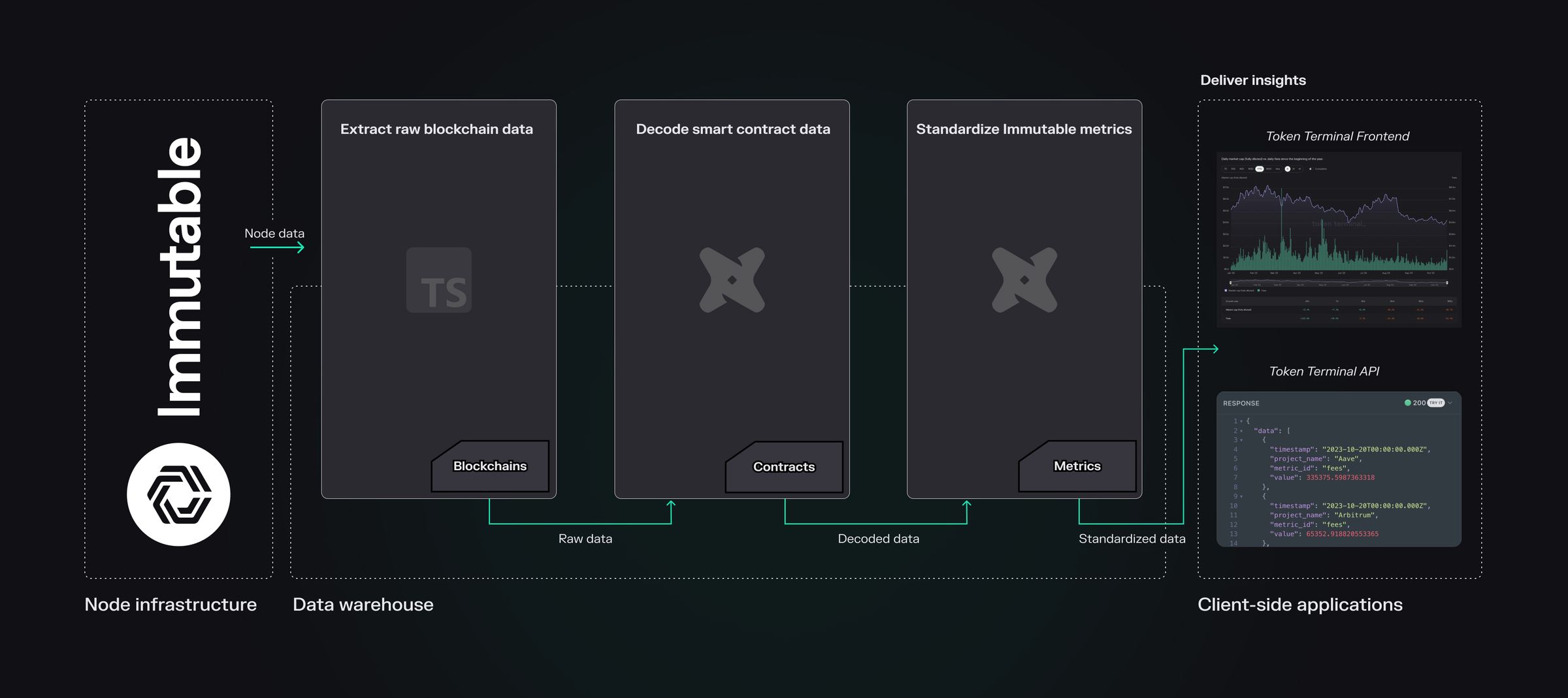
An overview of our end-to-end Data Pipeline for Immutable.

1. Chain dashboards: understand how Immutable benchmarks against other ecosystems in crypto

Access Immutable's onchain data on multiple levels, from chain to contract views

  • Our chain dashboards enable analysts to take a “chain-first” view into the data.
  • These dashboards make it easy for analysts to understand how Immutable compares against other ecosystems based on tens of different metrics.
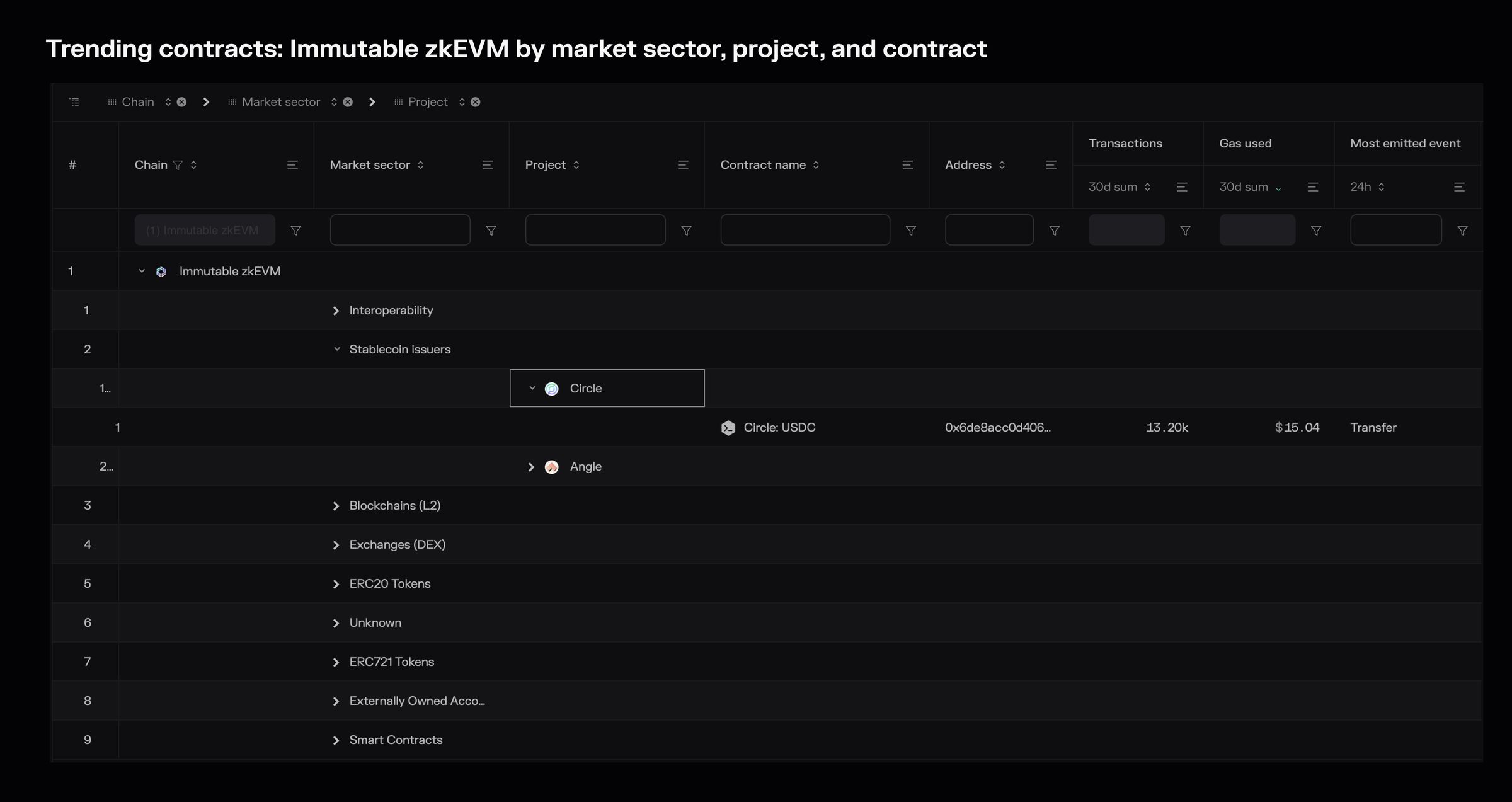
  • Further, we enable analysts to understand which market sectors, projects, and contracts that drive usage on Immutable.
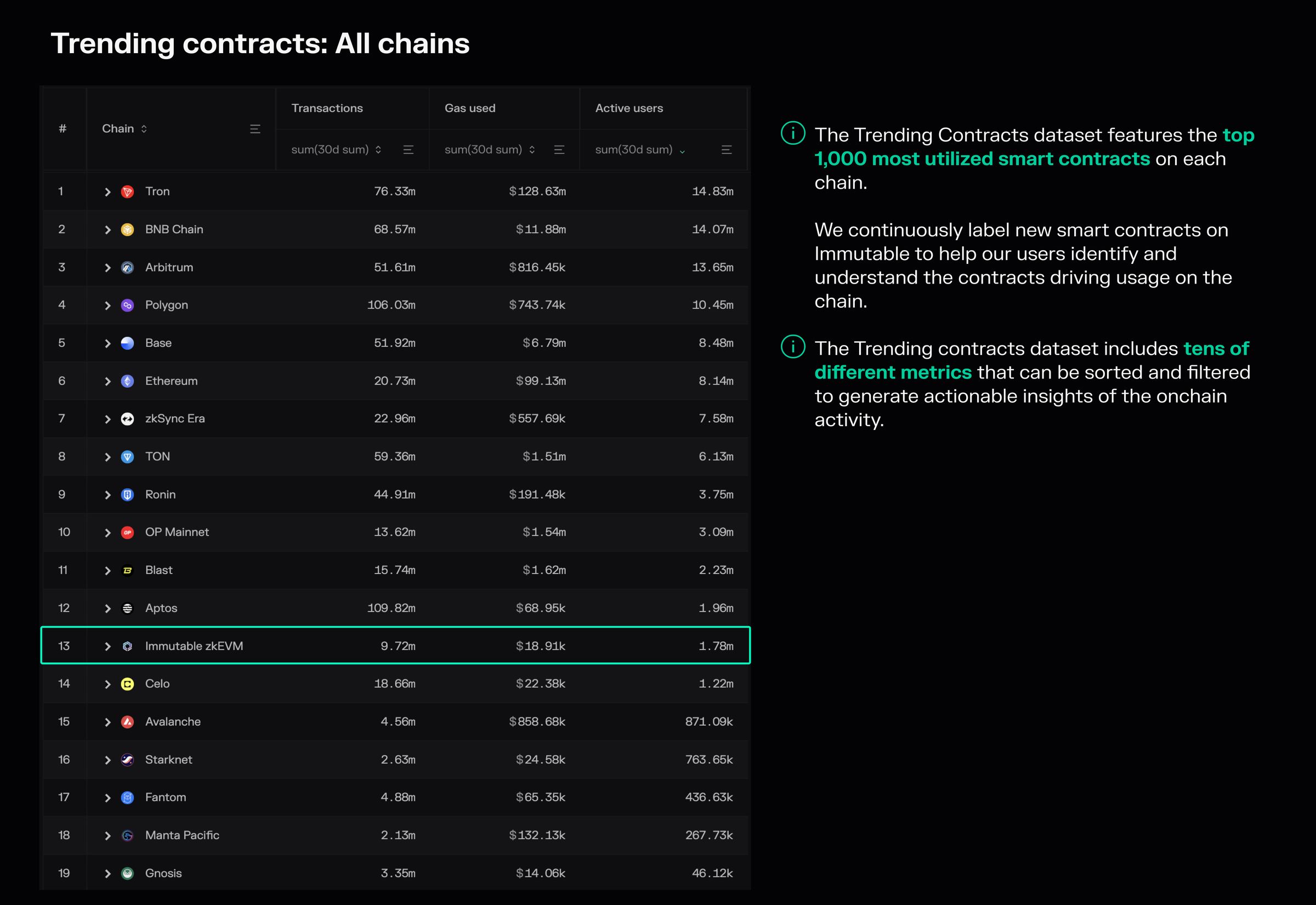
A chain comparison view built using the Trending contracts dashboard.
A chain > market sector > project > contract view built using the Trending contracts dashboard.

2. Market sector dashboards: understand how Immutable compares to other projects within its market sector

Compare the performance of Immutable within the NFT marketplaces market sector

  • Our market sector dashboards enable analysts to take a “market sector-first” view into the data.
  • These dashboards make it easy to understand how Immutable compares against other NFT marketplaces based on tens of different metrics.
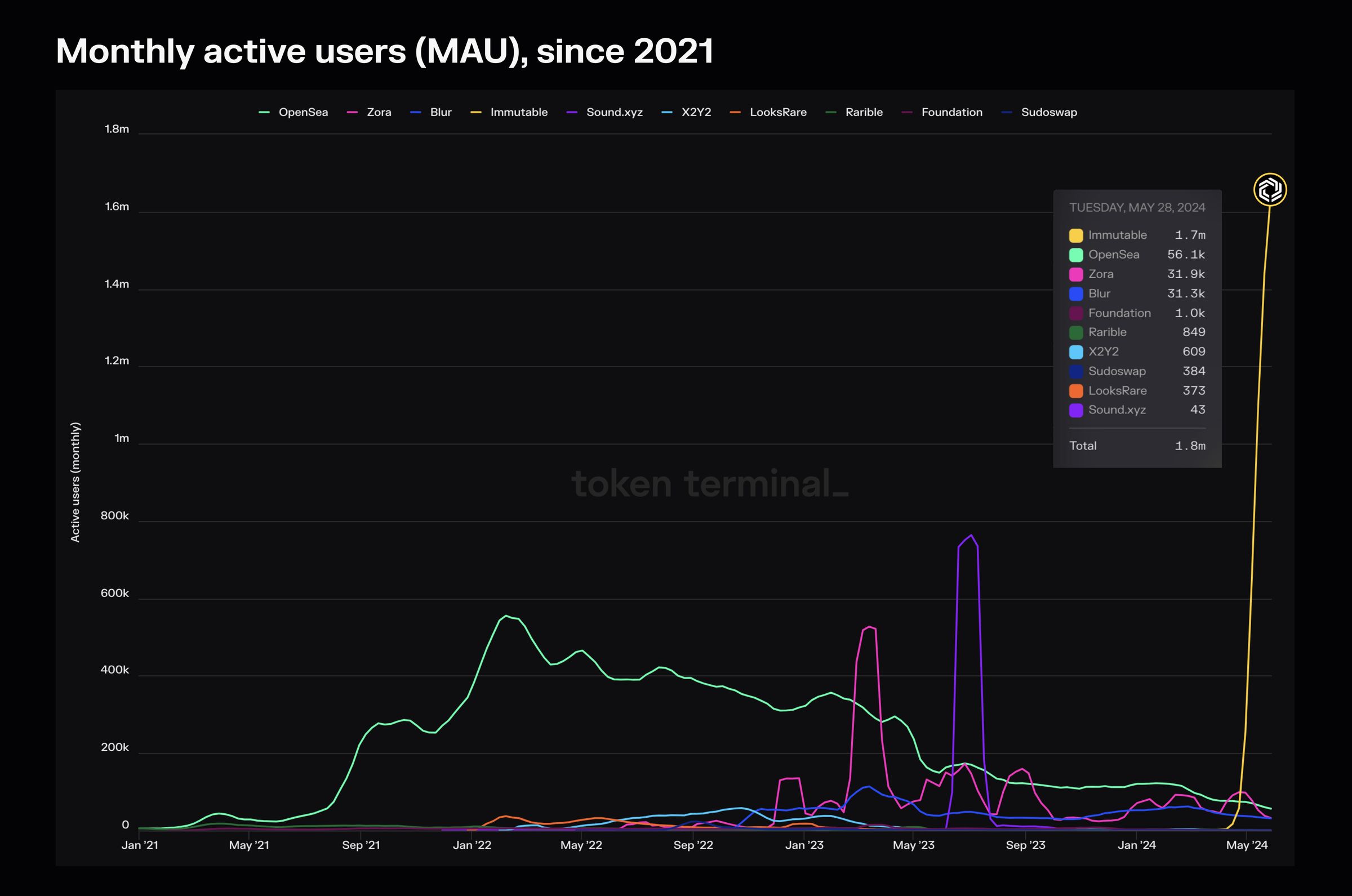
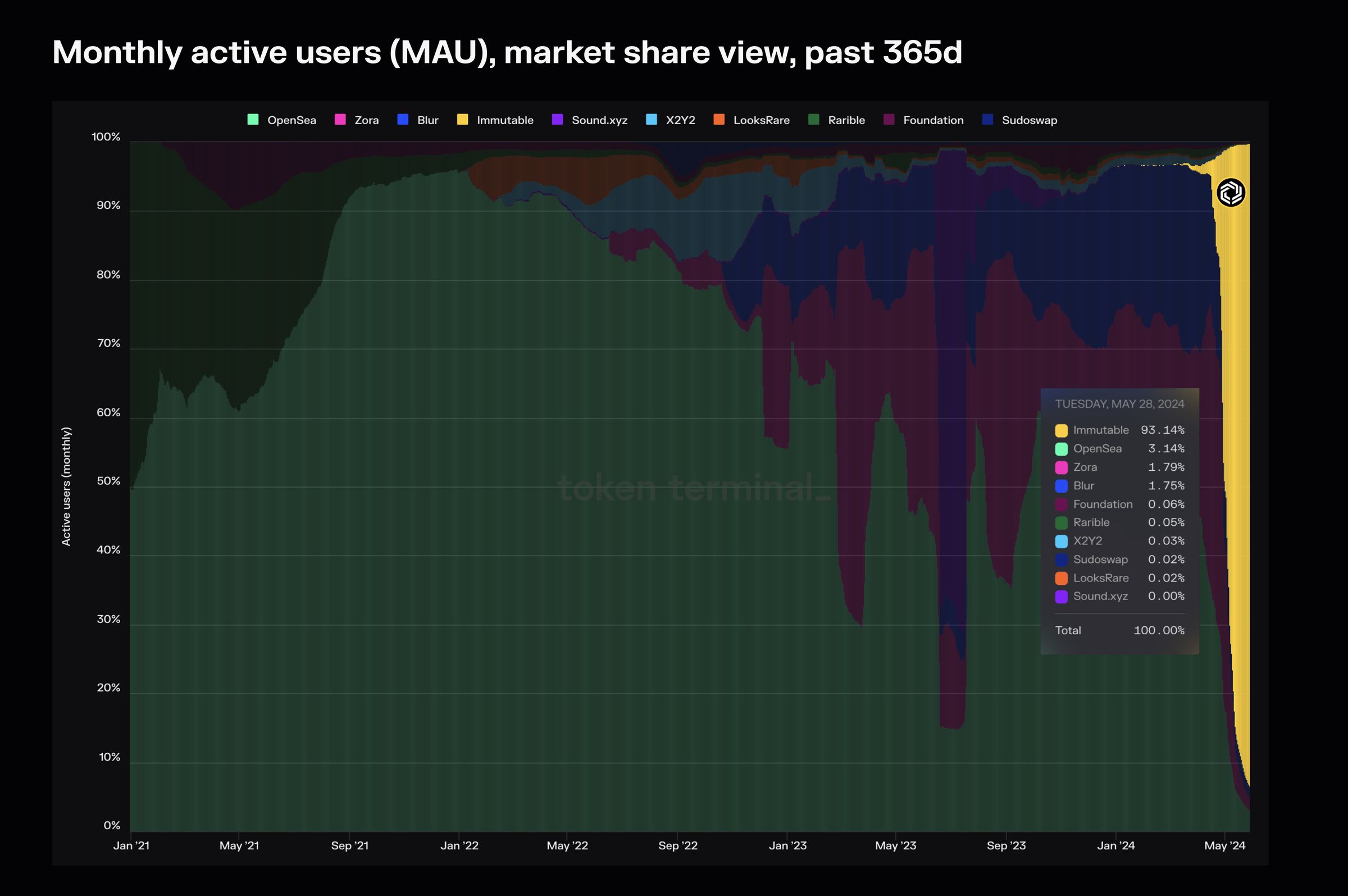
Monthly active users (MAUs) for Immutable highlighted on our Market sector dashboard.
Monthly active users (MAUs) for Immutable highlighted on our Market sector dashboard (market share view).

3. Project dashboards: understand how Immutable performs on financial and usage metrics

Perform in-depth analysis on Immutable

  • Our project dashboards enable crypto analysts to take a “project -first” view into the data.
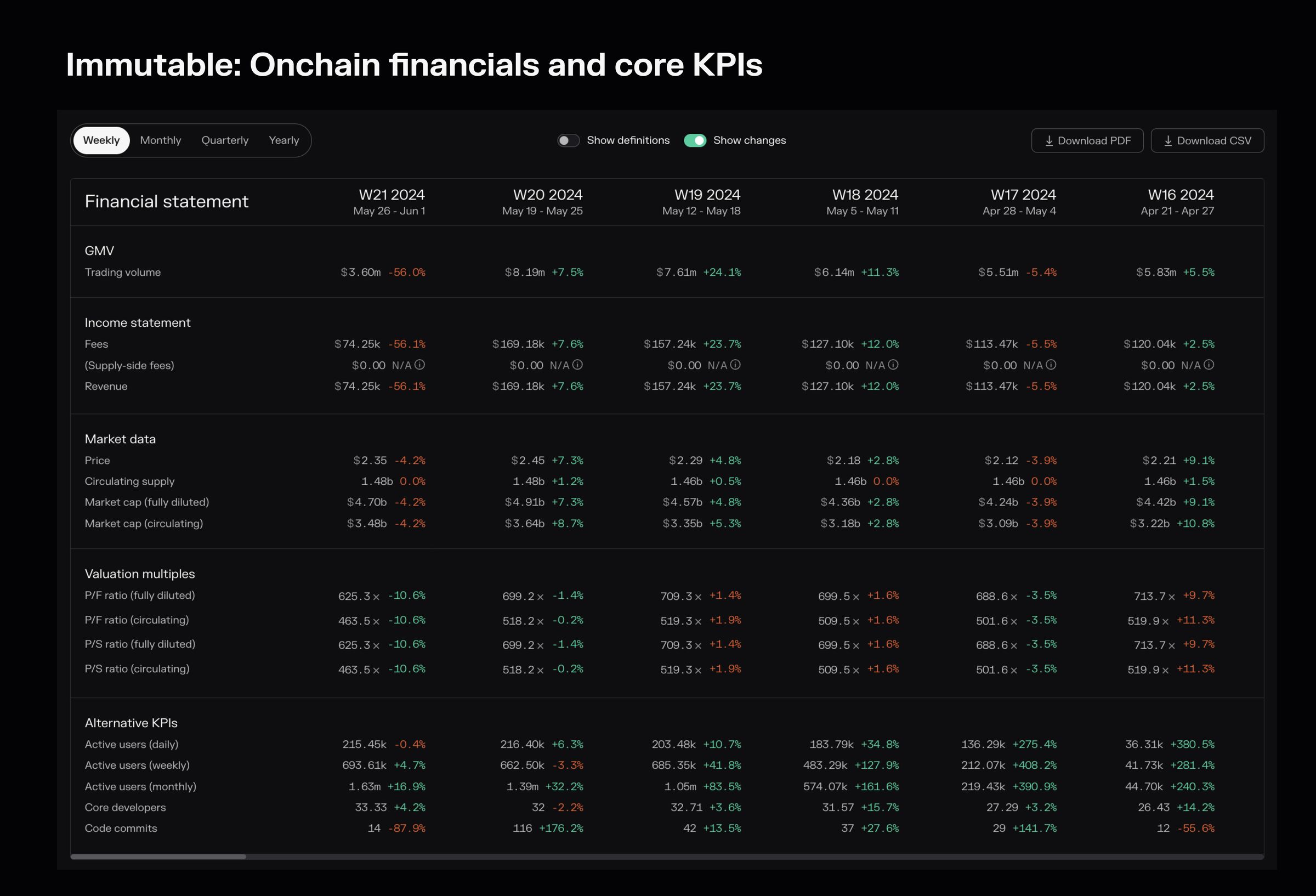
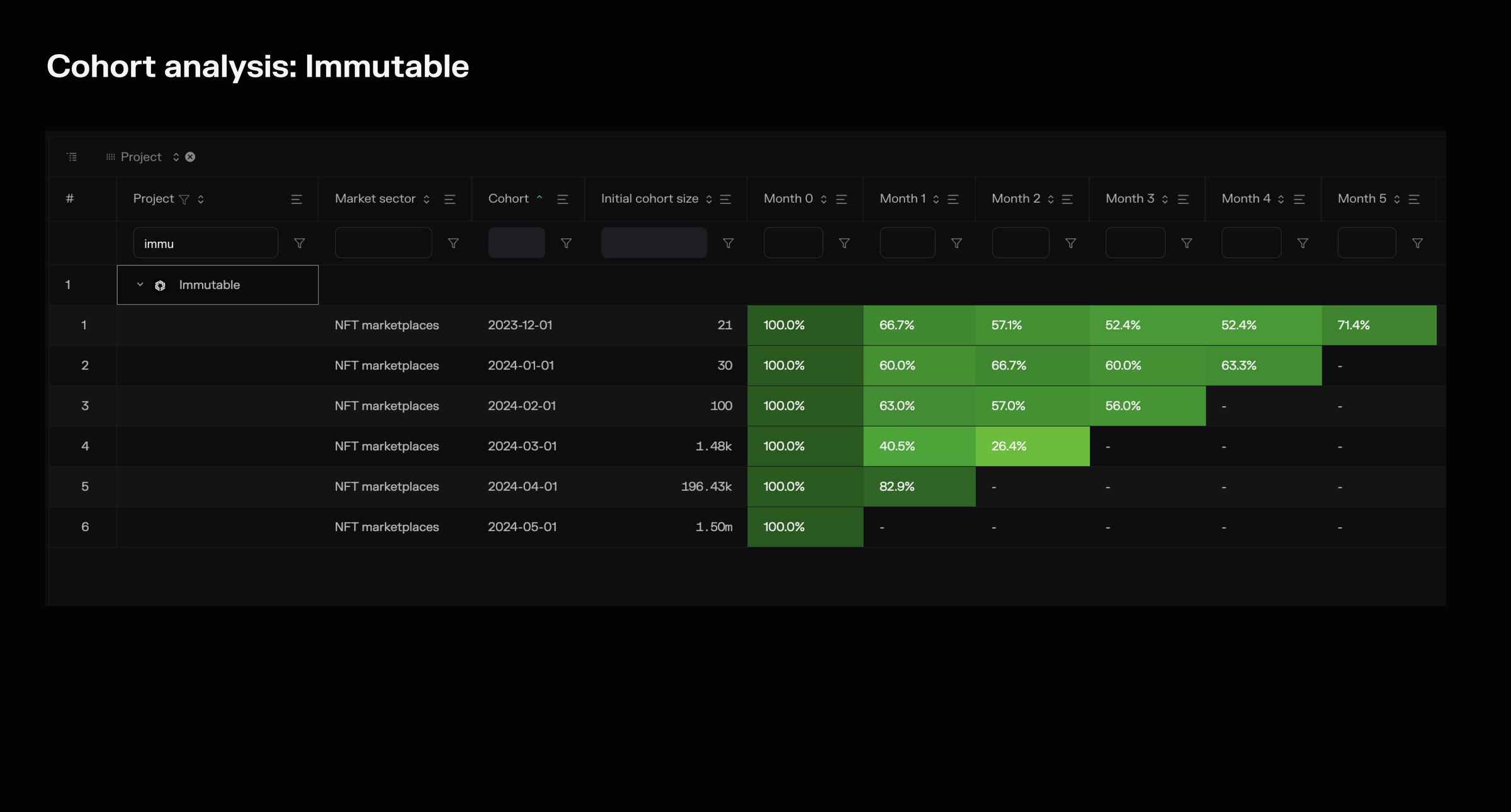
  • These dashboards make it easy to understand how Immutable performs on both financial (fees, revenue, token incentives, etc.) and alternative metrics (DAUs, MAUs, user retention, etc.) over time.
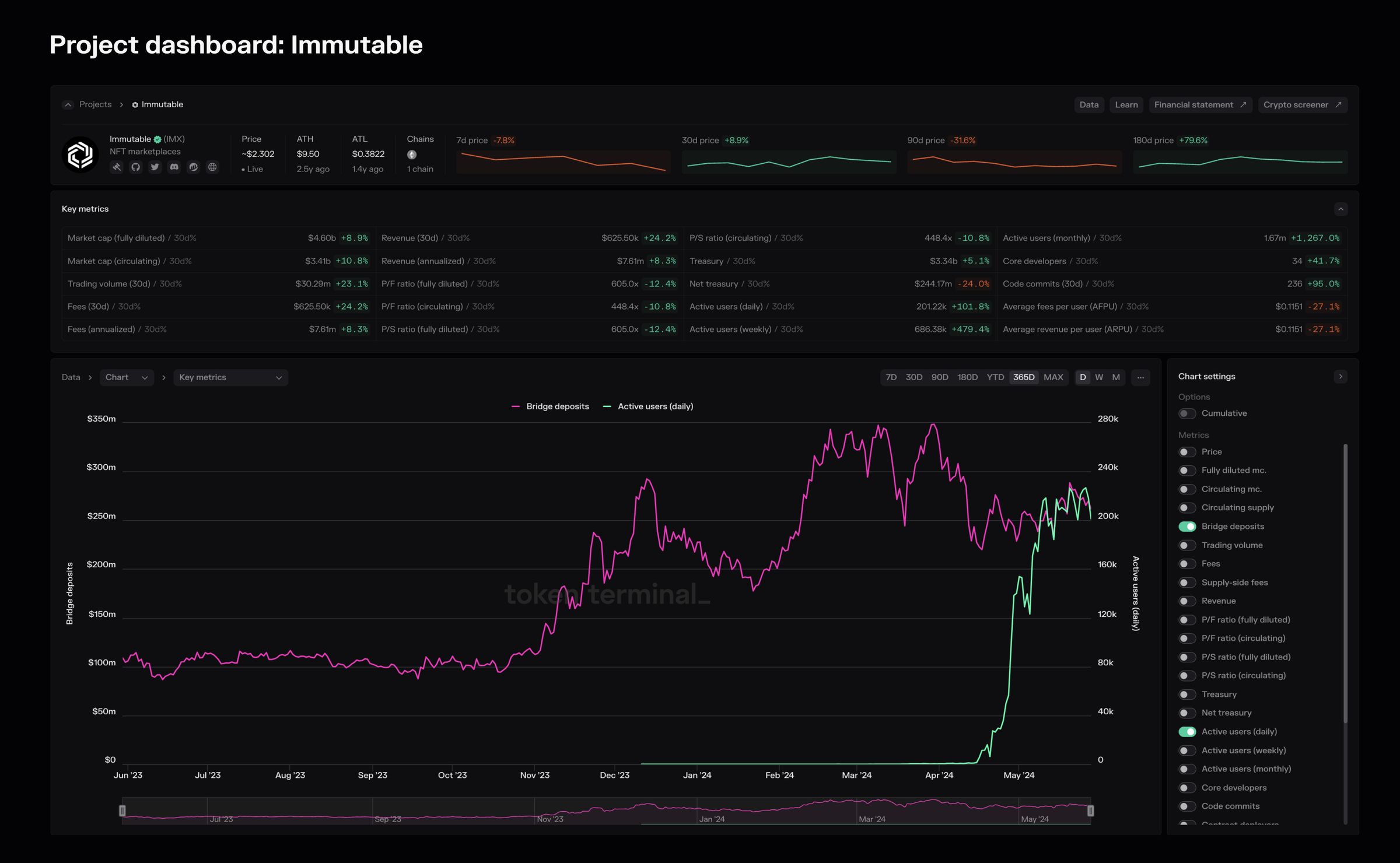
An overview of the Immutable project dashboard.
An overview of Immutable's onchain financials and core KPIs.
Cohort analysis (retention rates) of monthly active users on Immutable.

4. Metric dashboards: benchmark Immutable against the rest of the market using individual metrics

Evaluate Immutable's performance in the crypto market based on over 30 individual metrics

  • Our metric dashboards enable analysts to take a “metric-first” view into the data.
  • These dashboards make it easy to understand how Immutable compares against the rest of the crypto market based on a single metric (note that there are tens of different metrics available for these comparisons).
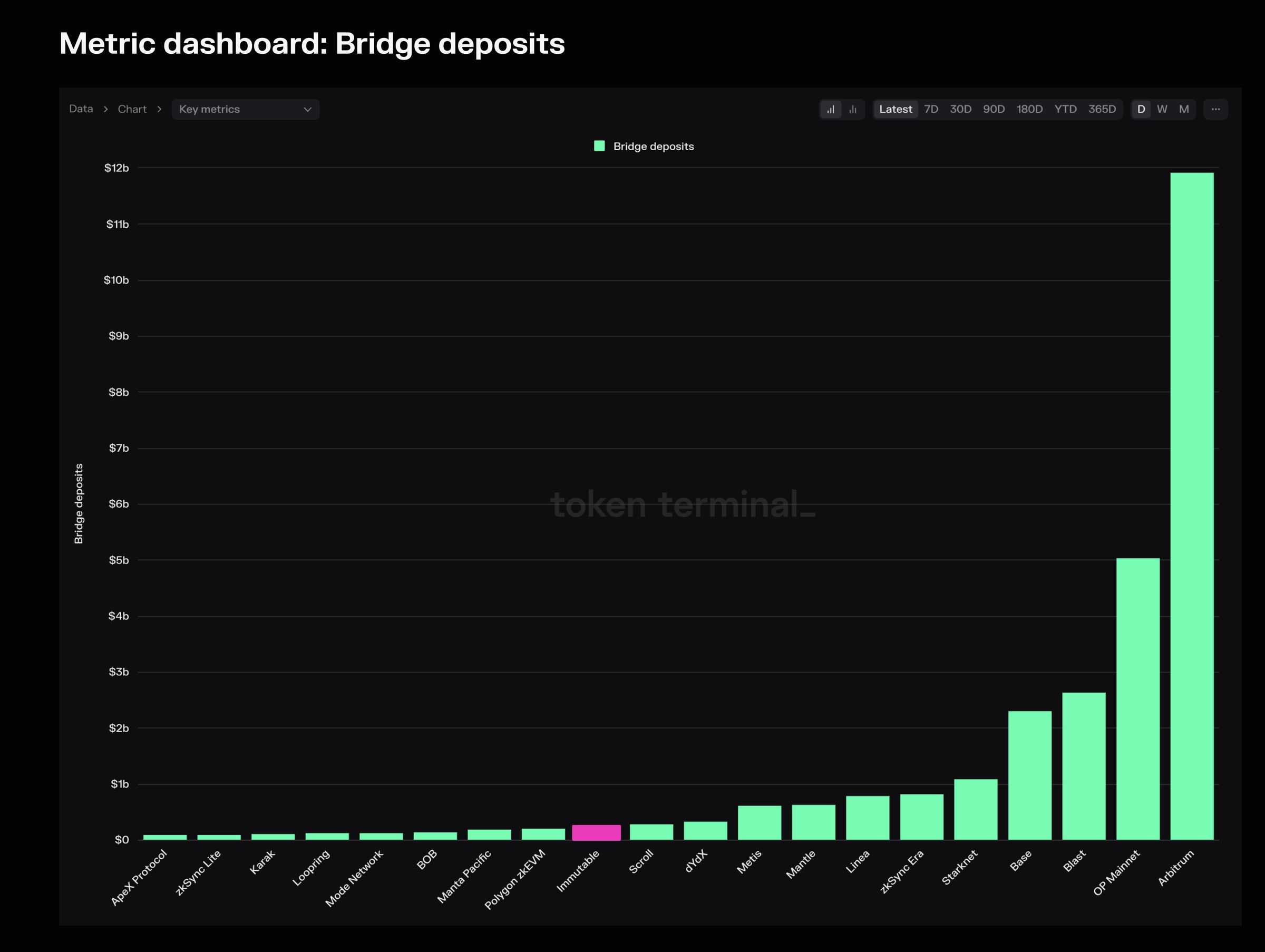
Immutable highlighted on the Bridge deposits dashboard.
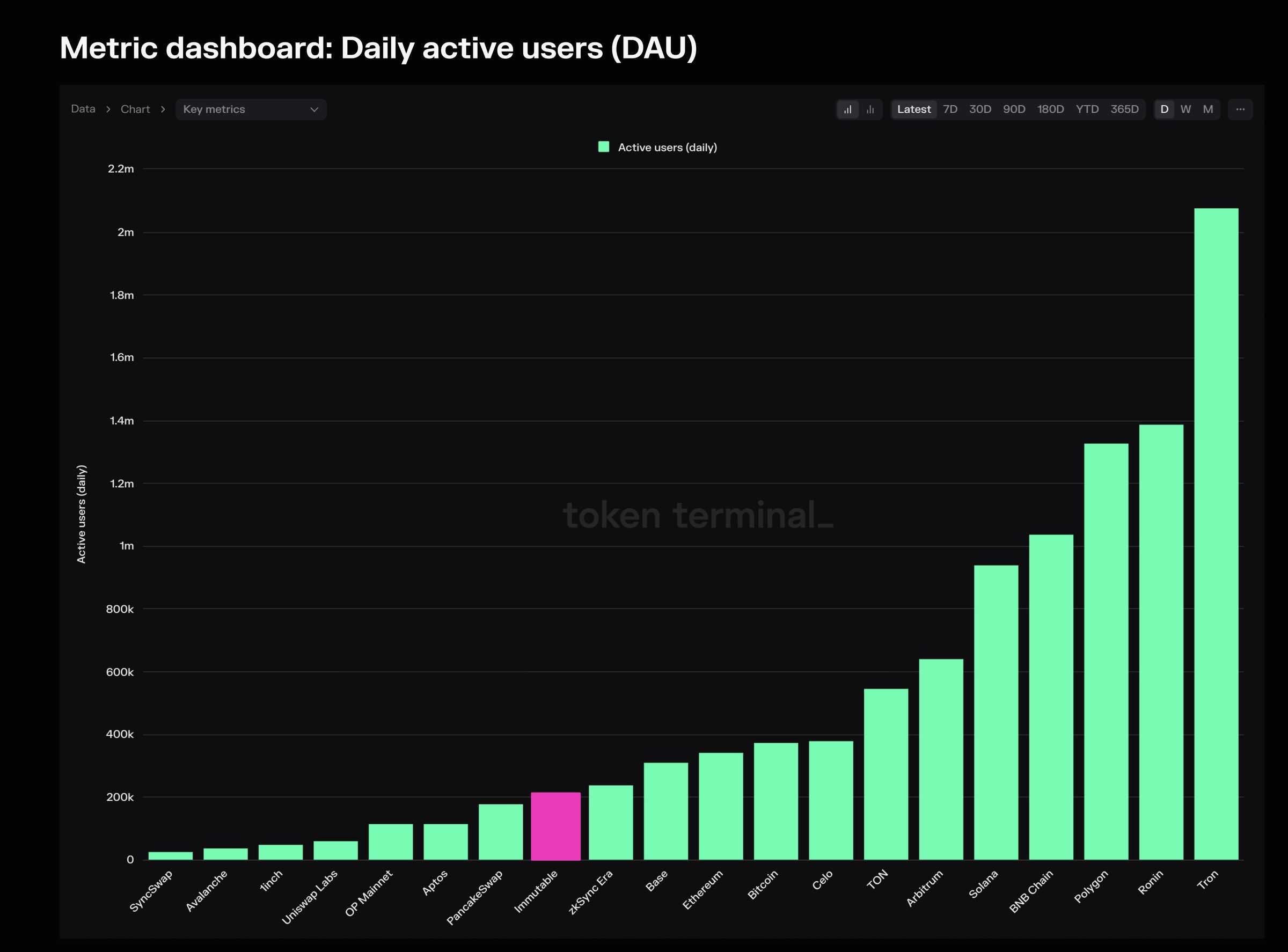
Immutable highlighted on the Daily active users (DAU) dashboard.

5. Custom dashboards: build your own Terminal to track the Immutable-specific metrics that matter

Create your own personalized dashboards to track the performance of Immutable

  • Our custom dashboards, such as the Crypto screener, enable analysts to take a “custom” view into the data.
  • These dashboards make it easy to understand how Immutable compares against the rest of the crypto market based on the metrics of the analyst’s choice.
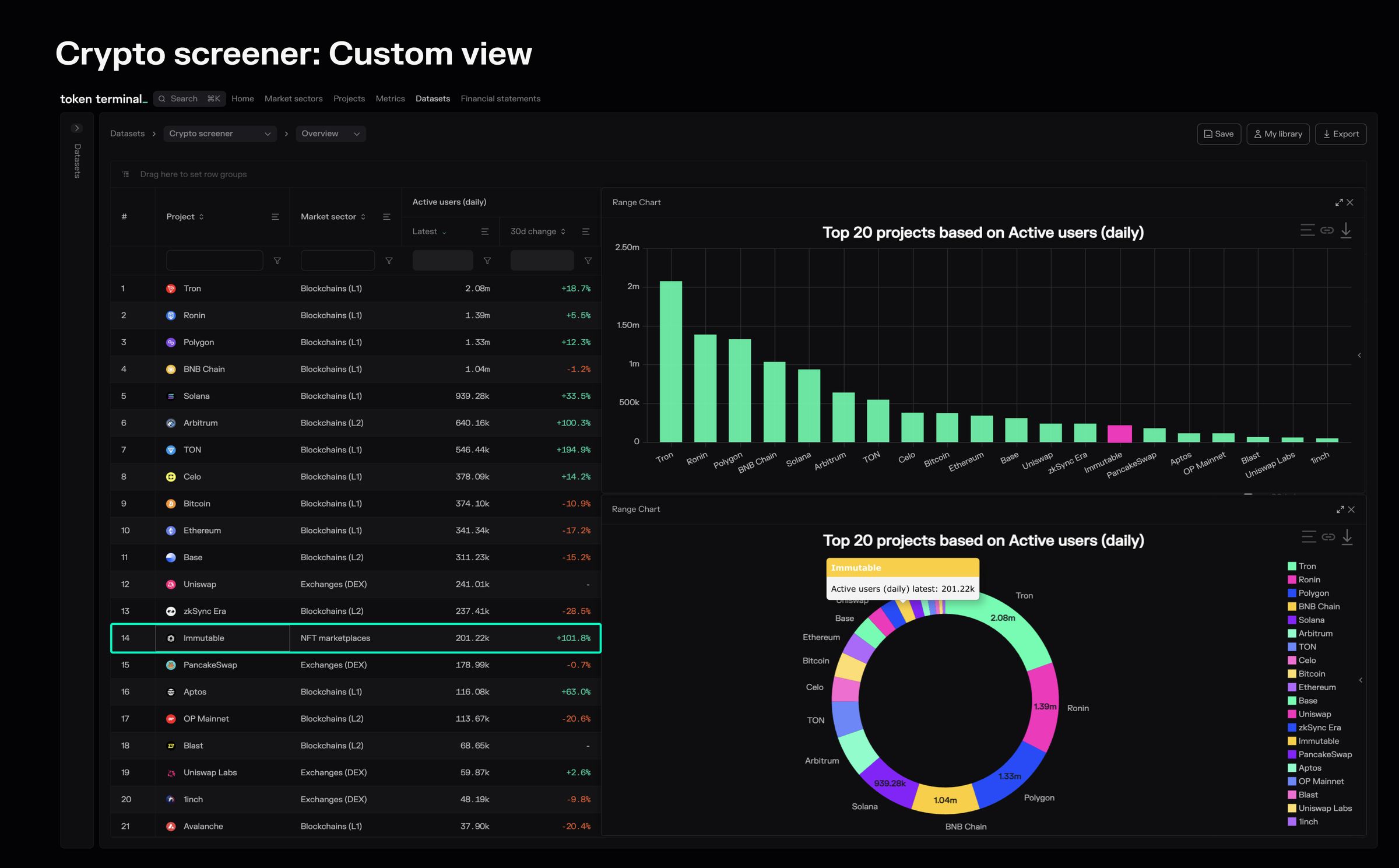
Immutable highlighted on the Crypto screener dashboard.

6. Institutional customers: Immutable reaches a new and growing customer segment in crypto

Immutable’s onchain data becomes accessible to hundreds of thousands of institutional customers

  • Token Terminal’s unique fullstack operating model allows us to serve Immutable's standardized onchain datasets to the world’s premier financial data companies and investment firms.
  • Starting today, Immutable data can be found on the Bloomberg Terminal (via the Crypto Fundamentals Application that is available on the Bloomberg App Store).
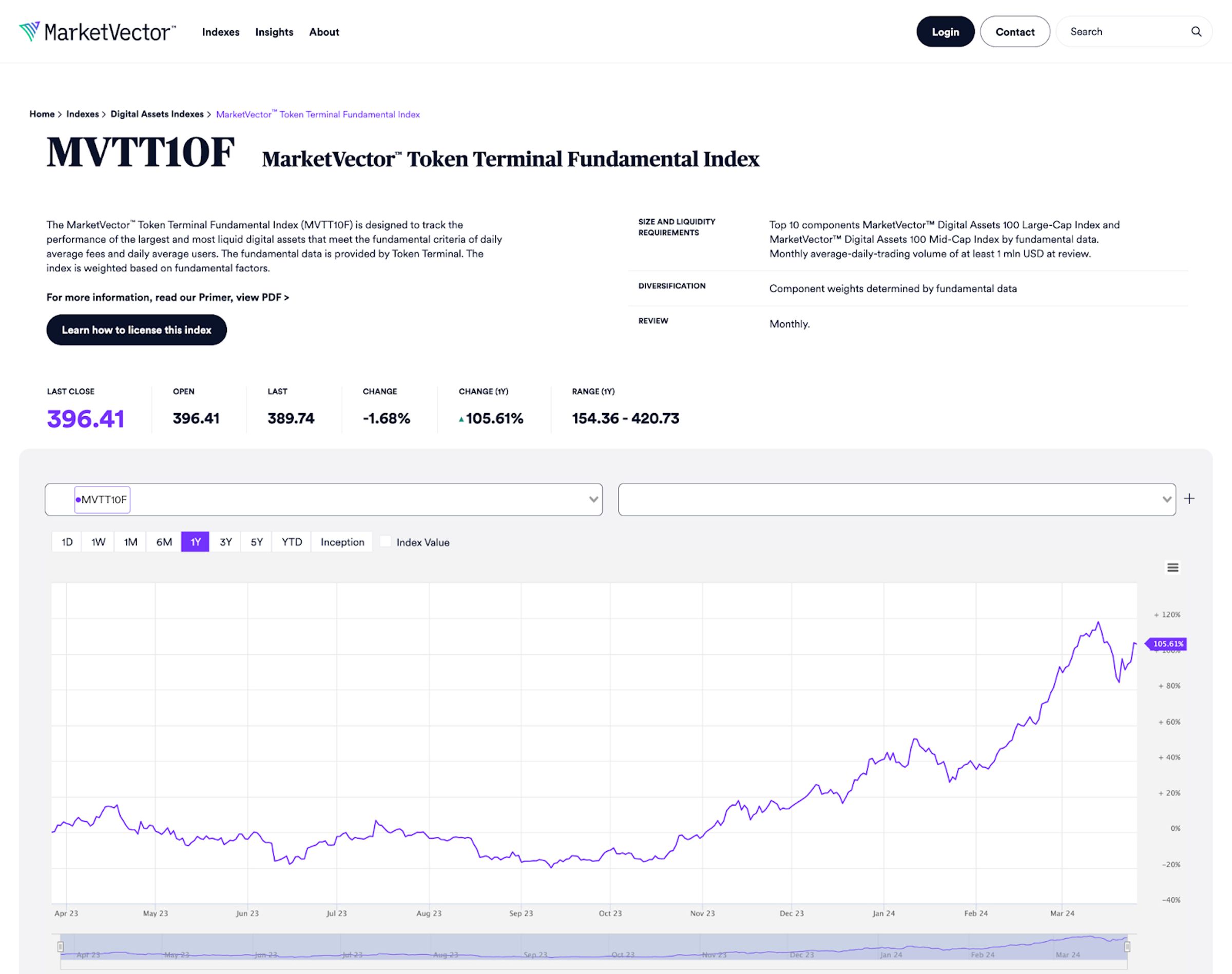
  • Further, IMX, the network’s native token, is eligible to be included in Token Terminal-powered cryptoasset indexes, launched by MarketVector, a regulated benchmark data provider that has built fundamentals-based cryptoasset indexes leveraging Token Terminal data.
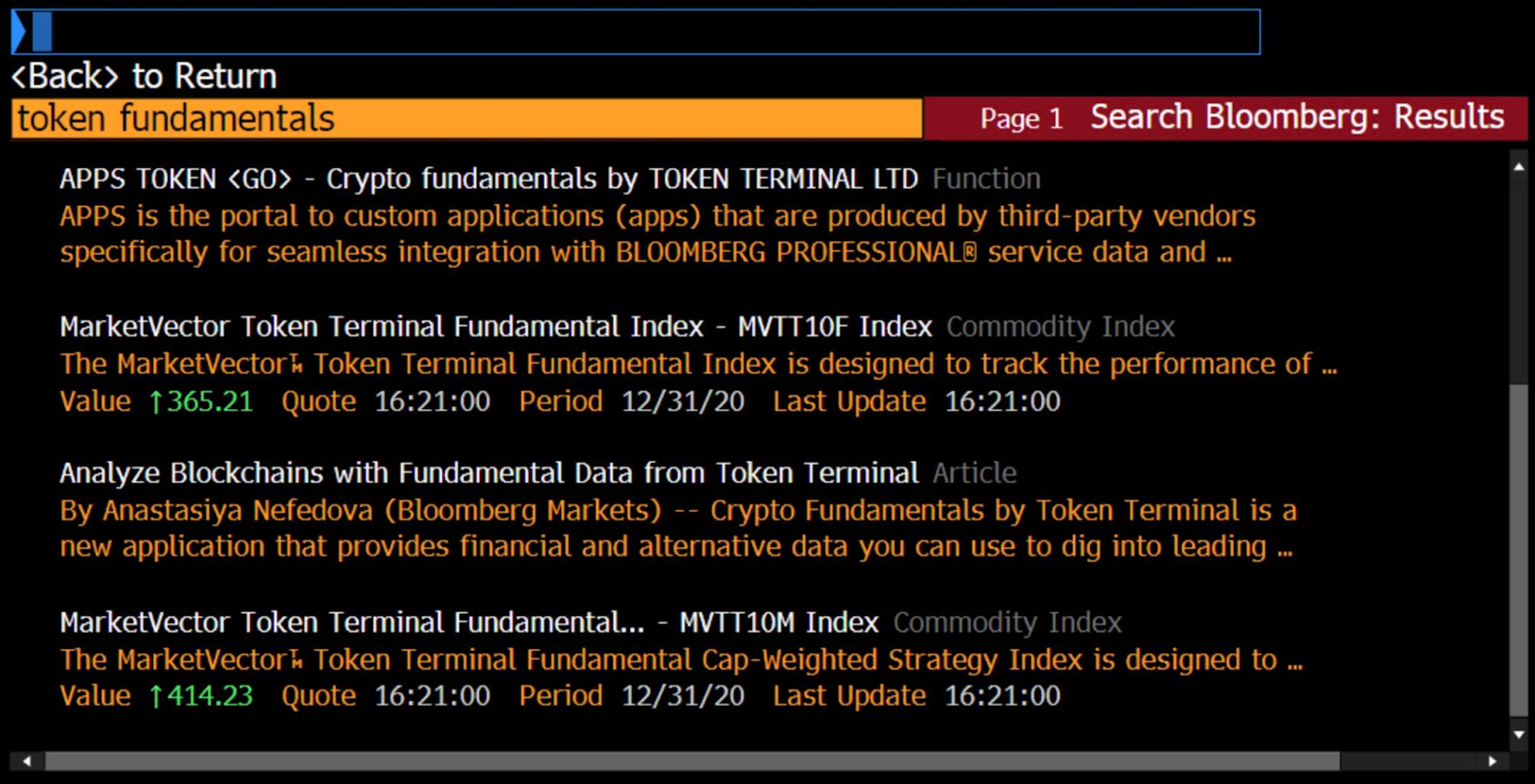
Crypto Fundamentals Application @ Bloomberg Terminal.
MVTT10F MarketVector™ Token Terminal Fundamental Index.

Relevant links

  1. Immutable dashboard on Token Terminal
  2. Terminal Pro
  3. Terminal API
  4. Data Room
  5. Data Partnership
  6. Docs
  7. Crypto Fundamentals Application @ Bloomberg Terminal
  8. MVTT10F MarketVector™ Token Terminal Fundamental Index

The authors of this content, or members, affiliates, or stakeholders of Token Terminal may be participating or are invested in protocols or tokens mentioned herein. The foregoing statement acts as a disclosure of potential conflicts of interest and is not a recommendation to purchase or invest in any token or participate in any protocol. Token Terminal does not recommend any particular course of action in relation to any token or protocol. The content herein is meant purely for educational and informational purposes only, and should not be relied upon as financial, investment, legal, tax or any other professional or other advice. None of the content and information herein is presented to induce or to attempt to induce any reader or other person to buy, sell or hold any token or participate in any protocol or enter into, or offer to enter into, any agreement for or with a view to buying or selling any token or participating in any protocol. Statements made herein (including statements of opinion, if any) are wholly generic and not tailored to take into account the personal needs and unique circumstances of any reader or any other person. Readers are strongly urged to exercise caution and have regard to their own personal needs and circumstances before making any decision to buy or sell any token or participate in any protocol. Observations and views expressed herein may be changed by Token Terminal at any time without notice. Token Terminal accepts no liability whatsoever for any losses or liabilities arising from the use of or reliance on any of this content.

Stay in the loop

Join our mailing list to get the latest insights!
Email
Sign up

Related Reads

South Korean Stocks Plunge Again, Latest Response from the Blue House

Korean Stock Market Plummets Amid Global Sell-Off, Presidential Office Responds South Korea's stock market experienced a sharp decline on Thursday. The benchmark KOSPI index fell over 4%, with major components SK Hynix and Samsung Electronics dropping over 8% and 5%, respectively. The sell-off quickly spread to related Hong Kong ETFs. The trigger was weak forward guidance from U.S. memory chip giants SanDisk and Western Digital, whose revenue forecasts fell short of lofty market expectations despite strong prior-quarter results. Their subsequent stock plunge led to a sell-off in Asian semiconductor stocks, highlighting the region's dependence on U.S. market sentiment. Since hitting a record high in mid-June, the KOSPI has fallen over 21% in about a month. In response to market volatility, the South Korean government has implemented measures, including raising cash margin requirements for single-stock leveraged ETFs. This led to a significant drop in their trading volume. A senior presidential official stated the focus is on closely monitoring the situation and formulating appropriate countermeasures. Analyst views on the market outlook diverge: while Morgan Stanley sees the sell-off as a buying opportunity due to low valuations, others like China Securities warn of continued high volatility as leverage unwinds. Looking ahead, analysts expect the global memory chip sector to remain in a high-sensitivity phase. However, Goldman Sachs maintains a long-term bullish target of 12,000 for the KOSPI, citing unmet AI-driven demand, with JPMorgan also viewing the pullback as a chance to accumulate positions.

marsbit16m ago

South Korean Stocks Plunge Again, Latest Response from the Blue House

marsbit16m ago

Tiger Research: What Will the Crypto World Look Like in 2036?

Tiger Research envisions the crypto world of 2036 through four narrative vignettes. In a fictional nation with a hyperinflating currency, the local "Bucks" are nearly obsolete. Citizens and eventually the government itself—for taxes, bonds, and salaries—adopt dollar-pegged stablecoins like USDT and USDC, marking a fundamental shift in monetary sovereignty. In Singapore, a young trader named Lia operates in a borderless, 24/7 market. She trades tokenized versions of everything from NVIDIA stock to Korean real estate indices on decentralized platforms, representing a generation for whom constant, global asset exposure is the norm. An infrastructure engineer, Do-hyun, reflects on the consolidation of blockchain networks. The hundreds of independent chains and Layer 2 solutions that boomed in the 2020s, fueled by incentives, have largely collapsed under their own weight. By 2036, only a few major, efficient infrastructures remain, having absorbed liquidity and users. Finally, media entrepreneur Jae-hoon witnesses the end of the traditional web advertising model. With AI agents generating over half of web traffic by 2029, banner ads become irrelevant. The industry pivots to a new machine-to-machine economy, using protocols like the x402 standard to charge AI models micropayments for direct data access, creating a more reliable revenue stream than human eyeballs ever did. The article paints a picture of 2036 defined by stablecoin adoption as sound money, perpetual global trading of all assets, consolidation into few dominant blockchain infrastructures, and the restructuring of digital commerce around AI agents.

marsbit40m ago

Tiger Research: What Will the Crypto World Look Like in 2036?

marsbit40m ago

IOSG: How Can Blockchains Keep Secrets? Three Answers to On-Chain Privacy

**Title: IOSG: How Does Blockchain Keep Secrets? Three Answers to On-Chain Privacy** **Summary:** Public blockchains expose every transaction. To protect sensitive data like institutional balances or trade sizes, three main approaches have emerged: 1. **Native Privacy Networks:** Projects like Zcash (with optional privacy) and Monero (with mandatory privacy) build secrecy directly into their own blockchains. However, they exist as isolated "islands," limiting interaction with mainstream DeFi applications. Canton, a permissioned network, offers privacy by restricting data sharing only to transaction participants, which appealed to JPMorgan for its deposit token. 2. **Privacy as an Add-On Layer:** This approach adds privacy to existing chains like Ethereum. Tornado Cash was an early "mixer" but was sanctioned. Railgun provides private balances and payments via zero-knowledge proofs on Ethereum. Zama uses Fully Homomorphic Encryption (FHE) to encrypt balances and amounts on-chain, enabling confidential DeFi activities like private yield vaults and over-the-counter trading while keeping transaction graphs public. 3. **The Core Trade-off:** All solutions sacrifice some privacy for functionality. Truly private chains (Zcash, Monero) lack smart contract versatility. Add-on layers (Zama, Railgun) reveal some metadata to enable computation. "Perfect" privacy that hides everything while allowing full functionality remains elusive. **Market Reality:** Demand is validated, with institutions moving trades off-screen to avoid slippage. However, the sector's revenue (est. $6-7M/year across all protocols) is minuscule compared to the ~$25B market cap of privacy assets. Protocols like Zama charge minimal, usage-based fees, while others like Railgun take a small percentage. The key gap is a sustainable pricing model. The conclusion is bullish on the underlying demand but suggests value will accrue to the applications (trading venues, wallets) that successfully monetize privacy, not necessarily the foundational privacy layers themselves.

marsbit43m ago

IOSG: How Can Blockchains Keep Secrets? Three Answers to On-Chain Privacy

marsbit43m ago

Trading

Spot
活动图片