沉默的 Twitter Space,是否暗示特朗普对加密立场的模糊?

深潮Published on 2024-08-15Last updated on 2024-08-15

特朗普对加密货币的立场可能并不像看起来那么坚定。

作者:Ankish Jain, crypto.news

编译:深潮 TechFlow

马斯克与特朗普的采访中没有提到比特币,是故意遗漏的,还是表明特朗普在即将到来的选举中的加密策略发生了更深层次的转变?

当 Twitter X 背后的科技大亨埃隆·马斯克宣布他将在他的平台上 采访共和党总统候选人唐纳德·特朗普时,人们的期待显而易见。

该活动被宣传为一次重大对话,吸引了政治爱好者和加密社区的广泛关注。然而,会议在开始之前就发生了意想不到的转变。

由于采访面临严重延误,在超过 45 分钟的时间里,热切的听众都被蒙在鼓里。马斯克后来透露,这次中断是由于“对 X 的大规模 DDOS 攻击”,他推测这次攻击很可能是由于“很多人反对只是听到特朗普总统所说的话”。
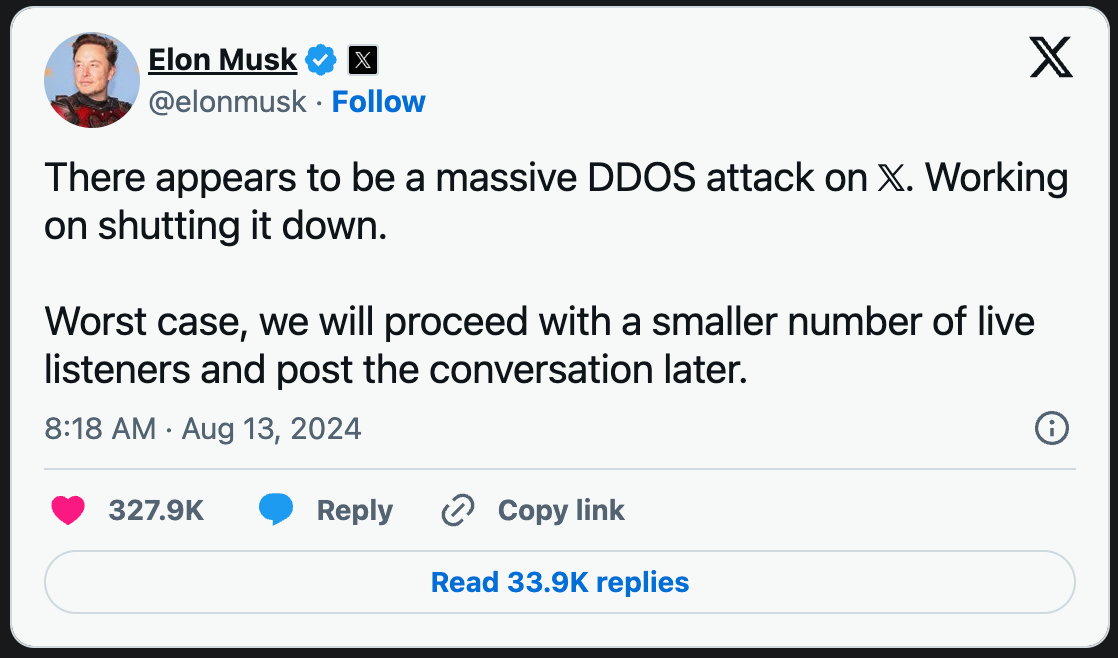
尽管一开始并不顺利,但谈话最终还是开始了。然而,与所有预测相反,没有一个关于加密货币或比特币的词。

这种沉默尤其令人惊讶,因为人们普遍猜测,如果特朗普当选,可能会塑造美国数字货币的未来。那么,发生了什么?加密货币话题的缺席是否表明特朗普立场或优先事项的转变?让我们来探讨一下。

解析戏剧性事件

当马斯克和特朗普的对话在X平台上展开时,很快就明显看出这不是一场普通的采访。整个讨论持续超过两小时,主要由特朗普主导,他经常长时间发言——有时带有明显的口齿不清——几乎不给马斯克插话的机会。话题范围广泛,涵盖了能源政策、气候变化、移民等问题。

早期,马斯克和特朗普讨论了最近针对前总统的暗杀企图。随后,特朗普将焦点转移到他增加美国石油钻探的立场上,这一观点与马斯克的商业利益直接冲突,特别是特斯拉专注于电动汽车和可持续能源。

在整个对话中,马斯克提到了他过去与民主党的关系,暗示他最近转向了更保守的观点。虽然这场会议在高峰时吸引了130万听众,但许多人对没有讨论比特币或加密货币感到困惑——考虑到马斯克和特朗普的背景,这似乎是不可避免的话题。

Polymarket,一个流行的预测平台,其投注者确信数字资产将成为讨论的关键部分,"比特币"被提及的赔率一度高达69%。加密货币的缺席不仅让听众感到惊讶——它还带来了严重的财务影响。

近500万美元押注在Polymarket上,预测特朗普会说哪些词,其中"加密货币"是最受关注的。尽管赌注如此之高,预期如此广泛,但这个词却从未出现,导致许多投注者遭遇意外结果。

然而,一位名为bama124的Polymarket用户以非凡的精确度成功预测了这种不确定性。通过准确预测特朗普会——和不会——说的确切词语,包括省略"加密货币",bama124赢得了近100万美元。这位投注者在几个关键短语上下了赌注,如"加密货币"、"比特币"、"特斯拉"和"审查制度",正确预测前总统不会提到这些词。

特朗普在Polymarket上赔率下降

在总统大选前的几个月里,唐纳德·特朗普似乎稳步走向胜利。自5月以来,他在Polymarket上的获胜赔率一直在上升,7月16日达到峰值,超过72%,当时他刚刚在一次暗杀企图中幸存。那时,特朗普被认为是领先者,特别是在乔·拜登在第一次总统辩论后信誉受损,最终导致拜登退出竞选之后。

随着卡玛拉·哈里斯进入总统竞选,局势发生了变化。现在作为领先的民主党候选人,哈里斯迅速获得了支持,赔率也反映了这一转变。截至8月13日,特朗普在Polymarket上的获胜赔率已降至46%,而哈里斯则上升到52%。这场竞争已经吸引了近5.83亿美元的总投注额——距离选举还有三个月。

值得注意的是,哈里斯的竞选得到了加密货币行业关键人物的积极支持。像马克·库班和安东尼·斯卡拉穆奇这样支持哈里斯的有影响力的人物,计划本周参加一场虚拟活动,以进一步推进她的竞选。此外,一个名为"加密货币支持哈里斯"的支持团体已经成立,旨在动员选民并增强加密货币社区内的筹款努力。

曾经是最受欢迎的候选人,特朗普现在发现自己在选举临近时处于追赶状态,政治潮流似乎正转向有利于哈里斯。

特朗普的情绪波动?

在2024年期间,特朗普采取了几项举措来争取加密货币社区的支持,作为他总统竞选的一部分。早在5月,他开始接受加密货币捐款,这标志着他在先前表示怀疑后立场的转变。6月,他特别支持比特币矿工,表示希望剩余的比特币能在美国境内开采。最后,特朗普是7月底在纳什维尔举行的比特币大会的主要嘉宾,进一步巩固了他对加密货币选民的吸引力。

然而,尽管有这些姿态,特朗普最近与马斯克的采访表明,他对加密货币的立场可能并不像看起来那么坚定。在两小时的对话中完全没有讨论数字资产,这让加密货币社区中的许多人感到困惑。这是有意的省略,还是暗示了对这个问题更模糊的立场?很难说,但这种沉默确实意味深长。


Related Reads

Former SpaceX Engineer Reconstructs Financial Execution System Using First Principles

Former SpaceX engineer Lex Li applies "First Principles Thinking" to financial infrastructure with Plan Execution Lab, recently raising angel funding at a $50M post-money valuation. The team argues that the core function of finance is capital allocation, and the critical gap is not in trading but in execution, which remains highly manual and fragmented. While assets, liquidity, and settlement have migrated on-chain, execution workflows (monitoring, risk management, liquidity coordination) are still human-native. In an era of accelerating AI agents, strategy decay is rapid, shifting the competitive edge from having the best strategy to having the most robust execution network. Plan Execution Lab introduces two core components: 1. **PlanX**: A Financial Execution Protocol designed as infrastructure for the migration from CEX to DEX, providing on-chain execution capabilities, liquidity access, risk management, and capital orchestration. 2. **Xgent**: An Autonomous Financial Runtime. Users define investment intents, risk preferences, and constraints; Xgent automatically constructs an execution graph, verifies it, and handles ongoing execution and optimization—streamlining the process from Intent to Autonomous Execution. The long-term vision is to create the "Bloomberg Terminal for Autonomous Finance"—a shared operating environment and execution network built collectively by participants like execution nodes, liquidity providers, and autonomous agents. The future of finance, they contend, belongs not to isolated algorithms but to open, collaborative execution networks.

marsbit22m ago

Former SpaceX Engineer Reconstructs Financial Execution System Using First Principles

marsbit22m ago

Former SpaceX Engineer Reconstructs Financial Execution System from First Principles

Plan Execution Lab, a financial infrastructure project founded by former SpaceX engineer Lex Li, has raised angel funding at a $50M post-money valuation. The startup is applying "first principles thinking" from Li's SpaceX experience to rethink financial market execution. Their analysis posits that while assets, liquidity, and settlement have moved on-chain, the execution layer remains fundamentally human-dependent and fragmented. In the era of AI Agents, strategy advantages decay rapidly, shifting the competitive edge from isolated algorithms to robust **execution networks**. Plan Execution Lab's solution is a two-part system: **PlanX**, a Financial Execution Protocol designed to facilitate the migration from centralized exchanges (CEX) to on-chain markets by providing core on-chain execution capabilities; and **Xgent**, an Autonomous Financial Runtime. Xgent allows users to define investment goals and constraints, then autonomously constructs and manages the execution logic—moving from **Intent to Execution Graph to Verification to Autonomous Execution**. The long-term vision is to create the "Bloomberg Terminal for Autonomous Finance"—an operating environment not for humans, but for agents and execution nodes. The future financial system, they argue, will be a collaborative network built by diverse participants contributing execution capabilities, not secret strategies. The core competition will shift to who builds the most powerful and adaptive execution network.

链捕手23m ago

Former SpaceX Engineer Reconstructs Financial Execution System from First Principles

链捕手23m ago

First Long-Horizon Doc2Repo Training Dataset: Code Agents Move Beyond Bug Fixing and Begin Creating Repositories

With the advancement of LLM Code Agents, the research focus is shifting towards long-horizon, real-world tasks, moving beyond simple bug fixes to full repository generation. To address this, researchers from Renmin University of China introduced the DeNovoSWE dataset. This dataset focuses on long-term software engineering tasks, specifically the "document-to-repository" challenge—generating an entire, executable code repository from a task description. The DeNovoSWE construction method employs a Divide & Conquer approach. It breaks down target repositories into core capabilities and uses a multi-agent Draft-Critic-Repair workflow to automatically generate high-quality, evaluation-aligned task documents. The dataset also implements difficulty-aware filtering to balance quality and diversity. The result is a high-quality, anti-leakage dataset of 4,818 instances. Experiments show that models trained on DeNovoSWE achieve significant improvements in long-horizon repository generation. For instance, Qwen3-30B-A3B-Instruct's performance on the BeyondSWE-Doc2Repo benchmark increased from 5.8% to 47.2%, and on NL2RepoBench from 4.3% to 23.0%. Similar gains were observed with stronger backbones, demonstrating that dedicated long-horizon training data is crucial for advancing Code Agents from maintainers to architects capable of planning and building complete software projects from scratch.

marsbit38m ago

First Long-Horizon Doc2Repo Training Dataset: Code Agents Move Beyond Bug Fixing and Begin Creating Repositories

marsbit38m ago

Even CZ Praised Hyperliquid as 'Awesome', But Its Biggest Moat Might Also Be Its Biggest Risk

In an episode of Galaxy Brains, Binance founder CZ praised Hyperliquid as "awesome" but clarified that while its product is strong, Binance cannot compete in its specific niche due to Hyperliquid's no-KYC, decentralized model. CZ noted he would not personally operate such a model, highlighting the inherent legal and compliance risks tied to its access advantage. The discussion underscores a core market structure conflict: on-chain perp platforms like Hyperliquid thrive on open, low-barrier access, which regulated exchanges like Binance cannot replicate without abandoning their global compliance posture. However, this very advantage makes Hyperliquid a clear target for regulatory scrutiny. The UK FCA has already issued a warning against Hyperliquid for potentially offering unauthorized services to UK users, framing it as a financial services provider rather than neutral infrastructure. Historical cases like the CFTC's action against bZeroX and Ooki DAO further illustrate that regulators may pursue decentralized structures if they facilitate leveraged trading for retail users without proper controls. Meanwhile, regulated venues like Cboe are developing US-compliant "continuous futures" that mimic perpetual exposure, narrowing the product gap. Hyperliquid's long-term edge may increasingly hinge on its access model—the very feature most exposed to regulatory pressure. The key question is whether its "access premium" can withstand escalating legal challenges as on-chain perps gain mainstream attention.

marsbit56m ago

Even CZ Praised Hyperliquid as 'Awesome', But Its Biggest Moat Might Also Be Its Biggest Risk

marsbit56m ago

Trading

Spot
Futures
活动图片