美联储对加密货币友好的客户银行实施限制

币界网Published on 2024-08-11Last updated on 2024-08-11

币界网报道:

美联储正在打击以加密货币友好方式而闻名的Customers Bancorp银行,迫使其在继续迎合加密货币行业之前跳过新的障碍。

作为美国为数不多的愿意参与数字资产交易的银行之一,Customers Bancorp现在必须提前30天向美联储报告,然后才能与加密货币公司建立任何新的关系。

该银行甚至运营着一个即时支付平台,允许企业使用区块链技术进行代币化支付。但美联储对此并不满意。
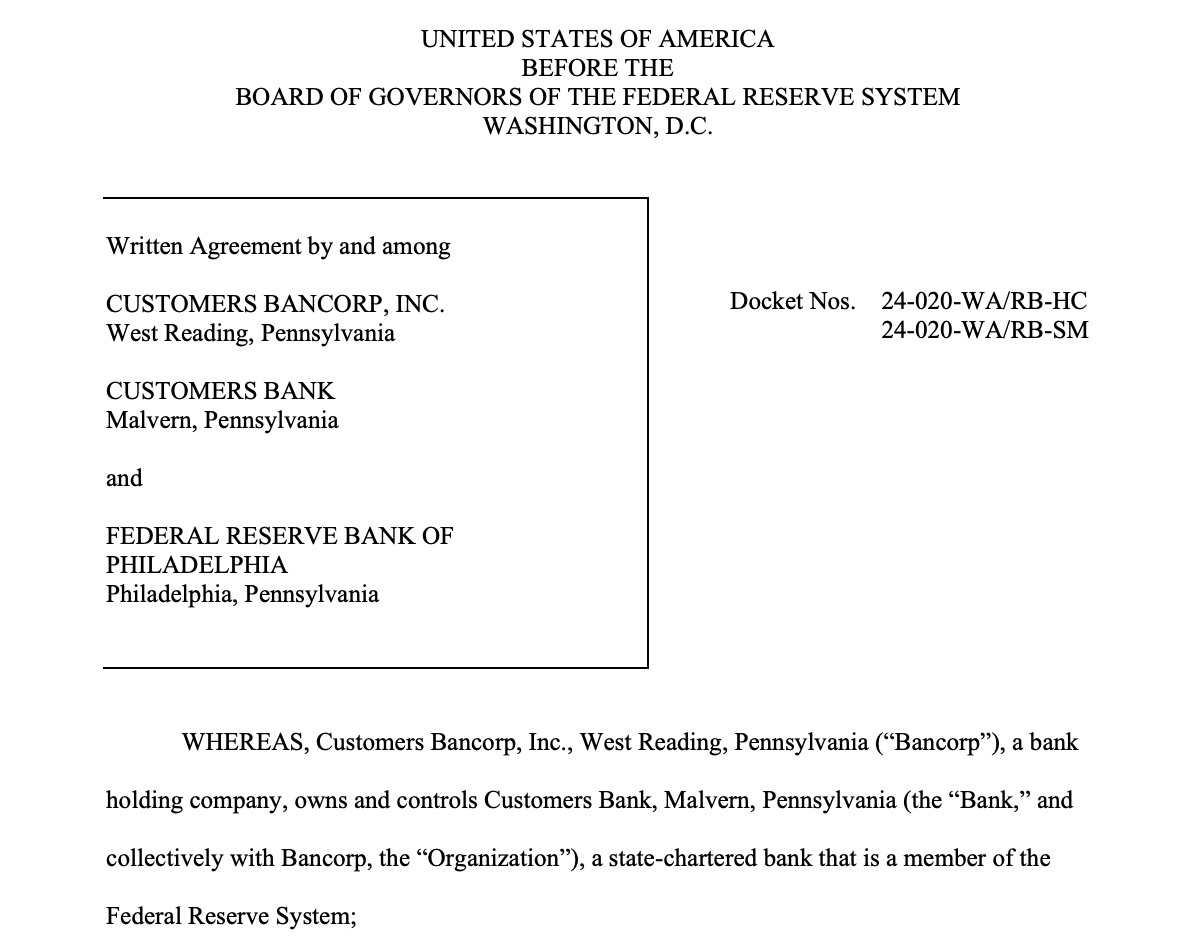
Fed enforces restrictions on crypto-friendly Customers Bank

费城联邦储备银行最近的检查显示,Customers Bancorp在管理风险方面存在重大缺陷,特别是在遵守反洗钱(AML)法律和《银行保密法》(BSA)方面。

美联储的回应?让银行的生活更加艰难,直到它成形。

董事会监督和风险管理

美联储已命令Customers Bancorp董事会加大力度,控制银行的运营,特别是在加密货币活动方面。

在60天内,董事会必须制定一项加强监督的计划。该计划需要明确说明他们将如何保持对银行主要业务的控制,并确保管理层遵守规则。

董事会还必须确保负责银行遵守BSA/AML和OFAC法规的人员知道他们在做什么,并拥有所需的资源。

如果该银行的董事会不监督政策和法律的遵守情况,包括该银行如何处理其加密货币战略,美联储表示,他们将陷入困境。

风险管理是美联储正在采取行动的另一个领域。客户Bancorp有60天的时间提交一份符合美联储标准的新风险管理计划。

该计划需要包括加强的政策、程序和标准,以识别、评估和管理风险。美联储希望看到明确的角色和责任、充足的资源以及定期更新风险敞口。

美联储华盛顿特区总部。

美联储还要求该行对其美元代币活动建立强有力的控制。董事会需要能够识别和监督出现的任何风险,他们需要确保银行以安全稳健的方式运营。

BSA/AML合规计划和客户尽职调查

美联储并没有止步于风险管理。他们还严厉要求客户银行遵守《银行保密法》和反洗钱法规。

该银行有60天的时间推出符合美联储标准的修订后的BSA/AML合规计划。

该计划必须包括一个内部控制系统,旨在使银行遵守法律,特别是在客户尽职调查、受益所有权和可疑活动监控方面。

美联储也坚持进行全面的风险评估。该评估需要查看银行的所有产品和服务、他们所处理的客户类型以及这些客户的位置。

银行的BSA/AML合规官必须胜任这项任务,拥有适当的资源和培训,以维持符合银行规模和风险状况的合规计划。

如果出现任何问题,需要有一个机制来跟踪、升级和审查银行最高层的合规失败。

除此之外,Customers Bancorp还必须彻底改革其客户尽职调查计划。银行需要制定严格的政策和程序来收集、分析和保存所有客户的准确信息。

这包括核实他们的身份,了解他们的财富来源,并知道他们应该期待什么样的交易。

该银行还必须弥补其现有客户尽职调查中的任何差距,并且需要一种可靠的方法,根据客户类型、交易量和地点等因素为每个客户分配风险评级。

Related Reads

The Reality of Payments in Latin America Is Not What You Think

The payment landscape in Latin America is undergoing a fundamental shift, driven by on-the-ground realities that challenge common perceptions. Based on over 500 hours of field research across the region, key insights emerge. Firstly, QR code payments, like Brazil's Pix, are becoming the dominant payment method in most emerging markets, overtaking cards. However, these domestic instant payment systems lack international interoperability, creating a significant gap for cross-border users. Secondly, the narrative around crypto cards is often misunderstood; their primary volume comes from high-net-worth professionals using them for salary conversions (e.g., USDT to local currency via Pix), not retail micro-payments. Competition in payments is shifting from customer acquisition to controlling the settlement layer, leading fintechs to acquire banking licenses for efficiency. Thirdly, treating "Latin America" as a single market is a mistake. Countries like Argentina, Brazil, and Mexico have distinct economic realities, user segments, and regulatory approaches. Brazil alone has at least five distinct user segments with different financial flows. Overlooked markets like Guatemala, Honduras, and El Salvador (the "forgotten five") offer high remittance volumes with lower competitive density. Finally, regulation in Latin America is often ahead of the US, with clearer frameworks for digital assets and a pragmatic approach from regulators focused on safety rather than obstruction. The margin on stablecoin forex is rapidly compressing toward zero, meaning future winners will be those building value-added services on top of the infrastructure, not just the cheapest exchange.

marsbit11m ago

The Reality of Payments in Latin America Is Not What You Think

marsbit11m ago

Making Music in a Bear Market: The Survival Experiment of a Bitcoin Band

"Orange Pill Jam: A Bitcoin Band's Survival in the Bear Market" Orange Pill Jam is a musical group exploring themes of financial sovereignty and privacy, born from the Bitcoin community. Formed after singer Mermaid performed her song "Dollar Apocalypse" at a 2022 conference, the band creates music intended for both Bitcoin enthusiasts and general audiences. Their creative process involves Mermaid writing lyrics and melodies, which producer/multi-instrumentalist Michi then shapes with a precise, rhythm-focused approach, often demanding numerous retakes to achieve his unique standard of timing. Their songs, like "Cypherpunks' Manifesto" and "Fire of Freedom," tackle concepts of digital privacy, the pitfalls of "free" services, and personal sovereignty, influenced by experiences in places like El Salvador. Despite operating in a crypto bear market with a Copyleft model (offering music for free sharing/remixing and accepting optional Bitcoin donations), they face practical challenges. Their growth is slow on platforms like YouTube and Spotify, which aren't optimized for their niche content. The band also navigates the rise of AI-generated music. While acknowledging AI's efficiency for certain tasks, they believe human creativity occupies a unique space that algorithms cannot replicate—the ability to create new genres and capture intangible rhythmic feeling. For Orange Pill Jam, the core argument for both Bitcoin in a downturn and human artistry in the AI age lies in this irreplaceable, intentional, and imperfectly human creative process. Their project persists as an anti-algorithm experiment, valuing the unquantifiable impact of music over scalable metrics.

marsbit17m ago

Making Music in a Bear Market: The Survival Experiment of a Bitcoin Band

marsbit17m ago

Latin America's Payments Landscape Is Not What You Think It Is

This report challenges common misconceptions about Latin America's payment landscape, based on over 500 hours of firsthand research. Key findings include: 1) Crypto card transaction volume primarily comes from high-net-worth individuals receiving USDT salaries, not retail spending. 2) QR code payments (e.g., Brazil's Pix, Argentina's Mercado Pago) are the dominant payment method across most emerging markets, not cards. 3) A major untapped opportunity lies in enabling cross-border interoperability between domestic instant payment systems. 4) Payment competition is shifting from customer acquisition to owning the settlement layer (e.g., acquiring banks). 5) Latin America is not a single market; Brazil, Mexico, Argentina, and smaller "forgotten five" countries (e.g., Guatemala, Honduras) have vastly different dynamics. 6) Stablecoin-to-fiat conversion margins are collapsing toward zero, pushing companies to build value-added services on top. 7) Future payment winners will be multi-country brands, not single-corridor specialists. 8) Marketing must target specific user segments (e.g., digital nomads, unbanked immigrants) with tailored messaging, not a generic "Brazilian" audience. 9) Contrary to perception, Latin American regulators are often ahead of the US in creating frameworks for digital assets and instant payments, with clear licensing deadlines. The core takeaway is that the region's payment rules are being rewritten, moving beyond cards and stablecoin arbitrage towards integrated, cross-border QR-based solutions.

链捕手28m ago

Latin America's Payments Landscape Is Not What You Think It Is

链捕手28m ago

Trading

Spot
Futures
活动图片