Эксперт спрогнозировал рост биткоина до $100 000 в случае победы Трампа на выборах

cryptonews.ruPublished on 2022-11-09Last updated on 2024-08-09

  • Основатель Transform Ventures заявил, что биткоин вырастет до $100 000 в случае избрания Дональда Трампа президентом.
  • Майкл Терпин добавил, что октябрь и ноябрь исторически являются хорошими месяцами для первой криптовалюты.

Курс биткоина вырастет до отметки в $100 000, если Дональд Трамп станет президентом Соединенных Штатов Америки. Об этом сообщает CoinDesk со ссылкой на слова основателя Transform Ventures Майкла Терпина.

Эксперт пояснил, после победы Трампа на выборах, наплыв новых покупателей может поднять цену первой криптовалюты до упомянутой выше отметки.

«Несмотря на следующие 60 дней, бычий рынок будет продолжаться по традиционным линиям четырехлетнего цикла с твердым ростом в октябре и ноябре», — добавил Терпин.

Он отметил, что исторически биткоин демонстрировал снижение в первые шесть месяцев после халвинга, «этот пятый цикл не является исключением». По его словам, октябрь и ноябрь всегда были сильными месяцами для первой криптовалюты, особенно в год халвинга.

Кроме того, основатель Transform Ventures назвал несколько причин, почему курс актива не опустится намного ниже $50 000.

По словам Терпина, актив не упадет ниже этой отметки, поскольку Банк Японии заявил, что они больше не будут повышать процентные ставки, а у Jump Trading закончатся монеты для продажи.

Напомним, в ночь на 9 августа 2024 года курс биткоина в моменте поднимался до отметки в $62 745. Позже цена первой криптовалюты откатилась до около $61 000. На момент написания актив торгуется вблизи $60 650:
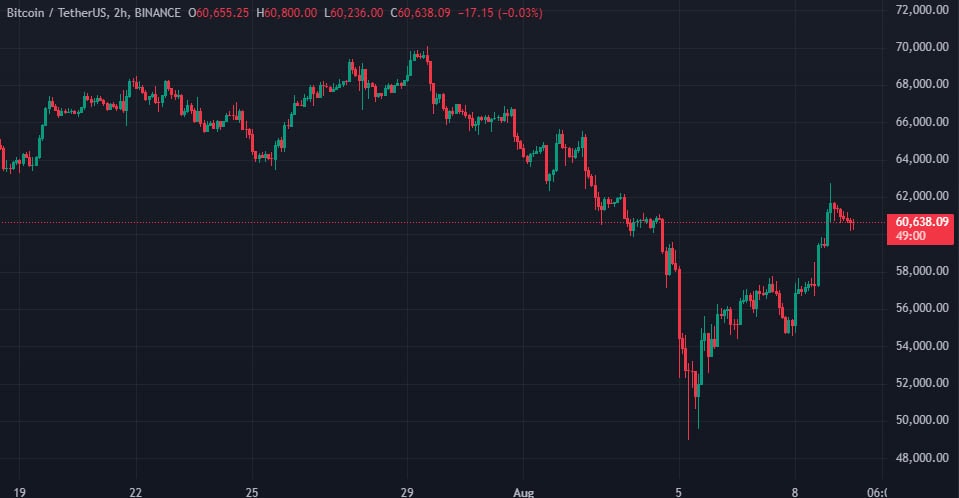

График BTC/USDT на бирже Binance. Данные: TradingView.

Related Reads

STRC 跌破面值,比特币财库实验进入下半场

The price of STRC, Strategy's dividend-paying preferred stock, has fallen below its $100 face value, triggering a re-evaluation of the "bitcoin treasury" corporate model. This highlights a critical tension: the company's asset base consists of high-volatility, non-cash-flow-generating Bitcoin, while its capital structure requires continuous cash payouts for dividends and interest. The decline of STRC signals that market pressure is shifting from asset price volatility to the pricing of the company's financing tools. Strategy's core model involves a three-step conversion: turning equity into Bitcoin exposure, converting Bitcoin holdings into capital market credit, and packaging non-yielding BTC into cash-paying securities like STRC. While Strategy holds a massive 847,363 BTC, the focus is now on cash flow mismatches. The company faces annual preferred stock dividend obligations of approximately $1.7 billion, far exceeding the cash flow from its legacy software business. Its ability to meet these obligations relies on continued access to capital markets. The market is now scrutinizing which of three potential costs becomes untenable first: rising dividend costs to attract investors, dilution costs from issuing more common stock, or the reputational cost of selling BTC—a move contrary to its "hodl" narrative. For the broader crypto market, a constrained Strategy means the potential loss of a predictable, narrative-driven marginal buyer for Bitcoin. The STRC discount serves as a reminder that the longevity of such models depends not just on Bitcoin's price, but also on financing windows, cash reserves, and investor willingness to pay a "trust premium" for the structure.

marsbit28m ago

STRC 跌破面值,比特币财库实验进入下半场

marsbit28m ago

Standard Chartered Bank’s 50-Fold Fantasy: Predicting AAVE to Reach $3,500

Standard Chartered Bank has issued an optimistic research report predicting that the AAVE token could surge 50-fold to $3,500 by 2030. This forecast is based on the projection that the total value locked (TVL) in DeFi will grow 37x to approximately $2.7 trillion, driven by stablecoin expansion and the tokenization of real-world assets (RWA). The bank's model links Aave's potential valuation directly to its protocol revenue, which is primarily driven by net interest margins. The report highlights Aave's current dominant position, noting it captures over 80% of the net earnings ("protocol retained earnings") in the lending sector while holding only about half of its TVL. It also points to the recent launch of the Aave V4 architecture and a healthy revenue stream of $142 million in 2025 as positive fundamentals. Grayscale's separate analysis, applying traditional valuation metrics like DCF, concluded AAVE is currently undervalued. However, the article notes significant challenges. Aave's peer-to-pool lending model suffers from inherent capital inefficiency, with an estimated $52 million annual "deadweight loss" due to idle funds needed for liquidity buffers. This structural flaw was exposed during the April KelpDAO exploit, which locked a WETH pool at 100% utilization for days. Emerging protocols like Morpho, with more efficient point-to-point models, are cited as growing competitive threats. In summary, while institutional forecasts paint a macro picture of massive growth fueled by RWA adoption, Aave's path forward hinges on addressing its core structural limitations and competitive pressures within the evolving DeFi lending landscape.

链捕手1h ago

Standard Chartered Bank’s 50-Fold Fantasy: Predicting AAVE to Reach $3,500

链捕手1h ago

Tidal Investment: We Remain Bullish on the AI Industry Chain, But the Reasons Have Changed

Tidal Investment remains optimistic about the AI industry chain, but the rationale has shifted. The market narrative has changed. While recent large-scale IPOs (e.g., SpaceX) and major fundraising plans by tech giants like Alphabet and Meta have caused some nervousness, this isn't a sign of an AI peak. The focus has moved from the initial question of AI's viability to the sustainability of massive investment cycles. The key players—primarily the major cloud providers—are not slowing down; their capital expenditure (Capex) guidance for 2026 has been increased across the board (e.g., Alphabet to $180B, Amazon to $200B). This investment cycle is proving resilient and difficult to stop. Unlike traditional hardware cycles, current AI Capex is distributed across multiple physical layers—computing, memory, networking, and critically, power infrastructure. Bottlenecks are shifting from chips to elements like electricity, transformers, and cooling systems, which have much longer lead times and cannot be easily pre-built like fiber optics during the dot-com bubble. Supply chain data (e.g., Eaton's 240% YoY data center orders) confirms this broad-based, project-driven expansion. Market concerns are acknowledged but viewed differently. First, while Capex growth currently outpaces revenue growth, raising ROI questions, this mirrors the early scaling phase of cloud computing itself. A change in view would require concrete signals like downward Capex revisions or missed AI product targets, which haven't materialized by mid-2026. Second, comparisons to the 2000 dot-com bust are flawed. That crash was driven by a massive, parallel oversupply of cheap capacity (fiber). The current cycle faces *supply constraints* in critical, capital-intensive physical infrastructure that cannot be overbuilt as easily. In conclusion, the wave of fundraising reflects the next, more complex act of the AI story. Physical bottlenecks and sustained high Capex plans suggest this is not the finale but an ongoing, capital-intensive build-out phase. The script has changed, but the play is far from over.

marsbit2h ago

Tidal Investment: We Remain Bullish on the AI Industry Chain, But the Reasons Have Changed

marsbit2h ago

Trading

Spot
Futures
活动图片