Краткосрочные инвесторы потеряли $850 млн при падении биткоина ниже $50 000

cryptonews.ruPublished on 2022-05-06Last updated on 2024-08-06

Волна паники захлестнула криптовалютный рынок 5 августа, когда цена биткоина рухнула ниже отметки в $50 000. Новые данные показывают, что основной удар пришелся на краткосрочных инвесторов, в то время как долгосрочные держатели не продавали.

По данным аналитической платформы CryptoQuant, во время резкого падения цены биткоина наибольший объем транзакций пришелся на монеты, возраст которых не превышал одной недели. Это указывает на то, что именно краткосрочные спекулянты стали главными продавцами.

Цифры впечатляют

Согласно анализу данных, проведенному сотрудником CryptoQuant Кауэ Оливейра (Cauê Oliveira):

  • Более $5,2 млрд в биткоинах было перемещено за один час монетами возрастом до 1 недели
  • Общие убытки от реализации составили около $850 млн
  • Из этой суммы только $600 000 пришлось на долгосрочных держателей
  • Наибольший объем убытков понесли инвесторы, державшие биткоины не более 3 месяцев

Эти цифры подчеркивают разницу в поведении между долгосрочными инвесторами, известными своей стратегией «держать и не продавать», и краткосрочными спекулянтами, более склонными к панике при резких колебаниях рынка.

Исторический масштаб падения

Криптоинвестор и популярный ютубер Quinten отметил историческую значимость этого события. Ссылаясь на данные CryptoQuant, он обратил внимание на тот факт, что объем убыточных транзакций в сети достиг «огромных» масштабов, редко наблюдаемых в истории биткоина и сравнимых с такими знаковыми событиями, как COVID, запрет майнинга в Китае, крахом Luna и банкротством FTX.
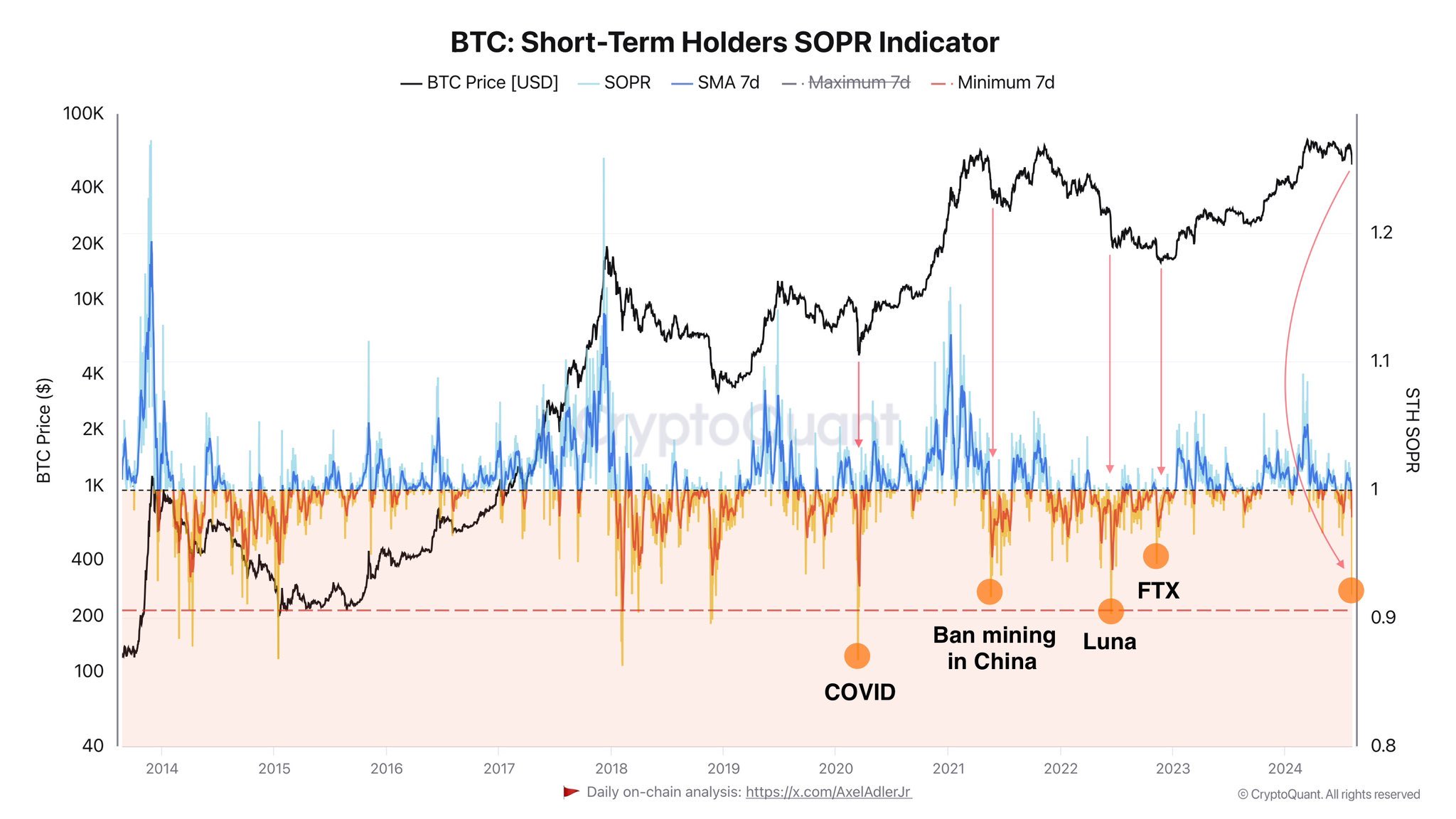
Соотношение прибыли и убытков в транзакциях краткосрочных инвесторов биткоина (SOPR). Источник: Quinten

Что дальше?

Несмотря на то, что цена биткоина уже отыграла более 20% потерь, поднявшись с шестимесячного минимума, как показывают данные скринера криптовалют Cryptovizor, не все эксперты уверены, что худшее позади.
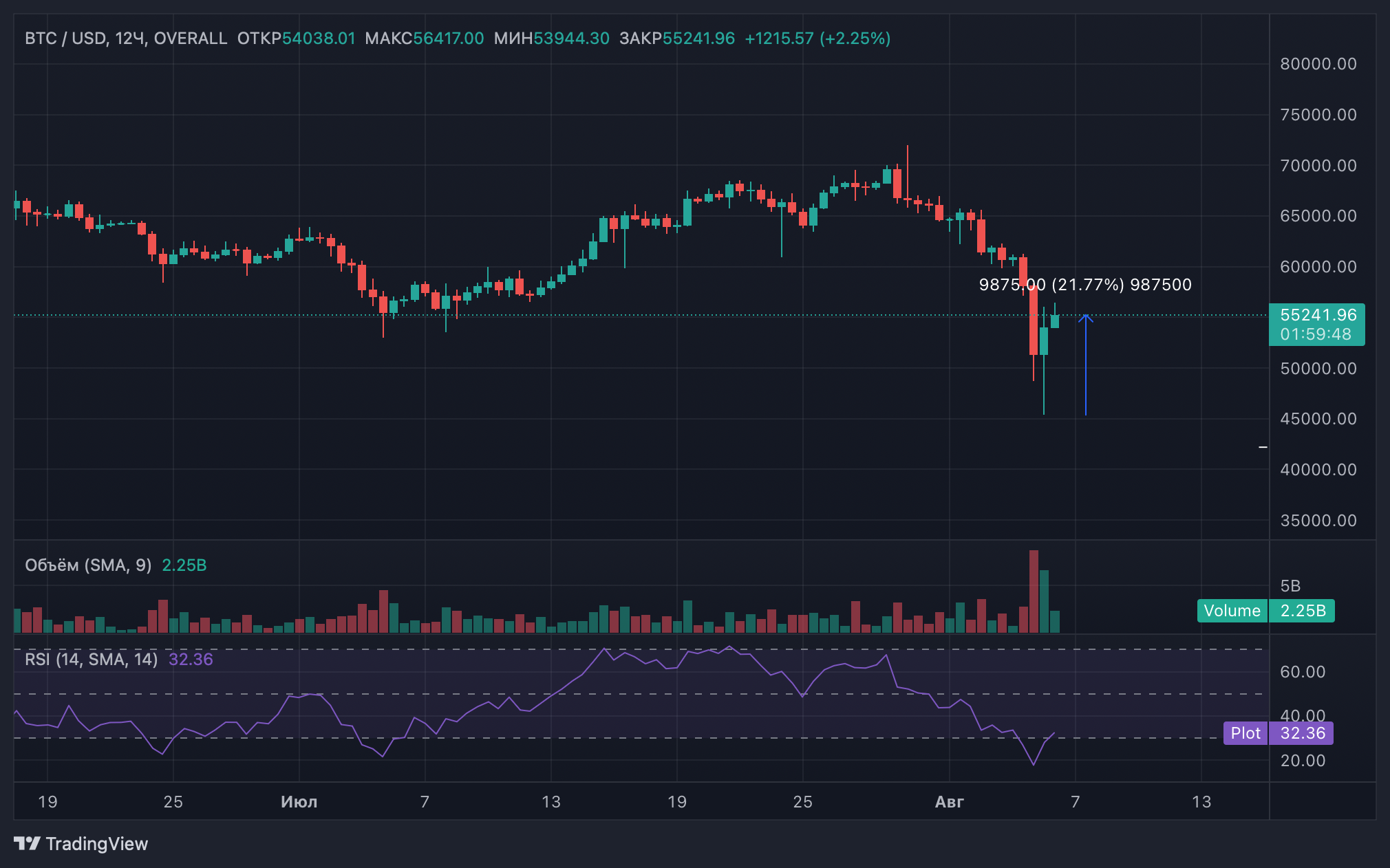
12-часовой график BTC/USD. Источник: Cryptovizor

Артур Хейс (Arthur Hayes), бывший генеральный директор криптовалютной биржи BitMEX, поделился своим мнением о текущей ситуации на рынке. Он считает, что недавнее падение — это только начало более масштабного кризиса.

«Это была лишь первая волна. Теперь мы ждем, когда всплывут тела перекредитованных марионеток из традиционных финансов», — написал Хейс, имея ввиду жертв японской иеновой кэрри-трейд стратегии, которые, как полагают, составили основную массу пострадавших от недельного обвала индекса Nikkei.

Хейс продолжил свой прогноз: «Затем начнется вторая волна. Рынок ждет спасения, однако ему предстоит пережить еще более сильные потрясения к пятнице. Наслаждайтесь передышкой, ибо битва продолжится».
Related Reads

SK Hynix Market Cap Exceeds Samsung for First Time in 26 Years, Korean Broker Calls for 50% More Upside

SK Hynix's market capitalization surpassed Samsung Electronics for the first time in 26 years on June 22, reaching 208.1 trillion won. The shift reflects a market trend where companies directly benefiting from AI infrastructure, like SK Hynix, are receiving higher valuation premiums than diversified giants. The surge is driven by AI-driven demand for High Bandwidth Memory (HBM), where SK Hynix holds a dominant 70-80% market share. Its Q1 2026 revenue exceeded 50 trillion won for the first time, with an operating profit margin of 72%. Hanwha Investment & Securities significantly raised its price target for SK Hynix to 430,000 won, the highest among Korean brokerages. The key rationale is that Long-Term Supply Agreements (LTAs) and robust HBM demand have fundamentally reduced the company's historical profit volatility. Several other brokers have also raised targets, arguing the valuation framework for memory semiconductors is being rewritten, moving away from a cyclical model. Despite the bullish outlook, the stock experienced a pullback of over 5% in regular trading on June 23 after briefly surpassing 3 million won pre-market, amid broader tech sector weakness. Some analysts caution that the市值 overtaking Samsung, whose profit scale and growth forecasts remain higher, could signal short-term overheating. However, high-return investors viewed the dip as a buying opportunity.

marsbit2m ago

SK Hynix Market Cap Exceeds Samsung for First Time in 26 Years, Korean Broker Calls for 50% More Upside

marsbit2m ago

GPU Rental Prices Drop 30% in Three Weeks: AI Value Chain Migrating from Nvidia to Memory Chips

GPU rental prices for Nvidia's flagship B200 chip have fallen by approximately 30% over three weeks, dropping from a high of $6.11/hour to $4.22/hour. This decline signals a potential easing of the "compute scarcity" narrative that has long supported AI hardware valuations. Concurrently, the semiconductor market is witnessing a significant divergence: while the VanEck Semiconductor ETF (SMH) has risen 15% in the past month, with memory giants Micron and SanDisk each surging nearly 60%, Nvidia's stock has declined about 3% over the same period. Analysts suggest this shift indicates that the AI value chain's bottleneck and profits are migrating from compute (GPUs) to memory. Demand for high-bandwidth memory (HBM) remains intensely strong, with contract prices soaring over 100% in H1 2026, granting memory manufacturers significant pricing power. In contrast, increased B200 supply from improved manufacturing yields and competitive pressure from new cloud providers are softening GPU rental rates. While long-term contracts, like SpaceX's $30 billion deal with Google, show sustained large-scale demand for Nvidia hardware, the softening spot prices pressure the margins of cloud providers and could eventually impact Nvidia's order flow if chip prices don't adjust. The key takeaway for investors is not a weakening AI thesis, but a recalibration within the sector: pricing power appears to be strengthening for memory chipmakers while showing signs of strain for leading GPU suppliers.

marsbit11m ago

GPU Rental Prices Drop 30% in Three Weeks: AI Value Chain Migrating from Nvidia to Memory Chips

marsbit11m ago

From Corning to Ciena: The 10X Stock Opportunities in the AI Optical Communication Chain

From Copper to Light: The AI-Driven Optical Communication Supply Chain and Investment Opportunities The exponential data demands of AI are pushing data centers beyond the physical limits of copper cables, forcing a critical transition to optical communication. This shift from electrical to photonic signals over distances greater than ~3 feet solves heat, power, and bandwidth constraints. The real investment opportunity lies not just in headline chipmakers, but across the entire essential photonics supply chain. **Key Investment Layers & Companies:** * **Glass & Fiber:** **Corning** is a dominant, irreplaceable supplier of advanced fiber to all major cloud/AI players (Meta, Amazon, Google, MSFT, OpenAI, NVIDIA), with multi-billion-dollar, multi-year contracts locked in years ahead of delivery. Its profit growth (93%) far outpaces revenue growth (36%), showing pricing power. * **Interconnects:** **Amphenol**, a consolidating giant in high-speed connectors (both copper and optical), shows robust growth (>80% in AI data centers) and expanding margins post-acquisition. **Credo Technology** bridges old and new worlds, extending copper's life in racks while moving into optics. It has hyper-growth but carries high customer concentration risk. * **Systems:** **Ciena** is a leader in coherent optics, enabling massive data capacity upgrades on existing fiber. It has a massive, growing order backlog ($~7B) and strong ties with cloud providers. * **Upstream & Enablers:** **AXT** produces mission-critical indium phosphide wafers for lasers, creating a supply bottleneck, but faces significant geopolitical/export license risk from its China-based manufacturing. **VEO Solutions** is the essential "picks and shovels" play, providing test equipment needed by every component in the optical chain, regardless of the eventual winner. A new pure-play photonics ETF (**FOTO**) offers a consolidated investment vehicle for this theme, though it is new and small. The core thesis is clear: the move from copper to light is inevitable and accelerating, with wealth creation spreading across this critical, multi-layered supply chain.

marsbit31m ago

From Corning to Ciena: The 10X Stock Opportunities in the AI Optical Communication Chain

marsbit31m ago

A Chip Company Releases AIDC Energy Storage Certification Standards. Why NVIDIA? Computing Power Reshapes Power Supply Logic. Who's in the Lead and Who's Left Out?

NVIDIA has released a "Battery Energy Storage System Self-Certification Guide," setting strict technical standards for energy storage systems specifically for AI data centers (AIDC). The guide focuses solely on certifying the Power Conversion System (PCS), not the batteries, with 10 mandatory performance metrics and 12 validation tests requiring real-world and simulation comparisons. Key requirements include rapid dynamic response to AI workloads, high-frequency system telemetry, and detailed electromagnetic transient models. The move is driven by the extreme and fluctuating power demands of next-generation AI hardware. Modern AIDCs require energy storage systems to act as intelligent, controllable grid assets, not just passive backup, to manage instantaneous, massive power load shifts that traditional UPS systems cannot handle. This redefines the competitive landscape for energy storage providers, shifting focus from capacity and cost to advanced control capabilities and system integration. While the market potential is significant—with forecasts of hundreds of GWh in new demand by 2030—the certification creates a high barrier to entry. It requires proven PCS delivery volumes and credible plans for rapid capacity scaling, favoring established, well-resourced players. Early movers like Fluence (partnering with Siemens) and several Chinese companies have secured projects ahead of the standard, but new entrants must now navigate this rigorous, costly, and time-intensive certification process to compete in the AIDC energy storage market.

marsbit1h ago

A Chip Company Releases AIDC Energy Storage Certification Standards. Why NVIDIA? Computing Power Reshapes Power Supply Logic. Who's in the Lead and Who's Left Out?

marsbit1h ago

Trading

Spot
Futures
活动图片