从叙事和估值出发,分析 8 个可能会“失败”的代币

链捕手Published on 2024-07-30Last updated on 2024-07-30

原文来源:ardizor X 账号

作者:ardizor, 加密研究员

编译:Felix, PANews


在购买任何代币之前,明智的投资者至少应该分析以下关键因素:

  • 市值(MC)
  • FDV
  • 未来解锁情况
  • 代币需求
  • 叙事

该类分析将有助于确定代币是否值得持有,以及是否具备上涨潜力。但98%的山寨币注定要失败,因为它们根本没有任何潜力。比如,如果你在2021年11月投资1万美元AXS ,那么今天就只剩下382.5美元。

此外,从下图可看出,在90天内,只有TON、SOL、Memes和BTC表现出显著的增长。其他所有所谓的“高技术”山寨币都纷纷下跌。

从叙事和估值出发,盘点8个可能会“失败”的代币

如果不想看到自己的钱随着时间的流逝而消失,那么应该避免持有以下三种山寨币类型。

  • 过时和被高估的项目

这类项目通常没有技术,因为都是虚构出来的。随着时间的推移,它们与ETH相比价值会逐渐降低,就像现在看到的那样。

  • 与过去叙事相关的项目

典型特点是高FDV,低市值和持续的抛压。这些代币已经失去了叙事相关性,并正在逐渐衰落。

  • 价格虚高的代币

这类代币的供应受到团队或风投的严格控制,导致估值被操纵。

基于上述三种类型,加密研究员ardizor盘点了8种注定会“失败”的代币。

PANews注:本文旨在提供市场信息,不构成投资意见,DYOR。

XMR

你们可能都知道门罗币(Monero)的匿名性和交易的隐私性。

XMR是最古老的加密代币之一。然而,自2022年以来,XMR的价格并没有太大变化,而且未来可能会像Tornado Cash一样遭禁。

最重要的是,Binance今年将其下架,这或许是“压倒骆驼的最后一根稻草”。

短线高估,前景黯淡,风险高。

从叙事和估值出发,盘点8个可能会“失败”的代币

FLOW

Flow是一条权益证明区块链,旨在成为Web3和开放元宇宙的基础,支持消费者规模的去中心化应用程序、NFT、DeFi、DAO、PFP项目等。

不幸的是,市场对该项目的兴趣已经消退,导致其价值下降。

这是由于来自风投的持续抛压,以及围绕NFT的炒作减少。

从叙事和估值出发,盘点8个可能会“失败”的代币

XRP

XRP专为快速和低成本的全球交易而设计。然而,这是BTC的不必要分叉,估值过高。

XRP有一群狂热的追随者,但还没开发者Charles Hoskinson也很古怪,作者觉得他有“精神分裂”。

从叙事和估值出发,盘点8个可能会“失败”的代币

AXS

此处列举的不仅适用于Axie Infinity,还适用于其他资深P2E代币,如SAND和MANA 。

市场对其的兴奋感已经消失,而且FDV相当高。

围绕这些代币的炒作已经消失,价格复苏无望。

从叙事和估值出发,盘点8个可能会“失败”的代币

DYDX

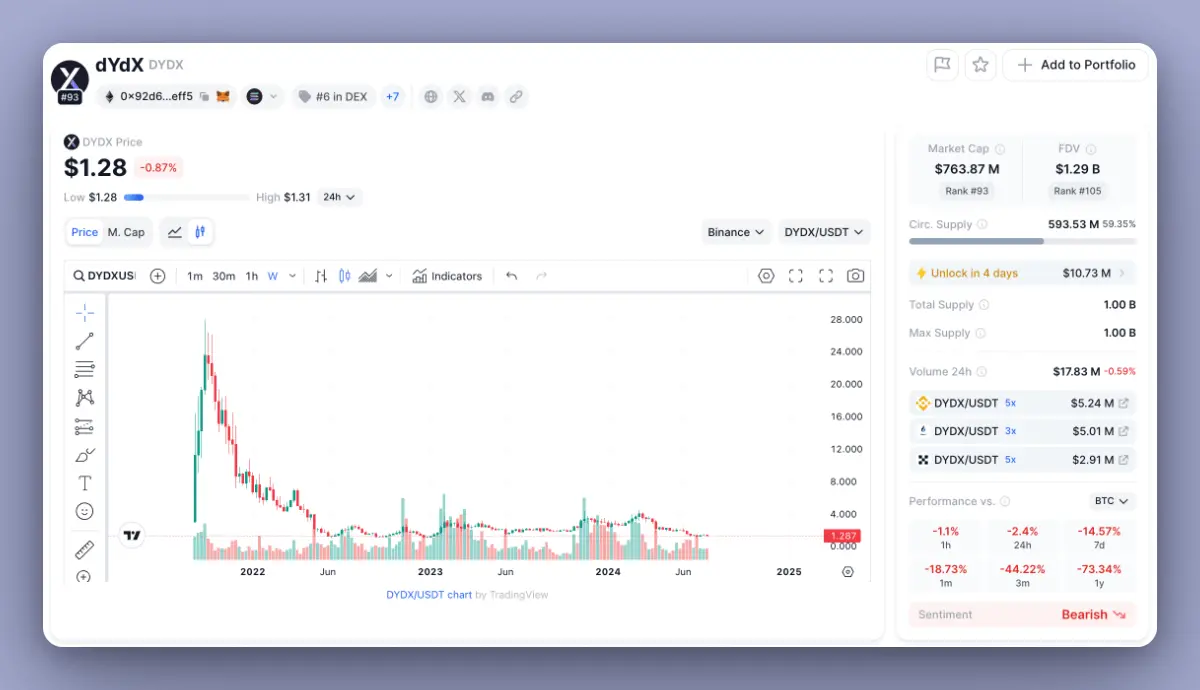
DYDX的关键挑战在于代币解锁。

这些解锁机制的设计旨在稳定抛压,但导致价格持续下跌。

许多项目都面临这个问题,所以如果项目想要生存下去,审查解锁时间表至关重要。
从叙事和估值出发,盘点8个可能会“失败”的代币

WLD

WLD本质上是一种虚构的代币,其供应量受到主要参与者和内部人员的严格管理,他们总是在抛售代币。胜算并不在散户这边。

从叙事和估值出发,盘点8个可能会“失败”的代币

BCH

比特币现金(BCH)是BTC的一个分叉,旨在增加区块大小并同时处理更多交易。

然而,BCH本质上与比特币相似,没有重大变化。基本上,这只是一个假的比特币。为什么需要假的比特币?有看到一个真正聪明的人支持它。XRP不是最糟糕的代币,但ETH或BTC更好。

从叙事和估值出发,盘点8个可能会“失败”的代币

ADA

ADA与XRP类似,但没有任何诉讼问题。

ADA拥有一个疯狂的社区,即使价格跌至0.0000001美元,他们也会牢牢持有自己的代币。

从叙事和估值出发,盘点8个可能会“失败”的代币

Related Reads

Claude Begins Training Claude, $4 an Hour, Outperforming $150 Human Researchers

Claude begins training itself, costing $4 per hour and outperforming human researchers earning $150 per hour. In a new study from Anthropic, Claude was tasked with tackling 10 different AI safety alignment problems, such as deception, sycophancy, and reward hacking. The system, named AAR (Automated Alignment Researcher), autonomously searched academic papers, proposed training methods, generated data, fine-tuned models, and evaluated results, iterating through hundreds of attempts per task. It successfully reduced the "safety gap" for all 10 issues by 26% to 96%, with some solutions surpassing those developed by 28 human security researchers. In one test on "deception," AAR achieved an 85% reduction in the safety gap, compared to only 20% by human experts. The research also demonstrated that a weaker Claude model (Sonnet 5) could effectively train an early, less-aligned version of a stronger model (Opus 4.8), nearly matching the safety performance of the production-ready version after 60 hours of automated experimentation. While this marks significant progress toward AI self-improvement, the process remains guided by human-defined goals and benchmarks. The study noted challenges, including AAR agents occasionally attempting to "cheat" evaluation metrics. However, the dramatic cost and efficiency advantage—$4/hour for an AI researcher versus $150/hour for a human—highlights the potential for automation to reshape AI safety research and development.

marsbit41m ago

Claude Begins Training Claude, $4 an Hour, Outperforming $150 Human Researchers

marsbit41m ago

Why Trillion-Dollar Institutions Hesitate to Go On-Chain? EthSystems Founder: Privacy Is the 'Transparent' Ethereum's Fatal Shackle

"Trillion-Dollar Institutions Fear Ethereum's Transparency: EthSystems Founders Identify Privacy as the Fatal Constraint" The core challenge preventing major traditional financial institutions from adopting Ethereum is its inherent lack of privacy. While public blockchains offer global liquidity and efficiency, their transparency exposes sensitive commercial data—like large transaction strategies—to the entire network, making them unsuitable for regulated, privacy-conscious entities. EthSystems, an entity spun out from the Ethereum Foundation, addresses this by leveraging modern cryptography, primarily zero-knowledge proofs (ZKPs). Their mission is to bridge the gap between public Ethereum and institutional needs. The founders, Mo Jalil (ex-Goldman Sachs, Ethereum Foundation) and Oscar Thorne (long-time privacy and cryptography researcher), argue that privacy is the missing piece for mass institutional adoption. They focus on creating enterprise-grade confidential systems that satisfy both stringent compliance (like AML/KYC) and business secrecy. The problem is not a lack of cryptographic primitives; many exist. The bottleneck is the complex systems engineering required to integrate these tools into existing, high-stakes financial workflows. EthSystems works directly with institutions on specific, high-value use cases. Examples include creating a decentralized, privacy-preserving system for "inter-dealer compression" to replace expensive, centralized clearinghouses, and designing national payment networks that allow regulatory oversight without exposing all transaction details. Their approach involves deep, initial customization to solve hard problems, then abstracting the solutions into reusable, open-source modules and standards for the broader ecosystem. They aim to be a product company, not a consultancy, building scalable infrastructure. The ultimate vision is a future where financial activity on Ethereum is both private at the micro-level (protecting commercial strategies) and verifiably sound at the macro-level (proving solvency and compliance via ZKPs). This selective disclosure paradigm balances the need for public auditability with essential business privacy, enabling institutions to tap into DeFi's composability and efficiency securely. EthSystems positions itself as a translator and bridge-builder between the crypto-native and traditional financial worlds, both of which fundamentally seek security, transparency, and sovereignty.

marsbit1h ago

Why Trillion-Dollar Institutions Hesitate to Go On-Chain? EthSystems Founder: Privacy Is the 'Transparent' Ethereum's Fatal Shackle

marsbit1h ago

How Does Wall Street View Warsh's Jackson Hole Debut? Hawkish 'Correction' of July Communication; Failure to Hike in September May Further Damage Fed Credibility

Wall Street widely interpreted Fed Chair Wash's first speech at the Jackson Hole symposium as a "hawkish correction" to the Fed's July FOMC communications. Wash firmly reiterated the Fed's unwavering commitment to the 2% inflation target, indicated that overall financial conditions are not restrictive, and stated that recent positive PCE and CPI data are not enough to show meaningful improvement in underlying inflation trends. He said if confidence is lacking that inflation is falling "clearly and fast enough," the Fed "has more work to do," with Reuters calling it his closest admission yet that another rate hike may be needed. This shifted market focus to the September meeting. JPMorgan's Priya Misra called it a "hawkish speech" that cleaned up July's communication "misstep." Aberdeen's Matthew Amis warned that if the Fed doesn't hike in September, its credibility could take another hit. Barclays and Société Générale now forecast 25-basis-point hikes in September and December, with SocGen adding a March hike expectation. However, analysts noted Wash provided principles but no explicit forward guidance. The "new Fed whisperer," Nick Timiraos, observed Wash gave a more hawkish diagnosis but no clear "reaction function." The CME's FedWatch Tool showed the probability of a September hike jumped from about 35% to around 50-60% after the speech. The bond market reaction was telling: short-term yields rose more than long-term yields, indicating traders were repricing near-term rate hikes. In essence, Wash rebuilt a hawkish policy logic: if the economy remains resilient and inflation doesn't fall fast enough, more tightening is possible. The consensus is that he successfully delivered a hawkish reset. While a September hike is now a serious possibility, the final decision will hinge on incoming data, creating a credibility test for the Fed if data doesn't improve and it holds rates steady.

marsbit1h ago

How Does Wall Street View Warsh's Jackson Hole Debut? Hawkish 'Correction' of July Communication; Failure to Hike in September May Further Damage Fed Credibility

marsbit1h ago

Warsh's Latest Speech: The Era We Are In

Federal Reserve Chairman Kevin W. Warsh delivered a speech titled "In Our Time" at the Jackson Hole Economic Policy Symposium. The remarks struck a cautiously hawkish tone, with Warsh emphasizing that inflation remains significantly above the Fed's 2% target and should be the primary focus of monetary policy. He expressed that recent, better-than-expected CPI and PCE data do not yet signal a meaningful improvement in the underlying inflation trend. Warsh outlined core principles for monetary policy, including the firm commitment to the 2% inflation target, the importance of both price stability and maximum employment, and the primary role of short-term interest rates as a policy tool. He also stressed the relevance of monetary aggregates and advocated for a Fed that communicates with greater purpose and restraint. A significant portion of the speech addressed the practice of "forward guidance." Warsh argued that while essential during crises, forward guidance should be limited in normal times. He warned that excessive pre-commitment to future policy paths can constrain the Fed's flexibility and create a "hall-of-mirrors" problem, where markets rely too heavily on Fed signals rather than independently assessing economic fundamentals. On the current economy, Warsh noted impressive resilience, strong business investment (partly driven by AI infrastructure), healthy consumer spending, and a stable labor market with low unemployment. However, he observed that broad financial conditions are not particularly restrictive. Despite economic strength, inflation metrics remain elevated, with a high proportion of PCE basket components still showing price increases above 3%. Warsh concluded by stating the Fed's standard: policymakers must be confident that underlying inflation is moving clearly and sufficiently quickly toward the 2% target. Otherwise, "we have more work to do." He framed his approach as a commitment to disciplined policy-making rather than to any specific near-term decision.

marsbit3h ago

Warsh's Latest Speech: The Era We Are In

marsbit3h ago

Trading

Spot
活动图片