TON 鲸鱼在 7 天内卖出数百万代币, 价格会持续下跌吗

币界网Published on 2024-07-30Last updated on 2024-07-30

币界网报道:

v2-f44164ba57459691de5f2a8169c0c89b_720w.webp

基于 Telegram 的项目 Toncoin (TON) 尽管今年大部分时间表现优于比特币 (BTC),但其市场主导地位已有所减弱。市场看跌趋势下在最新反弹之前,TON 经历了艰难的两周,价格下跌了 18.3%。

截至发稿时,该代币的交易价格为 6.65美元,这一分析证明该代币可能尚未脱离困境。原因如下。

鲸鱼抛售 Toncoin,引发市场担忧

Toncoin 可能下跌的主要原因是鲸鱼的行为。鲸鱼是持有大量加密货币流通供应的实体或个人。因此,他们的行为和不作为会影响价格。

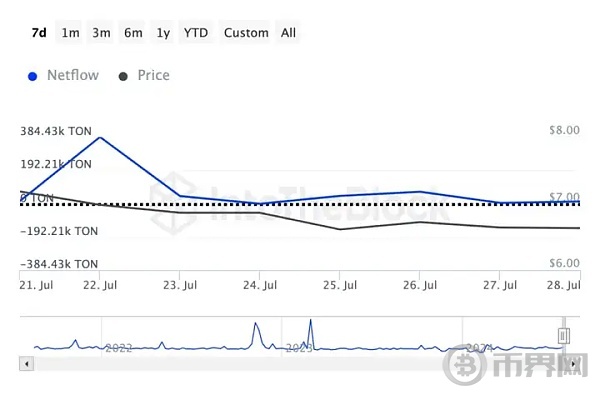
根据 IntoTheBlock 的数据,TON 大持有者的净流量在过去七天内大幅下降了 97.05%。

这与几周前的大量流入形成了鲜明对比。净流量是大量流入和流出之间的差额。如果比率为正,则意味着鲸鱼积累的资金多于他们出售的资金。

然而,负比率意味着相反的情况,TON 就是如此。此外,仔细检查发现,鲸鱼在 7 月 21 日至 28 日期间出售了 140 万枚 TON 代币。如果这种情况持续下去,TON 的价格可能会抹去近期部分温和涨幅。
v2-f885bcc6f16632930d399827818d9462_720w.webp

Toncoin 大额持有者净流量。来源:IntoTheBlock

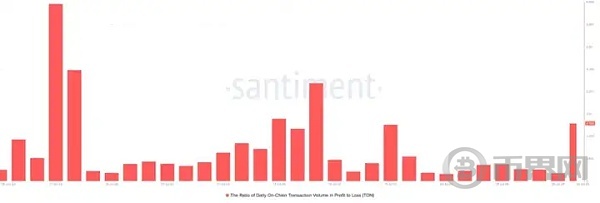
由于 TON 的价格反弹,每日链上交易的盈利与亏损比率达到了自 7 月 19 日以来的最高水平。该指标显示代币持有者是亏损还是盈利。当该指标为负时,实际亏损多于收益。

在 Toncoin 的情形下,价格上涨导致获利回吐增加。然而,获利回吐通常会导致下跌,尤其是在抛售压力增加的情况下。因此,如果链上交易的盈利与亏损比率上升,TON 的上涨趋势可能会停止。
v2-24d18d637eb03b00e29cd0e67fab4cdb_720w.webp

TON 价格预测:反弹力度不够

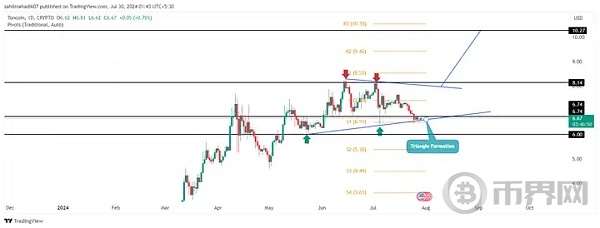
这一熊市周期推动了 TON 价格的持续盘整趋势,揭示了三角形模式的形成。在过去两个月中,趋同的趋势线继续挤压 TON 代币的价格差,为其重大突破做好准备。
v2-5625c77cefd6574a2eac5d3b5f6ff2f7_720w.webp

就当前的上涨趋势而言,争执图设置应为买家提供暂时的突破以恢复力量。Toncoin 价格盘中上涨 0.76%,显示出从三角形支撑位反转至市场新突破的尝试。

但Toncoin 价格仍在努力从三角形支撑位反弹,这表明买家信心不足。20D 和 50D EMA之间最近出现看跌交叉,可能会加速三角形模式的看跌势头。

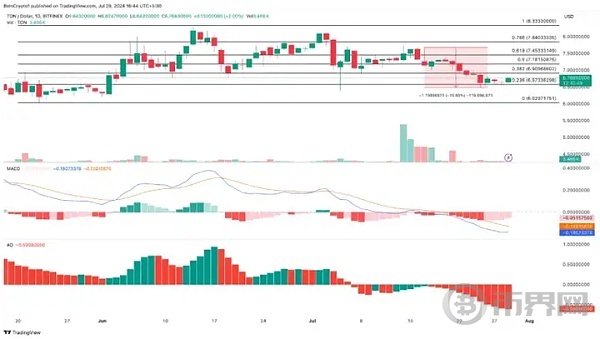
同时根据日线图,Toncoin 的价格上涨没有得到重要指标的支持。例如,Awesome Oscillator (AO) 为负。AO 衡量市场动量并确定加密货币价格的早期变化。当 AO 为正时,动量向上增加。但是,如果指标读数为负,就像 TON 一样,动量就会减小。另一个具有类似看跌倾向的震荡指标是移动平均收敛散度 (MACD)。

截至发稿时,MACD 在红色区域下跌,增强了下跌趋势的可能性。如果这种情况持续下去,TON 的价格可能会跌至 6.57 美元。但是,如果抛售压力增加,其价值可能会跌至 6.02 美元。
v2-32e94480bf1b1d6c2e0aed6f4ce654b4_720w.webp

但如果鲸鱼开始积累更多 TON,而不是像现在这样,其价值可能会反弹。如果这是真的,Toncoin 的价格可能会跃升至 6.90 美元,最终达到 7.18 美元。

本次鲸鱼持续抛售是导致加密货币进一步下跌的一个因素,通过链上交易量的获利回吐增加我认为 Toncoin 的上涨趋势短期内会放缓并且Toncoin 的 AO 和 MACD 为负也说明了市场势头疲软,市场信心减弱或投资转向其他资产价格将继续下跌。

Related Reads

Jensen Huang: Prompts are Becoming Obsolete, Loops are the New Paradigm

Jensen Huang, alongside AI leaders like Peter Norvig, Boris Cherny, and Andrew Ng, is advocating for a shift from "prompt engineering" to "loop engineering" as the new paradigm for AI development. Instead of manually crafting individual prompts, the focus is now on designing autonomous loops—systems where AI agents execute tasks, self-validate results, and iterate until completion without constant human oversight. A loop is a management framework that enables agents to operate independently. Key implementations are seen in Claude Code (with features like /loop, /goal, and /schedule) and OpenAI Codex, which employ multiple agents working in parallel within isolated environments. A core principle is the separation of roles: one agent (or model) performs the task, while an independent agent (or a smaller, separate model) validates the output to ensure objectivity. The article outlines a practical roadmap for implementing loops, starting with a "four-condition test" to assess suitability, building a minimal viable loop, and emphasizing critical pitfalls to avoid, such as lacking hard stop conditions or allowing loops to handle tasks requiring human judgment. This evolution is framed as the fourth major shift in AI interaction: from Prompt Engineering (crafting instructions) to Context Engineering (providing background information), then to Harness Engineering (building tool-enabled environments), and finally to Loop Engineering (creating self-sustaining systems). This progression reflects a consistent trend of increasing abstraction, moving human involvement from direct instruction to system design and rule-setting. The concept has academic roots in frameworks like ReAct, which formalized the "reason-act-observe" cycle. While loop engineering promises greater automation, experts caution about managing token costs and warn against outsourcing understanding—AI can assist, but deep problem comprehension remains essential.

marsbit1h ago

Jensen Huang: Prompts are Becoming Obsolete, Loops are the New Paradigm

marsbit1h ago

Trading

Spot
Futures
活动图片