The United States Federal Reserve is starting the process of paring back its $9 trillion balance sheet that ballooned in recent years in a move called quantitative tightening (QT).
Analysts from a crypto exchange and financial investment firm have conflicting opinions about whether QT, starting on Wednesday, will put an end to a decade of unprecedented growth across crypto markets.
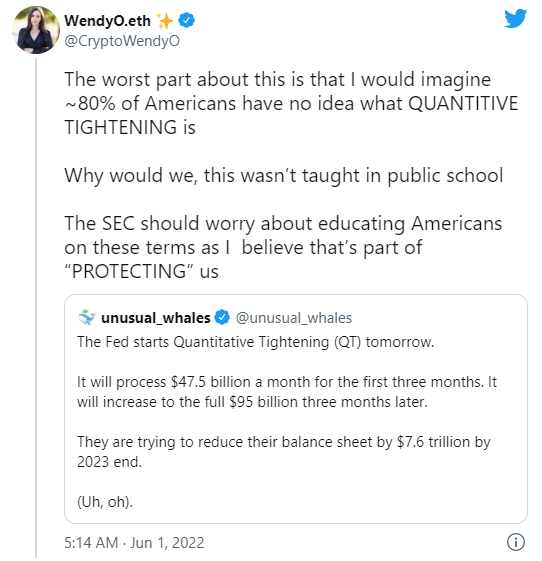
Laypeople can consider QT the opposite of quantitative easing (QE), or money printing, which the Fed has been engaged in since the start of the COVID-19 pandemic in 2020. Under QE conditions, more money is created and distributed while the Fed adds bonds and other treasury instruments to its balance sheet.
The Fed plans on shrinking its balance sheet by $47.5 billion per month for the next three months. In September of this year, it plans on a $95 billion reduction. It aims to see its balance sheet reduced by $7.6 trillion by the end of 2023.
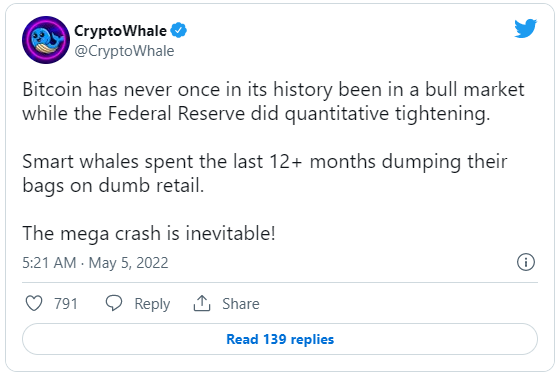
Pav Hundal, manager at the Australian crypto exchange Swyftx, believes that QT could have a negative impact on markets. He told Cointelegraph on Wednesday that “it’s very possible thatyou might just see growth in market cap trimmed slightly:”
“The Fed is culling assets harder and faster than a lot of analysts had expected and it’s difficult to imagine that this won’t have some kind of impact on investor sentiment across markets.”
Initiated in March 2020, the impact of QE on the crypto market was dramatic. CoinGecko data shows that the crypto market cap languished through 2019 and early 2020, but a vibrant bull market began in late March 2020 as the money printer fired up. The total crypto market cap burst from $162 billion on March 23, 2020, to a peak of just over $3 trillion last November.
Over a similar time frame, the Fed balance sheet increased 2.1 fold from $4.17 trillion on January 1, 2020, to $8.95 trillion on June 1, 2022. That is the fastest rate of increase since the last global financial crisis starting in 2007.
Financial advisory firm deVere Group CEO Nigel Green believes market reactions to QT will be minimal because “it’s already priced in.” Green said there may be a “knee-jerk reaction from the markets” because of the unexpected speed with which QT is being rolled out, but he sees it as a little more than a wobble:
“Furthermore, we expect a market bounce imminently, meaning investors should be positioning portfolios to capitalise on this.”
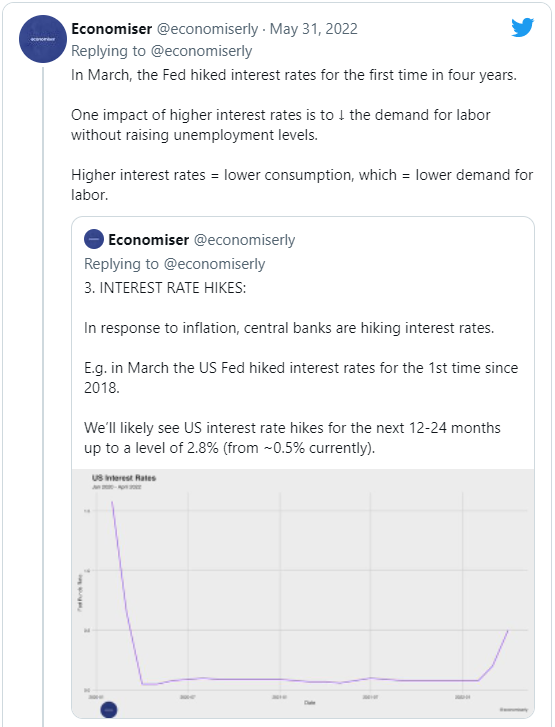
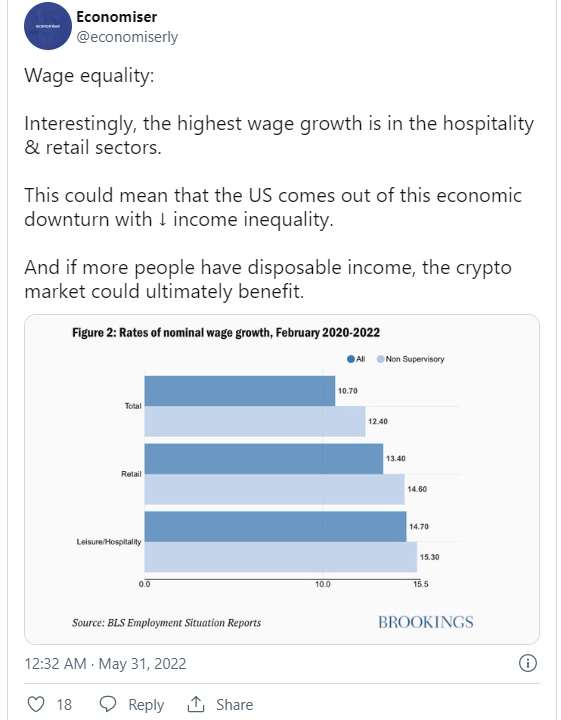
Wage increases among American workers, especially in the hospitality industry, have already been observed as labor demand remains high. Assuming wages remain high through QT, the U.S. may emerge from the economic downturn with lower income inequality. Crypto market analyst Economiser explained in a Tuesday tweet that if people wind up with more cash in their pockets from their higher wages, “the crypto market could ultimately benefit” from QT.
Hundal added that while markets are experiencing increased volatility lately, Bitcoin (BTC) could benefit as it is now demonstrating its position as a bellwether asset. He noted that Bitcoin dominance is currently at about 47%, up by eight percentage points from the start of 2022. He said, “There are different ways to interpret this,” adding:
“It does suggest that market participants are seeking to park value in Bitcoin, meaning we could see weakness continue to trend across alt coin markets if current market conditions continue to play out.”