Sam Altman砸1400万美元的基本收入研究出炉 结果却让人大跌眼镜

币界网Published on 2024-07-23Last updated on 2024-07-23

币界网报道:

来源:AGI Hunt

OpenAI 的CEO Sam Altman 可是掏了血本,整整1400万美刀砸下去搞了个大实验,就为了验证一个问题:

每月给穷人发1000美元,到底会发生啥?
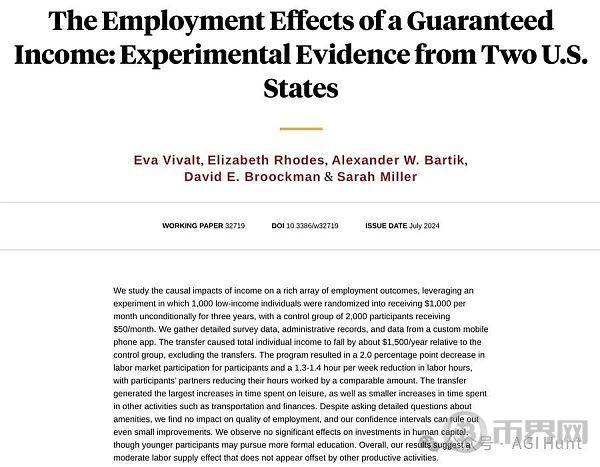
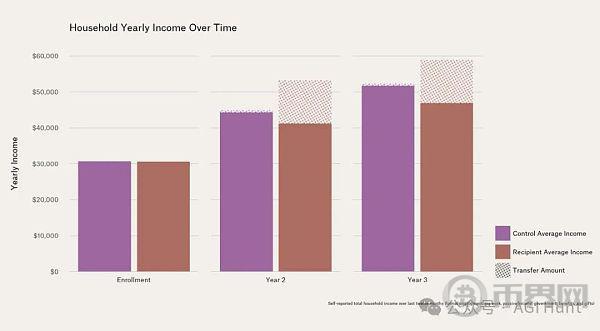
这实验可不是闹着玩的,整整3年时间,3000名收入低于2.8万美元的美国人参与其中。

其中1000人每月领1000美元,剩下2000人只能拿50美元(想想都心酸)。

结果呢?让人大跌眼镜!

先说说好消息:

  1. 领钱的人存款增加了25%,比对照组多了不少。

  2. 他们还变得更有爱心了,每月多花22美元帮助别人,比对照组多了26%。

  3. 有人还搬家到更好的社区,或者住上了更贵的房子。

但是!坏消息来了:

  1. 领钱的人工作时间反而减少了,而且收入增长还不如对照组。

  2. 虽然一开始压力小了,精神状态好了,但到了第二年第三年,这些好处就消失得无影无踪了。

  3. 更让人失望的是,这笔钱并没有明显改善他们的身体健康状况。

有意思的是,专家们对实验结果的预测也大跌眼镜。他们原本以为发钱能带来更多好处,结果现实给了他们一记耳光。
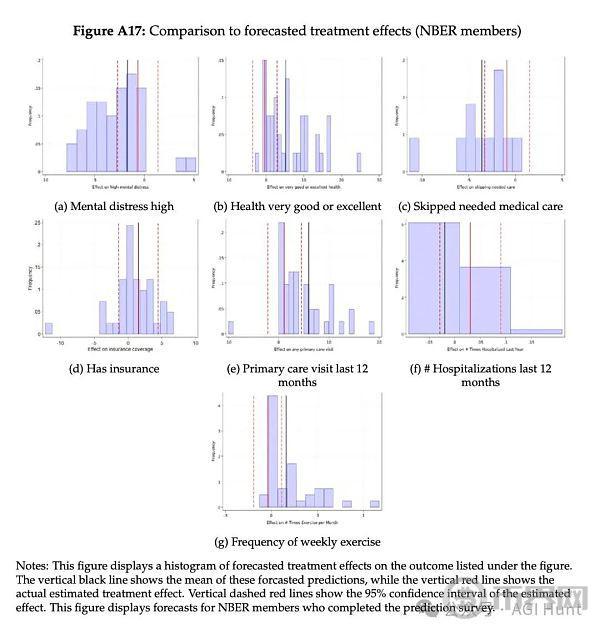
不过话说回来,Sam Altman这波操作也是大手笔啊!为了保证实验的科学性,他们可是下了不少功夫:

  1. 邮件随机招募参与者,还特意多找了些低收入群体。

  2. 为了防止对照组因为拿钱少就不配合,给所有人都发了50美元/月的"基本工资"。

  3. 甚至还和伊利诺伊州政府合作,通过立法确保实验收入不影响参与者的福利待遇。

而且为了全方位追踪参与者的生活变化,研究团队可谓绞尽脑汁

  1. 让参与者安装手机App,记录时间使用情况。

  2. 定期进行面对面或电话调查,响应率高达95%(这执行力,给跪了)。

  3. 还让参与者抽血检查身体状况,简直无所不用其极。

  4. 甚至连信用报告都要查,看看大家的债务和银行余额变化。

不得不说,这实验的规模和细致程度,在学术圈里绝对是顶级水平

那么问题来了,为啥Sam Altman要搞这么大动作呢?

原来,这位AI界的大佬早就看出来了,人工智能可能会抢走很多人的饭碗。所以他认为,未来可能需要给每个人发"基本工资",让大家有口饭吃。

这次实验,就是为了看看这招到底靠不靠谱。

有意思的是,不只是Sam Altman,连马斯克Twitter创始人Jack Dorsey都支持这个想法。就连AI界的老前辈Geoffrey Hinton最近还建议英国政府搞全民基本收入呢。

看来,大佬们是真怕AI抢了咱们的饭碗啊!

不过话说回来,这实验结果也给了我们一记当头棒喝:

光发钱可解决不了所有问题

正如一位参与者Sarah所说:

"我开始陷入一种心态,觉得钱来得太容易,反而不那么注意理财了。现在回想起来,真希望当初能存下更多。"

另一位参与者Carla则表示:

"当我接到电话说能每月领1000美元时,我差点哭出来。感觉就像是奇迹发生了。知道自己能还清那一大堆医疗债务,我的大脑仿佛进入了另一个境界。"

看来,钱确实能解决很多问题,但也可能带来新的问题。

那么问题来了,既然直接发钱效果不尽如人意,Sam Altman又有什么新想法呢?

据说,他最近提出了个新概念,叫"全民基本算力"。

啥意思呢?就是每个人都能分到一部分GPT-7的算力,想怎么用就怎么用。

Sam Altman说:

"你拥有了自己的生产力的一部分。"

听起来是不是很酷?不过这玩意儿到底靠不靠谱,还真说不准。

总之呢,这次实验虽然结果不尽如人意,但也给了我们很多思考。

在AI时代,如何保障每个人的基本生活,确实是个值得深思的问题。

Sam Altman这波操作,虽然没找到完美答案,但至少为我们指明了一个方向:

光发钱可不行,还得有更全面的配套措施。

那么问题来了,你认为AGI时代应该怎么保障大众的生计呢?

Related Reads

Podcast Notes: Hyperliquid Has Become the Top Interest Point for Traditional Hedge Funds

Empire Podcast hosts Jason Yanowitz and Santiago Santos discuss the surging institutional interest in Hyperliquid, a decentralized perpetual exchange, marking the highest level of engagement from traditional hedge fund managers since Paul Tudor Jones endorsed Bitcoin in 2020. The primary driver is the demand for weekend trading of commodities like oil, especially during geopolitical tensions such as the Iran conflict, as Hyperliquid provides the only active price discovery venue when traditional markets are closed. Trade XYZ, a front-end on Hyperliquid, has seen significant growth, with weekend oil price predictions having a median error of only 50 basis points. Santos predicts commodity trading volume on Hyperliquid will surpass Bitcoin within the year and that its market cap could rise from $25 billion to $100 billion. Other key points include Kraken raising $200 million at a reduced valuation of $13.3 billion, and the SEC clarifying that self-custodied DeFi frontends like MetaMask are not subject to broker-dealer rules, resolving a major regulatory uncertainty. The hosts also note the strong correlation between crypto and macro markets, with the S&P 500 posting one of its best 10-day rallies since 1950. They highlight MicroStrategy's continued Bitcoin acquisitions and the potential of real-world asset (RWA) tokenization as a key trend. The discussion concludes with skepticism towards many L2 projects, predicting a wave of protocols truly going to zero as capital concentrates in proven assets like Bitcoin and Hyperliquid.

marsbit5h ago

Podcast Notes: Hyperliquid Has Become the Top Interest Point for Traditional Hedge Funds

marsbit5h ago

a16z: The Next Frontier of AI, The Triple Flywheel of Robotics, Autonomous Science, and Brain-Computer Interfaces

a16z presents a comprehensive investment thesis for the next frontier of AI: Physical AI, centered on a synergistic flywheel of robotics, autonomous science, and novel human-computer interfaces (HCIs) like brain-computers. While the current AI paradigm scales on language and code, the most disruptive future capabilities will emerge from three adjacent fields leveraging five core technical primitives: 1) learned representations of physical dynamics (via models like VLA, WAM, and native embodied models), 2) embodied action architectures (e.g., dual-system designs, diffusion-based motion generation, and RL fine-tuning like RECAP), 3) simulation and synthetic data as scaling infrastructure, 4) expanded sensory channels (touch, neural signals, silent speech, olfaction), and 5) closed-loop agent systems for long-horizon tasks. These primitives converge to power three key domains: * **Robotics:** The literal embodiment of AI, requiring all primitives for real-world physical interaction and manipulation. * **Autonomous Science:** Self-driving labs that conduct hypothesis-experiment-analysis loops, generating structured, causally-grounded data to improve physical AI models. * **Novel HCIs:** Devices (AR glasses, EMG wearables, BCIs) that expand human-AI bandwidth and act as massive data-collection networks for real-world human experience. These domains form a mutually reinforcing flywheel: Robotics enable autonomous labs, which in turn generate valuable data for robotics and materials science. New interfaces provide rich human-physical interaction data to train better robots and scientists. Together, they represent a new scaling axis for AI, moving beyond the digital realm to interact with and learn from physical reality, promising significant emergent capabilities and value.

marsbit5h ago

a16z: The Next Frontier of AI, The Triple Flywheel of Robotics, Autonomous Science, and Brain-Computer Interfaces

marsbit5h ago

Trading

Spot
Futures
活动图片