6月二级市场报告:买方市场迹象明显,资产购买需求超报价75%

Odaily星球日报Published on 2024-07-20Last updated on 2024-07-20

Abstract

6 月 70% 的交易集中在五个领域:区块链服务、DeFi、基础设施、技术开发、GameFi。

原文作者:SecondLane

原文编译:深潮 TechFlow

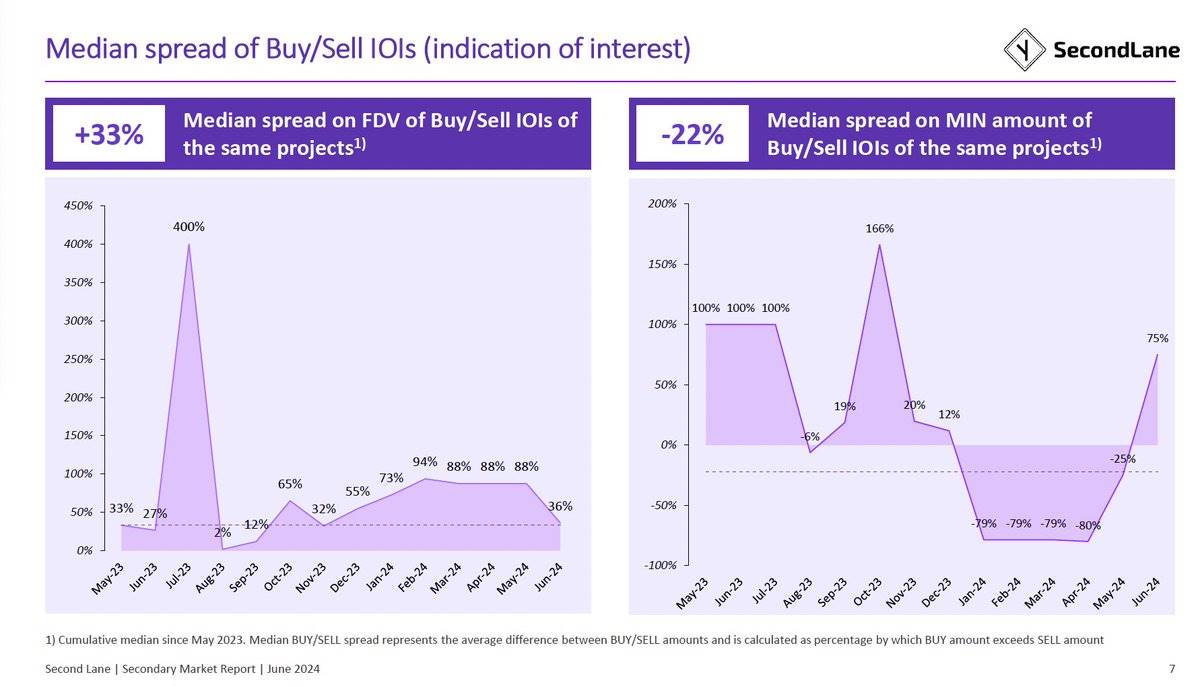
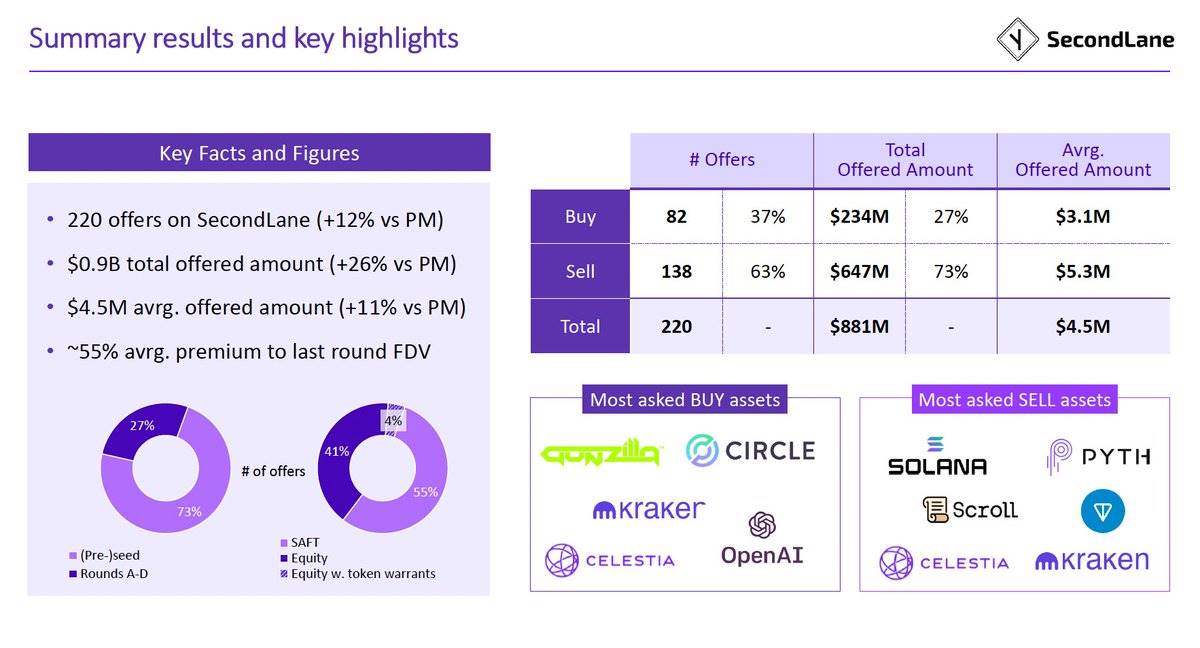
  • 六月份是今年第一个明显表现出买方市场的月份,买入请求比卖出报价多出 75% !

  • 同一资产的买卖报价之间的估值差距从上个月的 88% 下降到 36% 

6月二级市场报告:买方市场迹象明显,资产购买需求超报价75%

  • 2024 年 6 月的订单簿总价值为 8.83 亿美元

  • 平均报价金额为 450 万美元,比上个月的 390 万美元大幅上升

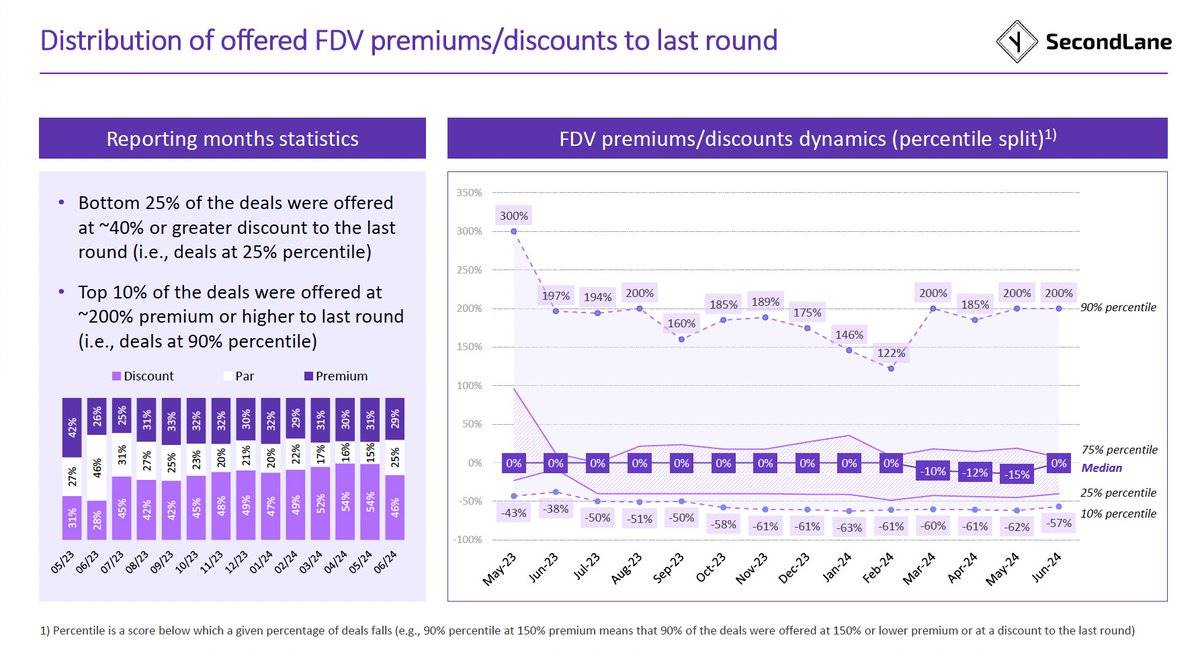
  • 平均溢价为上一轮完全稀释估值的 55% 

  • 主要项目:Circle、Solana、Scroll、Kraken、Celestia、TON、Pyth、Gunzilla、OpenAI
6月二级市场报告:买方市场迹象明显,资产购买需求超报价75%

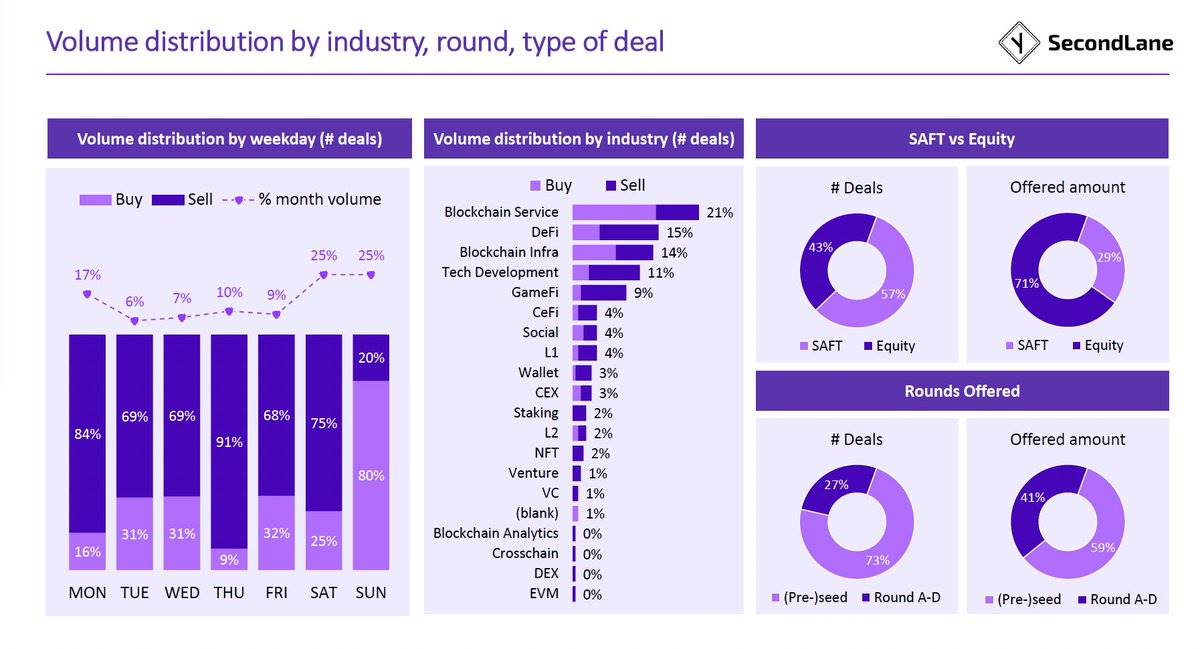
  • 57% 的交易为 SAFT, 44% 的交易为股权交易

  • 73% 的交易为(早期)种子轮, 27% 的交易为 A 至 D 轮

  • 70% 的交易集中在五个领域:区块链服务、DeFi、基础设施、技术开发、GameFi
6月二级市场报告:买方市场迹象明显,资产购买需求超报价75%

  • 具有上一轮溢价的交易减少了 2% 

  • 与上一轮持平的交易增长了 10% 

  • 46% 的交易在六月以折扣进行, 25% 持平, 29% 具有上一轮溢价

  • 六月所有交易的中位折扣为上一轮的 15% 

  • 前 10% 的交易提供了上一轮 200% 或更高的溢价

  • 后 25% 的交易提供了上一轮 40% 或更大的折扣

6月二级市场报告:买方市场迹象明显,资产购买需求超报价75%

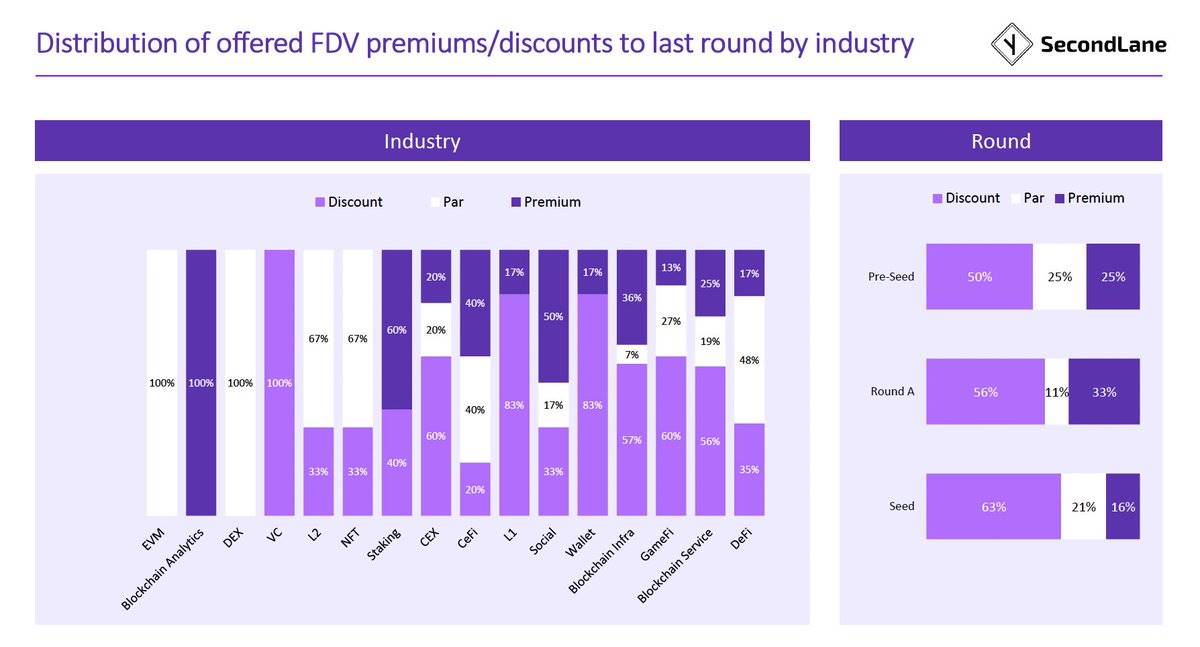
  • 在 VC 基金、CEX、L1s、钱包、GameFi、区块链基础设施和服务中的 LP 位置享有最大折扣

      (深潮注:文中“折扣”指交易中的折扣,这意味着某些资产的交易价格比其上一轮融资或市场价格低。例如,某些交易以低于上一轮融资的价格进行,这种情况被称为“折扣”)

  • 区块链分析和质押项目享有最高溢价

  • A 轮项目享有最高溢价,种子轮项目享有最大折扣

6月二级市场报告:买方市场迹象明显,资产购买需求超报价75%

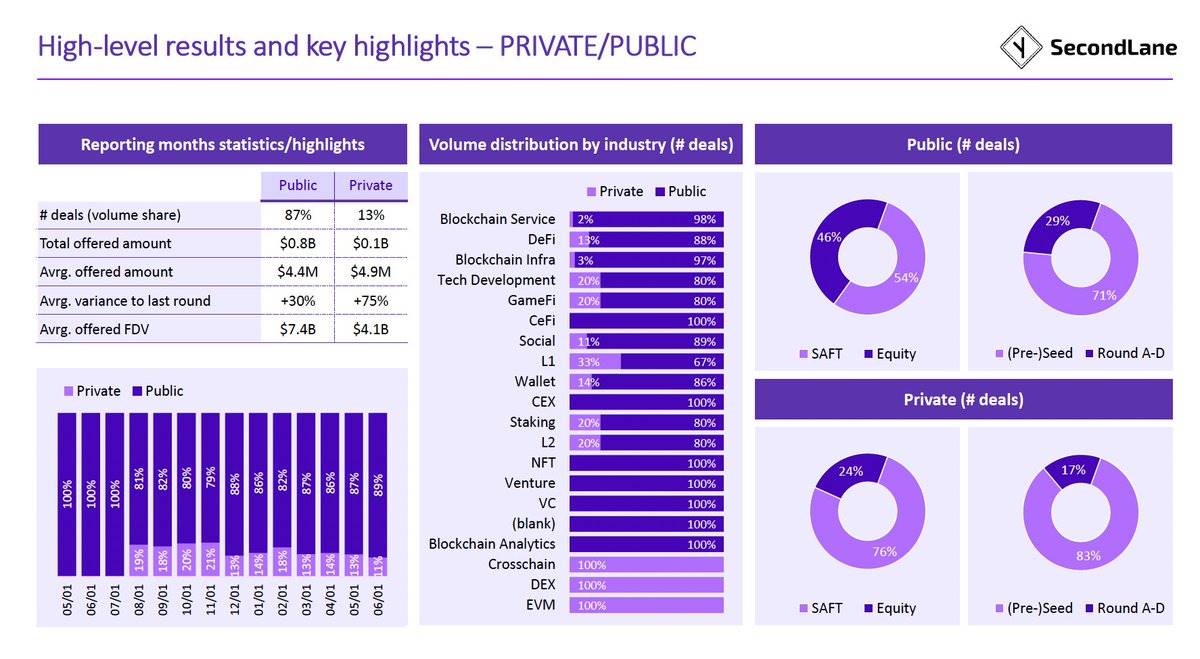
  • 13% 的交易在没有公开曝光的情况下流通,估值较低(非公开报价的完全稀释估值为 41 亿美元,而公开报价为 74 亿美元)

  • 大多数私募交易为 SAFT(76% ),在(早期)种子轮阶段(83% ),针对 DEXes、EVM 和跨链解决方案
6月二级市场报告:买方市场迹象明显,资产购买需求超报价75%

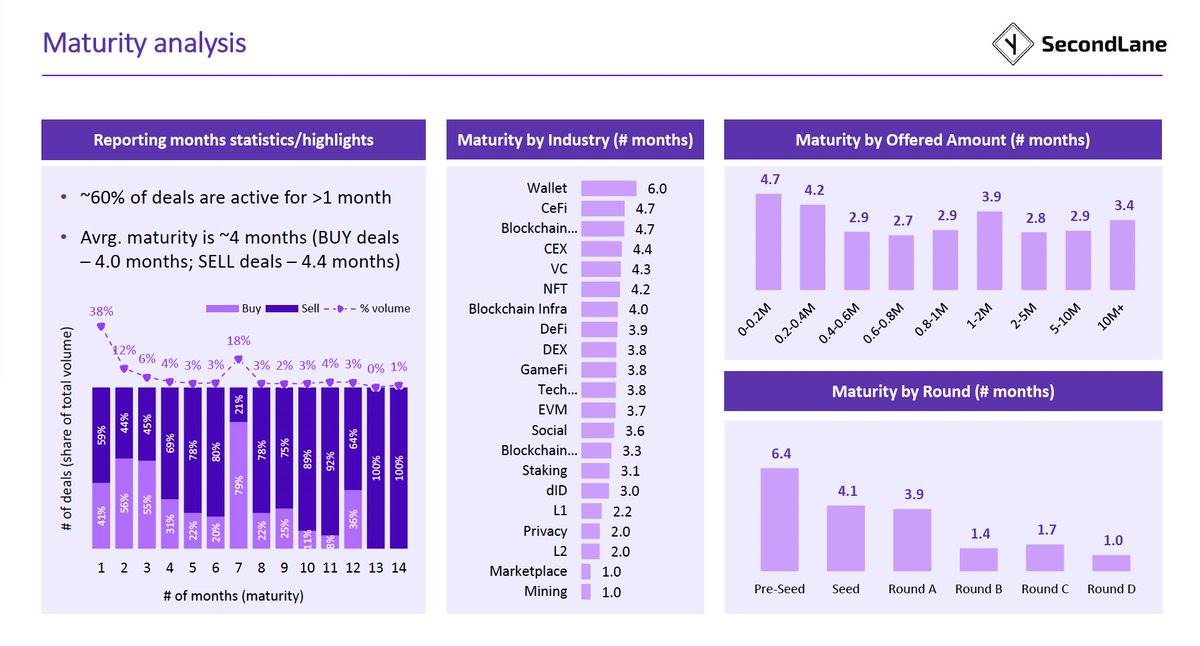
  • 交易平均到期时间增长到买入请求的 4 个月和卖出报价的 4.4 个月,直到到期或交易完成

  • 60% 的交易活跃超过 1 个月

  • 最长的到期时间为:

  • 早期 vs 晚期轮次:早期种子轮为 6.4 个月;种子轮和 A 轮约为 4 个月,B、C、D 轮为 1 个月以上

  • CeFi、钱包、CEX 项目、VC、NFT、区块链基础设施

6月二级市场报告:买方市场迹象明显,资产购买需求超报价75%

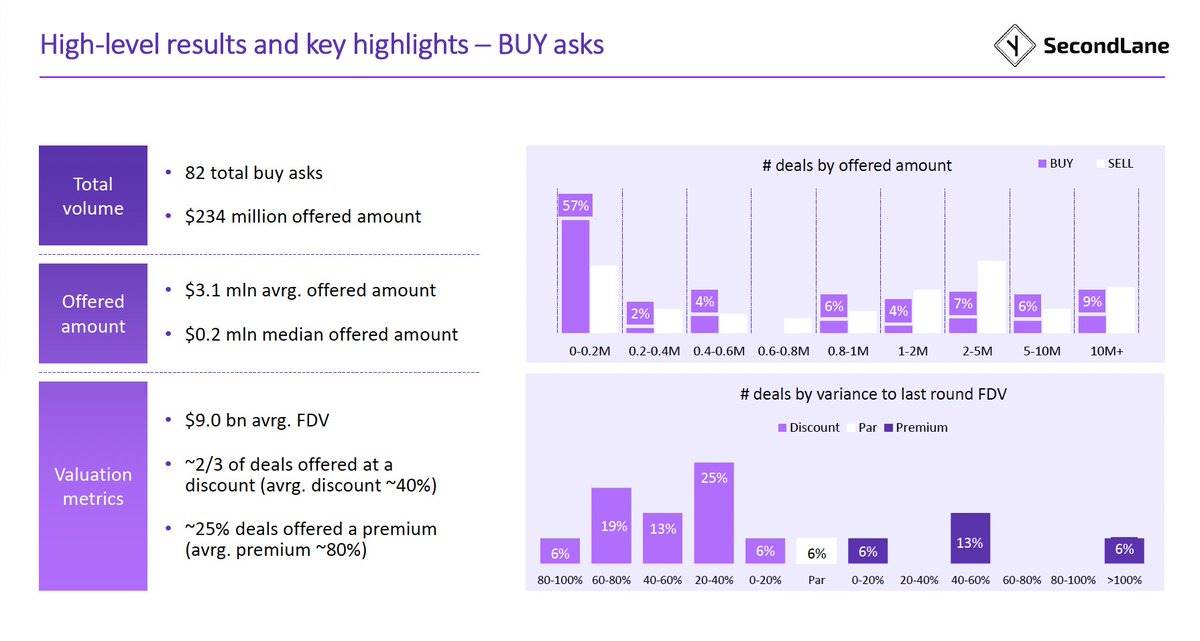
  • 中位买入请求为 20 万美元,平均估值为 90 亿美元

  • 2/3 的买入请求以折扣进行(平均折扣为上一轮或现货价格的 40% );6% 持平;25% 要求平均溢价 80% 以上
6月二级市场报告:买方市场迹象明显,资产购买需求超报价75%

  • 中位卖出报价为 200 万美元,平均估值为 65 亿美元

  • 40% 的交易以折扣进行(平均折扣为 45% );32% 持平;29% 要求溢价(平均 270% 以上)

Related Reads

Gold Price Achieves Strongest Rally in 46 Years, Tokenized Gold Trading Volume Already Exceeds Full-Year 2025

Gold is experiencing its strongest rally since 1979, with prices reaching a record high near $5,600 per ounce in January. This surge is driven primarily by central banks, not retail investors. In 2025, central banks net purchased 863 tonnes of gold, with a similar increase expected in 2026. Traditional gold investment methods—physical bullion and ETFs—present trade-offs like storage issues, limited access, or management fees. Tokenized gold emerges as a third option: digital tokens representing ownership of physical bars stored in professional vaults. These tokens are globally transferable in seconds, divisible, and redeemable for physical metal. The potential impact mirrors that of dollar stablecoins. Stablecoins digitized the dollar, enabling cheap, instant, global transfers and driving adoption from $27 billion in 2020 to over $3 trillion today. Similarly, tokenized gold solves gold's "form problem"—its lack of divisibility, portability, and accessibility. Adoption is accelerating. In Q1 2026, tokenized gold trading volume hit $90.7 billion, surpassing the $84.6 billion for all of 2025. Its market cap exceeded $6 billion, growing 5.5 times faster than physical gold holdings in the quarter. While concerns about counterparty risk exist, tokenized gold represents a direct claim on allocated bars, with major issuers providing regular attestation reports. Just as stablecoins placed dollars on a digital, global rail, tokenized gold now offers a more practical form for this ancient asset, potentially expanding access to billions.

marsbit2m ago

Gold Price Achieves Strongest Rally in 46 Years, Tokenized Gold Trading Volume Already Exceeds Full-Year 2025

marsbit2m ago

Japanese Rates Return to 1996 Levels, Can Bitcoin Withstand the September Rate Hike?

Japanese borrowing costs have hit their highest levels since 1996, with yields on 30-year bonds reaching 4.185%. This marks a significant shift for a country long reliant on negative rates. Concurrently, Bitcoin surged 22% past $80,000, seemingly decoupled from the bond market turmoil. Historically, the massive yen carry trade has fueled global risk assets, predicated on near-zero Japanese rates. This assumption is now challenged. A potential rate hike by the Bank of Japan in September could strengthen the yen, forcing carry trade unwinds and potentially triggering a global deleveraging event, as seen in August 2024 when Bitcoin fell sharply. Conversely, if the yen weakens further, Bitcoin could attract Japanese investors as a hedge against currency depreciation and the country's massive debt burden. Institutional adoption in Japan is growing, with regulatory changes paving the way for potential crypto ETFs by 2027. The key variable is the BoJ's September policy signal. If it hints at a rapid tightening cycle to combat inflation and support the yen, risk assets like Bitcoin may face selling pressure from carry trade liquidation. However, if debt sustainability concerns limit its hawkishness, leading to a weaker yen, Bitcoin could benefit. Currently, the market is betting on a slow-motion debt crisis, not a sudden collapse. While Bitcoin shows resilience, its fate remains tied to the direction of the yen and the scale of any carry trade unwind.

marsbit5m ago

Japanese Rates Return to 1996 Levels, Can Bitcoin Withstand the September Rate Hike?

marsbit5m ago

How Can Bitcoin Resist Quantum Computers? A Comparison of Three Lattice-Based Signature Schemes

"Bitcoin's Quantum Defense: A Comparison of Three Lattice-Based Signature Schemes" by the Blockstream Research Team explores how Bitcoin can transition to quantum-resistant digital signatures, as current schemes like Schnorr and ECDSA are vulnerable to quantum computers. The report evaluates three lattice-based signature candidates—Dilithium, Falcon, and Hawk—against criteria like on-chain cost (key/signature size), implementation complexity, deployment risks, and support for Bitcoin's key derivation standard (BIP-32). The analysis recommends a minimum Security Level 3 for Bitcoin due to its long-term security needs. Dilithium (ML-DSA) is praised for its simplicity and integer-only operations, making it easier to implement securely, but it has the largest signature size (~5.3 KB for Level 3). Falcon (FN-DSA) offers the most compact signatures (e.g., ~3.1 KB for Level 5) and the fastest verification, though its signing requires complex floating-point sampling—a solvable engineering challenge. Hawk, despite its small size, was withdrawn from NIST standardization after a security vulnerability was discovered, highlighting the importance of conservative security margins. Currently, neither Dilithium nor Falcon has a fully viable, production-ready BIP-32 key derivation method. The report concludes that if a lattice-based scheme had to be chosen now, Falcon-1024 would be the preferred option for its balance of size, speed, and mature security assumptions. However, the short-term recommendation remains hash-based signatures (like SPHINCS+) for their lower risk, with a potential future hybrid or full transition to Falcon once its standard (FN-DSA) is finalized and well-supported.

marsbit7m ago

How Can Bitcoin Resist Quantum Computers? A Comparison of Three Lattice-Based Signature Schemes

marsbit7m ago

Trading

Spot
活动图片