空投积分交易市场Whales Market参与指南和前景预测

Odaily星球日报Published on 2024-03-29Last updated on 2024-03-29

Abstract

Whales Market优缺点都很明显,今年内还存在市值上涨空间。

原创 | Odaily星球日报

作者 | 范佳宝
空投积分交易市场Whales Market参与指南和前景预测

Whales Market,是基于  Solana 链的、允许用户在正式代币发行前进行代币预先交换的点对点一级市场平台。

此前,对于中小投资者而言,能得到代币的方式基本就三种——空投、二级市场交易和作为激励的代币。而 Whales Market 则让用户可以交易自己的尚未上线交易所的代币(如 Portal、STRK)或者空投活动的积分点数(Magic Eden Points、Grass Points)以及白名单等。这一举措盘活了更早期市场的流动性,可称得上是极大的创新。

使用介绍

目前,Whales Market 支持三种交易,分别是 Pre-Market、OTC market 和 Points Market,并即将推出 Runes 和 WLs market(白名单市场)两种交易功能。

Pre-Market

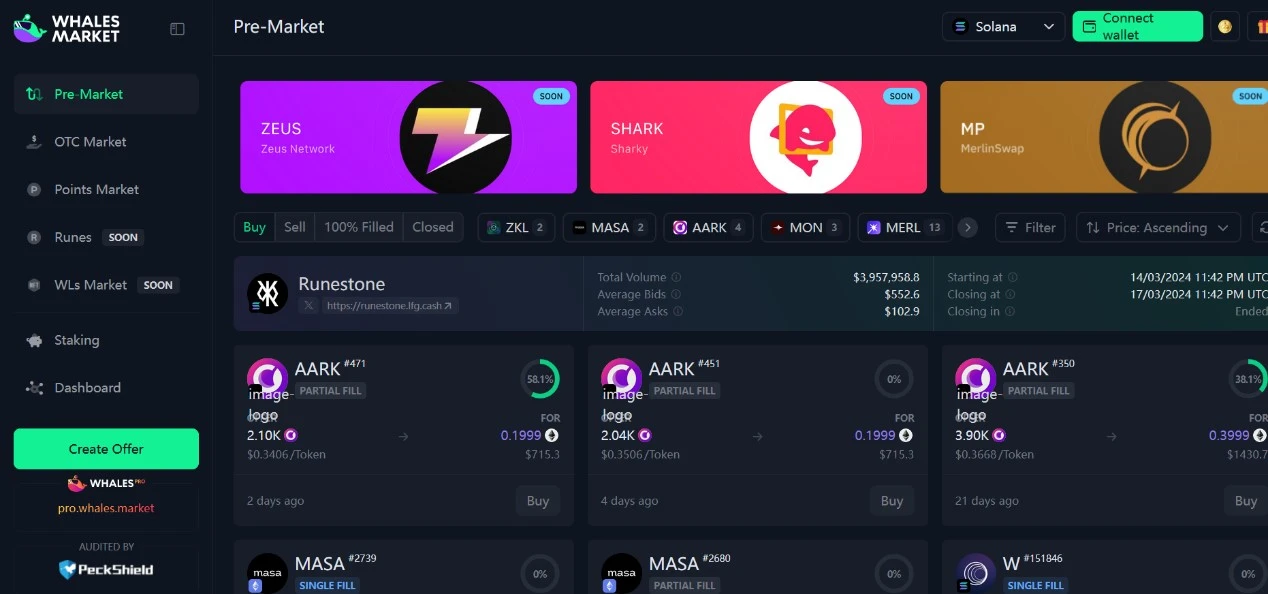
Pre-Market 交易那些尚未正式正式上线交易所的代币,而 Whales Market 提供了一个提前价格博弈的机会。
空投积分交易市场Whales Market参与指南和前景预测

OTC Market

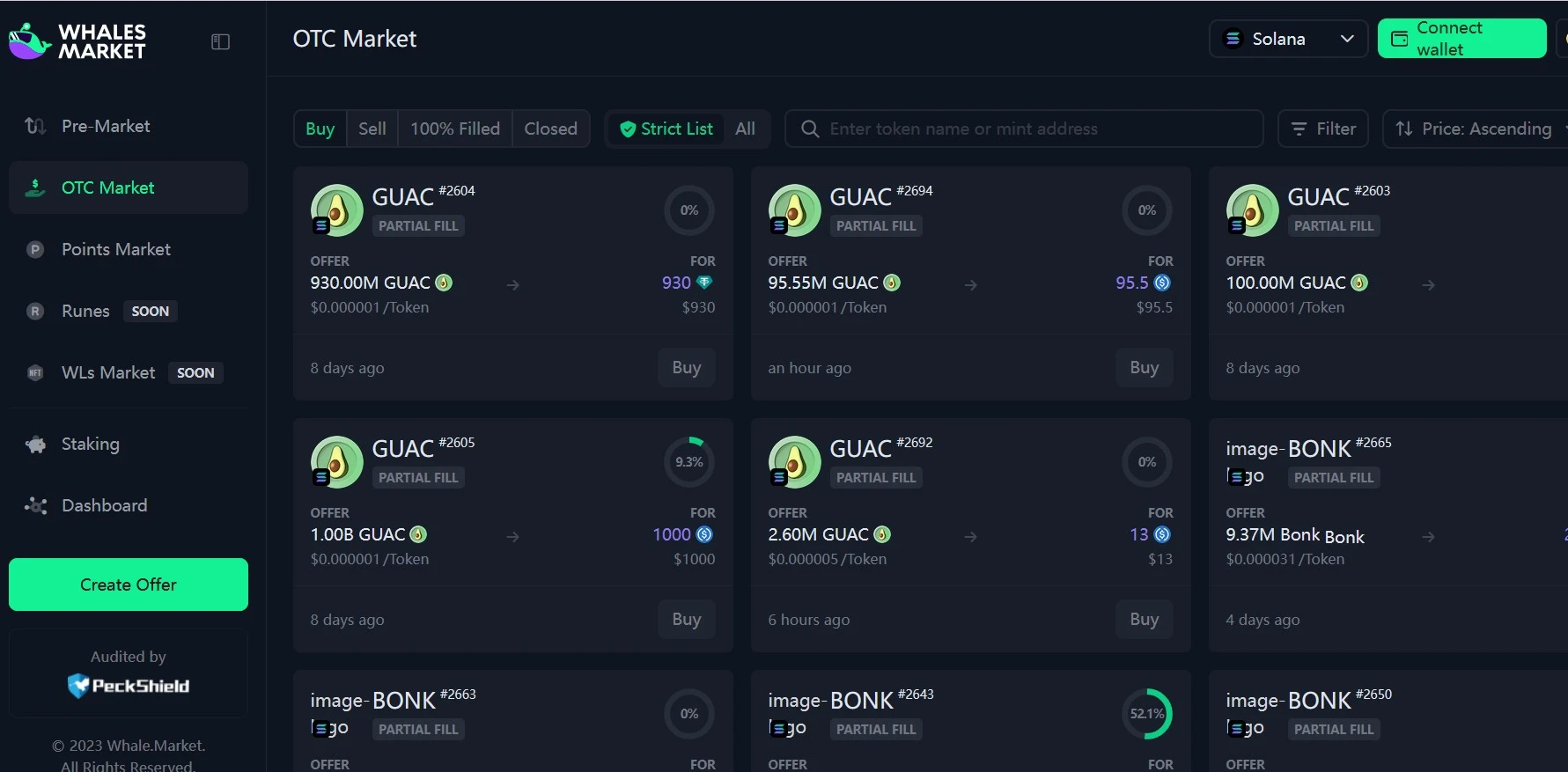
在交易所中,对流动性不足的代币(比如很多热度不高的土狗)进行交易挂单会产生大量的滑点容差。在这种情况下,点对点的 OTC 交易似乎是更好的模式。Whales Market 中的 OTC 交易分为两种,一种是带有蓝色盾牌标志的认证挂单,代表着 Whales Market 对其进行过安全筛选和认证。第二种则是普通的 OTC 交易,没有 Whales Market 的筛选,更加鱼龙混杂。
空投积分交易市场Whales Market参与指南和前景预测

Points Market

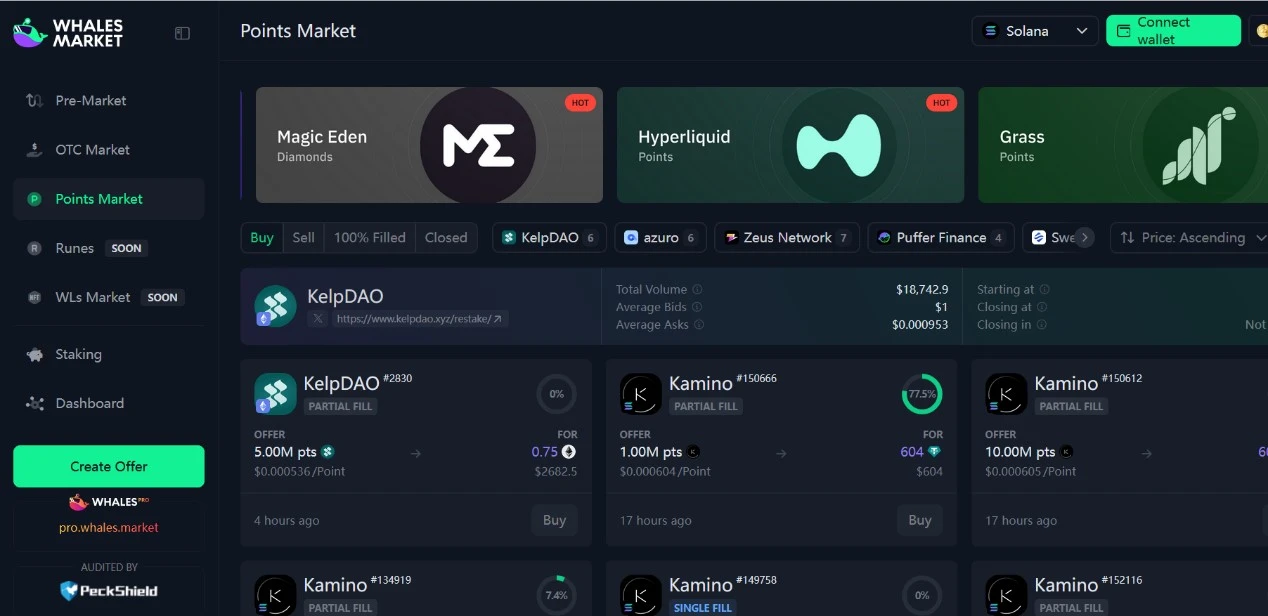
我们在完成空投任务时会收获积分,用于代币正式发行后的领取空投。出于各种原因,如预期之后正式代币价格下降、需要资金周转等,往往会有人想出售代币空投活动的积分。而自然也会有人想要购买积分抢占先机。Pre-Market 允许用户提前交易积分点数,空投后再进行交割,增加了一处博弈的环节。
空投积分交易市场Whales Market参与指南和前景预测

订单簿式的点对点交易

由于想在流动性有限的情况下尽量撮合交易,Whales Market 采用了买卖双方挂单点对点成交的方式。也即任意一方选择出售/购买的币种、数量和价格,创建买/卖订单并持续挂在市场内,直到该订单被满足以成交。如图中的 GUAC 代币买单,显示有买单数量、总价、代币单价,和该订单已经被完成的百分比。

双重抵押机制

此外,Whales Market 还利用双重抵押机制保障交易。不管是挂单方还是吃单方,是买方还是卖方,参与交易的双方都必须缴纳和订单金额相等的保证金。如一方违约,终止最后的代币交割,那么另一方就能收到过错方的保证金作为补偿。

 代币机制介绍和基本面分析

Whales Market 的代币名为 WHALES,共计 1 亿枚。

代币释放情况

  1.   65% 用于激励, 4 年内线性释放,由 DAO 进行代币治理。

  2.   9.5% 的团队占比,锁定 9 个月后, 36 个月内线性释放。

  3.   7.5% 用于提供流动性,其中 2.5% 预留给 CEX 上市。

  4.   7% 在私募环节售出。

收益分配

  1.    60% 分配给 WHALES 代币质押人。

  2.    20% 用来支付后续的开发费用。

  3.   10 % 回购并销毁代币。

  4.   10 % 分配给 LOOT 和 xLOOT(创始人之前的项目)的持有者。

代币质押

用户可以在操作页面中的 staking 界面质押 WHALES 以获取治理代币 xWHALES。如前文所述,xWHALES 将提供给用户奖励。

 此外,Whales Market 已于 3 月 15 日开始每月将销毁未质押代币的 1% ,以保证项目的良好运行。

项目基本面介绍

根据 CoinGecko 的数据显示,截至写就本文的日期(2024.3.28),$WHALES 的价格为$ 1.99 ,市值为 3917 万美元,占总流通量 1.93 亿美金的 21% 。

最高点为 2 月 26 日出现的$ 4.41 ,相较于最高点跌去 57% ,最低点则出现在 1 月 8 日,即项目刚上线的$ 0.08 ,也就是说目前的价格是最初的 200 倍。
空投积分交易市场Whales Market参与指南和前景预测

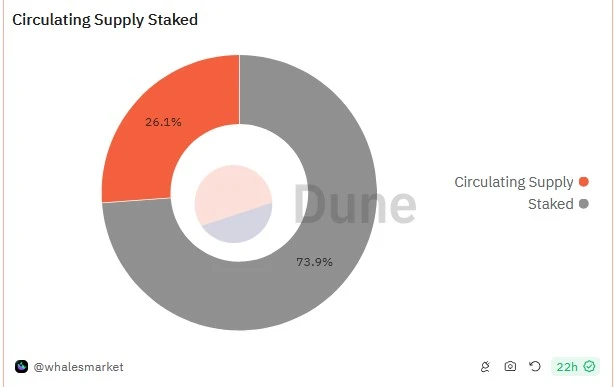
根据 Dune 的数据显示,截至目前,Whales Market 的用户数量为 25150 人,质押占比为 73.9% 。同时有有 102 万美元的收入已经按照前文计划被分享。

此外,创始人兼管理者为 Dexter,曾开发过 Telegram 机器人项目 Lootbot,并着手开发新的 AI 项目 gm.ai。

项目前景和市值估算

Whales Market 优缺点明显:

优点

  1.    Whales Market 的代币是线性释放,无需担心未来短时间内出现大量释放稀释价格。

  2.    Whales Market 的代币赋能简单、直接、有效。

  3.    采用回购销毁的机制,能够对抗代币释放带来的通胀影响。

  4.    大部分代币都在质押当中,大量解除或增加质押会被链上监控,可以防止巨鲸突然砸盘。

  5.   赛道新颖,潜力无限,后续还会开发新功能。

缺点

  1.  目前流通量仅为 21% ,大部分代币还未释放。

  2.  创始人 Dexter 在最近 Solana 链上的“收款空投”模式中,将链上筹集的 sol 转入交易所,引发用户不满,以及对 Dexter 所负责的 Whales Market 的担忧。

  3.  代币涨幅已达一开始的数百倍,早期获利者潜在的获利砸盘风险。

项目市值估算

考虑到目前还没有同赛道的平台,我们基于市盈率等数据进行估算:

据 Dune 上的数据显示,目前代币流通数量为 400 万枚,质押数量则为 1219 万枚。

考虑到目前 Whales Market 的发展相对平稳,可以拿现在的非质押比例计算每个月销毁比例,即为 0.274* 0.01 = 0.00274 = 0.274% ,也即每个月销毁 0.274% 的代币。仅计算主要的激励代币,每个月释放的代币比例也会造成 1.35% 的代币增加。也就是说 Whales Market 目前是通胀模型。
空投积分交易市场Whales Market参与指南和前景预测

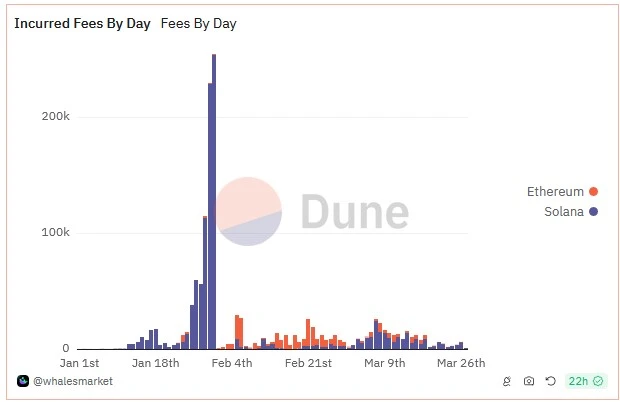
前文所述,Whales Market 的市值为 3917 万美元,分配收益为 102 万美元,考虑到 Whales Market 上的交易主要发生在 1 月 10 日之后,剔除项目新发的时段,将动态市盈率计算区间定为 2.5 个月,计算得市盈率为 8.3 。但是考虑到 whales 今年的代币通胀将会增加流通总量 20% 左右的代币,则最终今年的动态市盈率为 9.96 。对比其他大多数 DeFi 项目,如 AAVE 等,P/E(本年收益/本年分红)基本在 20 以上,由此可以看出 Whales Market 在 2024 年内还存在市值上涨空间。

Whales Market 承诺,协议收入将持续大于通胀带来的影响,确保了用户的收益下限保障,这也是优势所在。
空投积分交易市场Whales Market参与指南和前景预测

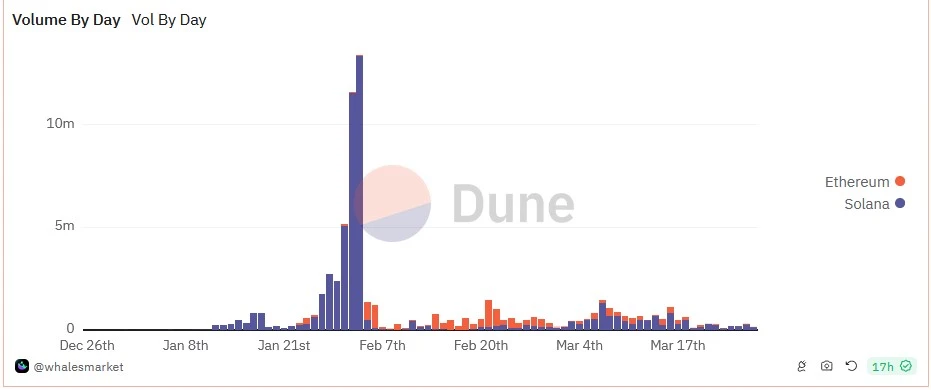
而根据 Dune 上的数据显示,Whales Market 在大项目登陆时交易量会激增,如 Ether.Fi、Blast、Jupiter 等。这无疑能带来用户增长、收入增加和代币价格的升高。考虑到 2024 年大概率是牛市的一年,将会有众多优质项目登录 Whales Market。

结语

Whales Market 所处的赛道新颖,竞争对手少,且代币有赋能和治理保障。并且,随着大项目陆续登陆,只要不再出现如最近的创始人募资转移到交易所这样的争议事件,我们仍然看好 Whales Market 在 2024 年的发展。

Related Reads

Early Investor of Unitree Bets on a Brain-Computer Interface Company

"Wabo Technologies, a brain-computer interface (BCI) startup, has secured new funding from Vertex Ventures (under Temasek), Hongtai Fund, Chengdu Future Industry Fund, and Huifengda Capital. Vertex Ventures is known for its early bet on Unitree Robotics. Inspired by the sci-fi film "Avatar," founder Zhang Xingzhi has pursued human-machine interaction for over a decade. He established Wabo in late 2025, coinciding with China's push for BCI as a future industry. Unlike companies focused solely on medical hardware, Wabo positions itself as a model company. Its core mission is to develop a "Human Neural Intent Model" that decodes EEG, EMG, and behavioral signals to understand a user's goals, confirmations, corrections, and stop intentions before physical action, translating them into standardized control signals for machines, robots, or smart devices. The young, full-stack team, backed by academic collaborators from Tianjin University and Fudan University, quickly attracted investors. The company had previously raised a seed round from Ceyuan Capital. Investors were impressed by Wabo's systematic capabilities in data collection, signal processing, and engineering, seeing potential beyond a single hardware product toward a reusable layer of human intent interpretation. Applications span medical rehabilitation, smart homes, embodied AI, and even space exploration, with Wabo partnering with Tianjin University on pioneering "space BCI" research. Wabo plans a dual-headquarters strategy, with Shanghai focusing on high-end R&D and model development, and Chengdu handling hardware, product development, and supply chain. The BCI sector in China is heating up, with over 30 financing deals in early 2026. Zhang believes future competition will center on who can build a sustainable data-model-scenario loop. He predicts industry consolidation within three years, with only companies that master this闭环 surviving. The vision from "Avatar" is inching closer to reality."

marsbit11m ago

Early Investor of Unitree Bets on a Brain-Computer Interface Company

marsbit11m ago

ChangXin Technology: A Cyclical Stock Standing Atop the Cycle Peak

Changxin Technology: A Cyclical Stock at the Peak On July 27, 2026, Changxin Technology topped the A-share market with a market capitalization of 3.28 trillion yuan, surging 465% on its first trading day. The company, which lost 16.3 billion yuan in 2023, reported an estimated net profit of 50-57 billion yuan for the first half of 2026. Its dramatic reversal mirrors the volatile DRAM (Dynamic Random Access Memory) cycle. The DRAM industry is inherently cyclical, with booms and busts every 3-4 years. This is due to product standardization and a significant time lag in supply adjustment. When prices rise, manufacturers expand capacity, but new production takes 2-3 years to come online, often leading to oversupply and price crashes when demand cools. Changxin's performance perfectly tracks this cycle. It recorded deep losses in 2023-2024 during the industry downturn, turned its first annual profit in 2025, and saw profits skyrocket in Q1 2026. This surge is primarily price-driven. The AI boom has led major players like Samsung and SK Hynix to shift 70-80% of new capacity to high-margin HBM (High Bandwidth Memory), creating a severe shortage and price explosion in general-purpose DRAM markets where Changxin competes. However, a massive global capacity expansion is underway. The top three manufacturers have announced nearly $70 billion in capital expenditure for 2026. Changxin itself plans to expand from three to seven 12-inch wafer fabs. This investment will translate into significant new supply in 2-3 years. While DRAM prices are expected to remain high through 2026-2027, price growth is already slowing, and a potential downturn is forecast for around 2028 as new capacity ramps up. A key challenge for Changxin is catching up in the critical HBM segment. While it has delivered HBM3 samples, leaders are already mass-producing more advanced HBM3E. Success in HBM is crucial for gaining true cyclical resilience. In conclusion, Changxin is a commendable company that has broken foreign monopolies in DRAM. Its long-term growth narrative—driven by import substitution and AI—is valid. Yet, its current valuation of 5-6x forward P/E, typical for a cyclical stock at its peak, suggests much future growth is already priced in. AI may extend the current cycle but cannot eliminate the industry's inherent volatility. For investors, the critical question is preparedness for the inevitable downturn when the cycle turns.

marsbit16m ago

ChangXin Technology: A Cyclical Stock Standing Atop the Cycle Peak

marsbit16m ago

What If the CLARITY Act Ultimately Fails to Pass?

This article examines the potential consequences if the CLARITY Act, a major US crypto market structure bill, fails to pass in the Senate. Having cleared the House in July 2025 and a key committee in May 2026, the bill's passage into law this year is now considered uncertain, with prediction markets showing its probability dropping from 82% in February to 35%. The article analyzes three main areas of impact should the bill fail. First, for the crypto market, analysts believe a negative reaction is limited and partially priced in already, with Bitcoin's recent weakness attributed more to macro factors. The specific details of the failed bill would matter more than its failure alone. Second, for US stocks, Coinbase (COIN) could see short-term pressure, with analysts citing a potential drop to the $140-$160 range, though its long-term thesis is not solely tied to the bill. For Circle, failure might be neutral or even positive long-term, as a passed bill could invite more stablecoin competition. Bitcoin-treasury firms like Strategy (MSTR) are seen as more directly tied to Bitcoin's price than the legislation. Third, in Washington, the failure is framed within a broader political struggle. Democratic resistance is partly linked to concerns over former President Trump's crypto holdings, making the bill a political tool. If it fails in 2026, the industry would likely rely on existing frameworks like the GENIUS Act and agency-level rules. Missing the August window likely pushes any significant progress to 2027, a period of political reshuffling after midterm elections, making consensus harder to achieve.

Odaily星球日报1h ago

What If the CLARITY Act Ultimately Fails to Pass?

Odaily星球日报1h ago

SK Hynix Q2 Profit Soars Sixfold, Still 'Misses Expectations'; Secures Long-Term Agreements with 10 Clients, HBM4 to Accelerate Volume Ramp in Second Half

SK Hynix reported record-breaking Q2 2026 financial results, with operating profit soaring 557% year-over-year to 60.5 trillion won and revenue increasing 257% to 79.3 trillion won, driven by strong demand for AI server memory, HBM, and enterprise SSDs. The operating profit margin reached 76.3%. However, both figures fell short of analyst expectations, leading to a drop in its share price. The company attributed the earnings miss to three factors: a high sales mix of HBM, which limited upside from surging prices of general-purpose DRAM; a deceleration in memory price increases compared to Q1; and long-term supply agreements (LTAs) with major customers that lock in prices, reducing sensitivity to spot market gains. SK Hynix has signed LTAs with about 10 clients, covering roughly half of its sales. Despite the miss, the company remains optimistic about AI-driven demand. Its net profit of 93.9 trillion won was significantly boosted by a one-time gain from the partial sale of its Kioxia stake. Financially, it strengthened its cash position, ending the quarter with a net cash position of 69.4 trillion won. Looking ahead, SK Hynix plans capital expenditures at the high end of its 40-50 trillion won range for 2026 to expand capacity for HBM and advanced NAND products, including accelerating the mass production of HBM4 in the second half of the year.

marsbit1h ago

SK Hynix Q2 Profit Soars Sixfold, Still 'Misses Expectations'; Secures Long-Term Agreements with 10 Clients, HBM4 to Accelerate Volume Ramp in Second Half

marsbit1h ago

Trading

Spot
活动图片