Author: David, TechFlow Deep Tides
2026 will be a big year for IPOs. This judgment was validated as early as January.
January wasn't even over yet, crypto custodian BitGo rang the bell on the NYSE, and Chinese AI companies Zhipu and MiniMax listed on the Hong Kong Stock Exchange successively. Three companies, different sectors, all chose January.
Zhipu's public offering was oversubscribed by 1164 times, MiniMax rose 109% on its first day. Money is really rushing in.
But these few companies in January are just the beginning, the list of companies expected to IPO this year is much longer. Super unicorns abroad are getting bigger and bigger, and there's a batch of Chinese tech companies going through the process in Hong Kong and A-shares...
Which ones might land this year, what are their valuations, and when will there be a chance to participate?
We've reviewed the IPOs worth watching in 2026, broken down by sector.
The Trillion-Dollar Club on the US Stock Market
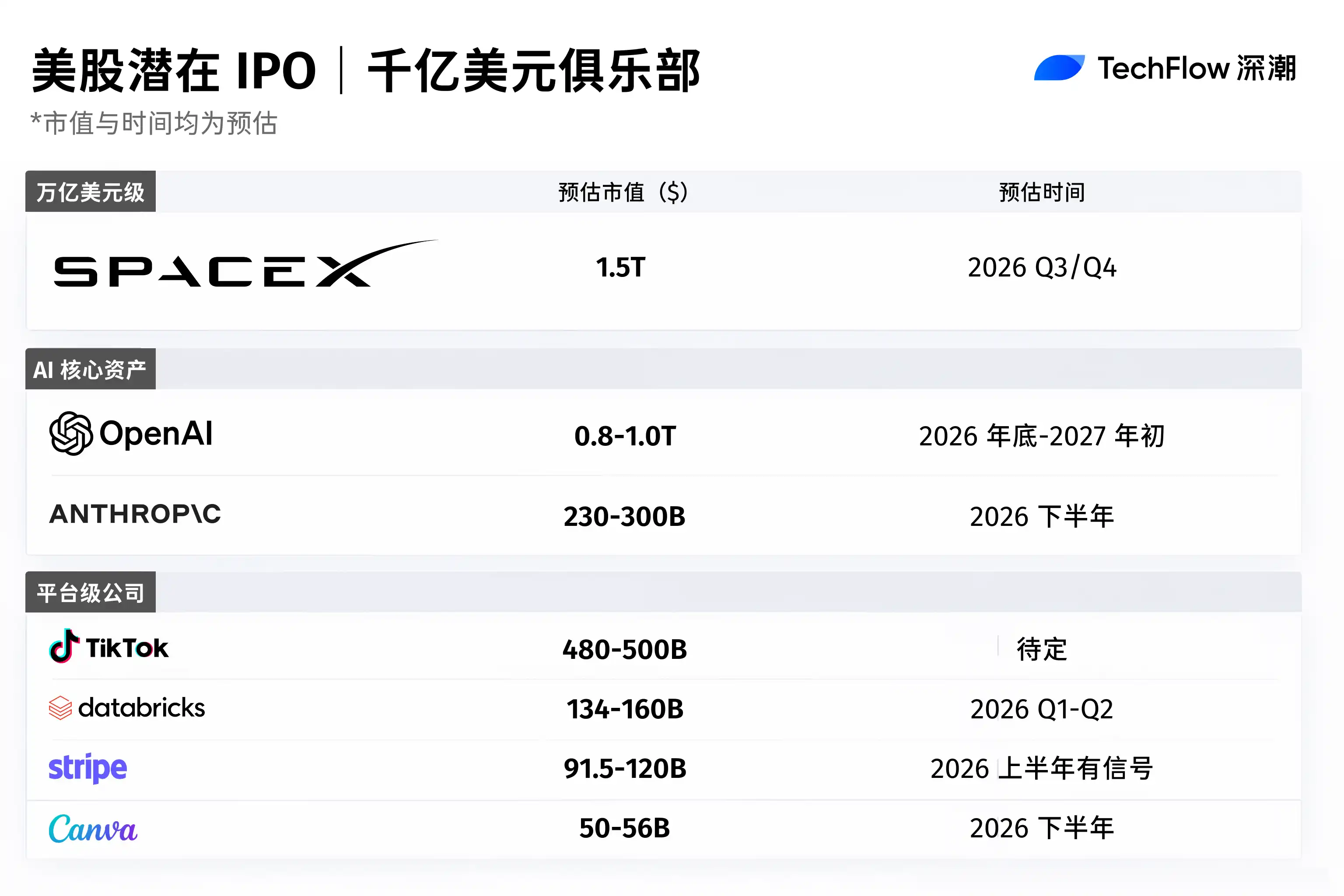
Data source: BloomBerg, AI compiled
If 2025 was the year crypto companies collectively went public, 2026 might be the year tech giants reopen the IPO door.
The most watched in this round are not startups, but those super unicorns that have been nurtured in the private market for many years.
Their common point is that their valuations have reached the limit of the private market, there are only so many institutions that can take over, and continuing to raise funds doesn't make much sense.
Among them, some missed the window because the market environment was bad before, some because the founders deliberately remained private.
In 2026, these conditions are maturing simultaneously.
1. SpaceX, Valuing the Sea of Stars
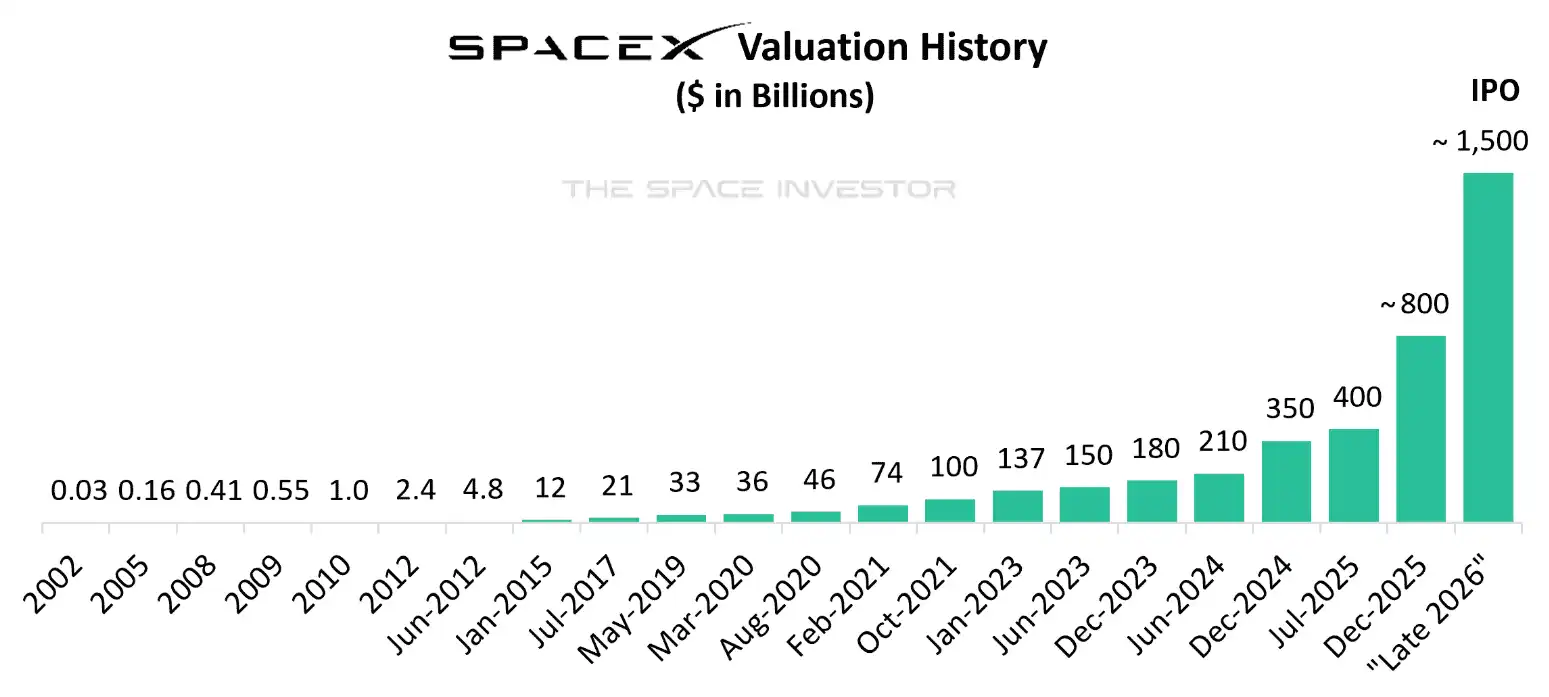
Estimated Market Cap: $1.5 Trillion
Estimated Time: 2026 Q3/Q4
On December 10, Musk confirmed on Twitter:
SpaceX plans to IPO in 2026.
According to Bloomberg, the target is to raise over $30 billion, with a valuation of about $1.5 trillion. If true, this would surpass Saudi Aramco's 2019 record of $29 billion, becoming the largest IPO in human history.
SpaceX currently has two core businesses. The first is rocket launches, Falcon 9 launched over 160 times in 2025, accounting for more than half of global launch volume. The second is Starlink satellite internet, with over 10,000 satellites in orbit in 2025 and over 8 million users, with estimated annual revenue of $15.5 billion.
According to internal SpaceX documents推算, when Starlink users reach scale, the company's annual revenue could reach $36 billion, with an operating profit margin of 60%.
If achievable, a $1.5 trillion valuation implies about a 70x price-to-sales ratio. This ratio is already high, but for companies growing over 50%, the market might be willing to pay.
Another small data point you might overlook is, SpaceX looks like a space company, but actually 70% of its revenue comes from Starlink.
Investors aren't buying the dream of "Mars colonization," but the world's largest satellite internet service provider, a network service provider disguised in a space suit.
Why is Musk willing to go public now?
According to Ars Technica, it's mainly to raise funds to build space data centers, such as using modified Starlink satellites as orbital AI computing nodes.
It sounds like science fiction, but which of the things SpaceX has done over the past 20 years didn't sound like science fiction?
Valuing the sea of stars is sexy enough.
2. OpenAI vs Anthropic, The AI Duo's Listing Race
Estimated Market Cap: $830 Billion - $1 Trillion (OpenAI), $230 Billion - $300 Billion (Anthropic)
Estimated Time: Late 2026 - Early 2027 (OpenAI), Second Half of 2026 (Anthropic)
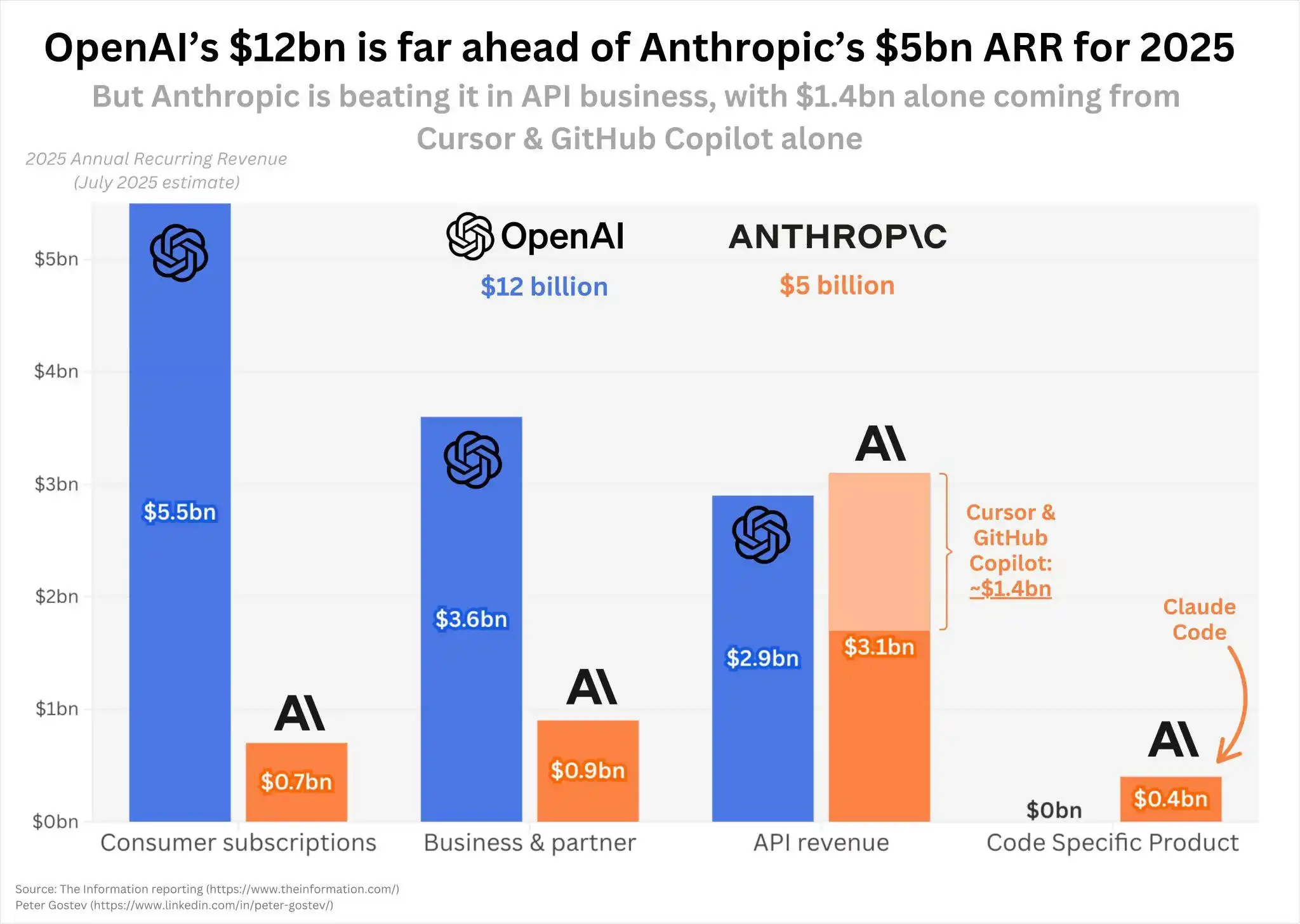
These two are written together, ChatGPT and Claude are often used together.
OpenAI is currently valued at about $500 billion, with annualized revenue exceeding $13 billion (Sam Altman has even said revenue far exceeds this number), and aims to list with a $1 trillion valuation.
CFO Sarah Friar stated the listing is targeting 2027, but some advisors believe it could be brought forward to the second half of 2026.
Sam Altman was very frank on a podcast: "My excitement level about being the CEO of a public company is 0%."
But he also admitted, "We need a lot of capital, and sooner or later we will break the shareholder number limit." OpenAI just completed its restructuring from non-profit to for-profit, with Microsoft's stake reduced to 27%, clearing the way for an IPO.
Anthropic is moving faster.
According to the Financial Times, the company has hired Wilson Sonsini (the law firm that helped Google and LinkedIn with their IPOs) to prepare for an IPO, possibly as early as 2026.
Current valuation is $183 billion, a new round of financing is underway, targeting a valuation exceeding $300 billion; meanwhile Microsoft and Nvidia may jointly invest $15 billion.
In terms of revenue data, Anthropic looks more promising:
Annualized revenue is about $9 billion, expected to reach $20-26 billion in 2026, and could touch $70 billion in 2028. Claude's subscription revenue growth rate is 7 times that of ChatGPT, although from a smaller base.
It's hard to say who will win the competition between the two companies.
OpenAI dominates the C-end, with 800 million weekly active users for ChatGPT; but Anthropic is growing faster in the enterprise market.
Who will list first? Currently, Anthropic seems better prepared. But OpenAI is larger, and once it decides to act, the market attention will be completely different.
3. ByteDance Won't List, But Can TikTok?
Estimated Market Cap: $480 Billion - $500 Billion
Estimated Time: Under consideration, uncertain
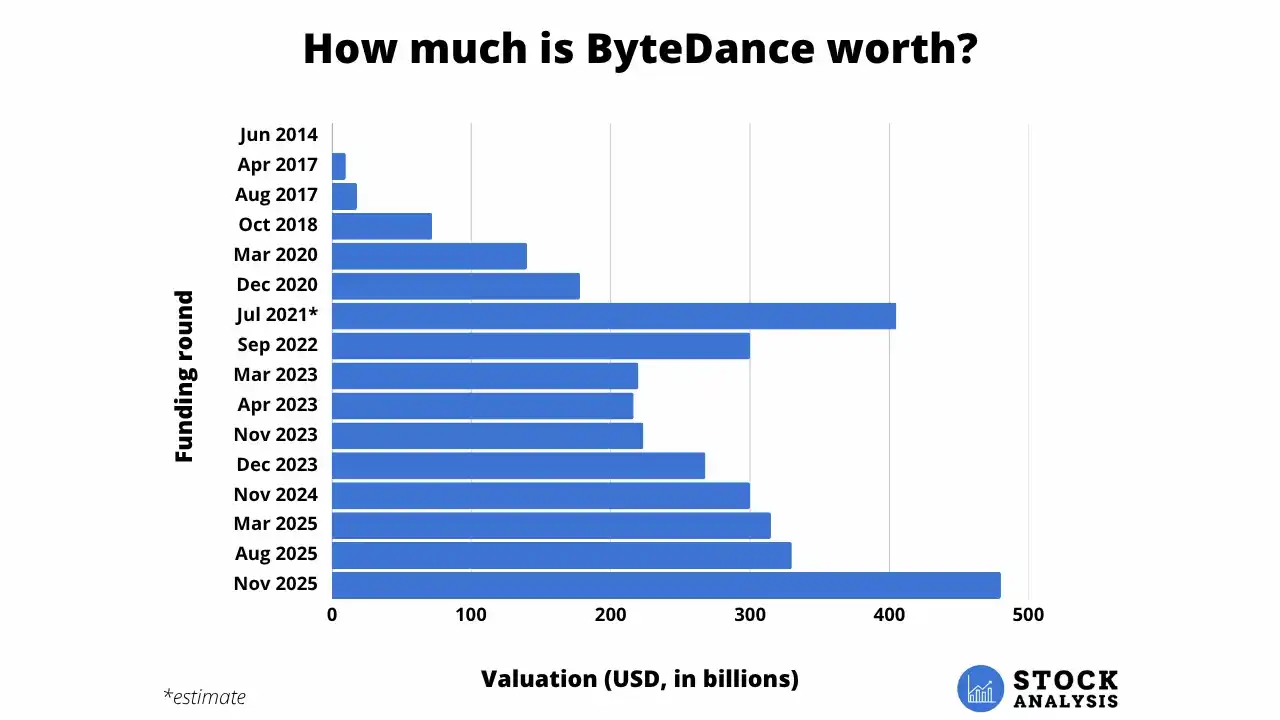
ByteDance is the world's second highest valued unlisted company, second only to OpenAI.
In a secondary share sale in November 2025, Today Capital竞得 shares for nearly $300 million, corresponding to a valuation of $480 billion.
The company's global revenue in 2024 was $110 billion, a year-on-year increase of 30%. Douyin's dominant position in the Chinese market goes without saying, and the Doubao chat robot's monthly active users surpassed DeepSeek to become number one domestically.
Planned capital expenditure for 2026 is 160 billion RMB, of which 85 billion RMB is for AI chip procurement.
But ByteDance has clearly stated before: there are no IPO plans.
However, the variable might be TikTok. If the US spin-off finally materializes, market rumors suggest TikTok US's separate valuation could rise from the current $400 billion to $500 billion.
A spun-off TikTok US could instead become one of the largest tech IPOs in 2026.
4. Databricks, You Haven't Heard of It, But Everyone Uses It
Estimated Market Cap: $134 Billion - $160 Billion
Estimated Time: 2026 Q1-Q2
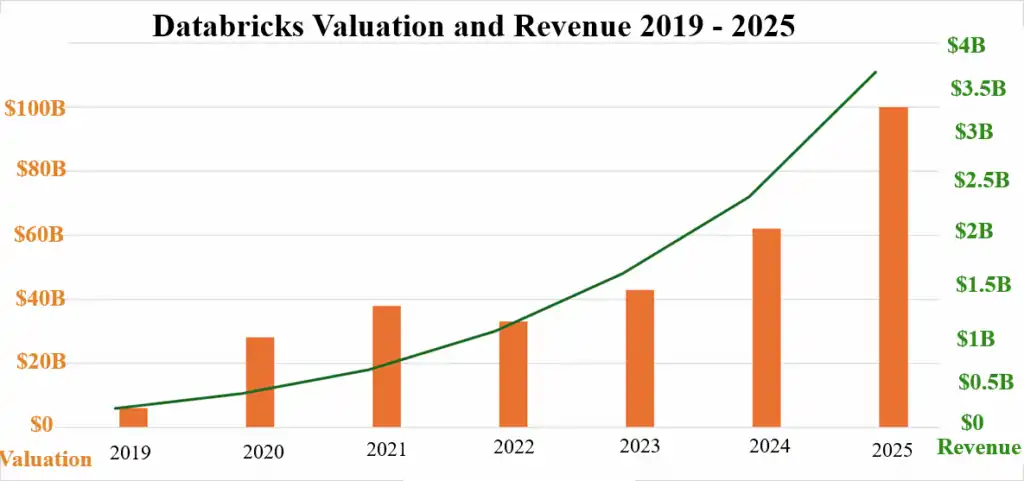
Databricks is a company that most ordinary people haven't heard of, but almost all large companies use.
It provides a unified platform for data lakes + data warehouses, allowing enterprises to store, process, analyze massive data, and train AI models on it.
In December 2025, Databricks completed a $4 billion Series L funding round, valuing it at $134 billion.
For comparison, its valuation was $100 billion three months ago and $62 billion a year ago. This growth rate is extremely rare in the private market.
Financially, the company's annualized revenue exceeds $4.8 billion, a year-on-year increase of 55%;
Among this, AI product revenue exceeds $1 billion. Over 20,000 customers include OpenAI, Block, Siemens, Toyota, Shell. Most crucially, the company is already cash flow positive.
Analysts generally expect Databricks to go public in early 2026.
If it does IPO, it will directly compete with Snowflake. Snowflake was valued at $70 billion at its 2020 IPO, with its stock price doubling on the first day.
Databricks is larger and growing faster, so market expectations will only be higher.
5. Stripe, The One Least in a Hurry
Estimated Market Cap: $91.5 Billion - $120 Billion
Estimated Time: Signals in H1 2026, but might delay
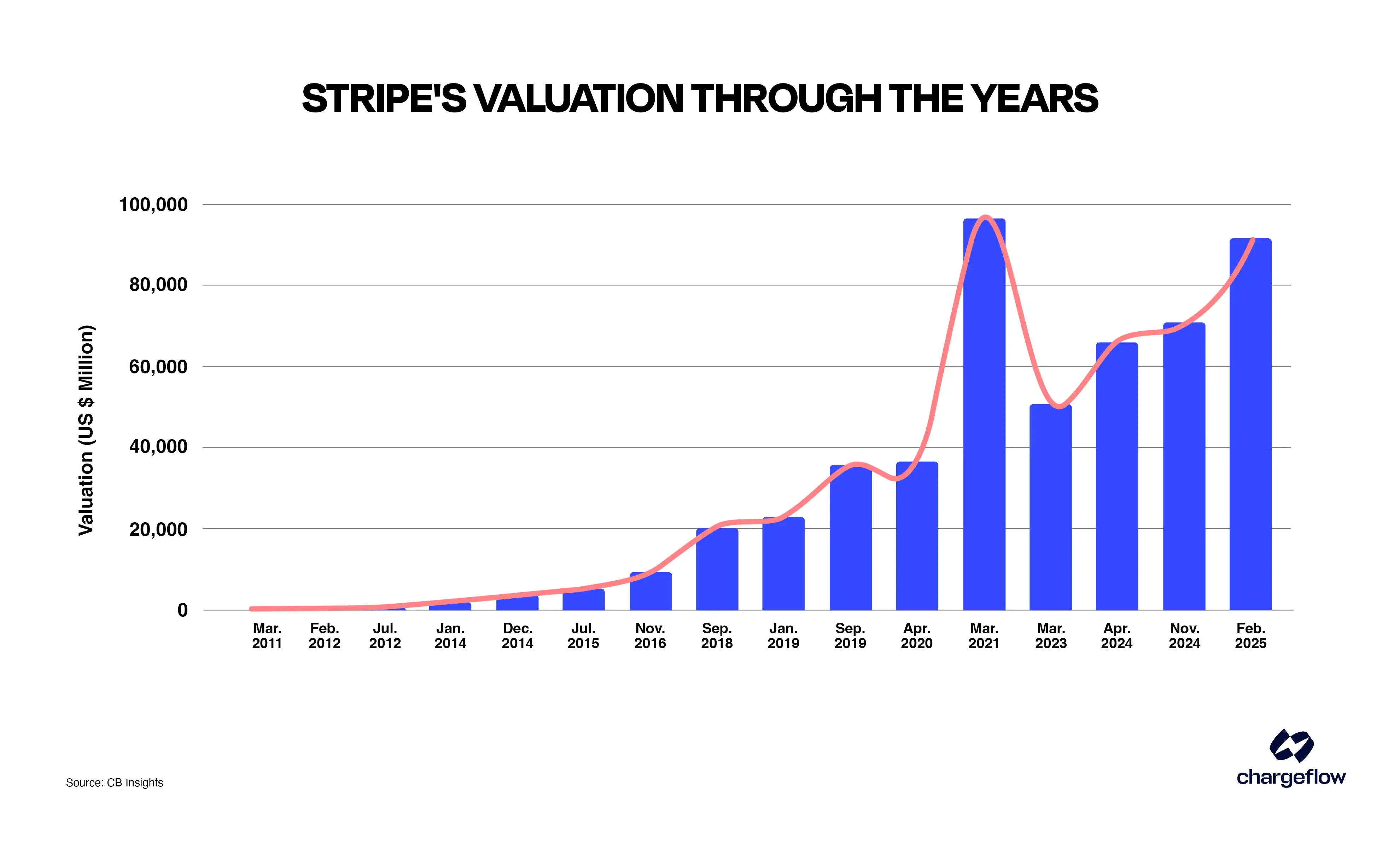
Stripe might be the most special one in this batch: the most qualified to go public, but the least wanting to.
Valuation $91.5 billion, revenue over $18 billion, already profitable. Processes $1.4 trillion in global payments, with customers like OpenAI, Anthropic, Shopify, Amazon. Financially, this is the cleanest among these companies.
But the Collison brothers have always avoided the IPO question. In February 2025, they explained on the All In podcast:
Stripe is profitable and doesn't need to raise funds through an IPO; many financial services companies like Fidelity haven't gone public for decades; shareholders can get liquidity through regular employee stock buybacks, not necessarily needing the public market.
How long can this logic hold?
Sequoia has already started finding ways to distribute Stripe shares to LPs, which is usually a signal from VCs urging a company to go public. Employees' 10-year options are also expiring, increasing the pressure to cash out.
If the IPO market remains hot in 2026, the probability of Stripe顺势 listing is not small. But if the market cools down, the Collison brothers have the capital to keep waiting. The difference between them and the other companies in this batch is that the choice is in their own hands.
6. Canva, Probably the Least Risky in This Batch
Estimated Market Cap: $50 Billion - $56 Billion
Estimated Time: Second Half of 2026
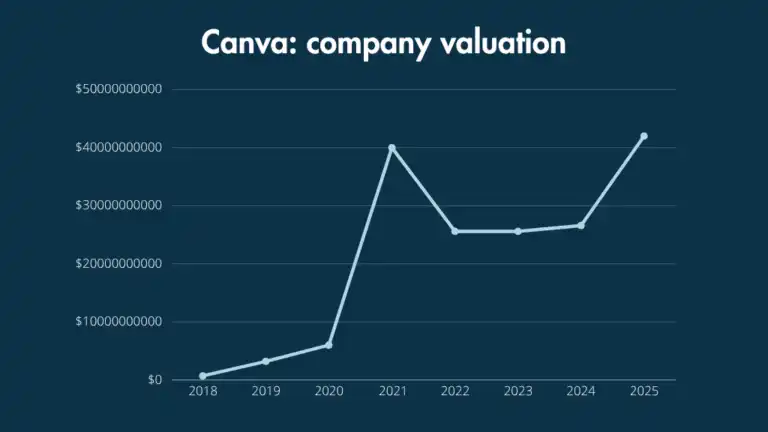
Source:https://www.stylefactoryproductions.com/blog/canva-statistics
Compared to those trillion-dollar behemoths ahead, Canva seems much quieter. An Australian design tool company, valuation $4.2 billion, revenue over $3 billion, profitable.
No geopolitical risks, no burning cash pressure from the AI arms race, the business model is simple: sell subscriptions, make design tools.
Blackbird Ventures told investors in November last year that Canva would be ready in the second half of 2026. CEO Melanie Perkins has always been resistant to listing, but employee liquidity needs might push her to change her mind.
If you're looking for a "stable" option among these IPOs, Canva might be the closest. Not as sexy as SpaceX, but also without so many variables.
To summarize, it's no coincidence that these companies are preparing to go public en masse in 2026.
For example, the AI arms race needs ammunition. OpenAI plans to invest $1.4 trillion in the next 5 years, Anthropic承诺 $50 billion to build data centers, ByteDance spends heavily on chip purchases every year. The private market can't fill this money.
However, for ordinary investors, the significance of these IPOs might be different from before.
These companies have already grown large and mature enough in the private market; by the time they can be bought, they are no longer "early stage." The fattest part of the growth has been eaten by the private market.
Chinese Tech IPOs, Two Lines in Hong Kong and A-Shares
Zhipu and MiniMax抢跑 the Hong Kong stock market in January, but the big show of Chinese tech company IPOs has just begun.
In 2026, commercial aerospace and robotics are the two hottest main lines, targeting the STAR Market and the Hong Kong stock market respectively.
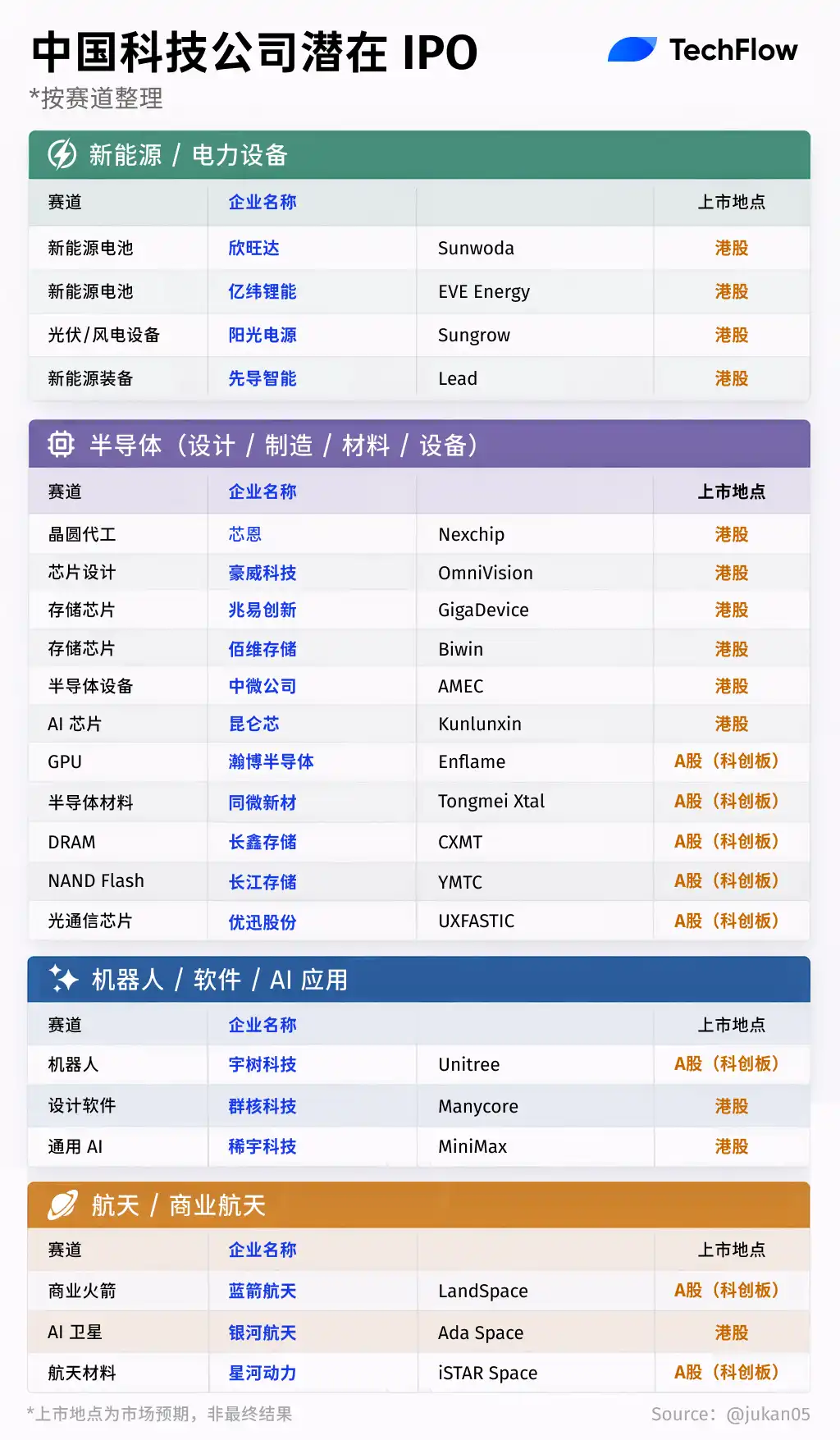
Source:X user @jukan05
Compiled by: TechFlow Deep Tides
1. LandSpace, Sprinting to be the "First Share of Commercial Rockets"
Estimated Market Cap: 20-22 Billion RMB
Estimated Time: 2026
Listing Venue: STAR Market
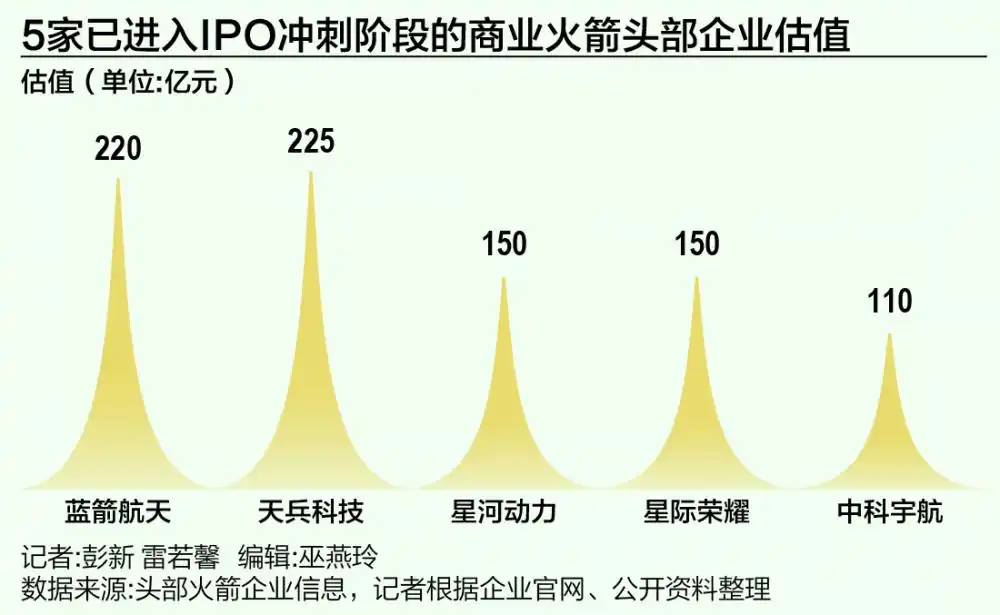
On December 31, 2025, LandSpace's STAR Market IPO was accepted, planning to raise 7.5 billion RMB. It only took 5 months from initiating辅导 to being accepted, rocket speed.
LandSpace is a leading player in domestic commercial aerospace, making liquid oxygen methane engines and launch vehicles.
Founder Zhang Changwu has a financial background, started his business in 2015, raised 17 rounds in 10 years, backed by 85 funds. The latest valuation is about 22 billion RMB, with Sequoia, Matrix Partners, Country Garden Venture Capital as early shareholders, the National Manufacturing Transformation and Upgrading Fund also entered last year.
LandSpace chose the STAR Market's fifth set of standards,这套标准原本 only for biopharmaceuticals, expanded to commercial aerospace last year.
The requirement is "achieving the first successful orbit insertion of a payload using a medium-to-large reusable launch vehicle technology". Last December, LandSpace's Zhuque-3 did a recovery test, the first stage rocket didn't soft land, but the orbit insertion mission was successful, barely meeting the line.
However, on January 5, LandSpace was selected for an on-site inspection, the first batch this year. The subsequent progress depends on the inspection results.
2. CAS Space, The Second Fastest Progressing Rocket Company
Estimated Market Cap: Over 10 Billion RMB
Estimated Time: 2026
Listing Venue: STAR Market
CAS Space just completed its listing辅导 in January, it is the fastest progressing commercial aerospace enterprise towards an IPO after LandSpace.
This company was incubated by the Chinese Academy of Sciences Institute of Mechanics, making medium-to-large solid rockets. The Lijian-1 has been launched 8 times, holding the record for consecutive launches of ton-level payloads by domestic private rockets.
On January 12, the Lihong-1 completed a suborbital flight test, reaching a maximum altitude of 120 km, successfully crossing the Kármán line into the space environment, with the payload capsule parachuting for recovery.
Different from LandSpace's liquid rocket route, CAS Space takes the solid rocket route, with lower cost and faster response, but also a lower payload ceiling. The two companies卡的是 different markets.
Founder Yang Yiqiang is 58 years old, from the China Academy of Launch Vehicle Technology (CALT), was the first chief commander of the Long March 11. This kind of "national team" background is a scarce resource in the commercial aerospace circle.
3. Unitree Robotics, The Unknowable Spring Festival Gala Star
Estimated Market Cap: Over 12 Billion RMB
Estimated Time: 2026
Listing Venue: STAR Market (most likely)
At the 2025 Spring Festival Gala, 16 humanoid robots wearing Northeastern floral-patterned jackets danced "Yang BOT", the company behind it was Unitree Robotics. This performance made Unitree famous overnight and made capital疯抢.
Unitree makes quadruped robots and humanoid robots, the core selling point is vertical integration. Motors, reducers, controllers, lidar, motion control algorithms are all self-developed. Founder Wang Xingxing holds 34.76% of the shares, is the actual controller. The company was founded in 2016, now has over a thousand employees, annual revenue is about 1 billion RMB, and net profit is already tens of millions.
On July 18, Unitree appeared on the CSRC's IPO辅导 list, the sponsor is CITIC Securities. Insiders say it will most likely go for the STAR Market. At a valuation of 12 billion RMB, it would be the new leader of the robotics sector on the STAR Market after listing.
Robotics companies usually choose Hong Kong stocks because they burn money and have large refinancing needs. Unitree choosing A-shares indicates its financial health is better than its peers.
4. Hong Kong's "18C" Channel, A Batch of Tech Companies on the Way
The Hong Kong Stock Exchange launched "Chapter 18C" in March 2023, a special listing green light for "Specialist Technology Companies". The core logic is:
You can be unprofitable, you can even have little revenue, as long as your technology is hard enough, R&D investment is large enough, and your market cap is high enough, you can list in Hong Kong.
The threshold is divided into two tiers. "Commercialized companies" require a market cap of at least HK$6 billion and revenue of at least HK$2.5 billion in the most recent year. "Non-commercialized companies" require a market cap of at least HK$10 billion, but have no hard requirements on revenue.
Zhipu and MiniMax rang the bell this January, also taking this route. The advantage of Hong Kong stocks is the flexible门槛, friendly to loss-making companies. The disadvantage is that liquidity is not as good as A-shares, and valuations are generally lower.
There is another batch queuing in Hong Kong in 2026. Looking together with the domestic STAR Market, the following sectors might be worth watching:
1) Semiconductors are the most crowded track.
CXMT (ChangXin Memory Technologies) and YMTC (Yangtze Memory Technologies Corp) are two of the three giants of "red memory", doing DRAM and NAND Flash respectively, both冲刺 the STAR Market.
Ennovance is one of the "Four Little Dragons" of domestic GPUs, also queuing for the STAR Market. On the Hong Kong side, Kunlun芯 (Baidu's AI chip company), OmniVision (image sensors), GigaDevice (memory chips, listed on HKEX on Jan 13), and Biwin Storage have all taken action. AMEC (etching equipment leader) is also going for a secondary listing in Hong Kong.
2)New energy equipment clusters in Hong Kong.
Sunwoda, EVE Energy are global leading battery suppliers, Sungrow does光伏 and wind power inverters, Hymson does lithium battery manufacturing equipment. These几家 are all targeting Hong Kong.
3) The aerospace track is more than just rockets.
Geespace (under Geely) does AI satellite internet, has submitted to Hong Kong. Aisida Aerospace makes rocket composite material fairings,冲刺 the STAR Market.
Due to space limitations, we won't expand on these companies one by one, but a trend can be seen:
The main battlefield for Chinese tech IPOs in 2026: the STAR Market takes hard tech (semiconductors, aerospace, robotics), Hong Kong takes new energy and AI companies that already have revenue.
Finally, against the backdrop of soaring precious metals like gold and silver, whether you are bullish on US stocks or domestic assets, I wish you all to catch your own big opportunities in the capital market.





