2026 Prediction Market: The Seven Differentiated Strategies for New Players to Break Through

marsbitPublished on 2026-02-12Last updated on 2026-02-12

Abstract

By 2026, the prediction market landscape is expected to become highly competitive, with new entrants leveraging differentiation to capture market share. Established platforms, while holding liquidity and regulatory advantages, are often burdened by technical debt, creating opportunities for agile newcomers. Differentiation can be achieved across seven key dimensions: 1. **Product Quality**: Superior UX, API stability, transparent fees, and diverse order types. 2. **Asset Variety**: Offering exclusive markets, especially in underserved niches. 3. **Capital Efficiency**: Utilizing yield-bearing collateral and innovative margin mechanisms. 4. **Oracle & Settlement**: Enhancing reliability with hybrid or AI-driven oracles for new markets. 5. **Liquidity Provision**: Incentivizing market makers or adopting pooled liquidity models. 6. **Regulatory Compliance**: Tapping into restricted markets via localized licensing. 7. **Strategic Focus**: Choosing between horizontal (infrastructure-focused) or vertical (end-to-end user experience) approaches. Success will hinge on excelling in one or more of these areas to challenge incumbents.

Author: Jake Nyquist, Founder of Hook Protocol

Compiled by: Blockchain Knight

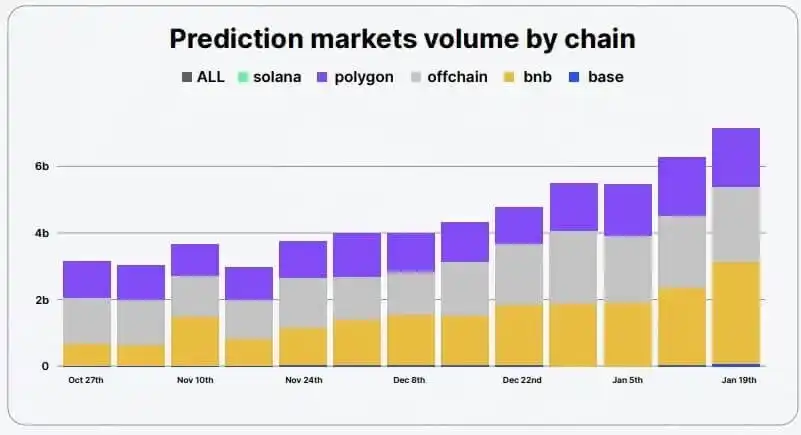
In 2026, major institutions are launching new prediction markets.

From the competitive battles of the past five years between NFTs and perpetual contract exchanges, we have learned that differentiated products can quickly capture market share.

Although leading platforms currently hold advantages in liquidity and regulation, they are burdened with heavy technical debt, making it difficult to respond flexibly to new players.

So how should newcomers compete? In my view, the core of differentiation in prediction markets revolves around seven dimensions:

1. Product Quality

Founding teams can differentiate in areas such as front-end user experience, API stability, development documentation, market structure, and fee mechanisms.

Currently, many established platforms have obvious shortcomings: unreasonable tier settings, opaque fee rules, slow and unstable APIs, and limited order types.

A high-quality product experience, especially services for API-based programmatic traders, is itself a lasting core advantage, enabling a platform to hold its ground even against competitors with stronger channel capabilities.

3. Capital Efficiency

Capital efficiency determines how effectively traders can use their collateral. Currently, there are two key levers:

First, yield-bearing collateral: Instead of letting idle funds earn only treasury yields, platforms can offer higher returns, similar to Lighter supporting LP deposits as collateral or HyENA's USDC-margined perpetual contract model.

Second, margin mechanisms. Due to gap risk, the value of leverage in prediction markets is generally underestimated. However, platforms can offer limited leverage for continuous markets or implement portfolio margin for hedging positions.

Exchanges can also subsidize lending pools or act as market-making counterparties to internalize gap risk, rather than passing losses on to users.

4. Oracles and Market Settlement

Oracle reliability remains a systemic weakness in the industry. Settlement delays and incorrect outcomes significantly amplify trading risks.

Beyond improving stability, platforms can implement innovative oracle mechanisms: human-machine hybrid systems, zero-knowledge proof-based solutions, AI-driven oracles like Context, etc., to unlock new markets that traditional oracles cannot support.

5. Liquidity Provision

Exchanges cannot survive without liquidity. Viable approaches include: paying to onboard professional market makers, using token incentives to encourage ordinary users to provide liquidity, and adopting Hyperliquid's HLP aggregated liquidity model.
Some platforms can also fully internalize liquidity, emulating FTX's model of relying on Alameda as an internal trading team.

6. Regulatory Compliance

Kalshi, with its US regulatory approval, has achieved embedded distribution through Robinhood and Coinbase, capturing retail traffic that Polymarket cannot reach.

There are still numerous jurisdictions and regulatory frameworks available for exploration. Compliant prediction markets can unlock similar channels, such as adapting to US state gambling regulations.

7. Vertical Strategy vs. Horizontal Strategy

Horizontal Strategy: Similar to Hyperliquid in the perpetual contracts space, focusing on building top-tier underlying trading infrastructure, inviting third parties to build front-ends and vertical scenarios, and encouraging ecosystem builders to add markets and develop revenue-generating front-ends (e.g., Phantom) through proposals.

Vertical Strategy: Exemplified by Lighter, which controls the front-end, launches mobile apps, and creates an end-to-end user experience, focusing on integrated experiences and direct user connections.

Polymarket's resistance to deeply embedded partnerships, contrasted with Kalshi's open attitude, is a clear reflection of the trade-offs between these two strategies.


Related Questions

QAccording to the article, what are the seven key dimensions for differentiation in the prediction market competition?

AThe seven key dimensions are: 1. Product Quality, 2. Asset Types and Market Selection, 3. Capital Efficiency, 4. Oracles and Market Settlement, 5. Liquidity Provision, 6. Regulatory Compliance, and 7. Vertical Strategy vs. Horizontal Strategy.

QHow can new prediction market exchanges compete with established platforms that have liquidity and regulatory advantages?

ANew players can compete by focusing on product differentiation, such as superior user experience, stable APIs, better documentation, unique market offerings, innovative capital efficiency mechanisms, reliable oracles, creative liquidity solutions, navigating different regulatory frameworks, and adopting a focused vertical or horizontal strategy.

QWhat two core methods are mentioned for improving capital efficiency in prediction markets?

AThe two core methods are: 1. Interest-bearing collateral, which allows idle funds to earn higher yields, and 2. Margin mechanisms, which can provide limited leverage for continuous markets or portfolio margin for hedged positions.

QWhat is the difference between a horizontal strategy and a vertical strategy for a prediction market platform, as described in the article?

AA horizontal strategy, like Hyperliquid's, focuses on building top-tier underlying trading infrastructure and inviting third parties to build front-ends and verticals. A vertical strategy, like Lighter's, involves controlling the front-end, launching mobile apps, and crafting a full user experience to connect directly with users.

QWhich platform is cited as an example of using regulatory compliance to gain access to retail traffic unavailable to competitors like Polymarket?

AKalshi is cited as the example, as it leveraged its US compliance credentials to achieve embedded distribution with platforms like Robinhood and Coinbase.

Related Reads

Gensyn AI: Don't Let AI Repeat the Mistakes of the Internet

In recent months, the rapid growth of the AI industry has attracted significant talent from the crypto sector. A persistent question among researchers intersecting both fields is whether blockchain can become a foundational part of AI infrastructure. While many previous AI and Crypto projects focused on application layers (like AI Agents, on-chain reasoning, data markets, and compute rentals), few achieved viable commercial models. Gensyn differentiates itself by targeting the most critical and expensive layer of AI: model training. Gensyn aims to organize globally distributed GPU resources into an open AI training network. Developers can submit training tasks, nodes provide computational power, and the network verifies results while distributing incentives. The core issue addressed is not decentralization for its own sake, but the increasing centralization of compute power among tech giants. In the era of large models, access to GPUs (like the H100) has become a decisive bottleneck, dictating the pace of AI development. Major AI companies are heavily dependent on large cloud providers for compute resources. Gensyn's approach is significant for several reasons: 1) It operates at the core infrastructure layer (model training), the most resource-intensive and technically demanding part of the AI value chain. 2) It proposes a more open, collaborative model for compute, potentially increasing resource utilization by dynamically pooling idle GPUs, similar to early cloud computing logic. 3) Its technical moat lies in solving complex challenges like verifying training results, ensuring node honesty, and maintaining reliability in a distributed environment—making it more of a deep-tech infrastructure company. 4) It targets a validated, high-growth market with genuine demand, rather than pursuing blockchain integration without purpose. Ultimately, the boundaries between Crypto and AI are blurring. AI requires global resource coordination, incentive mechanisms, and collaborative systems—areas where crypto-native solutions excel. Gensyn represents a step toward making advanced training capabilities more accessible and collaborative, moving beyond a niche controlled by a few giants. If successful, it could evolve into a fundamental piece of AI infrastructure, where the most enduring value in the AI era is often created.

marsbit13h ago

Gensyn AI: Don't Let AI Repeat the Mistakes of the Internet

marsbit13h ago

Why is China's AI Developing So Fast? The Answer Lies Inside the Labs

A US researcher's visit to China's top AI labs reveals distinct cultural and organizational factors driving China's rapid AI development. While talent, data, and compute are similar to the West, Chinese labs excel through a pragmatic, execution-focused culture: less emphasis on individual stardom and conceptual debate, and more on teamwork, engineering optimization, and mastering the full tech stack. A key advantage is the integration of young students and researchers who approach model-building with fresh perspectives and low ego, prioritizing collective progress over personal credit. This contrasts with the US culture of self-promotion and "star scientist" narratives. Chinese labs also exhibit a strong "build, don't buy" mentality, preferring to develop core capabilities—like data pipelines and environments—in-house rather than relying on external services. The ecosystem feels more collaborative than tribal, with mutual respect among labs. While government support exists, its scale is unclear, and technical decisions appear driven by labs, not state mandates. Chinese companies across sectors, from platforms to consumer tech, are building their own foundational models to control their tech destiny, reflecting a broader cultural drive for technological sovereignty. Demand for AI is emerging, with spending patterns potentially mirroring cloud infrastructure more than traditional SaaS. Despite challenges like a less mature data industry and GPU shortages, Chinese labs are propelled by vast talent, rapid iteration, and deep integration with the open-source community. The competition is evolving beyond a pure model race into a contest of organizational execution, developer ecosystems, and industrial pragmatism.

marsbit14h ago

Why is China's AI Developing So Fast? The Answer Lies Inside the Labs

marsbit14h ago

3 Years, 5 Times: The Rebirth of a Century-Old Glass Factory

Corning, a 175-year-old glass company, is experiencing a dramatic revival as a key player in AI infrastructure, driven by surging demand for high-performance optical fiber in data centers. AI data centers require vastly more fiber than traditional ones—5 to 10 times as much per rack—to handle high-speed data transmission between GPUs. This structural demand shift, coupled with supply constraints from the lengthy expansion cycle for fiber preforms, has created a significant supply-demand gap. Nvidia has invested in Corning, along with Lumentum and Coherent, in a $4.5 billion total commitment to secure the optical supply chain for AI. Corning's competitive edge lies in its expertise in producing ultra-low-loss, high-density, and bend-resistant specialty fiber, which is critical for 800G+ and future 1.6T data rates. Its deep involvement in co-packaged optics (CPO) with partners like Nvidia further solidifies its position. While not the largest fiber manufacturer globally, Corning's revenue from enterprise/data center clients now exceeds 40% of its optical communications sales, and it has secured multi-year supply agreements with major hyperscalers including Meta and Nvidia. Financially, Corning's optical communications revenue has surged, doubling from $1.3 billion in 2023 to over $3 billion in 2025. Its stock price has risen nearly 6-fold since late 2023. Key future catalysts include the rollout of Nvidia's CPO products and the scale of undisclosed customer agreements. However, risks include high current valuations and potential disruption from next-generation technologies like hollow-core fiber. The company's long-term bet on light over electricity, maintained even through the telecom bubble crash, is now being validated by the AI boom.

marsbit15h ago

3 Years, 5 Times: The Rebirth of a Century-Old Glass Factory

marsbit15h ago

Trading

Spot
Futures
活动图片




